Digital Receipts Market Size, Share & Demand Report By Deployment Mode (Cloud-Based, On-Premise, Hybrid), By Receipt Delivery Channel (Email-Based, SMS-Based, Mobile Wallet and App-Based, QR Code-Based), By End Use (Retail and E-commerce, Banking and Financial Services, Hospitality and Travel, Healthcare, Transportation and Logistics, Entertainment and Media) By Region & Segment Forecasts, 2026–2034
USD 3950
Market Overview
The global Digital Receipts Market size was valued at USD 3.84 billion in 2026 and is projected to reach USD 9.12 billion by 2034, expanding at a CAGR of 11.4% during the forecast period from 2026 to 2034. The market is witnessing stable expansion as retailers, financial institutions, hospitality providers, and e-commerce platforms continue shifting from paper-based billing systems toward digital transaction ecosystems. The increasing penetration of smartphones, digital payment applications, and cloud-based point-of-sale infrastructure has strengthened the adoption of digital receipt platforms across developed and emerging economies. Businesses are integrating digital receipts into customer engagement strategies to improve transaction transparency, reduce operational costs, and support sustainability goals.
A major global factor supporting market growth is the rising focus on environmental sustainability and paper waste reduction. Governments and enterprises are implementing eco-friendly business practices that encourage electronic invoicing and digital transaction documentation. Retailers are increasingly replacing thermal paper receipts with email, SMS, QR-code, and mobile wallet receipts to improve customer convenience and comply with sustainability initiatives. The rapid growth of omnichannel retailing has also accelerated the need for centralized digital transaction records that can be accessed across online and offline purchasing channels.
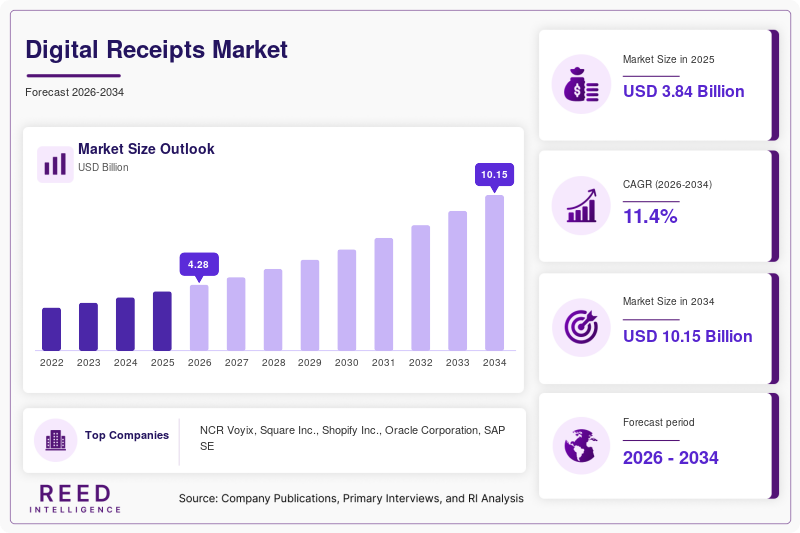
Key Highlights
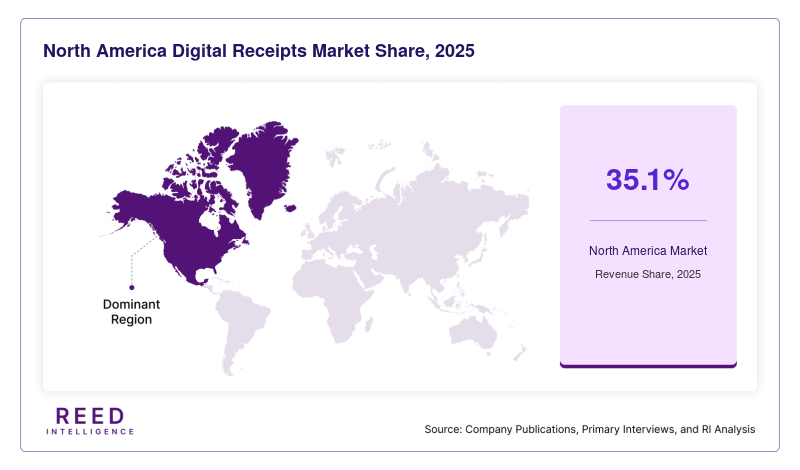
- North America dominated the market with a 35.1% share in 2025.
- Asia Pacific is expected to grow at the fastest CAGR of 12.6% during 2026–2034.
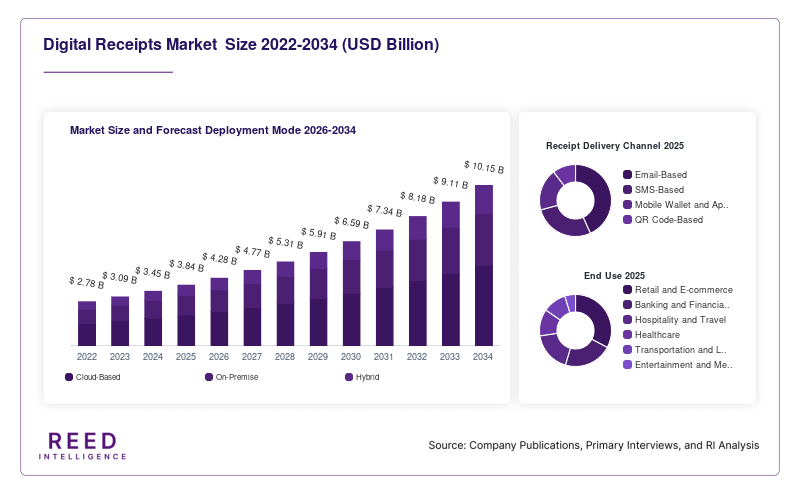
- By deployment mode, cloud-based platforms accounted for the largest share of 61.8%, while hybrid deployment solutions are projected to grow at a CAGR of 13.2%.
- By end use, retail and e-commerce led with a 43.9% share, whereas hospitality and travel are expected to expand at a CAGR of 12.8%.
- The United States remained the dominant country, with market values of USD 820 million in 2024 and USD 910 million in 2025.
Market Trends
AI-driven personalization integrated with digital receipt platforms
Retailers and payment technology providers are increasingly integrating artificial intelligence tools into digital receipt systems to improve customer engagement and retention. Digital receipts are evolving from simple transaction records into intelligent communication channels that provide personalized product recommendations, loyalty rewards, and targeted promotions. Businesses are analyzing customer purchase histories through AI-driven analytics to identify spending patterns and improve cross-selling opportunities. This trend is especially visible in supermarkets, fashion retail, and online commerce platforms where companies seek to improve repeat purchases and customer lifetime value.
The integration of AI into digital receipt ecosystems also enables automated expense categorization, predictive purchasing insights, and smart budgeting applications for consumers. Financial technology firms are partnering with retailers to create receipt-linked loyalty programs that enhance customer convenience. In addition, merchants are embedding dynamic QR codes and digital payment verification tools into receipts to strengthen post-purchase engagement. As consumer expectations for personalized digital experiences continue to rise, AI-enabled receipt systems are becoming an important component of modern retail technology strategies.
Expansion of contactless and mobile payment ecosystems
The rapid adoption of contactless payments and mobile wallets is contributing significantly to the growth of the Digital Receipts Market. Consumers increasingly prefer fast and paperless checkout experiences, encouraging businesses to deliver receipts through email, SMS, and mobile applications. Payment service providers are integrating digital receipt functions directly into mobile wallets, enabling users to store transaction histories in centralized digital platforms. The growth of cashless payment infrastructure in urban markets has strengthened demand for receipt digitization technologies across retail, transportation, healthcare, and entertainment industries.
The trend has accelerated further with the expansion of near-field communication technology and QR-code-based transactions. Businesses are using digital receipts to streamline returns management, reduce checkout delays, and improve customer convenience. Many retailers are also adopting self-checkout systems that automatically issue digital receipts after payment completion. In emerging economies, the rising penetration of smartphones and affordable internet services is increasing consumer familiarity with digital transaction records. This broader digital payment transformation is expected to create long-term opportunities for receipt software providers and cloud-based transaction management platforms.
Market Drivers
Rising adoption of paperless retail operations across industries
Businesses across retail, banking, hospitality, and transportation sectors are increasingly implementing paperless operational models to improve efficiency and reduce costs. Traditional paper receipts involve recurring expenses related to printing equipment, thermal paper procurement, storage, and maintenance. Digital receipts help companies reduce these operational burdens while improving transaction accuracy and accessibility. Large retailers are promoting paperless checkout experiences to align with sustainability objectives and improve brand perception among environmentally conscious consumers.
The growing use of self-service kiosks and automated checkout systems is further accelerating digital receipt adoption. Retailers are integrating receipt delivery into mobile applications and loyalty platforms to improve post-purchase communication. Governments in several countries are also encouraging digital invoicing and electronic transaction documentation to improve tax compliance and reduce paper waste. These regulatory and operational changes are increasing investments in receipt management software, cloud-based invoicing platforms, and integrated customer communication systems.
Growing demand for customer data analytics and loyalty management
Digital receipts provide businesses with valuable transactional data that can be analyzed to improve marketing strategies and customer retention. Companies are increasingly using receipt-linked analytics to understand consumer purchasing behavior, identify product preferences, and optimize promotional campaigns. Unlike traditional paper receipts, digital receipts allow merchants to establish continuous customer engagement after the transaction is completed. This capability is becoming increasingly important in highly competitive retail and e-commerce markets.
Retailers are also integrating digital receipts with loyalty programs and rewards platforms to improve customer retention rates. Businesses can automatically issue discount offers, cashback rewards, and promotional notifications through digital receipt systems. Financial institutions and fintech companies are using receipt data to provide spending insights and budgeting tools for users. The ability to generate measurable marketing value from digital receipts is encouraging organizations to invest in advanced analytics and customer relationship management technologies, thereby supporting long-term market growth.
Market Restraint
Data privacy concerns and cybersecurity risks affecting adoption
Despite growing adoption, data privacy concerns and cybersecurity risks remain significant challenges for the Digital Receipts Market. Digital receipts often contain sensitive customer information, including payment details, purchase histories, email addresses, and phone numbers. Businesses must comply with strict data protection regulations while ensuring secure transmission and storage of transaction records. Failure to protect consumer data can result in financial losses, regulatory penalties, and reputational damage.
Consumers in several regions remain cautious about sharing personal information during checkout processes, particularly when digital receipts are linked with loyalty programs or targeted marketing campaigns. Small and medium enterprises may face additional difficulties due to limited cybersecurity budgets and inadequate technical infrastructure. Cyberattacks targeting payment systems and customer databases have increased concerns regarding unauthorized data access and digital fraud. In some cases, retailers have delayed digital receipt implementation because of compliance challenges associated with data protection regulations such as GDPR and regional financial privacy standards. These concerns may slow adoption rates in industries where customer trust and data security are critical operational priorities.
Market Opportunities
Increasing integration of digital receipts with financial management applications
The growing adoption of personal finance applications is creating substantial opportunities for digital receipt providers. Consumers are increasingly using budgeting and expense-tracking applications to monitor spending patterns and manage financial planning. Digital receipt systems can automatically synchronize transaction data with these platforms, improving user convenience and reducing manual recordkeeping. Financial technology companies are actively integrating receipt digitization capabilities into mobile banking and expense management applications.
This opportunity is particularly significant among younger consumers and business travelers who prefer digital expense tracking solutions. Enterprises are also implementing automated receipt management tools to simplify reimbursement and accounting processes for employees. Integration with accounting software can improve tax preparation, auditing, and corporate expense analysis. As businesses continue adopting cloud-based financial systems, demand for interoperable receipt management technologies is expected to increase. This trend is likely to support new partnerships between retailers, payment processors, and fintech providers.
Expansion of smart retail infrastructure in emerging economies
Emerging economies are witnessing substantial investments in digital retail infrastructure, creating favorable conditions for the Digital Receipts Market. Rapid urbanization, expanding middle-class populations, and increasing smartphone penetration are encouraging retailers to modernize transaction systems. Governments in several Asian, Middle Eastern, and Latin American countries are promoting digital payment adoption through financial inclusion initiatives and smart city programs.
Retail chains and shopping malls in emerging markets are implementing advanced point-of-sale systems that support digital receipts and mobile payment integration. Small retailers are increasingly adopting cloud-based billing applications because of lower hardware requirements and subscription-based pricing models. In addition, the growth of organized retail and e-commerce platforms is increasing the need for centralized transaction management systems. Technology providers are introducing multilingual receipt platforms and region-specific payment integrations to improve adoption rates. These developments are expected to create long-term revenue opportunities for software vendors and transaction management service providers.
Segmental Analysis
By Deployment Mode
Cloud-based platforms accounted for the largest share of the Digital Receipts Market in 2024, representing approximately 61.8% of total revenue. The dominance of this subsegment is primarily attributed to lower implementation costs, scalability, and easier integration with existing payment infrastructure. Retailers and service providers are increasingly adopting cloud-based receipt management systems to improve operational flexibility and support omnichannel transaction processing. These solutions allow businesses to deliver receipts through multiple digital channels including email, SMS, mobile applications, and digital wallets.
Cloud-based systems also support centralized storage and real-time transaction analytics, enabling businesses to monitor purchasing behavior and customer engagement. Small and medium enterprises are increasingly selecting cloud deployment models because subscription-based pricing structures reduce initial infrastructure investments. The rapid growth of e-commerce and mobile commerce platforms is further contributing to demand for cloud-integrated receipt solutions.
By End Use
Retail and e-commerce represented the dominant end-use segment in 2024, accounting for approximately 43.9% of the global market share. The increasing transition toward digital shopping experiences and cashless transactions has accelerated the adoption of electronic receipt systems across online and offline retail channels. Large retail chains are using digital receipts to improve customer engagement, simplify returns management, and reduce paper consumption. E-commerce companies are integrating automated receipt delivery systems into checkout platforms to improve transaction transparency and customer communication.
Retailers are also using digital receipts as marketing tools by embedding promotional offers, loyalty rewards, and product recommendations into transaction confirmations. The growth of omnichannel retail strategies has increased demand for centralized receipt management systems that synchronize customer purchase histories across multiple sales channels. Subscription-based shopping services and online grocery delivery platforms are further contributing to the expansion of this segment.
By Receipt Delivery Channel
Email-based digital receipts accounted for the largest share of the market in 2024 due to their widespread adoption across retail, banking, and hospitality industries. Businesses continue to prefer email receipts because they are cost-effective, easy to implement, and compatible with existing customer communication systems. Consumers also favor email receipts because they provide permanent transaction records that can be easily searched and archived. Retailers are integrating promotional campaigns and personalized product suggestions into email receipts to improve customer engagement and marketing effectiveness.
The segment’s growth is further supported by the expansion of e-commerce and online payment platforms, where email confirmations remain a standard transaction practice. Enterprises are increasingly combining email receipt systems with customer relationship management tools to improve analytics and retention strategies. Financial institutions are also using encrypted email receipt systems to improve transaction transparency and digital banking experiences. The growing acceptance of paperless billing practices across enterprises continues to strengthen this segment’s market position.
Regional Analysis
North America
North America accounted for the largest share of the Digital Receipts Market in 2025, representing approximately 35.1% of global revenue. The region is expected to maintain steady expansion with a projected CAGR of 10.8% between 2026 and 2034. Strong adoption of digital payment technologies, widespread smartphone penetration, and advanced retail infrastructure continue to support market growth across the region. Retailers and financial institutions are increasingly implementing cloud-based receipt systems to improve operational efficiency and customer engagement. The growing use of contactless payments and omnichannel retail strategies is also contributing to the increasing demand for digital receipt platforms.
The United States remains the dominant country within the regional market due to the strong presence of retail chains, payment technology providers, and fintech companies. One unique growth factor supporting the country’s market expansion is the rapid integration of digital receipts with loyalty management ecosystems. Major retailers are using digital transaction records to improve customer retention and targeted marketing strategies. The growing popularity of self-checkout systems and subscription-based retail services is further encouraging businesses to adopt digital receipt technologies across supermarkets, convenience stores, and online commerce platforms.
Europe
Europe represented a significant portion of the global Digital Receipts Market in 2025 and is expected to expand at a CAGR of 10.2% during the forecast period. The regional market is supported by strict environmental regulations and sustainability initiatives aimed at reducing paper waste. Businesses across retail, hospitality, and transportation sectors are adopting electronic transaction documentation to comply with sustainability standards and improve operational efficiency. Increasing digital payment adoption and growing investment in cloud-based retail infrastructure are also contributing to regional market growth.
Germany remains the leading country in the European market due to its strong retail sector and advanced industrial infrastructure. A unique growth factor driving adoption in Germany is the increasing use of digital invoicing and electronic transaction management among small and medium enterprises. Businesses are integrating receipt management systems with enterprise resource planning platforms to streamline accounting and tax compliance processes. The country’s focus on industrial digitization and smart retail technologies is encouraging long-term investments in secure digital transaction ecosystems.
Asia Pacific
Asia Pacific is projected to record the fastest CAGR of 12.6% during the forecast period, driven by rapid urbanization and expanding digital payment ecosystems. The region is witnessing significant growth in smartphone usage, mobile commerce, and cloud-based retail technologies. Retailers and financial service providers are increasingly implementing digital receipt systems to improve customer convenience and support cashless payment initiatives. The expansion of e-commerce platforms and online grocery services is also contributing to the growing demand for centralized digital transaction management solutions.
China continues to dominate the regional market because of its extensive mobile payment infrastructure and large consumer base. One distinctive growth factor supporting the market in China is the widespread use of super-app ecosystems that integrate payments, loyalty programs, and digital receipts within a single platform. Consumers increasingly rely on mobile wallets for everyday transactions, encouraging retailers to adopt electronic receipt systems at scale. Government support for digital economy initiatives and smart city projects is also strengthening long-term market growth opportunities.
Middle East & Africa
The Middle East & Africa region is experiencing gradual growth in the Digital Receipts Market and is expected to register a CAGR of 9.7% between 2026 and 2034. Increasing investments in smart retail infrastructure, digital banking services, and financial technology platforms are supporting market expansion. Governments across the Gulf region are promoting digital transformation initiatives that encourage electronic transactions and paperless business operations. Retailers are also modernizing payment systems to improve customer experiences and operational transparency.
The United Arab Emirates remains the dominant country within the regional market due to its strong retail sector and rapid digital transformation initiatives. A unique growth factor supporting market expansion in the UAE is the increasing implementation of smart shopping environments in malls and urban commercial centers. Retailers are integrating mobile payments, QR-code billing, and automated customer engagement tools into shopping experiences. Tourism growth and rising demand for luxury retail services are also encouraging businesses to invest in advanced digital receipt solutions.
Latin America
Latin America is expected to experience stable growth in the Digital Receipts Market during the forecast period, supported by increasing digital banking penetration and expanding e-commerce activity. The region accounted for a moderate share of global market revenue in 2025 and is projected to grow at a CAGR of 9.9% through 2034. Retail modernization and improvements in internet connectivity are encouraging businesses to transition toward cloud-based transaction systems. Governments in several countries are also supporting electronic invoicing initiatives to improve tax transparency and reduce informal economic activity.
Brazil continues to lead the regional market due to its large consumer population and expanding digital payment infrastructure. One unique growth factor supporting adoption in Brazil is the growing popularity of instant payment systems and mobile commerce applications. Consumers are increasingly using digital wallets and online banking platforms for everyday purchases, creating strong demand for electronic transaction records. Retail chains and food delivery platforms are integrating digital receipt technologies to improve customer convenience and streamline financial reporting processes.
Competitive Landscape
The Digital Receipts Market is moderately competitive, with technology providers focusing on cloud integration, customer analytics, and payment ecosystem partnerships to strengthen market presence. Leading companies are investing in artificial intelligence, secure transaction processing, and omnichannel retail solutions to improve service differentiation. Strategic collaborations between payment processors, fintech firms, and retail software providers are becoming increasingly common as businesses seek integrated digital transaction ecosystems.
NCR Voyix remains one of the leading participants in the market due to its strong retail technology portfolio and extensive customer base across global retail chains. The company recently expanded its cloud-based commerce platform capabilities to support advanced digital receipt analytics and customer engagement tools. Other prominent companies are introducing mobile wallet integrations, AI-powered promotional systems, and multilingual receipt management platforms to strengthen competitiveness.
Key Players
- NCR Voyix
- Square Inc.
- Shopify Inc.
- Oracle Corporation
- SAP SE
- Toshiba Global Commerce Solutions
- Ingenico Group
- Epson America Inc.
- Clover Network LLC
- Diebold Nixdorf
- Verifone Systems
- Lightspeed Commerce Inc.
- Toast Inc.
- Revel Systems
- PAX Technology
Recent Developments
- In February 2026, NCR Voyix introduced an AI-enabled digital receipt analytics platform designed to improve customer personalization for retail chains.
- In August 2025, Shopify expanded its digital receipt integration capabilities for mobile commerce merchants across Asia Pacific markets.
- In November 2025, Verifone Systems partnered with a fintech payment provider to launch mobile wallet-based receipt management services for hospitality businesses.
- In March 2026, Toast Inc. launched QR-code-enabled digital receipt functionality for restaurant operators seeking contactless customer engagement solutions.
- In January 2026, Oracle Corporation introduced upgraded cloud receipt management tools integrated with enterprise retail analytics platforms.
Digital Receipts Market Segments
Deployment Mode
- Cloud-Based
- On-Premise
- Hybrid
Receipt Delivery Channel
- Email-Based
- SMS-Based
- Mobile Wallet and App-Based
- QR Code-Based
End Use
- Retail and E-commerce
- Banking and Financial Services
- Hospitality and Travel
- Healthcare
- Transportation and Logistics
- Entertainment and Media
By Region
- North America
- Europe
- APAC
- Middle East and Africa
- LATAM