Digital Thermometer Market Size, Share & Demand Report By Product Type (Infrared Thermometers, Digital Stick Thermometers, Wearable Thermometers), By Application (Medical, Home Healthcare), By End-User (Hospitals, Clinics, Home Care), By Distribution Channel (Online, Offline), By Region & Segment Forecasts, 2025–2034
USD 3950
Market Overview
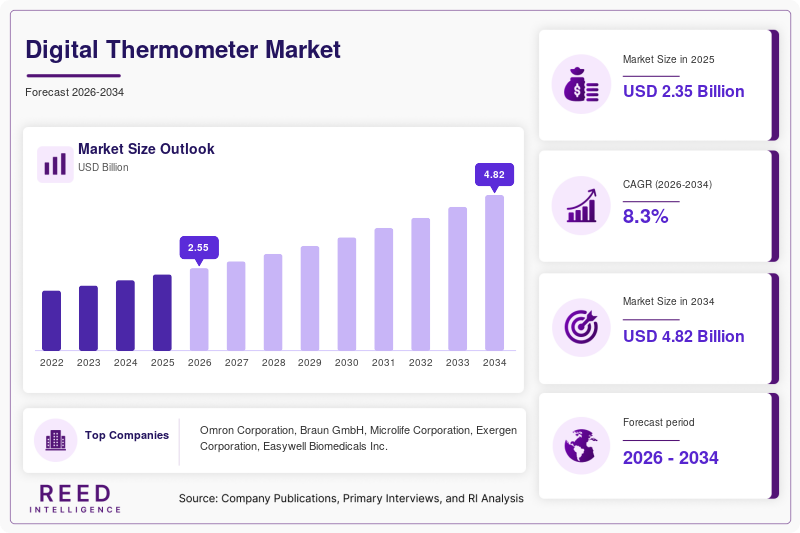
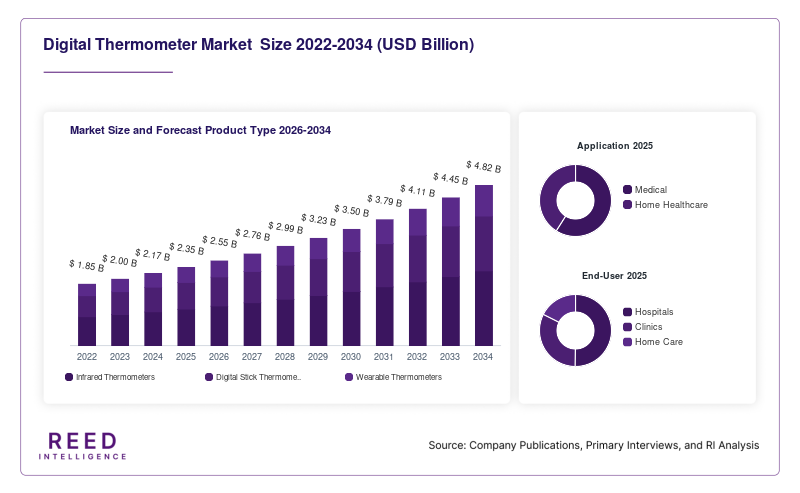
The global Digital Thermometer Market size was valued at approximately USD 2.35 billion in 2025 and is projected to reach around USD 4.82 billion by 2034, expanding at a CAGR of 8.3% during the forecast period (2025–2034). The market has witnessed consistent growth driven by increasing awareness of personal health monitoring and the widespread adoption of digital healthcare devices across both developed and emerging economies.
One of the major global factors supporting market growth is the rising focus on preventive healthcare and home-based monitoring solutions. Consumers are increasingly prioritizing early diagnosis and routine health checks, leading to higher demand for accurate, portable, and user-friendly temperature measurement devices. Digital thermometers, with features such as fast readings, memory storage, and non-contact technology, have gained strong traction across households, hospitals, and clinics.
Key Highlights:
- North America dominated the market with a 34.2% share in 2025, while Asia Pacific is expected to register the fastest CAGR of 9.6%.
- By product type, infrared thermometers led with a 46.8% share in 2024, whereas wearable thermometers are projected to grow at a CAGR of 10.4%.
- By application, medical usage accounted for the largest share, while home healthcare is anticipated to be the fastest-growing segment.
- The United States remained the dominant country, with market values of USD 0.78 billion in 2024 and USD 0.82 billion in 2025.
Market Trends
Shift Toward Non-Contact Thermometry
The Digital Thermometer Market is experiencing a notable shift toward non-contact infrared thermometers. These devices provide quick and hygienic temperature readings without physical contact, making them highly suitable for infection control environments. Their adoption has increased significantly across hospitals, airports, workplaces, and public facilities. The demand remains steady due to continued emphasis on hygiene and reduced cross-contamination risks. Technological improvements have also enhanced measurement accuracy, addressing earlier concerns about reliability.
Integration with Smart Health Ecosystems
Another prominent trend shaping the Digital Thermometer Market is the integration of thermometers with smart health systems and mobile applications. Modern devices now offer Bluetooth or Wi-Fi connectivity, enabling users to track temperature data over time and share it with healthcare professionals. This trend aligns with the broader growth of digital health and telemedicine. Smart thermometers are increasingly being used for continuous monitoring, especially in pediatric and chronic care settings. As healthcare systems move toward data-driven models, connected thermometers are expected to play a growing role in remote patient management.
Market Drivers
Increasing Adoption of Home Healthcare Devices
The rising preference for home healthcare solutions is a key driver of the Digital Thermometer Market. Consumers are increasingly investing in personal medical devices to monitor health conditions conveniently. Digital thermometers are among the most commonly used tools for daily health assessment. Their affordability, ease of use, and availability through online and offline channels contribute to their widespread adoption. This trend is particularly strong among aging populations and individuals managing chronic illnesses.
Growing Demand for Accurate and Rapid Diagnostics
Healthcare providers are emphasizing quick and precise diagnostic tools, which has significantly boosted demand for digital thermometers. Compared to traditional mercury thermometers, digital variants provide faster results with improved accuracy. This efficiency is critical in clinical environments where timely decision-making is essential. The shift toward digital solutions is also supported by regulatory restrictions on mercury-based devices, further accelerating market growth.
Market Restraint
Accuracy Variability in Low-Cost Devices
One of the primary challenges in the Digital Thermometer Market is the variability in accuracy among low-cost products. While premium devices offer high precision and advanced features, budget-friendly options often lack consistency in readings. This issue can lead to reduced consumer trust, particularly in critical healthcare settings where accuracy is essential. The presence of numerous low-quality products in the market also intensifies competition and affects overall brand credibility. Additionally, improper usage and lack of calibration can further impact measurement reliability. These factors collectively hinder the widespread adoption of digital thermometers in certain regions, especially where cost sensitivity is high.
Market Opportunities
Expansion in Emerging Healthcare Markets
Emerging economies present significant growth opportunities for the Digital Thermometer Market. Increasing healthcare expenditure, improving infrastructure, and rising awareness about health monitoring are driving demand in these regions. Governments and private organizations are investing in medical devices to enhance healthcare accessibility. As a result, digital thermometers are becoming more widely available in rural and semi-urban areas.
Development of Wearable Temperature Monitoring Devices
The growing interest in wearable health technology offers a promising opportunity for the market. Wearable thermometers enable continuous temperature tracking, which is particularly useful for monitoring chronic conditions and pediatric patients. These devices are expected to gain traction as consumers seek more convenient and non-invasive solutions. Advances in miniaturization and sensor technology are likely to support the development of innovative wearable products, contributing to long-term market expansion.
Segmental Analysis
By Product Type
Infrared thermometers dominated the Digital Thermometer Market in 2024, accounting for approximately 46.8% of the total share. Their popularity is attributed to non-contact measurement capabilities and rapid results. These devices are widely used in clinical and public settings due to their convenience and hygiene benefits.
Wearable thermometers are expected to be the fastest-growing segment, with a projected CAGR of 10.4%. The growth will be driven by increasing demand for continuous monitoring solutions. These devices offer real-time data tracking, making them suitable for chronic disease management and pediatric care.
By Application
The medical application segment held the largest share of the Digital Thermometer Market in 2024, contributing around 58.3%. Hospitals and clinics extensively use digital thermometers for patient monitoring due to their accuracy and efficiency.
The home healthcare segment is anticipated to grow at the fastest CAGR of 9.8% during the forecast period. Rising awareness about self-monitoring and the convenience of using digital thermometers at home will drive growth in this segment.
By End-User
Hospitals were the dominant end-user segment in 2024, accounting for nearly 49.5% of the market share. The high volume of patient admissions and the need for accurate temperature monitoring have supported segment growth.
Home care settings are projected to be the fastest-growing segment, with a CAGR of 9.7%. Increasing preference for home-based healthcare and the availability of user-friendly devices will contribute to this growth.
By Distribution Channel
Offline channels dominated the market in 2024, holding a share of 61.2%. Pharmacies and medical stores remain the primary distribution points for digital thermometers due to consumer trust and product accessibility.
Online channels are expected to grow at the fastest CAGR of 10.1%. The increasing popularity of e-commerce platforms and the convenience of online shopping will drive this segment’s growth.
Regional Analysis
North America
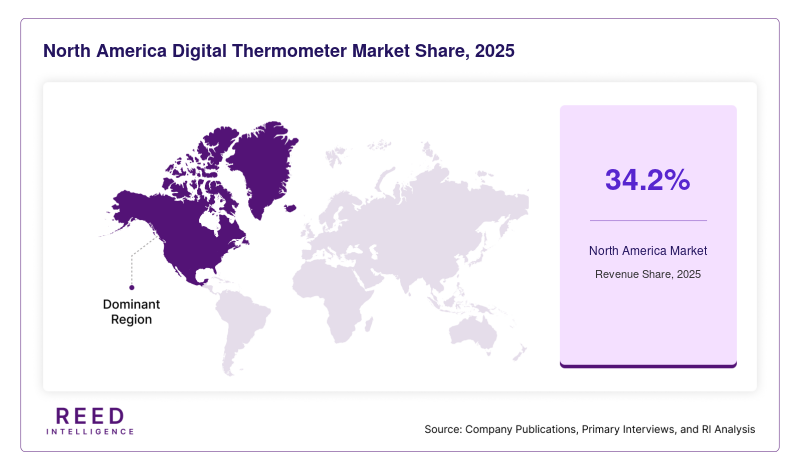
North America accounted for approximately 34.2% of the Digital Thermometer Market share in 2025 and is expected to grow at a CAGR of 7.5% during the forecast period. The region’s growth has been supported by strong healthcare infrastructure and high adoption of advanced medical technologies. The presence of established manufacturers and widespread awareness about personal health monitoring have contributed to sustained demand.
The United States dominated the regional market due to its advanced healthcare system and high consumer spending on medical devices. A key growth factor in the country is the increasing use of digital thermometers in home healthcare settings. The growing aging population and emphasis on preventive care have further strengthened market expansion.
Europe
Europe held a significant share of around 26.8% in 2025 and is projected to expand at a CAGR of 7.9%. The region has experienced steady demand driven by stringent healthcare regulations and the transition toward digital medical devices. Public health initiatives and increasing focus on patient safety have supported the adoption of digital thermometers.
Germany emerged as the leading country in the region, supported by its strong healthcare infrastructure and technological advancements. The country’s emphasis on quality medical devices and innovation has played a crucial role in driving market growth.
Asia Pacific
Asia Pacific accounted for 22.5% of the Digital Thermometer Market in 2025 and is expected to register the fastest CAGR of 9.6% through 2034. The region’s rapid growth is attributed to expanding healthcare access, rising disposable incomes, and increasing awareness about health monitoring.
China led the regional market, driven by its large population and growing healthcare investments. The increasing demand for affordable and efficient medical devices has significantly boosted the adoption of digital thermometers across urban and rural areas.
Middle East & Africa
The Middle East & Africa region captured around 8.1% of the market in 2025 and is projected to grow at a CAGR of 8.4%. The market has been influenced by improving healthcare infrastructure and rising government initiatives to enhance medical services.
Saudi Arabia dominated the region, supported by ongoing healthcare reforms and investments in modern medical equipment. The country’s focus on improving healthcare quality has contributed to the adoption of digital thermometers.
Latin America
Latin America held a share of approximately 8.4% in 2025 and is expected to grow at a CAGR of 8.1%. The region has witnessed gradual growth due to increasing healthcare awareness and expanding distribution networks.
Brazil emerged as the leading country, driven by its large population and growing demand for healthcare products. The expansion of retail pharmacies and online platforms has facilitated easier access to digital thermometers, supporting market growth.
Competitive Landscape
The Digital Thermometer Market is moderately competitive, with several global and regional players focusing on product innovation and expansion strategies. Leading companies are investing in research and development to enhance product accuracy and introduce advanced features such as connectivity and wearable technology.
One of the prominent market leaders is Omron Corporation, known for its extensive portfolio of healthcare devices. The company has recently introduced advanced digital thermometers with improved sensor technology and smart connectivity features, strengthening its market position.
Other key players are also focusing on strategic collaborations, product launches, and geographic expansion to increase their market presence. The competitive environment is expected to remain dynamic, with continuous advancements in technology shaping the industry landscape.
Key Players
- Omron Corporation
- Braun GmbH
- Microlife Corporation
- Exergen Corporation
- Easywell Biomedicals Inc.
- Citizen Systems Japan Co., Ltd.
- BPL Medical Technologies
- Hicks Thermometers India Limited
- Beurer GmbH
- Kinsa Inc.
Recent Developments
- In 2024, major manufacturers introduced smart digital thermometers with mobile app integration to enhance remote monitoring capabilities.
- In 2025, several companies expanded their product portfolios to include wearable temperature monitoring devices.
- Strategic partnerships between healthcare providers and device manufacturers increased the adoption of digital thermometers in telehealth services.
- Companies focused on expanding distribution networks in emerging markets to strengthen their global presence.
Digital Thermometer Market Segments
Product Type
- Infrared Thermometers
- Digital Stick Thermometers
- Wearable Thermometers
Application
- Medical
- Home Healthcare
End-User
- Hospitals
- Clinics
- Home Care
Distribution Channel
- Online Retail
- Pharmacies and Medical Stores
- Supermarkets and Hypermarkets
- Specialty Healthcare Stores
By Region
- North America
- Europe
- APAC
- Middle East and Africa
- LATAM