Digital Voice Recorder Market Size, Share & Demand Report By Product Type (Portable Handheld Digital Voice Recorders, Smart AI-Enabled Voice Recorders), By Storage Capacity (Up to 8 GB, 8 GB–32 GB, Above 32 GB), By Application (Professional Recording, Educational Recording, Healthcare Documentation), By Distribution Channel (Online Retail, Consumer Electronics Stores, Specialty Audio Equipment Stores), By Region & Segment Forecasts, 2026–2034
USD 3950
Market Overview
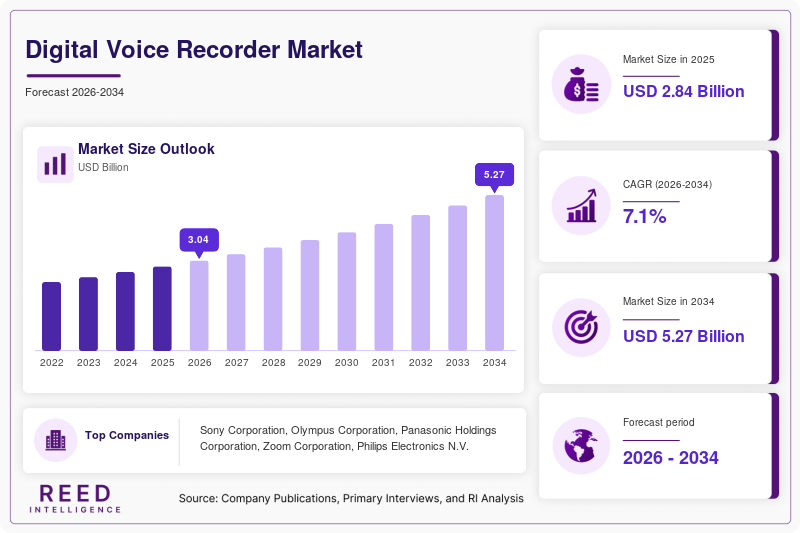
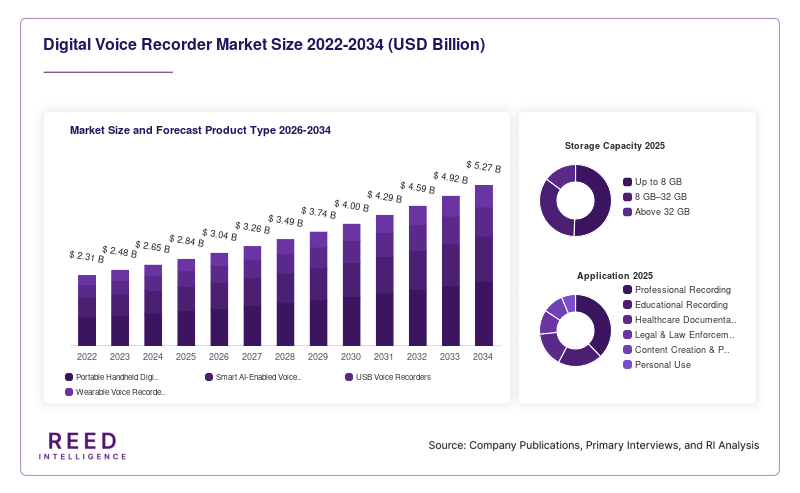
The Digital Voice Recorder Market Size was valued at USD 2.84 billion in 2026 and is projected to reach USD 4.93 billion by 2034, expanding at a CAGR of 7.1% during the forecast period (2026–2034). The market continues to evolve as professionals, students, journalists, healthcare practitioners, legal experts, and corporate organizations increasingly adopt digital recording solutions for accurate audio documentation and information management. Improvements in recording quality, storage capacity, speech enhancement technologies, and connectivity features are supporting wider adoption across both professional and personal applications.
A major global factor supporting the growth of the Digital Voice Recorder Market is the increasing demand for efficient digital documentation and content management. Organizations worldwide are seeking reliable tools for recording meetings, interviews, lectures, consultations, conferences, and field observations. Digital voice recorders offer portability, long battery life, secure storage, and superior audio quality, making them valuable devices for capturing and preserving spoken information. The growing transition toward digital workflows and remote collaboration environments has further reinforced demand for advanced recording solutions.
Key Highlights
- North America accounted for the largest market share of 34.8% in 2025, while Asia Pacific is projected to register the fastest CAGR of 8.4% during 2026–2034.
- By Product Type, Portable Handheld Digital Voice Recorders held the dominant share of 61.5% in 2025, while Smart AI-Enabled Voice Recorders are forecast to grow at a CAGR of 9.6%.
- By Storage Capacity, 8 GB–32 GB Devices represented 44.2% share in 2025, whereas Above 32 GB Devices are expected to expand at 8.8% CAGR.
- By Application, Professional Recording accounted for 39.7% share in 2025, while Content Creation & Podcasting applications are anticipated to grow at 9.4% CAGR.
- By Distribution Channel, Online Retail captured 49.3% share in 2025, while Direct-to-Consumer Sales are projected to register a CAGR of 9.1%.
- The United States remained the dominant country market, recording values of USD 612 million in 2024 and USD 654 million in 2025.
Market Trends
Integration of Artificial Intelligence and Speech Recognition Features
Manufacturers are increasingly incorporating artificial intelligence capabilities into digital voice recorders. Features such as automatic transcription, speaker identification, voice tagging, intelligent noise suppression, and searchable audio content are improving productivity for professional users. AI-enabled recording devices are becoming particularly attractive in legal, healthcare, media, and educational applications where efficient information management is essential.
Expansion of Cloud Connectivity and Wireless Synchronization
Modern digital voice recorders are evolving beyond standalone storage devices. Manufacturers are introducing Wi-Fi, Bluetooth, and cloud integration capabilities that allow users to synchronize recordings directly with cloud storage platforms and mobile applications. This trend enhances accessibility, simplifies file management, and supports remote collaboration requirements.
Market Drivers
Growing Demand for Professional Audio Documentation
Organizations across legal, healthcare, education, media, and corporate sectors increasingly require accurate audio documentation for operational efficiency and regulatory compliance. Digital voice recorders provide dependable recording quality and secure storage capabilities, making them preferred solutions for capturing interviews, consultations, meetings, and official proceedings.
Increasing Adoption Among Content Creators and Journalists
The growing number of independent content creators, podcasters, vloggers, researchers, and journalists is generating strong demand for high-quality portable recording devices. Professional-grade voice recorders offer superior audio capture compared to standard smartphone microphones, supporting the creation of clear and reliable content in diverse environments.
Market Restraint
Competition from Smartphone Recording Applications
The widespread availability of advanced smartphone recording applications presents a significant challenge to the Digital Voice Recorder Market. Modern smartphones offer improved microphone quality, cloud storage integration, and voice recording capabilities, reducing the need for dedicated recording devices among casual users.
Market Opportunities
Development of Industry-Specific Recording Solutions
Manufacturers have opportunities to introduce specialized voice recording products tailored to healthcare, legal, education, and law enforcement sectors. Industry-specific devices with customized security features, transcription capabilities, and compliance support can create additional revenue streams.
Growing Demand for Secure Encrypted Audio Storage
Organizations handling sensitive information increasingly require secure recording solutions with encrypted storage and controlled access features. Rising concerns regarding data privacy and information security are expected to drive demand for advanced digital voice recorders equipped with enhanced cybersecurity capabilities.
Segmental Analysis
By Product Type
The Digital Voice Recorder Market is segmented into:
- Portable Handheld Digital Voice Recorders
- Smart AI-Enabled Voice Recorders
- USB Voice Recorders
- Wearable Voice Recorders
Portable Handheld Digital Voice Recorders accounted for the largest market share of 61.5% in 2025. Their portability, long battery life, reliable recording quality, and widespread availability contributed to strong adoption among professionals and students.
Smart AI-Enabled Voice Recorders are expected to register the fastest CAGR of 9.6% during the forecast period. Advanced transcription features, intelligent noise filtering, and cloud-based functionality will drive future segment growth.
By Storage Capacity
The market is categorized into:
- Up to 8 GB
- 8 GB–32 GB
- Above 32 GB
8 GB–32 GB Devices represented 44.2% of market revenue in 2025. This storage range provided sufficient capacity for most professional and educational recording requirements while maintaining affordability.
Above 32 GB Devices are projected to grow at a CAGR of 8.8% through 2034. Increasing demand for long-duration recordings, high-resolution audio files, and extensive content archives will support segment expansion.
By Application
The market includes:
- Professional Recording
- Educational Recording
- Healthcare Documentation
- Legal & Law Enforcement Recording
- Content Creation & Podcasting
- Personal Use
Professional Recording accounted for 39.7% market share in 2025. Businesses, consultants, journalists, and researchers relied extensively on digital voice recorders for accurate documentation and information capture.
Content Creation & Podcasting is anticipated to witness the fastest growth at a CAGR of 9.4% throughout the forecast period. Expanding creator economies and increasing demand for professional-quality audio production will support segment development.
By Distribution Channel
The market is segmented into:
- Online Retail
- Consumer Electronics Stores
- Specialty Audio Equipment Stores
- Direct-to-Consumer Sales
- Others
Online Retail held 49.3% share in 2025 due to product availability, competitive pricing, and convenient purchasing experiences offered by e-commerce platforms.
Direct-to-Consumer Sales are expected to expand at a CAGR of 9.1% through 2034. Manufacturers are increasingly leveraging proprietary online channels to offer customized products, software services, and direct customer support.
Regional Analysis
North America
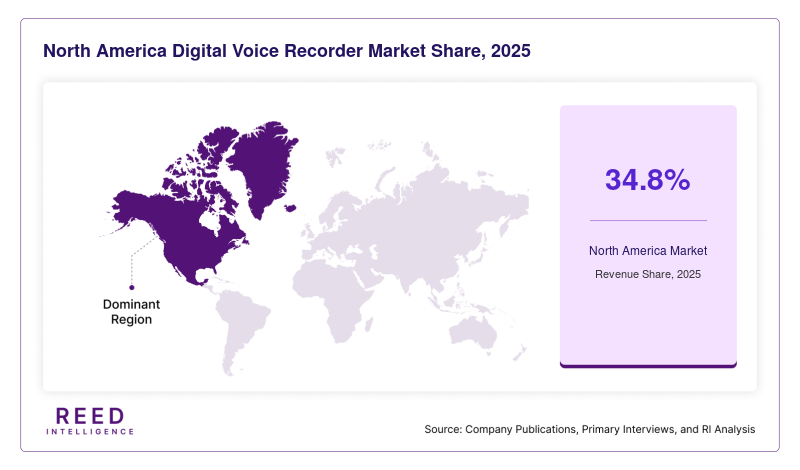
North America accounted for 34.8% of the Digital Voice Recorder Market share in 2025 and is projected to grow at a CAGR of 6.5% during 2026–2034. Demand remains supported by strong adoption across corporate enterprises, legal firms, educational institutions, and media organizations.
The United States dominated the regional market due to extensive use of professional recording equipment in journalism, content production, legal documentation, and business communication environments. Continued investment in digital workplace technologies supported market growth.
Europe
Europe held 28.6% market share in 2025 and is anticipated to expand at a CAGR of 6.8% through 2034. The region benefits from widespread adoption of digital recording solutions in healthcare, education, public administration, and professional services sectors.
Germany remained the leading country market due to strong demand from corporate organizations, educational institutions, and media production companies. Technological innovation and digital transformation initiatives supported product adoption.
Asia Pacific
Asia Pacific represented 24.5% of the global market in 2025 and is forecast to register the fastest CAGR of 8.4% during 2026–2034. Rising educational enrollment, expanding content creation industries, and increasing adoption of professional productivity tools continue to drive regional demand.
China emerged as the dominant market owing to rapid digitalization, growing media production activities, and increasing demand for educational recording devices. Expanding e-commerce platforms further supported market accessibility.
Middle East & Africa
The Middle East & Africa accounted for 6.0% market share in 2025 and is expected to grow at a CAGR of 7.2% during the forecast period. Increasing investments in education, public administration, and professional communication technologies are contributing to market expansion.
United Arab Emirates led the regional market due to growing adoption of digital productivity tools within government institutions, corporate organizations, and educational facilities.
Latin America
Latin America captured 6.1% market share in 2025 and is projected to expand at a CAGR of 7.0% through 2034. Growth is supported by rising demand for digital learning tools, expanding media industries, and increasing professional documentation requirements.
Brazil remained the dominant country due to growing adoption of recording technologies across educational institutions, media organizations, and legal service providers.
Competitive Landscape
The Digital Voice Recorder Market remains moderately competitive, with established consumer electronics manufacturers competing through product innovation, audio quality enhancements, connectivity features, and software integration capabilities. Companies continue investing in artificial intelligence technologies, cloud services, and advanced microphone systems to strengthen their market positions.
Sony Corporation remains a leading participant in the market due to its extensive portfolio of professional and consumer audio recording products. The company recently introduced next-generation digital voice recorders featuring enhanced noise cancellation technology, AI-assisted transcription functionality, and expanded cloud synchronization capabilities designed to improve productivity for professional users.
Olympus Corporation continues focusing on professional recording solutions for healthcare and legal applications. Panasonic Holdings Corporation emphasizes high-fidelity audio technologies and portable recording innovation. Zoom Corporation maintains strong positioning within content creation and podcasting segments. Philips Electronics continues expanding digital recording solutions with integrated workflow management features for business and professional users.
Key Players List
- Sony Corporation
- Olympus Corporation
- Panasonic Holdings Corporation
- Zoom Corporation
- Philips Electronics N.V.
- TASCAM (TEAC Corporation)
- Roland Corporation
- Sennheiser Electronic GmbH & Co. KG
- VoiceTracer Technologies
- EVISTR Technology Co., Ltd.
- Shenzhen Aigo Digital Technology Co., Ltd.
- Aiwa Co., Ltd.
- Grundig Intermedia GmbH
- Audio-Technica Corporation
- Fujitsu Limited
Recent Developments
- In 2025, major manufacturers launched AI-enabled digital voice recorders featuring real-time transcription and intelligent speaker recognition capabilities.
- Several companies expanded cloud storage integration and mobile application connectivity to improve recording accessibility.
- New professional-grade recording devices with advanced noise reduction technologies were introduced for content creators and business users.
- Manufacturers enhanced encryption and secure storage capabilities to address growing enterprise data protection requirements.
- Direct-to-consumer sales channels were expanded to improve customer engagement and support subscription-based software services.
Digital Voice Recorder Market Segments
Product Type
- Portable Handheld Digital Voice Recorders
- Smart AI-Enabled Voice Recorders
- USB Voice Recorders
- Wearable Voice Recorders
Storage Capacity
- Up to 8 GB
- 8 GB–32 GB
- Above 32 GB
Application
- Professional Recording
- Educational Recording
- Healthcare Documentation
- Legal & Law Enforcement Recording
- Content Creation & Podcasting
- Personal Use
Distribution Channel
- Online Retail
- Consumer Electronics Stores
- Specialty Audio Equipment Stores
- Direct-to-Consumer Sales
- Others
By Region
- North America
- Europe
- APAC
- Middle East and Africa
- LATAM