Diisononyl Adipate DINA Market Size, Share & Demand Report By Product Type (Standard DINA, High-Purity DINA), By Application (Flexible PVC Products, Wire & Cable, Automotive Materials, Coated Fabrics, Packaging Films), By End-Use Industry (Construction, Automotive, Healthcare, Packaging, Consumer Goods), By Distribution Channel (Direct Sales, Distributors & Traders), By Region & Segment Forecasts, 2026–2034
USD 3950
Market Overview
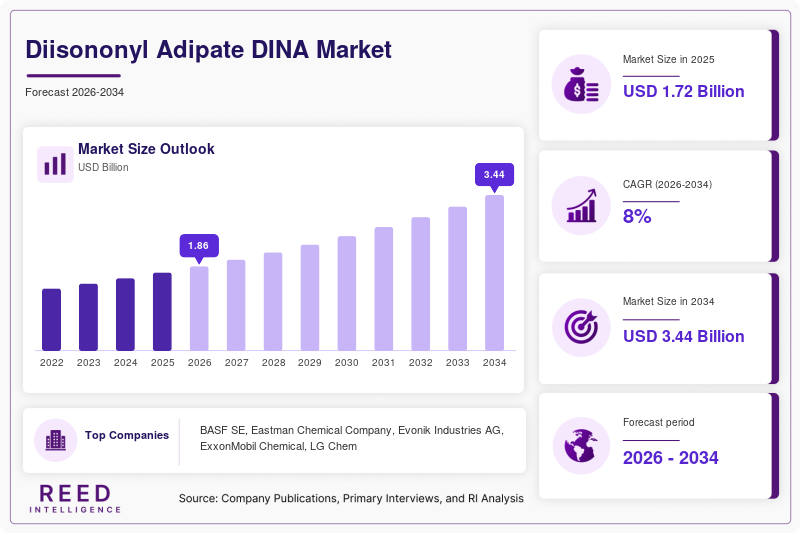
The Diisononyl Adipate DINA Market Size was valued at approximately USD 1.72 billion in 2026 and is projected to reach nearly USD 3.18 billion by 2034, expanding at a CAGR of 8.0% during the forecast period from 2026 to 2034. The global Diisononyl Adipate DINA Market has experienced steady growth due to increasing demand for flexible polymer formulations, rising consumption of specialty plasticizers, and expanding applications across automotive, construction, packaging, and consumer goods industries. Diisononyl adipate (DINA) is widely used as a low-temperature plasticizer because it provides enhanced flexibility, durability, and weather resistance in polyvinyl chloride (PVC) products and related polymer compounds.
One of the major global factors supporting the growth of the Diisononyl Adipate DINA Market has been the increasing shift toward high-performance and non-phthalate plasticizer solutions across industrial manufacturing sectors. Industries are increasingly adopting alternative plasticizers that offer improved thermal stability and lower environmental impact while maintaining product flexibility and mechanical performance. DINA has gained wider acceptance because of its compatibility with various polymers and its ability to improve low-temperature properties in flexible applications.
Key Highlights
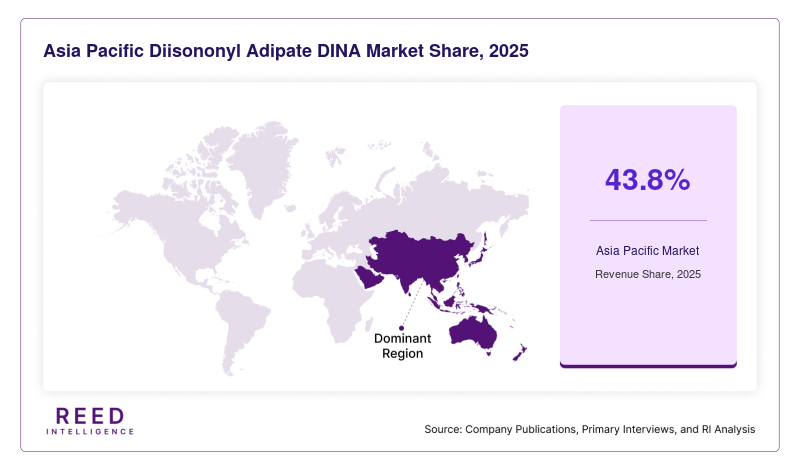
- Asia Pacific accounted for nearly 43.8% of the global Diisononyl Adipate DINA Market share in 2025, while North America is projected to register the fastest CAGR of 8.7% during the forecast period.
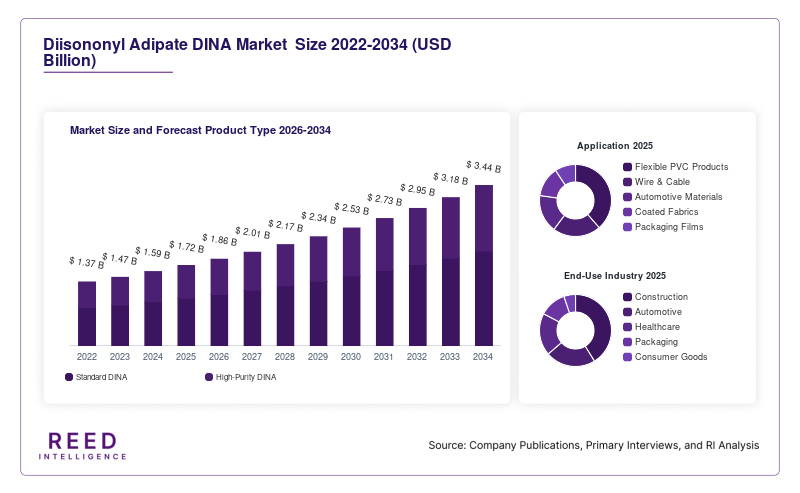
- By product type, standard DINA held the leading share of 61.5% in 2025, whereas high-purity DINA is anticipated to expand at a CAGR of 9.3% through 2034.
- By application, flexible PVC products remained the dominant segment with 48.6% market share in 2025, while automotive applications are expected to witness the fastest growth rate of 9.1%.
- By end-use industry, construction accounted for 36.2% of the global market share in 2025, whereas healthcare applications are forecast to grow at a CAGR of 9.5%.
- China represented the dominant country market with values of USD 298 million in 2024 and USD 324 million in 2025 due to rising polymer manufacturing activities and increasing flexible PVC production capacity.
Market Trends
Rising Adoption of Non-Phthalate Plasticizers
The growing preference for non-phthalate and specialty plasticizers has emerged as a major trend shaping the Diisononyl Adipate DINA Market. Regulatory authorities and industrial manufacturers are increasingly focusing on safer and environmentally compatible chemical additives for flexible polymer production. DINA is gaining popularity because it provides strong flexibility performance while supporting compliance with changing environmental standards.
Manufacturers across packaging, consumer products, and medical industries are increasingly replacing conventional phthalate-based plasticizers with alternative solutions that offer improved chemical stability and lower migration characteristics. This trend is expected to encourage wider adoption of DINA across multiple industrial sectors during the forecast period.
Increasing Demand for Flexible Automotive Materials
Another important trend influencing the Diisononyl Adipate DINA Market is the increasing use of flexible polymer materials in automotive manufacturing. Automotive producers are adopting lightweight interior components and advanced polymer systems to improve fuel efficiency, durability, and passenger comfort.
DINA-based formulations are widely used in automotive upholstery, wiring systems, sealants, and synthetic leather applications because of their low-temperature flexibility and weather resistance. The growing transition toward electric vehicles and advanced mobility solutions is expected to further increase the demand for specialty plasticizers in automotive material production.
Market Drivers
Expansion of Flexible PVC Manufacturing
The increasing production of flexible PVC materials has remained one of the primary drivers supporting the Diisononyl Adipate DINA Market. Flexible PVC products are extensively utilized in flooring systems, roofing membranes, cables, hoses, films, and coated fabrics across industrial and commercial sectors.
DINA enhances flexibility, processability, and durability in PVC formulations, making it an important additive for manufacturers seeking high-performance polymer products. The rising demand for flexible construction materials and industrial polymer solutions is expected to continue supporting market growth.
Growing Demand from Construction and Infrastructure Projects
Rapid urbanization and expanding infrastructure development have significantly contributed to the growth of the Diisononyl Adipate DINA Market. Construction projects increasingly require flexible and durable materials for waterproofing systems, wall coverings, flooring, and insulation products.
DINA-based polymer compounds provide enhanced resistance to temperature fluctuations and mechanical stress, supporting their adoption in modern construction applications. Increasing investments in residential, commercial, and industrial infrastructure are expected to strengthen future market demand.
Market Restraint
Volatility in Raw Material Prices
One of the major restraints affecting the Diisononyl Adipate DINA Market is the volatility in raw material prices associated with petrochemical feedstocks. DINA production depends on adipic acid and alcohol-based intermediates, which are influenced by fluctuations in crude oil prices and supply chain conditions.
Variations in raw material costs can impact manufacturing profitability and pricing stability across the market. Additionally, supply disruptions in global chemical production networks may create operational challenges for manufacturers.
Market Opportunities
Increasing Applications in Medical and Healthcare Products
The growing use of flexible polymer materials in medical and healthcare products presents substantial opportunities for the Diisononyl Adipate DINA Market. Medical tubing, blood bags, protective films, and healthcare packaging increasingly require flexible plasticizer solutions with improved chemical stability and durability.
DINA offers low-temperature flexibility and compatibility with medical-grade polymers, making it suitable for healthcare applications. Expanding healthcare infrastructure and rising demand for disposable medical products are expected to support future market opportunities.
Rising Investments in Sustainable Chemical Manufacturing
Increasing investments in sustainable chemical processing technologies are creating new opportunities within the Diisononyl Adipate DINA Market. Chemical manufacturers are focusing on improving production efficiency, reducing emissions, and developing environmentally responsible plasticizer solutions.
The adoption of cleaner manufacturing technologies and recyclable polymer systems is expected to support long-term demand for specialty plasticizers such as DINA. Companies investing in sustainable product innovation are likely to gain competitive advantages in evolving industrial markets.
Segmental Analysis
By Product Type
Based on product type, the Diisononyl Adipate DINA Market is segmented into standard DINA and high-purity DINA.
Standard DINA dominated the market with a share of 61.5% in 2025. Its extensive use in general-purpose flexible PVC applications contributed significantly to segment growth. Manufacturers preferred standard DINA because of its cost efficiency and strong compatibility with industrial polymer formulations.
High-purity DINA is expected to witness the fastest CAGR of 9.3% during the forecast period. Increasing demand for premium-quality polymer additives in healthcare, food packaging, and specialty industrial applications will support future segment growth. High-purity formulations offer improved performance and lower impurity levels for sensitive applications.
By Application
Based on application, the market is categorized into flexible PVC products, wire & cable, automotive materials, coated fabrics, and packaging films.
Flexible PVC products accounted for the largest market share of 48.6% in 2025 due to increasing use in flooring systems, hoses, membranes, and industrial sheets. DINA-based formulations provide enhanced flexibility and weather resistance in these applications.
Automotive materials are projected to grow at the fastest CAGR of 9.1% through 2034. Increasing production of lightweight interior components and advanced automotive polymer systems is expected to support future segment expansion. Automotive manufacturers are increasingly utilizing flexible materials to improve durability and passenger comfort.
By End-Use Industry
Based on end-use industry, the Diisononyl Adipate DINA Market is segmented into construction, automotive, healthcare, packaging, and consumer goods.
Construction remained the dominant end-use segment with 36.2% market share in 2025. Rising demand for waterproof membranes, flooring systems, and flexible insulation materials contributed significantly to segment dominance.
Healthcare is expected to register the fastest CAGR of 9.5% during the forecast period. Increasing demand for flexible medical-grade polymers and disposable healthcare products will support future segment growth. Expanding healthcare manufacturing capabilities are expected to strengthen adoption of specialty plasticizers.
By Distribution Channel
Based on distribution channel, the market is segmented into direct sales and distributors & traders.
Direct sales held the largest share of 67.4% in 2025 because large industrial customers preferred long-term procurement agreements and bulk chemical purchasing contracts. Manufacturers increasingly utilized direct supply networks to improve operational efficiency and customer relationships.
Distributors & traders are anticipated to grow at the fastest CAGR of 8.6% during the forecast period due to increasing demand from small-scale and regional polymer manufacturers. Expanding industrial supply chain networks are expected to support segment growth.
Regional Analysis
Asia Pacific
Asia Pacific held approximately 43.8% of the global Diisononyl Adipate DINA Market share in 2025. The region benefited from strong polymer manufacturing infrastructure, expanding construction activities, and increasing automotive production. China remained the dominant country due to large-scale PVC manufacturing capacity and rising industrial chemical consumption.
The regional market is expected to grow at a CAGR of 8.4% during the forecast period. Increasing investments in infrastructure development and flexible packaging production are expected to support future market expansion across Asia Pacific.
North America
North America accounted for nearly 24.6% of the global Diisononyl Adipate DINA Market share in 2025. The market benefited from increasing adoption of specialty plasticizers and rising demand for high-performance polymer applications.
The regional market is projected to expand at a CAGR of 8.7% through 2034. The United States emerged as the dominant country due to increasing use of advanced polymer materials in automotive and healthcare industries. Growing investments in sustainable chemical manufacturing are expected to strengthen regional demand.
Europe
Europe represented around 20.3% of the global Diisononyl Adipate DINA Market share in 2025. Strict environmental regulations and increasing preference for alternative plasticizers contributed significantly to regional market growth.
The market is forecast to witness a CAGR of 7.6% during the forecast period. Germany remained the leading country market because of strong automotive manufacturing capabilities and increasing adoption of specialty polymer additives. Rising investments in eco-friendly chemical solutions are expected to support future demand.
Middle East & Africa
The Middle East & Africa accounted for approximately 6.1% of the global market share in 2025. The region benefited from expanding industrial infrastructure and increasing petrochemical production activities.
The market is anticipated to grow at a CAGR of 7.8% through 2034. Saudi Arabia emerged as the dominant country due to growing investments in downstream chemical manufacturing and polymer production facilities. Expanding industrial diversification programs are expected to contribute to future regional growth.
Latin America
Latin America captured nearly 5.2% of the global Diisononyl Adipate DINA Market share in 2025. Increasing infrastructure development and growing demand for flexible construction materials supported regional market expansion.
The market is projected to register a CAGR of 7.5% during the forecast period. Brazil remained the leading country market because of increasing PVC consumption and expanding industrial manufacturing activities. Construction sector modernization is expected to support future regional demand.
Competitive Landscape
The competitive landscape of the Diisononyl Adipate DINA Market remains moderately fragmented, with major chemical manufacturers focusing on product innovation, capacity expansion, and sustainable chemical processing technologies. Companies are increasingly investing in specialty plasticizer production and environmentally compatible polymer additive solutions.
BASF SE remained one of the leading market participants due to its broad specialty chemicals portfolio and strong global distribution capabilities. The company recently expanded its plasticizer production capacity to support growing industrial demand for flexible polymer solutions.
Other manufacturers are increasingly focusing on strategic collaborations with PVC compound producers and automotive material suppliers. Product differentiation through low-temperature flexibility, chemical stability, and regulatory compliance has become a significant competitive strategy across the industry.
Key Players List
- BASF SE
- Eastman Chemical Company
- Evonik Industries AG
- ExxonMobil Chemical
- LG Chem
- Aekyung Petrochemical
- UPC Technology Corporation
- Nan Ya Plastics Corporation
- KLJ Group
- Mitsubishi Chemical Group
- Hanwha Solutions
- Shandong Qilu Plasticizers Co. Ltd.
- Polynt Group
- Bluesail Chemical Group
- Valtris Specialty Chemicals
Recent Developments
- In 2025, BASF SE expanded specialty plasticizer production capacity to support rising industrial demand.
- In 2024, Eastman Chemical Company introduced advanced low-temperature plasticizer solutions for automotive polymer applications.
- In 2025, Evonik Industries AG increased investments in sustainable chemical processing technologies for specialty additives.
- In 2024, LG Chem expanded flexible polymer material production facilities across Asia Pacific.
- In 2025, KLJ Group partnered with regional PVC manufacturers to strengthen specialty plasticizer supply networks.
Diisononyl Adipate DINA Market Segments
Product Type
- Standard DINA
- High-Purity DINA
Application
- Flexible PVC Products
- Wire & Cable
- Automotive Materials
- Coated Fabrics
- Packaging Films
End-Use Industry
- Construction
- Automotive
- Healthcare
- Packaging
- Consumer Goods
Distribution Channel
- Direct Sales
- Distributors & Traders
By Region
- North America
- Europe
- APAC
- Middle East and Africa
- LATAM