Diketene Derivatives Market Size, Share & Demand Report By Type (Acetoacetates, Acetoacetamides, Others), By Application (Pharmaceuticals, Agrochemicals, Coatings & Pigments, Others), By End-Use Industry (Chemical Industry, Healthcare, Agriculture, Others), By Form (Liquid, Solid), By Region & Segment Forecasts, 2025–2034
USD 3950
Market Overview
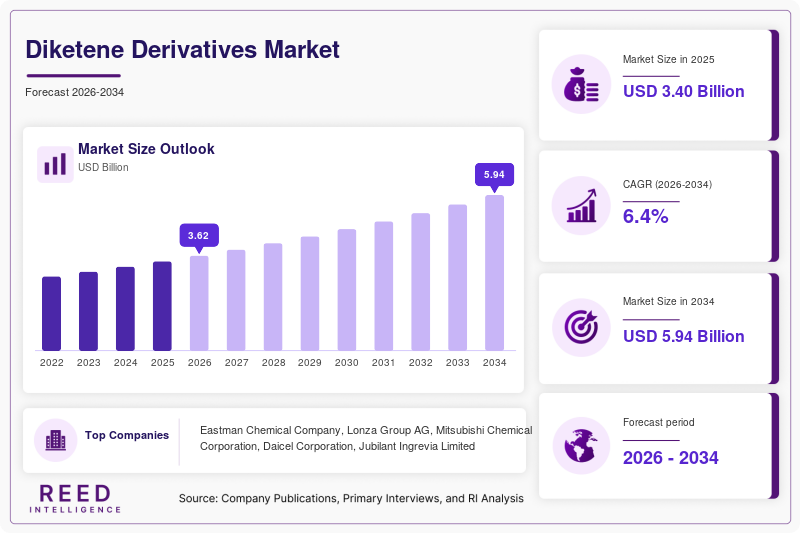
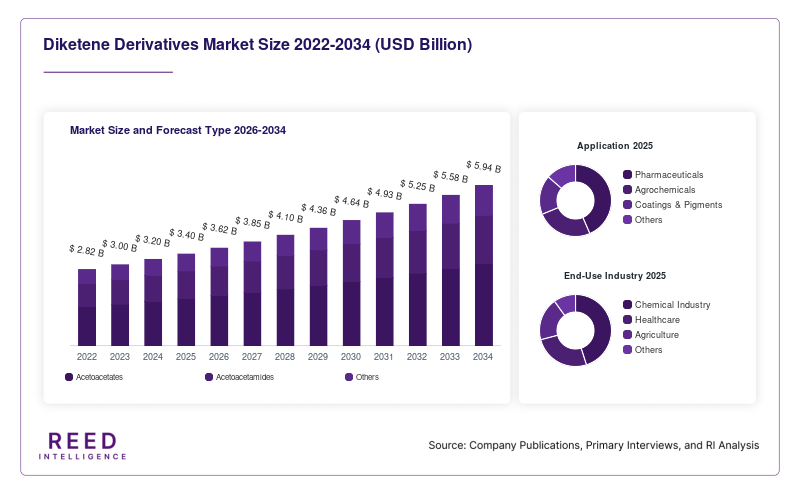
The Diketene Derivatives Market size was valued at approximately USD 3.4 billion in 2025 and is projected to reach USD 5.9 billion by 2034, expanding at a CAGR of 6.4% from 2025 to 2034. The market has demonstrated stable growth driven by increasing utilization of diketene-based intermediates across pharmaceuticals, agrochemicals, and specialty chemicals. These derivatives, including acetoacetates and acetoacetamides, are widely used due to their versatile reactivity and cost-effective synthesis pathways.
A key global factor supporting the growth of the Diketene Derivatives Market is the rising demand for pharmaceutical intermediates. As the global healthcare sector expands, the need for efficient and scalable chemical building blocks has increased. Diketene derivatives play a critical role in synthesizing active pharmaceutical ingredients (APIs), which has strengthened their adoption across emerging and developed economies.
Key Highlights
- Asia Pacific dominated the market with a share of 42% in 2025, while it will register the fastest CAGR of 7.2% during the forecast period.
- By type, acetoacetates led with a 48% share, while acetoacetamides will grow at the fastest CAGR of 7.0%.
- By application, pharmaceuticals held the largest share of 36%, whereas agrochemicals will expand at the fastest CAGR of 6.8%.
- China remained the dominant country with market values of USD 820 million in 2025 and USD 875 million in 2026.
Market Trends
Increasing Use in High-Performance Coatings
The Diketene Derivatives Market is witnessing growing adoption in coatings and pigment formulations. Diketene derivatives are used in producing acetoacetylated resins, which enhance adhesion, durability, and chemical resistance. As industries such as automotive and construction demand higher performance coatings, manufacturers are increasingly incorporating diketene-based intermediates. This trend is particularly strong in emerging economies where infrastructure development is accelerating.
Shift Toward Specialty Chemical Applications
Another notable trend shaping the Diketene Derivatives Market is the transition toward specialty chemical applications. Manufacturers are focusing on high-value derivatives tailored for niche industries, including dyes, inks, and advanced materials. This shift is driven by the need for customized chemical solutions and improved product performance. Additionally, the development of eco-efficient formulations has encouraged the use of diketene derivatives in sustainable product lines, aligning with evolving regulatory and environmental standards.
Market Drivers
Rising Demand from Pharmaceutical Industry
The pharmaceutical sector has emerged as a major driver of the Diketene Derivatives Market. These derivatives are widely used as intermediates in the synthesis of APIs, vitamins, and antibiotics. The continuous growth of the global pharmaceutical industry, coupled with increased investments in drug development, has significantly boosted demand. Moreover, the expansion of generic drug manufacturing in developing regions has further strengthened consumption levels.
Expanding Agrochemical Production
The growing need for enhanced agricultural productivity has led to increased usage of agrochemicals, thereby driving the Diketene Derivatives Market. Diketene derivatives are used in the production of herbicides, pesticides, and fungicides due to their effective chemical properties. As global food demand rises, agricultural intensification has become essential, leading to higher adoption of crop protection chemicals. This trend is expected to sustain market growth over the forecast period.
Market Restraint
Stringent Environmental and Safety Regulations
One of the major challenges faced by the Diketene Derivatives Market is the presence of stringent environmental and safety regulations. The production and handling of diketene and its derivatives involve hazardous chemical processes, which require strict compliance with safety standards. Regulatory authorities across various regions have implemented guidelines to limit emissions, manage chemical waste, and ensure worker safety.
These regulations often lead to increased operational costs for manufacturers, as they must invest in advanced safety systems and environmentally compliant technologies. Smaller players may face difficulties in meeting these requirements, which can restrict market entry and expansion. Additionally, concerns related to the environmental impact of chemical manufacturing have prompted industries to explore alternative compounds, potentially limiting the growth of diketene derivatives in certain applications.
Market Opportunities
Growth in Emerging Economies
Emerging economies present significant growth opportunities for the Diketene Derivatives Market. Rapid industrialization, urbanization, and expanding healthcare infrastructure in countries across Asia, Latin America, and Africa are driving demand for pharmaceuticals, agrochemicals, and coatings. As local manufacturing capabilities improve, the adoption of diketene derivatives is expected to increase, creating new revenue streams for market participants.
Development of Bio-Based Derivatives
The development of bio-based diketene derivatives offers a promising opportunity for market expansion. With increasing emphasis on sustainability, manufacturers are exploring renewable raw materials and eco-friendly production processes. Bio-based alternatives can help reduce environmental impact while maintaining performance characteristics. This innovation aligns with global sustainability goals and regulatory trends, making it a key area of focus for future growth in the Diketene Derivatives Market.
Segmental Analysis
By Type
Acetoacetates dominated the Diketene Derivatives Market in 2025, accounting for approximately 48% of the total share. This dominance was attributed to their widespread use in coatings, pigments, and pharmaceutical intermediates. Their versatility and compatibility with various chemical formulations made them a preferred choice across multiple industries.
Acetoacetamides will emerge as the fastest-growing subsegment, registering a CAGR of 7.0% during the forecast period. This growth will be driven by their increasing application in agrochemicals and specialty chemicals. Their enhanced stability and reactivity will make them suitable for advanced formulations, supporting their rising demand.
By Application
The pharmaceutical segment held the largest share of the Diketene Derivatives Market in 2025, contributing around 36%. The extensive use of diketene derivatives in synthesizing APIs and other pharmaceutical compounds supported this dominance. The growing demand for effective medications further strengthened this segment.
Agrochemicals will be the fastest-growing application segment, with a projected CAGR of 6.8%. This growth will be fueled by the rising need for efficient crop protection solutions. Increasing agricultural activities and the demand for higher yields will drive the adoption of diketene-based intermediates in agrochemical production.
By End-Use Industry
The chemical industry dominated the Diketene Derivatives Market in 2025, accounting for nearly 40% of the share. This was due to the extensive use of diketene derivatives in producing various chemical intermediates and specialty products. The broad applicability of these compounds across industries contributed to their strong demand.
The healthcare industry will grow at the fastest CAGR of 6.9% during the forecast period. The increasing focus on drug development and the expansion of healthcare infrastructure will drive the demand for pharmaceutical intermediates, boosting this segment’s growth.
By Form
Liquid diketene derivatives dominated the market in 2025 with a share of approximately 55%. Their ease of handling and compatibility with industrial processes made them widely preferred across applications. Liquid forms also offered better mixing properties, enhancing production efficiency.
Solid derivatives will witness the fastest growth, with a CAGR of 6.6%. This growth will be driven by their longer shelf life and ease of storage. Industries requiring stable and transportable chemical forms will increasingly adopt solid derivatives.
Regional Analysis
North America
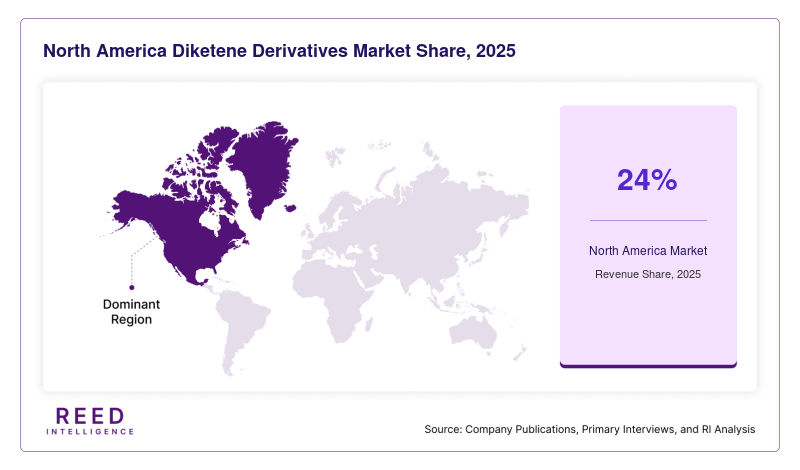
North America accounted for approximately 24% of the Diketene Derivatives Market share in 2025 and will grow at a CAGR of 5.8% from 2025 to 2034. The region’s market was supported by established chemical manufacturing infrastructure and strong demand from end-use industries.
The United States dominated the regional market due to its advanced pharmaceutical and specialty chemical sectors. A key growth factor is the increasing investment in research and development activities, which has driven demand for high-quality chemical intermediates.
Europe
Europe held around 21% of the Diketene Derivatives Market share in 2025 and is expected to grow at a CAGR of 5.6% during the forecast period. The region’s growth was influenced by strict regulatory frameworks and a focus on sustainable chemical production.
Germany emerged as the dominant country, supported by its strong chemical industry base. The country’s emphasis on innovation and environmentally compliant manufacturing processes has contributed to steady demand for diketene derivatives.
Asia Pacific
Asia Pacific led the Diketene Derivatives Market with a 42% share in 2025 and will expand at the fastest CAGR of 7.2% through 2034. The region’s dominance was driven by large-scale production capacities and rising industrial demand.
China remained the leading country, benefiting from its extensive manufacturing ecosystem. The availability of cost-effective raw materials and labor has enabled large-scale production, supporting both domestic consumption and exports.
Middle East & Africa
The Middle East & Africa accounted for approximately 7% of the Diketene Derivatives Market share in 2025 and will grow at a CAGR of 5.2% over the forecast period. The market was supported by increasing investments in industrial diversification.
Saudi Arabia dominated the region due to its expanding petrochemical sector. Government initiatives to develop downstream industries have contributed to the growing adoption of chemical intermediates, including diketene derivatives.
Latin America
Latin America held nearly 6% of the Diketene Derivatives Market share in 2025 and is projected to grow at a CAGR of 5.4% during the forecast period. The region’s growth was influenced by agricultural activities and chemical production.
Brazil emerged as the dominant country, driven by its strong agrochemical industry. The country’s focus on improving agricultural productivity has led to increased demand for crop protection chemicals, supporting the use of diketene derivatives.
Competitive Landscape
The Diketene Derivatives Market is characterized by the presence of several global and regional players focusing on product innovation and capacity expansion. Companies are investing in research and development to enhance product quality and meet evolving industry requirements.
A leading player in the market is Eastman Chemical Company, which has maintained a strong position through its diversified product portfolio and global presence. The company recently expanded its production capacity to meet growing demand from pharmaceutical and coatings applications.
Other key players are adopting strategies such as mergers, acquisitions, and partnerships to strengthen their market position. The competitive landscape remains moderately consolidated, with a focus on technological advancements and sustainable production practices.
Key Players
- Eastman Chemical Company
- Lonza Group AG
- Mitsubishi Chemical Corporation
- Daicel Corporation
- Jubilant Ingrevia Limited
- Laxmi Organic Industries Ltd.
- Ningbo Wanglong Technology Co., Ltd.
- Anhui Jinhe Industrial Co., Ltd.
- Nantong Acetic Acid Chemical Co., Ltd.
- Jiangsu Tiancheng Biochemical Products Co., Ltd.
- Shanghai Wujing Chemical Co., Ltd.
- Zhejiang NHU Co., Ltd.
- Hebei Chengxin Co., Ltd.
- Hubei Xinjing New Material Co., Ltd.
- Tokyo Chemical Industry Co., Ltd.
Recent Developments
- Eastman Chemical Company expanded its diketene derivatives production capacity in 2024 to meet rising global demand.
- Jubilant Ingrevia Limited introduced new high-purity diketene intermediates for pharmaceutical applications.
- Mitsubishi Chemical Corporation invested in advanced processing technologies to improve yield efficiency.
- Laxmi Organic Industries Ltd. increased its export capabilities to strengthen its global footprint.
- Daicel Corporation focused on developing eco-friendly diketene derivatives to align with sustainability goals.
Diketene Derivatives Market Segments
Type
- Acetoacetates
- Acetoacetamides
- Others
Application
- Pharmaceuticals
- Agrochemicals
- Coatings & Pigments
- Others
End-Use Industry
- Chemical Industry
- Healthcare
- Agriculture
- Others
Form
- Liquid
- Solid
By Region
- North America
- Europe
- APAC
- Middle East and Africa
- LATAM