Dimethylolpropionic Acid Market Size, Share Demand Report By Form (Solid Dimethylolpropionic Acid, Liquid Dimethylolpropionic Acid), By Application (Coatings, Adhesives & Sealants, Inks, Others), By End-Use Industry (Construction, Automotive, Textiles, Electronics, Packaging), By Distribution Channel (Direct Sales, Distributors, Online Sales), By Region & Segment Forecasts, 2025–2034
USD 3950
Market Overview
The Dimethylolpropionic Acid Market size was valued at approximately USD 520 million in 2025 and is projected to reach USD 890 million by 2034, expanding at a CAGR of 6.1% from 2025 to 2034. The market growth is primarily driven by the increasing global shift toward waterborne coatings and environmentally friendly polymer formulations. Dimethylolpropionic acid (DMPA), a key building block for water-dispersible polyurethanes, has gained strong traction due to regulatory pressure on solvent-based systems.
A major global factor supporting market growth is the tightening of environmental regulations across developed and developing economies. Governments have been encouraging the use of low-VOC (volatile organic compound) materials, which has significantly increased the adoption of DMPA-based formulations in coatings, adhesives, and sealants industries. The rise of sustainable construction practices and eco-friendly automotive coatings has further accelerated demand.
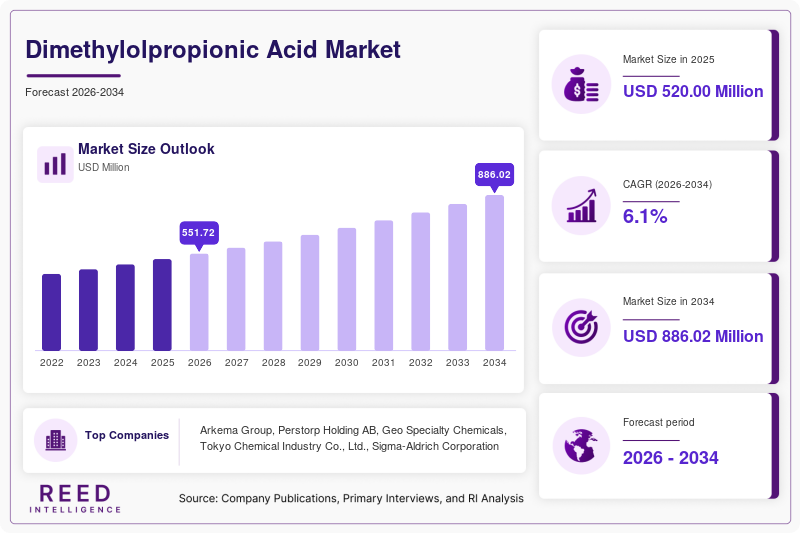
Key Highlights
- Asia Pacific dominated with 42% market share in 2025, while Middle East & Africa is expected to grow fastest at a CAGR of 7.4%.
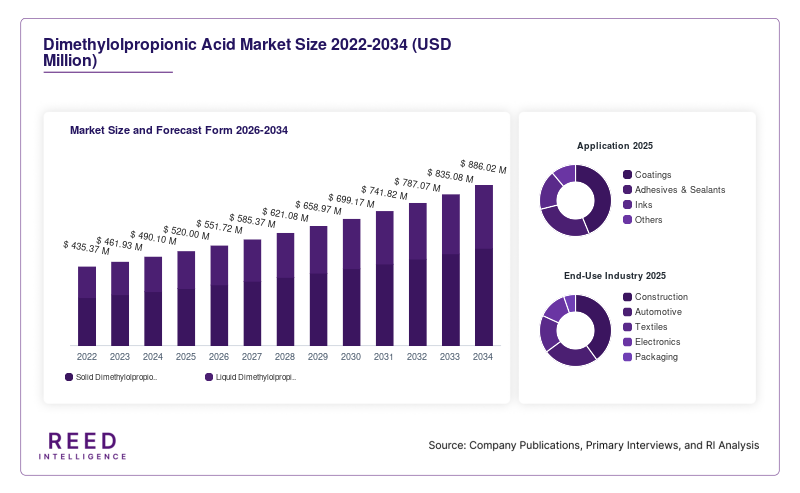
- In application, coatings led with 38% share, while adhesives & sealants is projected to grow fastest at 6.8% CAGR.
- By form, solid DMPA accounted for 61% share, while liquid DMPA is expected to expand at 6.5% CAGR.
- China remained the dominant country with market values of USD 142 million in 2025 and USD 151 million in 2026.
Market Trends
Rising Adoption of Waterborne Polyurethane Systems
The transition toward waterborne polyurethane dispersions has become a defining trend in the Dimethylolpropionic Acid Market. DMPA plays a critical role in imparting hydrophilicity to polyurethane systems, enabling water dispersion without compromising performance. Industries such as automotive coatings, textiles, and packaging are increasingly integrating these systems to meet environmental compliance standards. This shift has significantly expanded the application scope of DMPA in sustainable formulations.
Growth in High-Performance Coatings for Industrial Applications
Another notable trend is the increasing demand for high-performance coatings in industrial and infrastructure sectors. DMPA-based polymers provide enhanced durability, chemical resistance, and adhesion properties. These characteristics make them suitable for protective coatings used in harsh environments, including marine, oil & gas, and heavy machinery applications. The trend is further supported by investments in infrastructure modernization and industrial automation across emerging economies.
Market Drivers
Increasing Demand for Eco-Friendly Chemical Intermediates
The growing awareness of environmental sustainability has led to a surge in demand for eco-friendly chemical intermediates. DMPA is widely used in producing low-emission coatings and adhesives, making it a preferred choice for manufacturers aiming to comply with environmental regulations. The shift toward green chemistry has encouraged innovation in polymer production, further driving demand.
Expansion of the Construction and Automotive Sectors
Rapid urbanization and infrastructure development have significantly boosted the construction industry, increasing the demand for advanced coatings and sealants. Similarly, the automotive sector’s focus on lightweight materials and durable coatings has created strong demand for DMPA-based formulations. These industries rely on high-performance materials, positioning DMPA as a critical component in next-generation products.
Market Restraint
Volatility in Raw Material Prices
One of the major challenges in the Dimethylolpropionic Acid Market is the fluctuation in raw material prices. DMPA production relies on petrochemical derivatives, which are subject to price volatility due to changes in crude oil prices and supply chain disruptions. This instability impacts production costs and profit margins for manufacturers.
Additionally, smaller manufacturers face difficulties in maintaining consistent supply and pricing, which can hinder market expansion. The uncertainty in raw material availability also affects long-term contracts and pricing strategies, making it challenging for companies to sustain competitive pricing. While technological advancements may help reduce dependency on volatile inputs, this restraint continues to influence market dynamics.
Market Opportunities
Emerging Demand in Bio-Based Polyurethanes
The increasing focus on bio-based and renewable materials presents a significant opportunity for the Dimethylolpropionic Acid Market. Manufacturers are exploring the integration of DMPA into bio-based polyurethane systems to enhance sustainability without compromising performance. This trend is expected to open new avenues in packaging, textiles, and consumer goods industries.
Growth in Electronics and Specialty Applications
The rising demand for advanced materials in electronics and specialty applications is creating new growth opportunities. DMPA-based polymers are used in coatings for electronic components due to their insulating and protective properties. As the electronics industry continues to expand, particularly in Asia Pacific, the demand for specialized coatings is expected to increase, driving market growth.
Segmental Analysis
By Form
The solid form of DMPA dominated the market, accounting for 61% share in 2025. Its stability, ease of storage, and compatibility with various formulations made it widely preferred across industries.
Liquid DMPA is expected to be the fastest-growing subsegment, with a projected CAGR of 6.5%. Its ease of handling and suitability for automated manufacturing processes will drive its adoption, particularly in advanced coatings applications.
By Application
Coatings emerged as the leading application segment, holding 38% share in 2025. The demand for durable and environmentally friendly coatings has driven the adoption of DMPA-based formulations.
Adhesives & sealants are projected to grow at the fastest rate, with a CAGR of 6.8%. The increasing use of high-performance adhesives in construction and automotive industries will support this growth.
By End-Use Industry
The construction industry dominated the market with a 34% share in 2025, driven by the demand for protective coatings and sealants.
The automotive industry is expected to witness the fastest growth, with a CAGR of 6.9%, supported by the need for lightweight and durable materials.
By Distribution Channel
Direct sales accounted for the largest share of 65% in 2025, as manufacturers preferred direct engagement with large industrial clients.
Online distribution is anticipated to grow fastest at a CAGR of 7.2%, driven by digital transformation and increased accessibility.
Regional Analysis
North America
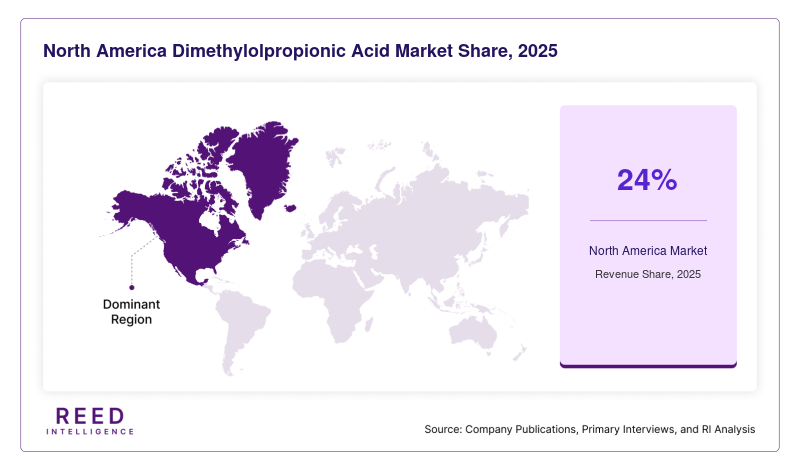
North America accounted for approximately 24% of the Dimethylolpropionic Acid Market share in 2025, and the region is expected to grow at a CAGR of 5.8% from 2025 to 2034. The region’s mature industrial base and strong regulatory framework have supported steady demand for DMPA-based products.
The United States dominated the regional market due to its advanced coatings and adhesives industry. The growing adoption of sustainable materials in construction and automotive sectors has been a key growth factor. Increasing investments in green building initiatives have further strengthened demand.
Europe
Europe held around 21% market share in 2025 and is projected to expand at a CAGR of 5.6% during the forecast period. The region’s strict environmental regulations have driven the adoption of low-VOC materials, boosting the demand for DMPA.
Germany emerged as the dominant country, supported by its strong automotive and industrial manufacturing sectors. The emphasis on sustainable production practices and innovation in polymer chemistry has contributed to market growth.
Asia Pacific
Asia Pacific led the Dimethylolpropionic Acid Market with a 42% share in 2025 and is expected to grow at a CAGR of 6.7% through 2034. Rapid industrialization and urbanization have significantly increased demand for coatings and adhesives in the region.
China dominated the regional market due to its large manufacturing base and growing construction activities. Government initiatives promoting environmentally friendly materials have accelerated the adoption of DMPA-based products.
Middle East & Africa
The Middle East & Africa accounted for 7% of the market share in 2025 and is anticipated to grow at the fastest CAGR of 7.4%. The region’s expanding construction and infrastructure sectors have created strong demand for coatings and sealants.
Saudi Arabia led the market, driven by large-scale infrastructure projects and investments in industrial development. The increasing focus on diversifying economies has further supported market growth.
Latin America
Latin America held approximately 6% market share in 2025 and is projected to grow at a CAGR of 6.0%. The region’s growing construction and automotive industries have contributed to steady demand for DMPA.
Brazil emerged as the dominant country, supported by infrastructure development and rising demand for durable coatings. Economic recovery and industrial growth have further strengthened market prospects.
Competitive Landscape
The Dimethylolpropionic Acid Market is moderately consolidated, with key players focusing on product innovation and strategic partnerships. Leading companies are investing in sustainable production processes and expanding their global presence.
Arkema Group stands out as a market leader, driven by its strong portfolio of specialty chemicals and continuous innovation. The company recently expanded its production capacity for eco-friendly intermediates, strengthening its position in the market.
Other prominent players include Perstorp Holding AB, Geo Specialty Chemicals, and Tokyo Chemical Industry. These companies are focusing on enhancing product quality and expanding their application scope to maintain competitiveness.
Key Players
- Arkema Group
- Perstorp Holding AB
- Geo Specialty Chemicals
- Tokyo Chemical Industry Co., Ltd.
- Sigma-Aldrich Corporation
- Santa Cruz Biotechnology, Inc.
- Alfa Aesar
- Haihang Industry Co., Ltd.
- Merck KGaA
- LANXESS AG
- BASF SE
- Mitsubishi Chemical Corporation
- Solvay SA
- Evonik Industries AG
- Wanhua Chemical Group
Recent Developments
- 2024: Arkema expanded its specialty intermediates production capacity to support sustainable coatings demand.
- 2023: Perstorp launched a new grade of DMPA designed for high-performance waterborne systems.
- 2023: BASF invested in research for bio-based polyurethane intermediates incorporating DMPA.
- 2022: Mitsubishi Chemical strengthened its distribution network in Asia Pacific.
- 2022: LANXESS introduced advanced polymer additives leveraging DMPA technology.
Dimethylolpropionic Acid Market Segments
Form
- Solid Dimethylolpropionic Acid
- Liquid Dimethylolpropionic Acid
Application
- Coatings
- Adhesives & Sealants
- Inks
- Others
End-Use Industry
- Construction
- Automotive
- Textiles
- Electronics
- Packaging
Distribution Channel
- Direct Sales
- Distributors
- Online Sales
By Region
- North America
- Europe
- APAC
- Middle East and Africa
- LATAM