DIP Microcontroller Socket Market Size, Share & Demand Report By Type (Standard DIP Sockets, Zero Insertion Force (ZIF) Sockets), By Application (Prototyping, Automated Testing, Development Boards), By End-Use Industry (Electronics Manufacturing, Education and Research, Industrial Automation), By Distribution Channel (Offline, Online), By Region & Segment Forecasts, 2025–2034
USD 3950
Market Overview
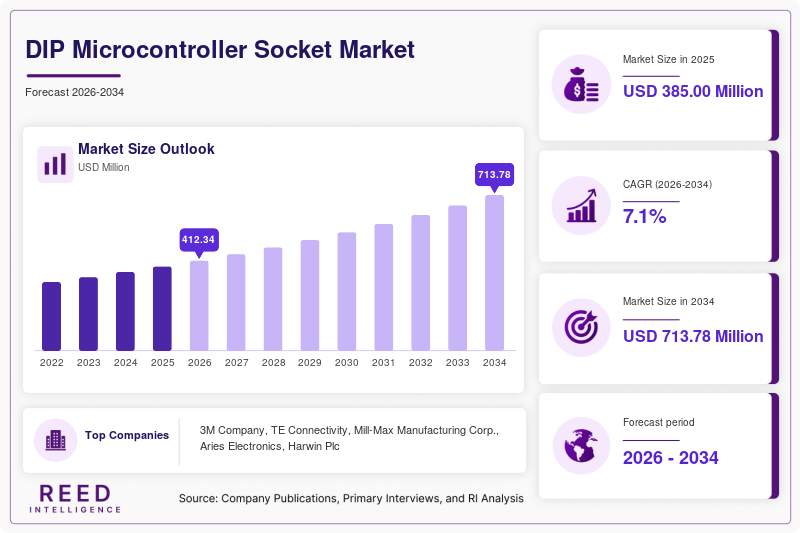
The DIP Microcontroller Socket Market size was valued at USD 385 million in 2025 and is projected to reach USD 712 million by 2034, expanding at a CAGR of 7.1% during the forecast period (2025–2034). The market growth is primarily attributed to the sustained demand for prototyping, testing, and embedded system development across electronics manufacturing and educational sectors. Despite the rise of surface-mount technology, dual in-line package (DIP) sockets remain relevant due to their ease of use, replaceability, and compatibility with legacy systems.
A key global factor supporting the growth of the DIP Microcontroller Socket Market is the increasing adoption of embedded electronics in industrial automation and consumer devices. Engineers and developers continue to rely on DIP sockets for rapid prototyping and debugging, particularly in research laboratories, universities, and small-scale electronics manufacturing units. Additionally, the growing maker movement and expansion of DIY electronics communities have further reinforced demand.
Key Highlights:
- North America dominated the market with a share of 34% in 2025, while Asia Pacific is expected to register the fastest CAGR of 8.3% during the forecast period.
- By type, standard DIP sockets accounted for the largest share, whereas zero insertion force (ZIF) sockets are anticipated to witness the fastest growth at a CAGR of 8.9%.
- By application, prototyping led the segment, while automated testing applications are projected to grow rapidly at a CAGR of 8.5%.
- The United States remained the dominant country, with market values of USD 112 million in 2025 and USD 118 million in 2026.
Market Trends
Rising Popularity of ZIF Sockets in Testing Applications
The DIP Microcontroller Socket Market is experiencing a noticeable shift toward zero insertion force (ZIF) sockets, particularly in testing environments. These sockets reduce mechanical stress on microcontroller pins and allow repeated insertion and removal without damage. This trend is gaining traction among semiconductor testing facilities and R&D labs, where reliability and efficiency are essential. As testing cycles become more intensive with complex chip designs, ZIF sockets are increasingly preferred over traditional variants.
Growth of DIY Electronics and Maker Ecosystems
Another prominent trend shaping the DIP Microcontroller Socket Market is the expansion of DIY electronics and maker communities. Platforms supporting hobbyists, students, and independent developers are driving the use of microcontroller-based kits that frequently incorporate DIP sockets. Educational institutions are also integrating hands-on electronics learning, further fueling demand. This trend supports steady consumption of DIP sockets, especially in entry-level and prototyping applications, contributing to long-term market sustainability.
Market Drivers
Increasing Demand for Rapid Prototyping in Electronics Development
The need for rapid prototyping in electronics design is a key driver for the DIP Microcontroller Socket Market. Engineers and developers rely on DIP sockets to quickly test microcontrollers without soldering, reducing development time and costs. This capability is particularly valuable in startups and research environments where flexibility and speed are critical. As product development cycles shorten across industries, the importance of reusable and adaptable socket solutions continues to grow.
Expansion of Industrial Automation and Embedded Systems
The rise of industrial automation and embedded systems is also fueling the growth of the DIP Microcontroller Socket Market. Microcontrollers are widely used in automation equipment, robotics, and control systems, requiring efficient testing and maintenance solutions. DIP sockets enable easy replacement and troubleshooting, making them essential in industrial environments. As automation adoption increases globally, demand for reliable socket solutions is expected to rise steadily.
Market Restraint
Shift Toward Surface-Mount Technology (SMT)
A significant restraint impacting the DIP Microcontroller Socket Market is the widespread adoption of surface-mount technology (SMT) in modern electronics manufacturing. SMT components are smaller, more efficient, and suitable for automated assembly processes, reducing the reliance on traditional DIP-based designs. As manufacturers prioritize compact and high-density circuit boards, the use of DIP packages and associated sockets has declined in certain applications.
Additionally, SMT eliminates the need for through-hole components, which are essential for DIP sockets. This transition is particularly evident in high-volume consumer electronics, where space optimization and cost efficiency are critical. Although DIP sockets continue to find relevance in prototyping and legacy systems, their growth potential is somewhat constrained by the ongoing industry shift toward advanced packaging technologies.
Market Opportunities
Expansion in Educational and Training Applications
The growing emphasis on STEM education presents a significant opportunity for the DIP Microcontroller Socket Market. Educational institutions are increasingly incorporating practical electronics training into their curricula, driving demand for user-friendly components such as DIP sockets. These sockets simplify circuit assembly and allow students to experiment without permanent soldering, making them ideal for learning environments.
Growth in Semiconductor Testing and Validation
Another promising opportunity lies in semiconductor testing and validation processes. As microcontroller complexity increases, manufacturers require reliable and reusable socket solutions for testing. DIP sockets, particularly ZIF variants, offer durability and precision, making them suitable for repeated testing cycles. The expansion of semiconductor manufacturing and quality assurance activities is expected to create sustained demand in this segment.
Segmental Analysis
By Type
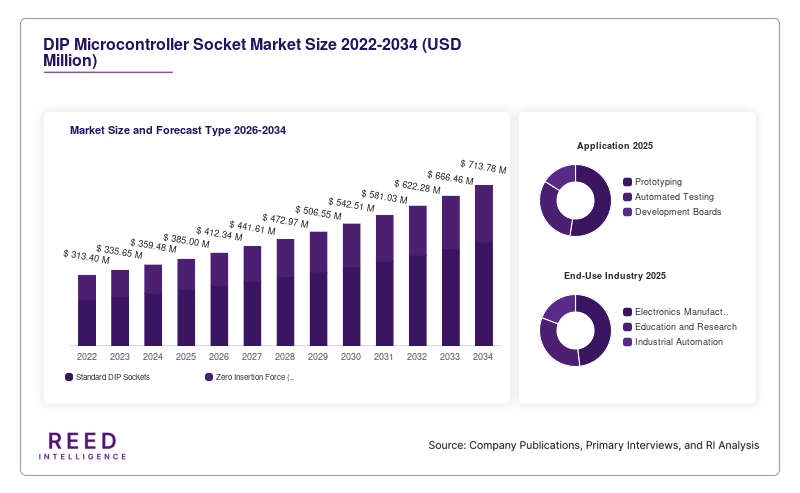
Standard DIP sockets dominated the DIP Microcontroller Socket Market in 2025, accounting for 58% of the total share. Their widespread use in basic prototyping and cost-effectiveness made them a preferred choice across educational institutions and small-scale manufacturers.
Zero insertion force (ZIF) sockets are projected to grow at the fastest CAGR of 8.9% during the forecast period. Their ability to reduce wear and tear on microcontroller pins and improve testing efficiency will drive adoption, particularly in semiconductor testing and high-frequency usage environments.
By Application
Prototyping applications held the largest share of 46% in 2025, driven by the need for flexible and reusable components in electronics development. DIP sockets allow easy insertion and removal of microcontrollers, making them ideal for iterative design processes.
Automated testing applications are expected to grow at a CAGR of 8.5%. The increasing complexity of integrated circuits and the need for efficient validation processes will boost demand for reliable socket solutions in testing environments.
By End-Use Industry
The electronics manufacturing segment dominated the DIP Microcontroller Socket Market with a 49% share in 2025. Manufacturers rely on DIP sockets for assembly, testing, and maintenance of electronic devices.
The education and research segment is anticipated to grow at a CAGR of 8.1%. Rising investments in STEM education and hands-on training programs will drive demand for user-friendly and reusable components.
By Distribution Channel
Offline distribution channels accounted for 62% of the market share in 2025, as industrial buyers prefer direct procurement from authorized distributors for quality assurance.
Online distribution channels are expected to grow at a CAGR of 8.7%. The increasing availability of electronic components through e-commerce platforms and the convenience of online purchasing will support segment growth.
Regional Analysis
North America
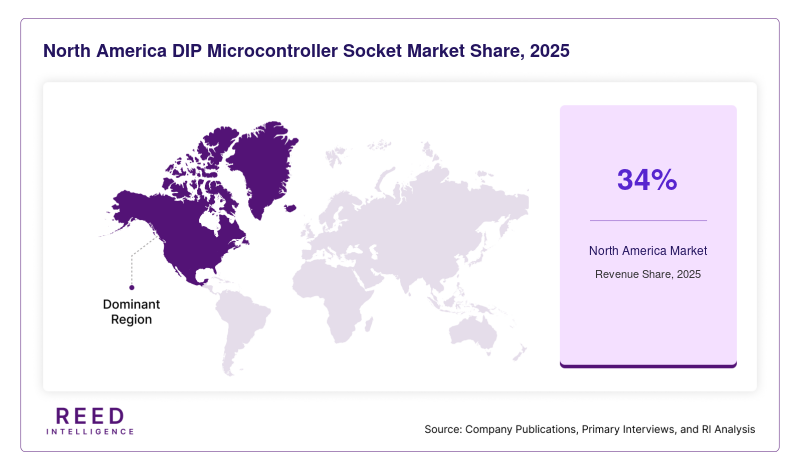
North America accounted for 34% of the DIP Microcontroller Socket Market share in 2025 and will grow at a CAGR of 6.8% during the forecast period. The region’s growth is supported by strong R&D infrastructure and widespread adoption of advanced electronics design practices.
The United States leads the regional market due to its robust semiconductor industry and emphasis on innovation. The presence of leading technology firms and research institutions drives demand for prototyping tools, including DIP sockets, particularly in product development and testing applications.
Europe
Europe held a 26% share of the DIP Microcontroller Socket Market in 2025 and is expected to grow at a CAGR of 6.5% through 2034. The region benefits from established industrial automation and automotive electronics sectors.
Germany dominates the European market due to its strong manufacturing base and focus on precision engineering. The country’s emphasis on industrial automation and embedded systems supports consistent demand for microcontroller sockets in development and maintenance processes.
Asia Pacific
Asia Pacific represented 28% of the market in 2025 and is projected to grow at the fastest CAGR of 8.3% during the forecast period. Rapid industrialization and expanding electronics manufacturing drive regional growth.
China leads the market due to its large-scale electronics production and growing semiconductor industry. The country’s focus on domestic manufacturing and innovation increases the demand for testing and prototyping components, including DIP sockets.
Middle East & Africa
The Middle East & Africa accounted for 6% of the DIP Microcontroller Socket Market in 2025 and will grow at a CAGR of 6.2%. Increasing investments in technology infrastructure and industrial diversification support market expansion.
The United Arab Emirates is a key contributor, driven by its focus on smart technologies and innovation hubs. The adoption of embedded systems in various sectors supports demand for microcontroller development tools.
Latin America
Latin America held a 6% share of the market in 2025 and is expected to grow at a CAGR of 6.4% through 2034. Growth is supported by increasing adoption of electronics in industrial and consumer applications.
Brazil dominates the regional market due to its expanding electronics manufacturing sector. The country’s focus on industrial development and technological advancement drives demand for prototyping and testing components.
Competitive Landscape
The DIP Microcontroller Socket Market is moderately fragmented, with several global and regional players competing on product quality, durability, and pricing. Key companies focus on expanding their product portfolios and enhancing socket performance to meet evolving industry requirements.
3M Company is a leading player in the market, known for its reliable electronic interconnect solutions. The company recently introduced advanced socket designs with improved thermal stability and durability, catering to high-performance applications. Other notable players include TE Connectivity, Mill-Max Manufacturing Corp., and Aries Electronics, which emphasize innovation and customization to strengthen their market positions. Strategic partnerships, product launches, and expansion into emerging markets remain key strategies adopted by these companies to maintain competitiveness.
Key Players List
- 3M Company
- TE Connectivity
- Mill-Max Manufacturing Corp.
- Aries Electronics
- Harwin Plc
- Preci-Dip SA
- Samtec Inc.
- Molex LLC
- Hirose Electric Co., Ltd.
- Yamaichi Electronics Co., Ltd.
- Sensata Technologies
- Advanced Interconnections Corp.
- WinWay Technology Co., Ltd.
- Ironwood Electronics
- Enplas Corporation
Recent Developments
- 3M Company launched enhanced DIP sockets with improved thermal resistance for industrial applications.
- TE Connectivity expanded its socket portfolio to include high-durability ZIF solutions for testing environments.
- Mill-Max Manufacturing introduced precision-machined sockets for advanced microcontroller applications.
- Samtec Inc. developed compact DIP socket designs to support space-constrained applications.
- Ironwood Electronics launched high-performance test sockets for semiconductor validation processes.
DIP Microcontroller Socket Market Segments
Type
- Standard DIP Sockets
- Zero Insertion Force (ZIF) Sockets
Application
- Prototyping
- Automated Testing
- Development Boards
End-Use Industry
- Electronics Manufacturing
- Education and Research
- Industrial Automation
Distribution Channel
- Offline
- Online
By Region
- North America
- Europe
- APAC
- Middle East and Africa
- LATAM