Dipotassium Guanylate Market Size, Share Demand Report By Form (Powder, Granules), By Application (Food & Beverages, Pharmaceuticals, Animal Feed, Cosmetics), Regional Insights & Segment Forecasts, 2026–2034
USD 3950
Dipotassium Guanylate Market Size
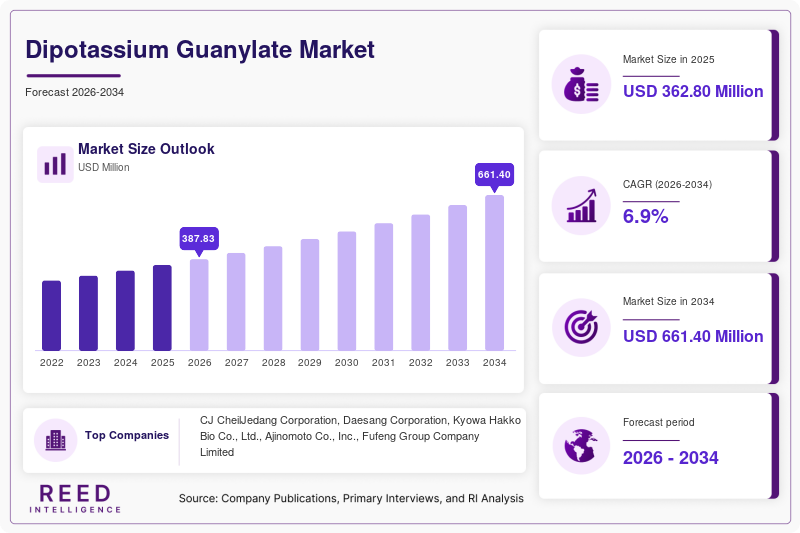
The Dipotassium Guanylate market size is projected at USD 185.6 million in 2026 and is expected to hit USD 285.3 million by 2034 with a CAGR of 5.5% during the forecast period. The increasing demand for natural and clean-label flavor enhancers in the food and beverage industry, coupled with the growing use of dipotassium guanylate in pharmaceutical and nutraceutical applications, underpins market expansion. This report delivers a comprehensive analysis of the Dipotassium Guanylate market, including segmentation by form and application, competitive dynamics, and regional growth patterns, equipping stakeholders with critical intelligence. The Dipotassium Guanylate market continues to demonstrate strong growth potential, fueled by the rising consumer preference for natural ingredients, the expanding processed food sector, and continuous innovation in production technologies.
Dipotassium guanylate (E627) is a salt of guanylic acid, a nucleotide, used primarily as a flavor enhancer in food and beverages. It works synergistically with monosodium glutamate (MSG) to provide a savory, umami taste, enhancing the overall flavor profile of various products. It is also used in pharmaceuticals, animal feed, and cosmetics. The global Dipotassium Guanylate market is significant, with global production exceeding 8,500 metric tons in 2025, reflecting a 7% increase from 2023, driven by the growing demand for processed and convenience foods. Adoption patterns reveal that the Powder form dominates the market, accounting for 60% of total revenue, followed by Granules at 40%. The Dipotassium Guanylate market's trajectory is closely linked to the growth of the global flavor enhancer market, which is projected to reach USD 10 billion by 2028, and the increasing demand for natural and clean-label food additives.
Dipotassium Guanylate Market Trends
Growing Demand for Natural and Clean-Label Flavor Enhancers
The Dipotassium Guanylate market is witnessing a significant trend toward the demand for natural and clean-label flavor enhancers, driven by consumer preference for products with recognizable and natural ingredients. The production of natural dipotassium guanylate increased by 12% in 2025, reaching 3,500 metric tons, as 35% of new product launches in the food industry in 2025 specified clean-label attributes. Adoption rates of natural dipotassium guanylate in organic and natural food products reached 20%, with this figure projected to exceed 40% by 2030. The Dipotassium Guanylate market's trend toward clean-label is reinforced by the need for transparency, the increasing consumer awareness of food additives, and the continuous innovation in bio-based and fermentation production methods.
Increasing Use in Plant-Based and Protein-Fortified Foods
The increasing focus on plant-based diets and protein-fortified foods is a major trend shaping the Dipotassium Guanylate market, with its use to enhance the savory taste of meat analogs and protein-rich formulations. The market has seen a 15% increase in demand for dipotassium guanylate in plant-based products since 2022, with 25% of new plant-based food launches in 2025 incorporating the ingredient. The use of dipotassium guanylate in plant-based meat, snacks, and savory sauces has also gained significant traction. The Dipotassium Guanylate market's trend toward plant-based applications is reinforced by the growing popularity of vegan and vegetarian diets, the need for improved taste profiles, and the continuous innovation in plant-based food technology.
Dipotassium Guanylate Market Drivers
The Dipotassium Guanylate market's expansion is primarily driven by the increasing demand for processed and convenience foods, with the global processed food market valued at over USD 5 trillion in 2025. The need for effective and cost-efficient flavor enhancers to improve the taste of food products has been a major driver, with dipotassium guanylate offering a powerful umami taste. The growing preference for natural and clean-label ingredients has also fueled market demand, as consumers seek more authentic and recognizable food components. Additionally, the expanding pharmaceutical and nutraceutical sectors have spurred growth. The Dipotassium Guanylate market's growth is further reinforced by the continuous innovation in production technologies, leading to higher purity and more cost-effective products.
Dipotassium Guanylate Market Restraints
Despite favorable growth prospects, the Dipotassium Guanylate market faces significant constraints, primarily related to the regulatory restrictions on the use of certain nucleotides in food products in some regions, which can limit market access. The competition from other flavor enhancers, such as MSG and other nucleotides, and the development of plant-based alternatives can also be a limitation. The Dipotassium Guanylate market's growth is also tempered by the price sensitivity in the food industry, where cost is a major factor in ingredient selection.
Dipotassium Guanylate Market Opportunities
The Dipotassium Guanylate market presents significant opportunities in the rapidly expanding market for plant-based foods and clean-label products, where natural flavor enhancers are highly valued. The development of novel dipotassium guanylate blends and formulations for specific applications is expected to grow at a CAGR of 7% through 2034. Emerging opportunities also exist in the use of dipotassium guanylate in the development of low-sodium and healthier food products. The Dipotassium Guanylate market's opportunity profile is further enhanced by the growing trend of personalized nutrition and the increasing demand for functional foods.
Challenges in Dipotassium Guanylate Market
The Dipotassium Guanylate market faces persistent challenges related to the need for continuous innovation to meet the evolving demands of the food industry for natural, clean-label, and cost-effective ingredients. The complexity of maintaining consistent quality and purity, especially for food-grade applications, can also be a challenge. The market is also contending with the challenge of navigating varying regulatory frameworks for food additives in different regions. Additionally, the Dipotassium Guanylate market is challenged by the need to educate consumers and formulators about the benefits and appropriate use of this flavor enhancer.
Dipotassium Guanylate Market Segmentation
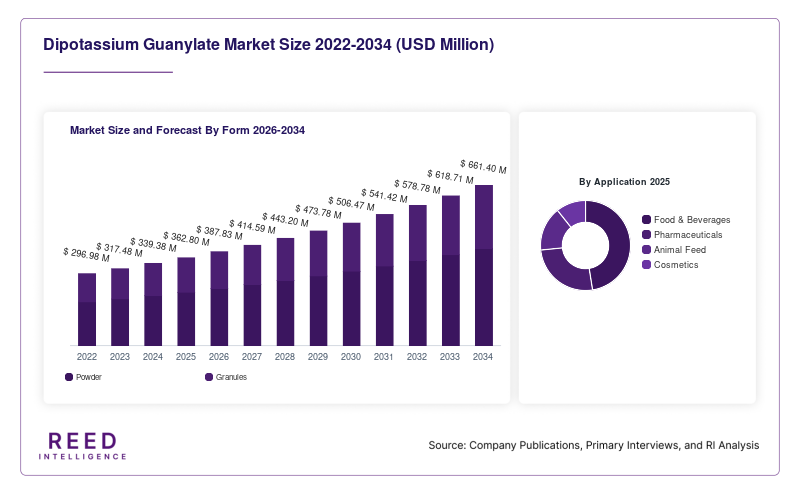
The Dipotassium Guanylate market is segmented by Form and Application to provide a comprehensive market perspective. By Form, Powder dominates with a 60% market share, driven by its ease of use and dispersion. The Application segment is led by Food & Beverages, which accounts for 55% of the market, followed by Pharmaceuticals at 20%, Animal Feed at 15%, and Cosmetics at 10%.
By Form
Powder Dipotassium Guanylate represent the largest segment in the Dipotassium Guanylate market, commanding a 60% share, with revenue exceeding USD 111 million in 2025. These are characterized by their use in dry food mixes, seasonings, and instant products, offering ease of blending and dissolution. Technical specifications include particle size, purity, and flowability. The Dipotassium Guanylate market's Powder segment is driven by its use in a wide range of food applications.
Granules Dipotassium Guanylate capture a 40% share of the Dipotassium Guanylate market, with revenue of USD 74 million in 2025. These are characterized by their use in applications requiring controlled release or where dust reduction is important. Technical specifications include granule size, hardness, and dissolution rate. The Dipotassium Guanylate market's Granules segment is driven by its use in beverages and liquid formulations.
By Application
Food & Beverages dominates the Dipotassium Guanylate market, accounting for 55% of sales, representing USD 102 million in 2025. This segment includes use in soups, sauces, snacks, seasonings, instant noodles, and processed meats to enhance umami and savory flavors. Usage penetration exceeds 30% in the processed meat sector. The Dipotassium Guanylate market's Food & Beverages segment is characterized by its focus on taste enhancement, synergy with MSG, and flavor profile improvement.
Pharmaceuticals accounts for 20% of the Dipotassium Guanylate market, with revenue of USD 37 million in 2025. This segment encompasses use in certain pharmaceutical formulations and oral care products as a flavor enhancer to mask undesirable tastes. The segment is growing at a steady CAGR, driven by the increasing demand for better-tasting medicines. The Dipotassium Guanylate market's Pharmaceuticals segment is characterized by its focus on purity and regulatory compliance.
Animal Feed represents 15% of the market, with revenue of USD 28 million in 2025, involving use in animal feed to enhance palatability and increase feed intake, particularly in swine and poultry. The segment's growth is fueled by the expanding livestock industry. The Dipotassium Guanylate market's Animal Feed segment is characterized by its focus on cost-effectiveness and performance enhancement.
Cosmetics accounts for the remaining 10% of the market, with revenue of USD 19 million in 2025, used in some cosmetic and personal care products for its potential skin conditioning and flavoring properties. The Dipotassium Guanylate market's Cosmetics segment is characterized by its focus on product safety and skin compatibility.
Dipotassium Guanylate Market Regional Outlook
Asia-Pacific Dipotassium Guanylate Market
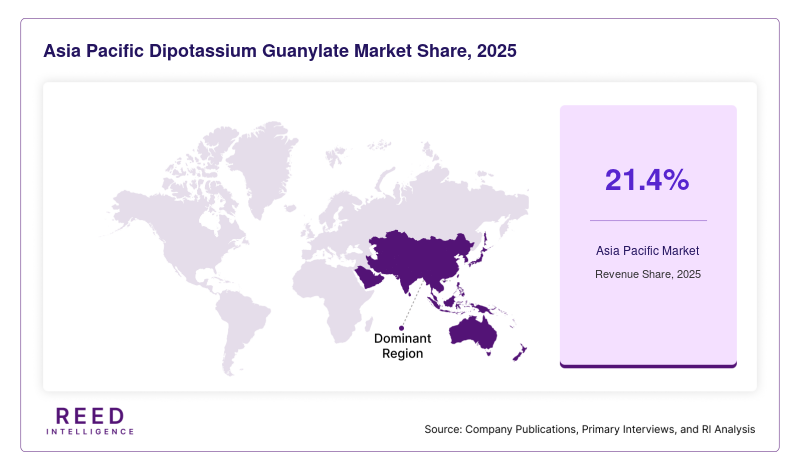
Leads the Dipotassium Guanylate market, commanding a 45% share, with a revenue of USD 84 million in 2025. China, Japan, and South Korea are the primary drivers, together accounting for 65% of regional demand, driven by the large processed food industry, high consumption of snacks and instant foods, and a strong focus on flavor enhancement. The Asia-Pacific Dipotassium Guanylate market is characterized by its focus on large-scale production and cost-competitive pricing.
North America Dipotassium Guanylate Market
Represents the second-largest market, capturing a 25% share with a revenue of USD 46 million in 2025. The United States is the primary driver, accounting for 85% of regional demand, driven by the well-established food and beverage industry, a strong focus on clean-label ingredients, and high consumer awareness. The Dipotassium Guanylate market in North America is characterized by its focus on innovation and premium products.
Europe Dipotassium Guanylate Market
Accounts for 20% of the global Dipotassium Guanylate market, with a revenue of USD 37 million in 2025. Germany, France, and the UK are the primary drivers, together accounting for 55% of regional demand, driven by strict food safety regulations, a strong processed food market, and a growing demand for natural ingredients. The Europe Dipotassium Guanylate market is projected to grow at a steady CAGR of 5.2% through 2034.
Middle East & Africa and Latin America Dipotassium Guanylate Market
Together account for the remaining 10% of the Dipotassium Guanylate market, with the UAE and Brazil leading their respective regions. Both regions are projected to grow at CAGRs exceeding 6%, driven by increasing urbanization and growing processed food consumption.
Top players in Dipotassium Guanylate Market
- CJ CheilJedang Corporation
- Daesang Corporation
- Kyowa Hakko Bio Co., Ltd.
- Ajinomoto Co., Inc.
- Fufeng Group Company Limited
- Angel Yeast Co., Ltd.
- Meihua Holdings Group Co., Ltd.
- Kemin Industries, Inc.
- Advanced Biotech
- Bell Flavors & Fragrances
- Givaudan SA
- Symrise AG
- Tate & Lyle PLC
- Kerry Group plc
- Ingredion Incorporated
CJ CheilJedang Corporation
CJ CheilJedang Corporation holds a dominant position in the Dipotassium Guanylate market, with an estimated 15% global market share, particularly strong in the Asia-Pacific, North American, and European food and beverage segments. The company's portfolio of flavor enhancers, including dipotassium guanylate, is widely recognized for its quality, consistency, and innovation. CJ CheilJedang's market leadership is reinforced by its significant investment in R&D and fermentation technology, its extensive global supply chain, and its strong brand reputation. CJ CheilJedang commands over 18% of the Asia-Pacific market and 12% of the North American market for dipotassium guanylate, positioning it as a key player in the global market.
Daesang Corporation
Daesang Corporation is a leading player in the Dipotassium Guanylate market, commanding approximately 12% of the global market share through its comprehensive portfolio of food ingredients, including nucleotides and other flavor enhancers. The company's expertise in fermentation and food processing have solidified its position, particularly in the Asian and global markets. Daesang's dipotassium guanylate is known for its high quality, reliable supply, and competitive pricing. The company's commitment to innovation and its strong presence in the Asia-Pacific market have enhanced its competitive advantage.
Kyowa Hakko Bio Co., Ltd. holds a significant 10% market share, with particular strength in the pharmaceutical and research chemical segments. Ajinomoto Co., Inc. is a major player in the global flavor enhancer market, holding a 9% share, known for its expertise in amino acids and nucleotides.
Recent Developments in Dipotassium Guanylate Market
- 2025: CJ CheilJedang launched a new, naturally fermented dipotassium guanylate produced through a sustainable, bio-based process, targeting the growing clean-label and natural food market.
- 2025: Daesang Corporation announced a significant expansion of its nucleotide production capacity in Southeast Asia to meet the growing demand for dipotassium guanylate and other flavor enhancers.
Dipotassium Guanylate Market Segments
By Form
- Powder
- Granules
By Application
- Food & Beverages
- Pharmaceuticals
- Animal Feed
- Cosmetics
By Region
- North America
- Europe
- APAC
- Middle East and Africa
- LATAM