Display Ad Design Software Market Size, Share & Demand Report By Deployment Mode (Cloud-Based, On-Premise, AI-Powered Design Suites), By Application (Social Media Advertising, Programmatic Advertising Design, Website Display Advertising, Mobile Advertising, Connected TV Advertising), By End User (Advertising & Marketing Agencies, E-commerce Companies, Media & Entertainment Firms, Retail Enterprises, Small & Medium Businesses, Others), By Region & Segment Forecasts, 2026–2034
USD 3950
Market Overview
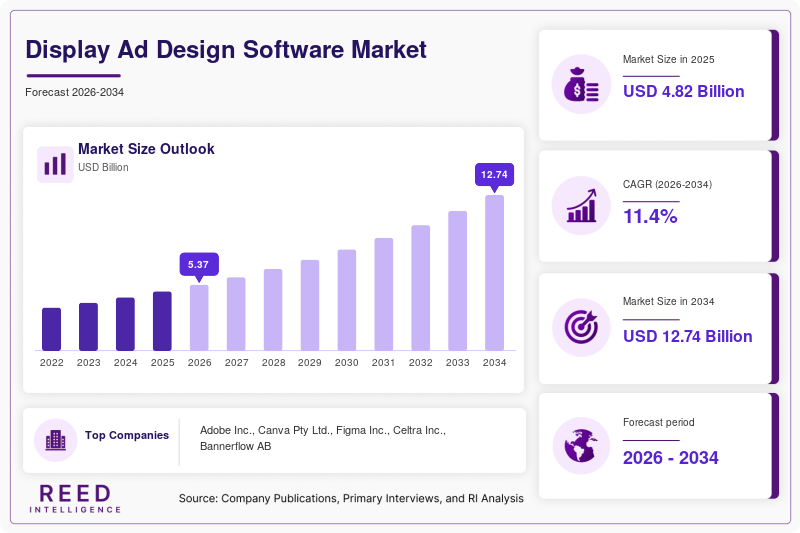
The global Display Ad Design Software Market size was valued at USD 4.82 billion in 2026 and is projected to reach USD 11.47 billion by 2034, expanding at a CAGR of 11.4% during the forecast period from 2026 to 2034. The market continues to gain momentum as businesses increase investment in digital advertising campaigns across websites, mobile applications, connected television platforms, and social media ecosystems. Growing competition among online brands has increased the demand for software platforms capable of producing visually optimized display advertisements with faster turnaround times and lower production costs.
A major global factor supporting market growth is the rapid expansion of performance-driven digital marketing strategies among enterprises and small businesses. Organizations are increasingly shifting advertising budgets from traditional print and television formats toward programmatic and personalized digital campaigns. This transition has encouraged companies to adopt advanced display ad design software equipped with AI-assisted templates, automated resizing tools, collaborative editing features, and cloud-based deployment models. In addition, the growing penetration of e-commerce, influencer marketing, and mobile internet usage has widened the adoption of creative design solutions among agencies, retailers, gaming companies, media firms, and direct-to-consumer brands.
Key Highlights
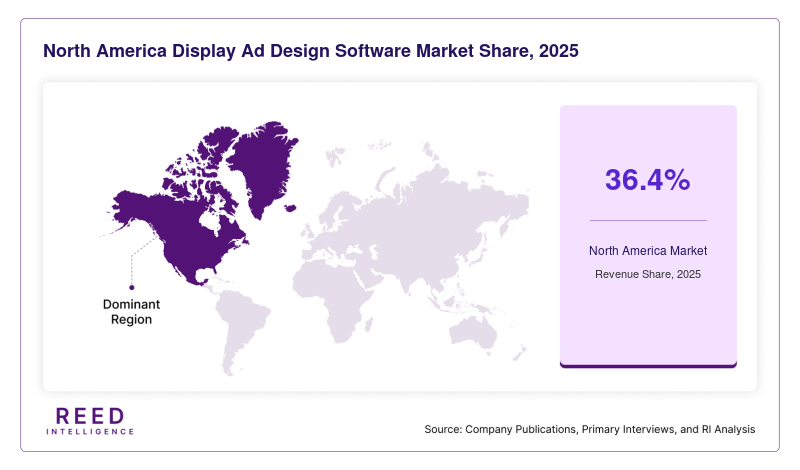
- North America dominated the market with a 36.4% share in 2025.
- Asia Pacific is expected to grow at the fastest CAGR of 12.1% during 2026–2034.
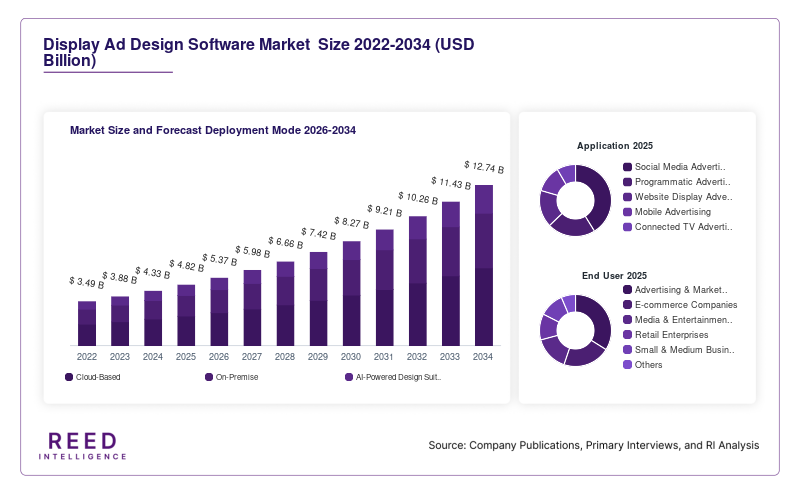
- By deployment mode, cloud-based platforms accounted for the largest share of 61.8%, while AI-powered design suites are projected to grow at a CAGR of 13.5%.
- By application, social media advertising led with a 39.6% share, whereas programmatic advertising design is expected to expand at a CAGR of 12.9%.
- The United States remained the dominant country, with market values of USD 1.08 billion in 2024 and USD 1.21 billion in 2025.
Market Trends
AI-Integrated Creative Automation Transforming Campaign Production
Artificial intelligence integration has become a defining trend in the Display Ad Design Software Market as businesses seek faster and more data-driven creative production processes. Software providers are introducing AI-powered features that automatically generate layouts, optimize color combinations, suggest headlines, and resize ad creatives for multiple digital channels. These capabilities reduce manual workload and improve campaign turnaround time for advertising agencies and in-house marketing teams. Companies are also leveraging machine learning algorithms to analyze audience engagement metrics and recommend design modifications that improve click-through rates and conversion performance. As digital campaigns become increasingly personalized, advertisers are adopting AI-supported design systems capable of producing hundreds of customized creatives within minutes. This trend is expected to accelerate further as businesses prioritize scalable advertising operations and cost-efficient creative management solutions.
Rising Adoption of Cloud-Based Collaborative Design Platforms
Cloud-based collaboration is emerging as another major trend influencing the market landscape. Enterprises operating across multiple geographic locations require centralized platforms that enable design teams, advertisers, and campaign managers to collaborate in real time. Modern display ad design software platforms now include cloud storage, workflow management dashboards, approval systems, and version control tools that streamline campaign execution. Remote and hybrid working models have further increased demand for browser-based creative environments that support seamless access from different devices and operating systems. In addition, integration with customer relationship management systems, marketing automation tools, and programmatic advertising platforms has improved operational efficiency for marketing departments. Vendors are increasingly introducing subscription-oriented cloud solutions with flexible scalability, making advanced design capabilities accessible to startups, freelancers, and small businesses with limited infrastructure investments.
Market Drivers
Expansion of Digital Advertising Budgets Across Industries
The steady increase in global digital advertising expenditure remains a primary growth driver for the Display Ad Design Software Market. Businesses across retail, healthcare, automotive, entertainment, finance, and education sectors are allocating larger portions of marketing budgets toward online advertising campaigns. The growth of e-commerce platforms and mobile commerce applications has intensified competition among brands, creating higher demand for visually engaging and performance-oriented digital advertisements. Display ad design software enables organizations to produce responsive creatives suitable for websites, social platforms, video networks, and mobile applications. In addition, companies are focusing on improving customer engagement through personalized advertising formats, which requires scalable design tools capable of generating multiple creative variations quickly. The increasing reliance on measurable digital campaigns continues to support long-term market growth.
Growth of Programmatic Advertising and Real-Time Campaign Optimization
The rapid adoption of programmatic advertising technologies is significantly contributing to market expansion. Programmatic ecosystems require a continuous supply of optimized display creatives compatible with different audience segments, devices, and ad placements. Display ad design software providers are integrating real-time analytics, automation features, and dynamic creative optimization capabilities to meet these evolving industry requirements. Marketing teams are increasingly seeking platforms that can automatically adjust designs according to customer behavior, geographic location, browsing history, and engagement patterns. This has encouraged software developers to introduce data-driven creative management tools that simplify campaign execution while improving advertising efficiency. The growing use of connected television advertising, digital out-of-home campaigns, and omnichannel marketing strategies is also creating strong demand for advanced display ad design platforms capable of supporting large-scale digital advertising operations.
Market Restraint
High Subscription Costs and Complex Integration Challenges
Despite strong market growth potential, the Display Ad Design Software Market faces challenges associated with high subscription costs and integration complexities. Advanced platforms equipped with AI-based automation, analytics dashboards, and collaborative workflow capabilities often require premium pricing structures that may limit adoption among small businesses and independent advertisers. Many organizations also face difficulties integrating design software with existing customer data platforms, ad servers, and marketing automation systems. These technical challenges can increase deployment timelines and operational expenses, particularly for enterprises operating across multiple digital channels. Furthermore, frequent software updates and evolving advertising platform requirements create compatibility concerns for users relying on legacy infrastructure. Small and medium-sized businesses in emerging economies may hesitate to invest in high-end creative software due to limited technical expertise and budget constraints. These factors could moderately restrict market penetration during the forecast period, especially among cost-sensitive customer segments.
Market Opportunities
Rising Demand for Video and Interactive Display Advertising
The growing popularity of video-based and interactive advertising formats presents significant opportunities for market participants. Brands are increasingly investing in animated banners, interactive display units, augmented reality advertisements, and short-form promotional videos to improve audience engagement. Display ad design software providers are responding by introducing tools that support motion graphics, dynamic transitions, and interactive user experiences without requiring advanced coding expertise. The expansion of streaming services, gaming platforms, and connected television advertising ecosystems is further increasing demand for visually immersive ad creatives. Businesses seeking higher consumer engagement rates are adopting software platforms capable of producing multimedia advertisements optimized for multiple devices and screen sizes. This opportunity is expected to encourage continuous innovation in user interface design, rendering technology, and real-time creative editing capabilities.
Increasing Adoption Among Small and Medium Enterprises
Small and medium enterprises are becoming an important growth opportunity for the Display Ad Design Software Market as digital marketing becomes more accessible and affordable. SMEs are increasingly using social media advertising, search engine marketing, and e-commerce campaigns to expand customer reach and improve sales performance. Cloud-based subscription models and low-code design environments have reduced the entry barriers associated with professional advertising software. Vendors are launching simplified interfaces, customizable templates, and automated design assistants specifically targeted at small businesses with limited creative expertise. In emerging economies, growing internet penetration and smartphone adoption are encouraging SMEs to invest in online brand promotion strategies. As competition intensifies across digital commerce platforms, demand for affordable and scalable display ad design tools among smaller organizations is expected to rise steadily throughout the forecast period.
Segmental Analysis
By Deployment Mode
Cloud-based deployment emerged as the dominant subsegment in the Display Ad Design Software Market, accounting for 61.8% of total market share in 2024. The widespread adoption of cloud infrastructure among enterprises has significantly contributed to this leadership position. Organizations prefer cloud-based platforms because they support remote collaboration, automatic software updates, scalable storage capacity, and lower upfront infrastructure investments. Advertising agencies and multinational companies increasingly rely on centralized creative environments that enable multiple teams to work on campaigns simultaneously. The flexibility offered by subscription-based cloud solutions has also encouraged adoption among startups and mid-sized businesses seeking affordable access to advanced design capabilities. Furthermore, integration with marketing automation systems, analytics platforms, and programmatic advertising tools has improved the operational efficiency of cloud-based creative workflows across industries.
AI-powered design suites are expected to register the fastest CAGR of 13.5% during the forecast period due to increasing demand for automation and personalization in digital advertising. Businesses are seeking software solutions capable of automatically generating creative concepts, resizing advertisements for multiple channels, and optimizing visual performance using predictive analytics. AI-assisted platforms reduce production timelines and support large-scale campaign execution with minimal manual intervention. The rising popularity of personalized advertising and dynamic creative optimization is encouraging software vendors to invest heavily in machine learning capabilities. In addition, companies are increasingly adopting generative AI technologies to create data-driven advertisements tailored to audience behavior, geographic preferences, and engagement patterns. This shift toward intelligent creative automation is expected to strengthen demand for AI-integrated design software globally.
By Application
Social media advertising represented the largest application segment in the Display Ad Design Software Market, capturing 39.6% of total market share in 2024. The expansion of platforms such as Instagram, TikTok, LinkedIn, Facebook, and YouTube has encouraged businesses to prioritize visually engaging social advertising campaigns. Brands increasingly require creative assets optimized for mobile viewing, short-form video content, and interactive promotional formats. Display ad design software supports rapid creative production for these dynamic digital environments by offering customizable templates, animation tools, and collaborative editing features. Small businesses and influencers also contribute significantly to segment growth by adopting affordable software solutions for targeted promotional campaigns. The growing role of social commerce and influencer partnerships continues to strengthen demand for scalable and user-friendly ad design platforms.
Programmatic advertising design is projected to expand at the fastest CAGR of 12.9% through 2034 due to increasing adoption of automated digital advertising technologies. Programmatic ecosystems require continuous delivery of personalized creatives optimized for multiple devices, audience groups, and ad placements. Businesses are therefore investing in software capable of producing high volumes of customized display advertisements efficiently. Dynamic creative optimization tools, audience analytics integration, and automated testing capabilities are becoming critical features for advertisers operating within programmatic environments. The rapid growth of connected television advertising and real-time bidding platforms is further increasing demand for responsive and data-driven creative solutions. Vendors focusing on automated workflow management and AI-based campaign optimization are expected to gain strong competitive advantages within this segment.
By End User
Advertising and marketing agencies accounted for the largest share of the Display Ad Design Software Market in 2024, contributing 44.1% of overall revenue. Agencies manage campaigns for multiple clients across industries, creating substantial demand for collaborative and scalable design software platforms. These organizations require tools that support high-volume creative production, real-time editing, asset management, and campaign performance tracking. The increasing complexity of omnichannel advertising strategies has encouraged agencies to adopt advanced software equipped with automation capabilities and integrated analytics dashboards. Furthermore, agencies increasingly rely on cloud-based creative ecosystems that simplify communication between designers, copywriters, and campaign managers operating across different geographic locations. The growing outsourcing of digital marketing operations by enterprises continues to support strong demand from this end-user segment.
E-commerce companies are expected to witness the fastest CAGR of 13.1% during the forecast period as online retail competition intensifies globally. Digital retailers continuously launch promotional campaigns across websites, mobile applications, search engines, and social media platforms to attract consumers and improve conversion rates. Display ad design software enables e-commerce businesses to create responsive advertisements tailored to seasonal promotions, customer preferences, and product recommendations. The increasing use of personalized shopping experiences and AI-driven recommendation engines further supports demand for scalable creative tools. In addition, rapid growth in cross-border e-commerce activities and direct-to-consumer business models is encouraging retailers to invest in multilingual and localized advertising strategies. These factors are expected to drive strong long-term growth within the e-commerce end-user segment.
Regional Analysis
North America
North America accounted for 36.4% of the global Display Ad Design Software Market in 2025 and is expected to maintain a strong position throughout the forecast period. The region is projected to register a CAGR of 10.6% between 2026 and 2034 due to the high concentration of digital advertising agencies, technology companies, and e-commerce enterprises. Businesses across the United States and Canada continue to increase spending on personalized advertising campaigns, which supports demand for AI-enabled creative management platforms. Advanced digital infrastructure and high cloud adoption rates further contribute to market expansion.
The United States remained the dominant country within North America due to its mature digital advertising ecosystem and strong presence of software developers. A major growth factor in the country is the increasing adoption of omnichannel marketing strategies among retail and media companies. Organizations are investing heavily in programmatic advertising and data-driven customer targeting, which requires scalable display ad design software solutions. Growing investments in connected television advertising and retail media networks are also creating additional opportunities for software providers operating in the region.
Europe
Europe represented a substantial share of the Display Ad Design Software Market in 2025 and is anticipated to grow at a CAGR of 9.8% during the forecast period. The region benefits from increasing adoption of digital marketing technologies across retail, automotive, travel, and financial services industries. Businesses are focusing on creative localization strategies to improve consumer engagement across multilingual markets. This has encouraged demand for software platforms capable of producing region-specific display advertisements efficiently. In addition, rising investments in privacy-focused advertising technologies are shaping software development trends across European countries.
Germany emerged as the leading country within the European market due to its strong digital economy and expanding e-commerce sector. One unique growth factor driving the German market is the increasing integration of AI-supported creative automation tools among medium-sized enterprises. Businesses are seeking software solutions that improve advertising productivity while maintaining compliance with regional data protection standards. The country’s growing startup ecosystem and expanding digital retail infrastructure continue to support adoption of advanced display ad design technologies across multiple industry verticals.
Asia Pacific
Asia Pacific is expected to record the fastest CAGR of 12.1% from 2026 to 2034, supported by rapid digitalization and increasing smartphone penetration. The region accounted for a significant portion of global market revenue in 2025 as businesses expanded online advertising campaigns across mobile-first consumer markets. Countries including China, India, Japan, and South Korea are witnessing strong growth in e-commerce, gaming, and social commerce activities, which increases demand for scalable creative production platforms. Growing internet accessibility and rising social media usage further contribute to regional market expansion.
China remained the dominant country within Asia Pacific owing to its large digital advertising industry and strong presence of technology-driven enterprises. A unique growth factor supporting the Chinese market is the rapid expansion of livestream commerce and integrated social shopping platforms. Brands operating within these ecosystems require highly customized display advertisements optimized for mobile devices and short-form content formats. Local software vendors are increasingly introducing AI-assisted multilingual design tools that support high-volume advertising production for domestic and international businesses operating in the country.
Middle East & Africa
The Middle East & Africa market is projected to grow steadily during the forecast period as organizations accelerate digital transformation initiatives across advertising and retail sectors. The region accounted for a smaller share of global revenue in 2025 but is expected to register a CAGR of 8.9% through 2034. Increasing internet penetration, rising smartphone usage, and government-led smart city initiatives are supporting digital advertising adoption across Gulf countries and parts of Africa. Businesses are increasingly adopting cloud-based marketing platforms to improve campaign efficiency and customer targeting capabilities.
The United Arab Emirates emerged as the dominant country in the regional market due to its advanced digital infrastructure and strong media industry presence. A major growth factor in the country is the rapid expansion of tourism and luxury retail advertising campaigns targeting international audiences. Businesses are increasingly investing in multilingual and visually interactive advertising formats to improve brand visibility. The presence of regional marketing agencies and technology startups is also encouraging adoption of advanced display ad design software platforms across the UAE market.
Latin America
Latin America continues to present gradual growth opportunities for the Display Ad Design Software Market, supported by rising digital advertising expenditure and expanding internet accessibility. The region is forecast to grow at a CAGR of 9.2% during 2026–2034 as companies increasingly adopt online promotional strategies to reach younger consumer populations. Retailers, entertainment companies, and financial institutions are investing in social media campaigns and mobile advertising initiatives, creating demand for flexible and affordable design software solutions. Cloud deployment models are particularly attractive for businesses seeking scalable digital marketing infrastructure.
Brazil remained the dominant country within Latin America due to its large consumer base and rapidly growing e-commerce industry. One unique growth factor supporting the Brazilian market is the increasing popularity of influencer-driven advertising campaigns across social media platforms. Brands are collaborating with content creators to produce customized display advertisements and interactive promotional materials. This trend is encouraging software providers to introduce user-friendly creative platforms that simplify rapid ad production and support localized digital marketing campaigns tailored to regional consumer preferences.
Competitive Landscape
The Display Ad Design Software Market is characterized by intense competition among global software developers, cloud platform providers, and specialized creative technology companies. Major participants focus on expanding AI capabilities, improving user interface functionality, and integrating advertising analytics into design workflows. Competition is also influenced by subscription pricing models, cloud deployment flexibility, and compatibility with programmatic advertising ecosystems. Vendors are increasingly targeting small and medium enterprises through affordable subscription plans and low-code design environments.
Adobe Inc. remained the leading company in the market due to its extensive creative software ecosystem and strong brand recognition across advertising industries. The company continues to strengthen its position through AI-powered design automation and integrated marketing cloud services. Canva, Figma, Celtra, and Bannerflow are also expanding their market presence through collaborative cloud-based advertising solutions and automated creative management tools.
Key Players
- Adobe Inc.
- Canva Pty Ltd.
- Figma Inc.
- Celtra Inc.
- Bannerflow AB
- Google LLC
- Creatopy
- Smartly.io
- VistaCreate
- Marq
- Visme
- Piktochart
- AdCreative.ai
- Celum GmbH
- Shutterstock Inc.
Recent Developments
- In March 2026, Adobe Inc. introduced advanced AI-powered creative automation features within its advertising design platform to improve real-time display ad personalization and campaign scalability.
- In October 2025, Canva Pty Ltd. expanded its enterprise collaboration tools with integrated approval workflows and automated ad resizing capabilities for multi-platform advertising campaigns.
- In December 2025, Bannerflow AB launched enhanced dynamic creative optimization solutions designed to support programmatic advertising and audience-specific display ad customization.
- In February 2026, Smartly.io strengthened its social advertising platform through new predictive analytics tools aimed at improving campaign performance tracking and creative efficiency.
- In August 2025, Celtra Inc. partnered with several global retail brands to expand AI-assisted video and interactive display advertising production capabilities across omnichannel marketing campaigns.
Display Ad Design Software Market Segments
Deployment Mode
- Cloud-Based
- On-Premise
- AI-Powered Design Suites
Application
- Social Media Advertising
- Programmatic Advertising Design
- Website Display Advertising
- Mobile Advertising
- Connected TV Advertising
End User
- Advertising & Marketing Agencies
- E-commerce Companies
- Media & Entertainment Firms
- Retail Enterprises
- Small & Medium Businesses
- Others
By Region
- North America
- Europe
- APAC
- Middle East and Africa
- LATAM