Dispute Dry Transformer Market Size, Share, Demand Report By Type (Cast Resin Transformers, Vacuum Pressure Impregnated Transformers, Open Wound Dry Transformers, Special Application Dry Transformers), By Application (Industrial Power Distribution, Renewable Energy Integration, Infrastructure & Utilities, Commercial Buildings, Transportation & EV Charging Infrastructure), By End-Use (Utilities, Industrial Sector, Commercial Sector, Renewable Energy Developers, Transportation Infrastructure Opera
USD 3950
Market Overview
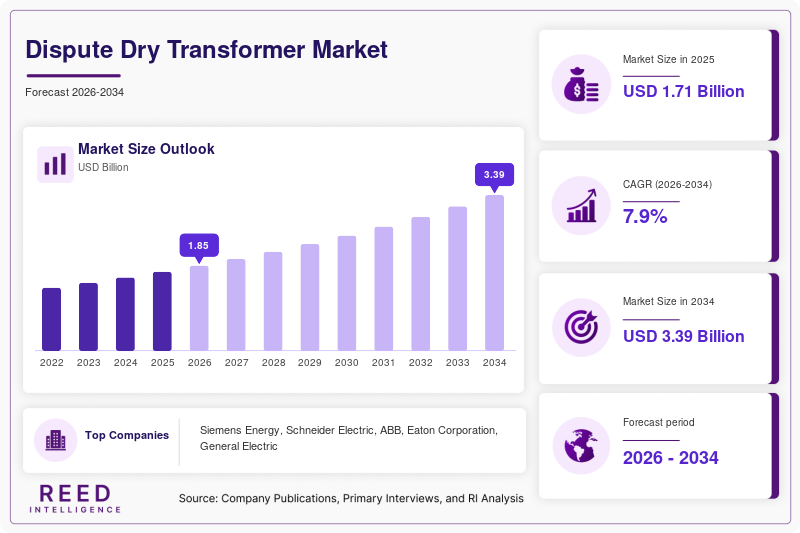
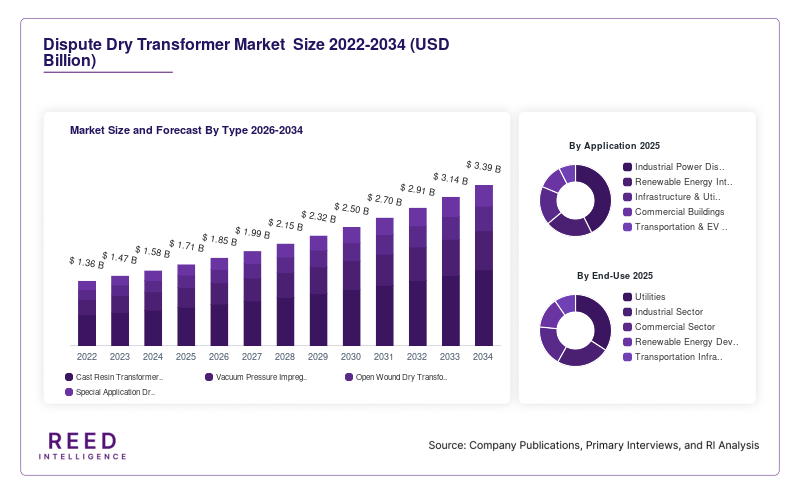
The Dispute Dry Transformer Market size is projected to demonstrate steady expansion between 2026 and 2034, supported by increasing electrification initiatives, modernization of aging grid infrastructure, and rising deployment of energy-efficient power distribution systems. In 2026, the global market size is estimated at approximately USD 1.85 billion, and it is forecast to reach nearly USD 3.42 billion by 2034, registering a CAGR of 7.9% during the period. Growth in the market is strongly influenced by the global transition toward low-maintenance and fire-safe transformer technologies, particularly in urban infrastructure and industrial electrification projects where dry-type transformers are preferred due to their reduced environmental risk and operational stability.
One major global factor supporting the Dispute Dry Transformer Market growth is the accelerating integration of renewable energy systems into national power grids. Solar and wind energy installations require reliable voltage regulation and efficient power distribution at multiple grid points, increasing reliance on dry-type transformers. Additionally, urbanization in developing economies has led to a rise in commercial construction projects, where compact and safe electrical systems are required. The demand for resilient grid systems capable of handling fluctuating energy loads has further strengthened adoption across utility and industrial sectors.
Key Highlights
- North America held a 34.2% share of the global Dispute Dry Transformer Market in 2025.
- Asia Pacific is projected to expand at the fastest CAGR of 11.2% during 2026–2034.
- By type, cast resin transformers accounted for a 40.1% share, while vacuum pressure impregnated transformers are projected to grow at a CAGR of 10.8%.
- By application, industrial power distribution led with a 42.3% share, whereas renewable energy integration applications are expected to expand at a CAGR of 12.1%.
- The United States recorded market values of approximately USD 620 million in 2024 and USD 680 million in 2025.
Market Trends
Rising adoption of smart monitoring-enabled dry transformers
The Dispute Dry Transformer Market is experiencing a notable shift toward the integration of smart monitoring systems that enable real-time performance tracking and predictive maintenance. These systems use embedded sensors to monitor temperature fluctuations, load variations, insulation conditions, and energy efficiency levels. This trend is being driven by utilities and industrial operators seeking to reduce downtime and improve asset life cycle management. The adoption of digital grid infrastructure is further accelerating demand for transformers equipped with IoT-enabled diagnostics. Additionally, predictive analytics platforms help identify early fault conditions, reducing operational risks and maintenance costs. This trend is particularly strong in urban distribution networks and renewable energy installations where reliability and efficiency are critical.
Increasing preference for eco-safe and low-emission insulation systems
Another major trend in the Dispute Dry Transformer Market is the growing preference for environmentally safe insulation technologies. Unlike oil-filled transformers, dry transformers eliminate the risk of oil leakage and fire hazards, making them suitable for commercial buildings, hospitals, and densely populated areas. Manufacturers are increasingly focusing on eco-friendly epoxy resin systems and recyclable insulation materials to comply with environmental regulations. Governments across several regions are tightening safety and environmental standards for electrical infrastructure, which is supporting adoption. This trend is also reinforced by corporate sustainability initiatives, where industries are transitioning toward greener power distribution systems to reduce carbon footprints and improve energy compliance ratings.
Market Drivers
Expansion of renewable energy infrastructure
The Dispute Dry Transformer Market is significantly driven by the expansion of renewable energy infrastructure across global markets. Solar farms, wind power installations, and hybrid energy systems require stable voltage conversion and efficient distribution systems, where dry-type transformers are increasingly preferred due to their safety and low maintenance characteristics. These transformers are widely used in inverter stations and grid connection points, where fluctuating power input demands high reliability. Government incentives promoting clean energy adoption have further strengthened investment in renewable infrastructure. As energy transition accelerates, the demand for durable and compact transformers continues to rise, particularly in decentralized energy systems and microgrid deployments that require consistent and safe electrical management solutions.
Growth in urban infrastructure and commercial construction
Rapid urban development and expansion of commercial infrastructure are contributing significantly to the growth of the Dispute Dry Transformer Market. High-rise buildings, shopping complexes, data centers, and metro rail systems require efficient and fire-safe electrical distribution systems. Dry transformers are preferred in such environments due to their compact design, low maintenance requirements, and suitability for indoor installation. Increasing construction activities in emerging economies are further amplifying demand, particularly in smart city projects where reliable energy systems are essential. Additionally, regulatory standards promoting fire safety in public infrastructure are encouraging developers to adopt dry-type transformers over conventional oil-based alternatives.
Market Restraint
The Dispute Dry Transformer Market faces a key restraint in the form of higher initial installation costs compared to conventional oil-filled transformers. Dry-type transformers require advanced insulation materials, specialized manufacturing processes, and robust cooling systems, which increase upfront investment requirements. This cost factor often limits adoption in price-sensitive markets, particularly in developing regions where infrastructure budgets are constrained. Additionally, industrial users with large-scale power requirements may prefer oil-filled transformers due to lower initial capital expenditure despite higher maintenance risks. The perception of higher cost without immediate operational savings continues to influence procurement decisions in several utility and industrial projects.
Another challenge arises from limited high-capacity application suitability of dry transformers in extremely heavy-load environments. While they perform efficiently in medium-voltage applications, their usage in ultra-high voltage transmission systems is restricted due to thermal limitations and design constraints. This restricts their deployment in certain large-scale industrial and grid expansion projects. Furthermore, lack of awareness in rural and semi-urban regions regarding long-term efficiency benefits also slows adoption rates. Supply chain limitations for advanced insulation materials and specialized components add additional pressure on manufacturing scalability, affecting overall market penetration in cost-sensitive regions.
Market Opportunities
Integration with smart grid modernization programs
The Dispute Dry Transformer Market presents strong opportunities through integration with global smart grid modernization initiatives. As power utilities transition toward digitalized and automated grid systems, demand for intelligent transformers capable of real-time monitoring is increasing. Dry transformers equipped with IoT sensors, remote diagnostics, and predictive maintenance capabilities are gaining traction in modern grid networks. These systems help utilities optimize energy distribution, reduce transmission losses, and improve grid reliability. Expansion of smart city projects and government-backed digital infrastructure programs further enhances adoption opportunities. The combination of digital energy management and efficient power distribution is expected to create sustained demand across urban and industrial networks.
Expansion in electric vehicle charging infrastructure
Another significant opportunity in the Dispute Dry Transformer Market is the rapid expansion of electric vehicle (EV) charging infrastructure. EV charging stations require reliable and compact power distribution systems capable of handling fluctuating load demands, making dry-type transformers a suitable choice. Governments and private players are investing heavily in nationwide EV charging networks, particularly in urban and highway corridors. Dry transformers offer advantages such as reduced fire risk, compact installation, and minimal maintenance, making them ideal for fast-charging hubs. As EV adoption continues to rise globally, the need for efficient power distribution systems in charging infrastructure is expected to generate consistent market growth opportunities.
Segmental Analysis
By Type Segment
The type segment of the Dispute Dry Transformer Market is primarily led by cast resin transformers, which accounted for approximately 40.1% market share in 2024. This dominance is attributed to their superior insulation strength, high resistance to environmental stress, and ability to operate efficiently in indoor and high-moisture conditions. Cast resin transformers are widely deployed across commercial buildings, metro systems, hospitals, and industrial facilities where fire safety and operational reliability are critical. Their maintenance-free design and long service life further strengthen adoption, particularly in urban infrastructure projects where downtime costs are high. In addition, increasing regulatory focus on fire-resistant electrical equipment continues to support demand for cast resin-based transformer systems across developed and emerging economies.
Vacuum pressure impregnated (VPI) transformers are expected to register the fastest growth at a CAGR of 10.8% during 2026–2034. These transformers are gaining traction due to their improved thermal endurance, compact structure, and enhanced electrical performance under fluctuating load conditions. VPI technology allows deeper penetration of insulating resin, resulting in better durability and reduced energy losses. Demand is rising from renewable energy integration projects, smart grid modernization, and industrial automation systems where efficiency and space optimization are essential. Furthermore, technological advancements in resin formulation and vacuum impregnation processes are enabling manufacturers to produce more cost-efficient and high-performance transformers, thereby expanding their application scope across utility substations and distributed energy systems.
By Application Segment
The industrial power distribution segment dominated the Dispute Dry Transformer Market with a market share of around 42.3% in 2024. This segment benefits from consistent demand in manufacturing plants, refineries, mining operations, and heavy machinery industries that require stable and reliable voltage supply for uninterrupted operations. Dry transformers are preferred in industrial environments due to their ability to operate safely in enclosed spaces without the risk of oil leakage or fire hazards. Their low maintenance requirements and resistance to harsh operating conditions further enhance their suitability for continuous industrial usage. Increasing automation in industrial processes and the expansion of manufacturing hubs in emerging economies are further supporting steady growth of this segment.
Renewable energy integration is projected to be the fastest-growing application segment, expanding at a CAGR of 12.1% during 2026–2034. The rising deployment of solar photovoltaic plants, wind farms, and hybrid energy systems is significantly increasing demand for efficient voltage regulation and grid interconnection equipment. Dry transformers are extensively used in inverter stations and substations due to their ability to handle variable power output and fluctuating loads efficiently. Additionally, government policies promoting clean energy transition and investments in decentralized power generation systems are accelerating adoption. The growth of microgrids and distributed energy networks is also contributing to increased deployment of dry transformers in renewable energy ecosystems.
By End-Use Segment
The utilities segment held the largest share of approximately 38.7% in 2024 within the Dispute Dry Transformer Market. Utility companies rely heavily on dry transformers for grid modernization, substation upgrades, and urban electricity distribution networks. Their preference is driven by enhanced safety features, reduced environmental risks, and lower operational maintenance compared to oil-filled transformers. Increasing electricity demand in urban areas and ongoing replacement of aging grid infrastructure are further supporting segment growth. Additionally, utilities are increasingly integrating digital monitoring systems with transformers to improve operational efficiency and reduce power losses across transmission and distribution networks.
The commercial segment is anticipated to witness the fastest growth, registering a CAGR of 11.5% during 2026–2034. This growth is driven by rapid expansion of commercial infrastructure such as data centers, shopping malls, office complexes, airports, and smart buildings. Dry transformers are increasingly preferred in commercial environments due to their compact design, fire safety compliance, and suitability for indoor installation. Rising investments in smart city projects and green building certifications are further encouraging adoption. Moreover, the growth of IT infrastructure and cloud computing facilities is significantly boosting demand for reliable and energy-efficient power distribution systems in commercial spaces.
Regional Analysis
North America
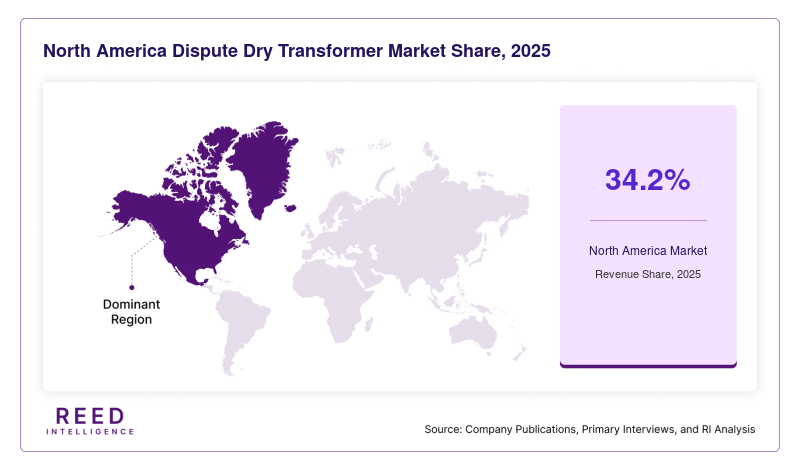
North America accounted for approximately 34.2% share of the Dispute Dry Transformer Market in 2025 and is projected to grow at a CAGR of 7.4% during 2026–2034. The region’s dominance is supported by strong investments in grid modernization, renewable energy integration, and digital infrastructure expansion. Utilities across the United States and Canada are increasingly replacing aging oil-based transformers with dry-type alternatives to improve safety and operational efficiency. The growing demand for reliable electricity supply in urban centers and industrial clusters is further strengthening market growth across the region.
The United States remains the leading country in North America due to large-scale deployment of smart grid technologies and continuous expansion of data centers and EV charging networks. Increasing regulatory pressure to improve fire safety standards in commercial and public infrastructure is also driving adoption of dry transformers. In addition, rising investments in wind and solar energy projects across states such as Texas and California are creating strong demand for efficient grid interconnection systems.
Europe
Europe held around 27.8% share of the Dispute Dry Transformer Market in 2025 and is expected to grow at a CAGR of 7.2% through 2034. The region’s growth is strongly influenced by stringent environmental regulations, decarbonization goals, and increasing investments in renewable energy infrastructure. Countries across Europe are actively upgrading power distribution systems to support electrification of transportation and industrial processes. Dry transformers are increasingly preferred due to their eco-friendly design and high operational safety standards.
Germany leads the European market due to its strong industrial base and rapid expansion of wind energy capacity. The country’s Energiewende initiative has significantly boosted demand for advanced electrical infrastructure, including dry transformers for grid stability. Additionally, increasing adoption of electric mobility and charging infrastructure is further strengthening market demand, particularly in urban and industrial zones.
Asia Pacific
Asia Pacific accounted for approximately 24.6% share in 2025 and is projected to register the fastest CAGR of 11.2% during 2026–2034. Rapid urbanization, industrial expansion, and large-scale infrastructure development are key drivers of market growth in the region. Governments across China, India, and Southeast Asia are heavily investing in smart cities, metro rail systems, and renewable energy projects, which is significantly increasing demand for dry transformers.
China dominates the regional market due to massive investments in grid expansion, industrial automation, and renewable energy integration. The country’s focus on reducing carbon emissions and improving energy efficiency is driving adoption of advanced transformer technologies. Additionally, expansion of EV charging networks and high-speed rail infrastructure is further accelerating demand for reliable and compact power distribution systems.
Middle East & Africa
Middle East & Africa accounted for approximately 7.1% share in 2025 and is projected to grow at a CAGR of 8.3% during 2026–2034. Growth in this region is driven by infrastructure diversification, urban expansion, and increasing investments in energy sector modernization. Countries in the Gulf Cooperation Council are focusing on reducing dependence on oil revenues by investing in industrial zones, smart cities, and renewable energy projects, all of which require efficient electrical distribution systems.
Saudi Arabia leads the regional market due to large-scale infrastructure projects under Vision 2030, including NEOM and other smart city developments. The country’s investment in solar and wind energy projects is also increasing demand for dry transformers in grid integration applications. Additionally, rising construction activities and industrialization across the UAE and South Africa are supporting steady market growth.
Latin America
Latin America held approximately 6.3% share in 2025 and is expected to grow at a CAGR of 7.6% during 2026–2034. The region’s growth is supported by ongoing electrification programs, expansion of renewable energy installations, and modernization of aging utility infrastructure. Governments are increasingly focusing on improving grid reliability and reducing transmission losses, which is driving adoption of dry transformer systems.
Brazil remains the dominant country in the region due to its strong renewable energy portfolio, particularly in hydro, wind, and solar power generation. Increasing investments in commercial construction and industrial expansion are further contributing to demand. Additionally, urbanization and expansion of public infrastructure projects such as metro systems and airports are supporting long-term market growth across the region.
Competitive Landscape
The Dispute Dry Transformer Market includes several established manufacturers focusing on technological upgrades, efficiency improvements, and expansion of production capabilities. Key companies such as Siemens Energy, Schneider Electric, ABB, Eaton, and General Electric are actively engaged in product innovation and grid modernization solutions. These companies are investing in digital transformer technologies that integrate monitoring systems and predictive maintenance features. A recent development includes Siemens Energy expanding its smart transformer production capacity to support rising demand for grid automation solutions in urban infrastructure projects.
Key Players
- Siemens Energy
- Schneider Electric
- ABB
- Eaton Corporation
- General Electric
- Toshiba Energy Systems
- Mitsubishi Electric
- Hitachi Energy
- Crompton Greaves
- Hyosung Heavy Industries
- Bharat Heavy Electricals Limited
- Fuji Electric
- Alstom Grid
- SGB-SMIT Group
- Wilson Power Solutions
Recent Developments
- In 2025, Siemens Energy expanded its smart dry transformer portfolio by integrating advanced IoT-based monitoring systems aimed at improving predictive maintenance, reducing downtime, and enhancing grid reliability across urban utility networks and industrial installations.
- In 2025, Schneider Electric introduced next-generation eco-efficient dry-type transformer insulation technology designed to improve thermal performance and support sustainability goals in commercial buildings and renewable energy infrastructure projects.
- In 2024, ABB increased its production capacity for medium-voltage dry transformers by upgrading manufacturing facilities with automated winding and resin casting systems to meet rising demand from renewable energy and infrastructure modernization programs.
- In 2024, Hitachi Energy advanced its digital transformer solutions by incorporating real-time condition monitoring and cloud-based analytics, enabling utilities to optimize load management and extend equipment lifecycle performance.
Dispute Dry Transformer Market Segments
By Type
- Cast Resin Transformers
- Vacuum Pressure Impregnated (VPI) Transformers
- Open Wound Dry Transformers
- Special Application Dry Transformers
By Application
- Industrial Power Distribution
- Renewable Energy Integration
- Infrastructure & Utilities
- Commercial Buildings
- Transportation & EV Charging Infrastructure
By End-Use
- Utilities
- Industrial Sector
- Commercial Sector
- Renewable Energy Developers
- Transportation Infrastructure Operators
By Region
- North America
- Europe
- APAC
- Middle East and Africa
- LATAM