Distarch Phosphate Market Size, Share & Demand Report By Source (Corn-Based, Potato-Based, Tapioca-Based, Wheat-Based), By Form (Powder, Liquid), By Application (Processed Foods, Bakery and Confectionery, Dairy Products, Pharmaceuticals, Cosmetics and Personal Care), By Distribution Channel (Direct Sales, Distributors and Wholesalers, Online Sales) By Region & Segment Forecasts, 2026–2034
USD 3950
Market Overview
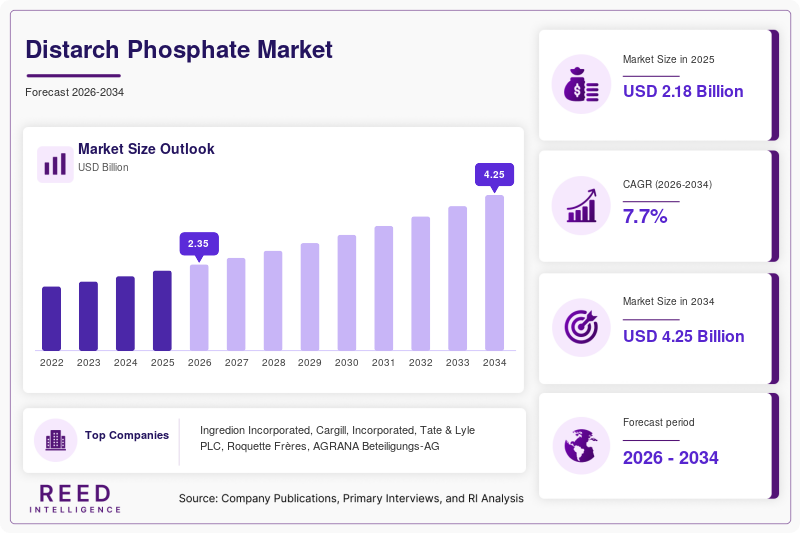
The Distarch Phosphate Market Size was valued at approximately USD 2.18 billion in 2026 and is projected to reach nearly USD 3.94 billion by 2034, expanding at a CAGR of 7.7% during the forecast period from 2026 to 2034. The global Distarch Phosphate Market is experiencing stable growth due to rising demand for modified starch ingredients across processed food, pharmaceutical, cosmetic, and industrial applications. Distarch phosphate is widely used as a stabilizer, thickener, emulsifier, and texture-enhancing ingredient in various formulations because of its high thermal stability, freeze-thaw resistance, and processing efficiency.
A major global factor supporting the growth of the Distarch Phosphate Market is the increasing consumption of convenience and processed food products worldwide. Rapid urbanization, changing dietary patterns, and growing consumer preference for packaged foods with improved shelf life and texture consistency are encouraging food manufacturers to adopt advanced modified starch ingredients. In addition, the growing utilization of starch derivatives in clean-label formulations, ready-to-eat meals, sauces, dairy products, bakery applications, and pharmaceutical excipients is supporting long-term market expansion across developed and emerging economies.
Key Highlights
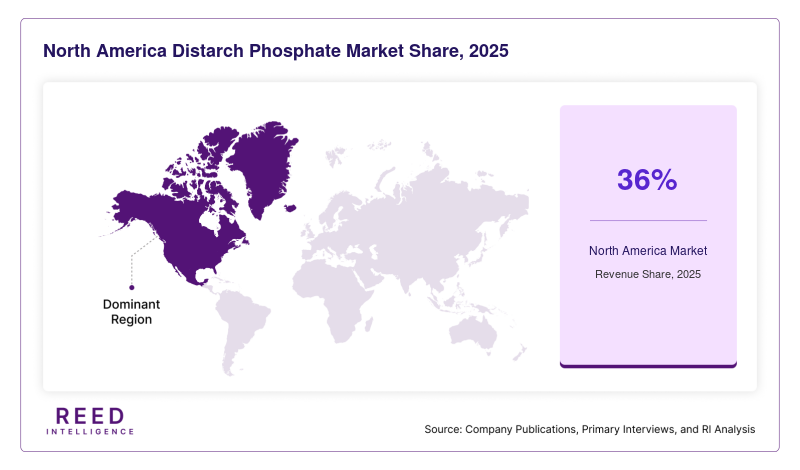
- North America dominated the market with 36% share in 2025, while Asia Pacific is projected to witness the fastest growth at a 8.9% CAGR during 2026–2034.
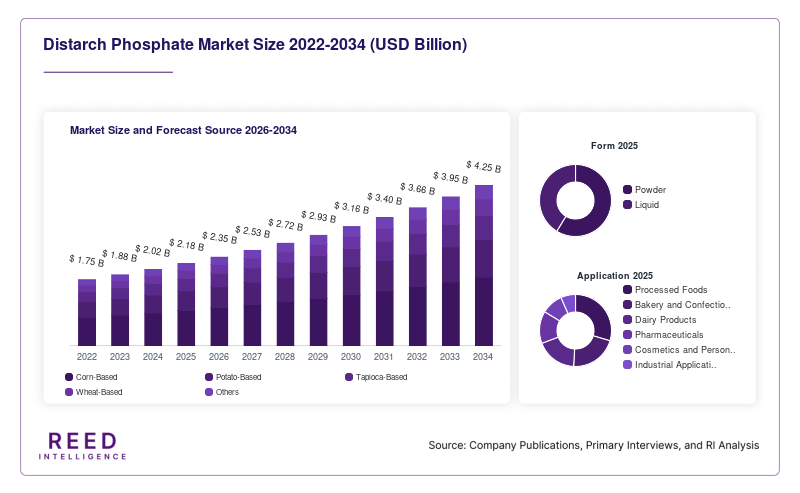
- By source, corn-based distarch phosphate accounted for the largest market share of 48% in 2025, while potato-based distarch phosphate is projected to expand at a CAGR of 8.5% during the forecast period.
- By application, processed food applications held the dominant market share of 44% in 2025, whereas pharmaceutical applications are anticipated to grow at a CAGR of 8.7% through 2034.
- By form, powder form represented the leading segment with 63% share in 2025, while liquid form is expected to witness a CAGR of 8.2% during the forecast timeline.
- The United States remained the dominant country market and was valued at approximately USD 512 million in 2024 and USD 553 million in 2025.
Market Trends
Increasing Demand for Clean-Label Modified Starch Ingredients
One of the major trends shaping the Distarch Phosphate Market is the increasing demand for clean-label and plant-based food ingredients. Consumers are becoming more conscious regarding ingredient transparency and product formulation, encouraging food manufacturers to adopt starch-based stabilizers that provide functional benefits while maintaining acceptable labeling standards.
Distarch phosphate is increasingly being utilized in soups, sauces, frozen meals, dairy products, and bakery formulations because of its ability to improve viscosity and texture stability without significantly altering taste profiles. Manufacturers are focusing on developing modified starch solutions sourced from non-GMO crops and sustainable agricultural inputs to align with evolving consumer preferences. This trend is expected to strengthen long-term market demand across food processing industries.
Growing Adoption in Pharmaceutical and Personal Care Formulations
Another significant trend in the Distarch Phosphate Market is the growing use of modified starch compounds in pharmaceutical and cosmetic applications. Pharmaceutical manufacturers are increasingly utilizing distarch phosphate as a binder, disintegrant, and stabilizing agent in tablet formulations and oral drug delivery systems. The ingredient supports formulation consistency and processing stability across multiple pharmaceutical manufacturing conditions.
In the personal care sector, distarch phosphate is being incorporated into skincare products, powders, lotions, and cosmetic emulsions because of its moisture absorption and texture-enhancing properties. The rising demand for multifunctional excipients and naturally derived cosmetic ingredients is expected to support broader market penetration over the forecast period.
Market Drivers
Expansion of the Global Processed Food Industry
The rapid expansion of the global processed food industry is a key driver accelerating the growth of the Distarch Phosphate Market. Food manufacturers are increasingly focusing on improving product texture, shelf stability, and consistency in packaged food products. Distarch phosphate provides improved resistance to heat, acidity, and mechanical processing, making it suitable for large-scale industrial food production.
The increasing demand for ready-to-eat meals, frozen foods, instant snacks, and convenience beverages is contributing significantly to market growth. Food processing companies are adopting modified starch ingredients to improve manufacturing efficiency and maintain product quality during storage and transportation.
Rising Utilization of Functional Food Ingredients
Another important driver supporting the Distarch Phosphate Market is the growing demand for multifunctional food ingredients across industrial applications. Manufacturers are increasingly seeking ingredients capable of delivering stabilization, emulsification, thickening, and water retention properties within a single formulation.
Distarch phosphate offers strong processing versatility across dairy products, confectionery, meat products, sauces, and infant nutrition formulations. The increasing adoption of advanced food processing technologies and functional ingredient systems is expected to support continuous market expansion throughout the forecast period.
Market Restraint
Regulatory Challenges Associated with Food Additives
One of the major restraints affecting the Distarch Phosphate Market is the strict regulatory environment governing food additives and modified starch ingredients. Regulatory authorities across multiple regions impose labeling requirements, ingredient usage limits, and safety evaluation procedures for modified food starch products. Variations in international food regulations may create operational challenges for manufacturers involved in global trade and product formulation standardization.
Market Opportunities
Rising Demand for Gluten-Free and Specialty Food Products
The growing consumer preference for gluten-free and specialty food products presents strong opportunities for the Distarch Phosphate Market. Modified starch ingredients are increasingly used in gluten-free bakery and processed food formulations to improve product texture, moisture retention, and structural stability.
Food manufacturers are investing in innovative starch formulations that can support dietary-specific product categories without compromising sensory performance. The expansion of health-focused food categories is expected to create favorable growth opportunities for ingredient suppliers and starch processing companies.
Increasing Penetration in Emerging Pharmaceutical Markets
Emerging pharmaceutical manufacturing markets across Asia Pacific and Latin America are creating new opportunities for the Distarch Phosphate Market. Pharmaceutical companies are expanding production capacity to meet growing demand for generic medicines and cost-efficient drug formulations.
Distarch phosphate is increasingly being adopted as a pharmaceutical excipient due to its compatibility with multiple drug delivery systems and manufacturing processes. Expanding healthcare infrastructure and increasing pharmaceutical exports from developing economies are expected to support future market growth.
Segmental Analysis
By Source
Based on source, the Distarch Phosphate Market is segmented into corn-based, potato-based, tapioca-based, wheat-based, and others. Corn-based distarch phosphate dominated the market with approximately 48% share in 2025 due to abundant corn production, cost efficiency, and broad application compatibility across processed food industries. Potato-based distarch phosphate is projected to witness the fastest growth at a CAGR of 8.5% during the forecast period because of increasing demand for premium texture-enhancing ingredients in clean-label and frozen food formulations.
By Form
By form, the market is segmented into powder and liquid. Powder form accounted for the largest market share of 63% in 2025 because of its ease of transportation, longer shelf life, and broad industrial usability across dry food processing applications. Liquid form is expected to grow at a CAGR of 8.2% through 2034 due to increasing adoption in beverage processing and ready-to-use industrial food manufacturing systems.
By Application
Based on application, the market includes processed foods, bakery and confectionery, dairy products, pharmaceuticals, cosmetics and personal care, and industrial applications. Processed foods held the dominant share of approximately 44% in 2025 due to increasing use of stabilizing and thickening agents in frozen meals, sauces, soups, and packaged snacks. Pharmaceutical applications are projected to witness a CAGR of 8.7% during the forecast period owing to rising utilization of modified starch excipients in tablet production and oral dosage formulations.
By Distribution Channel
The market is segmented into direct sales, distributors and wholesalers, online sales, and specialty ingredient suppliers. Direct sales accounted for the leading market share of approximately 46% in 2025 due to large-scale procurement agreements between starch manufacturers and industrial food processing companies. Online sales are expected to grow at a CAGR of 8.4% during the forecast period because ingredient suppliers are increasingly utilizing digital procurement platforms and B2B e-commerce distribution channels.
Regional Analysis
North America
North America accounted for approximately 36% share of the Distarch Phosphate Market in 2025 and is projected to grow at a CAGR of 7.1% during the forecast period. The region benefits from a well-established processed food manufacturing industry and strong demand for advanced food stabilization ingredients. The United States dominated the regional market due to increasing consumption of convenience foods and high adoption of modified starch ingredients across industrial food production facilities. Growing innovation in functional ingredient formulations is supporting regional market expansion.
Europe
Europe held around 28% market share in 2025 and is expected to expand at a CAGR of 7.0% through 2034. The region is witnessing growing demand for sustainable food ingredients and specialty starch formulations across bakery, dairy, and confectionery applications. Germany remained the dominant country market because of strong food processing capabilities and rising adoption of clean-label ingredient technologies. Increasing focus on ingredient traceability and food quality standards is supporting long-term regional growth.
Asia Pacific
Asia Pacific represented nearly 24% share in 2025 and is projected to witness the fastest growth at a CAGR of 8.9% during the forecast period. Rapid urbanization, increasing packaged food consumption, and expansion of pharmaceutical manufacturing activities are supporting strong market growth across the region. China remained the leading regional contributor due to rising processed food production and increasing starch manufacturing capacity. Growing middle-class consumption patterns are further accelerating regional adoption of modified starch ingredients.
Middle East & Africa
The Middle East & Africa accounted for approximately 7% share in 2025 and is expected to grow at a CAGR of 6.8% during the forecast period. Increasing demand for packaged food products and expansion of food import processing activities are supporting regional market growth. Saudi Arabia dominated the regional market because of increasing investment in food manufacturing infrastructure and growing consumption of processed food products. Expanding retail distribution networks are contributing to market development across the region.
Latin America
Latin America held nearly 5% market share in 2025 and is projected to expand at a CAGR of 6.6% through 2034. Brazil remained the dominant country market due to the expansion of domestic food processing industries and rising utilization of starch-based additives in bakery and beverage applications. Increasing industrialization of food production systems is contributing to the steady growth of the regional market.
Competitive Landscape
The Distarch Phosphate Market is moderately competitive with the presence of global starch manufacturers, ingredient suppliers, and food additive producers focusing on product innovation, sustainable sourcing, and functional ingredient development. Companies are emphasizing strategic expansions, production capacity enhancement, and customized formulation capabilities to strengthen market positioning.
Ingredion Incorporated remained one of the leading companies in the market due to its extensive modified starch product portfolio and strong global distribution network. The company recently expanded its specialty starch production capabilities to support increasing demand for functional food ingredients across processed food and pharmaceutical industries.
Cargill, Incorporated continues to strengthen its market presence through advanced starch processing technologies and clean-label ingredient innovations. Tate & Lyle PLC is focusing on specialty starch development for bakery and dairy applications, while Roquette Frères and AGRANA Beteiligungs-AG are expanding production capabilities to support growing demand from industrial food manufacturers and pharmaceutical companies.
Key Players List
- Ingredion Incorporated
- Cargill, Incorporated
- Tate & Lyle PLC
- Roquette Frères
- AGRANA Beteiligungs-AG
- Archer Daniels Midland Company
- Grain Processing Corporation
- Avebe U.A.
- Emsland Group
- BENEO GmbH
- Global Bio-Chem Technology Group Company Limited
- SPAC Starch Products India Ltd.
- Universal Starch-Chem Allied Ltd.
- KMC Kartoffelmelcentralen A.m.b.a.
- Foodchem International Corporation
Distarch Phosphate Market Segments
Source
- Corn-Based
- Potato-Based
- Tapioca-Based
- Wheat-Based
- Others
Form
- Powder
- Liquid
Application
- Processed Foods
- Bakery and Confectionery
- Dairy Products
- Pharmaceuticals
- Cosmetics and Personal Care
- Industrial Applications
Distribution Channel
- Direct Sales
- Distributors and Wholesalers
- Online Sales
- Specialty Ingredient Suppliers
By Region
- North America
- Europe
- APAC
- Middle East and Africa
- LATAM