Distillers Corn Oil Market Size, Share & Demand Report By Source (Dry Mill Ethanol Plants, Wet Mill Processing), By Application (Biodiesel Production, Animal Feed, Industrial Applications, Oleochemicals), By End Use (Fuel Manufacturers, Feed Manufacturers, Industrial Processors, Chemical Manufacturers), By Region & Segment Forecasts, 2026–2034
USD 3950
Market Overview
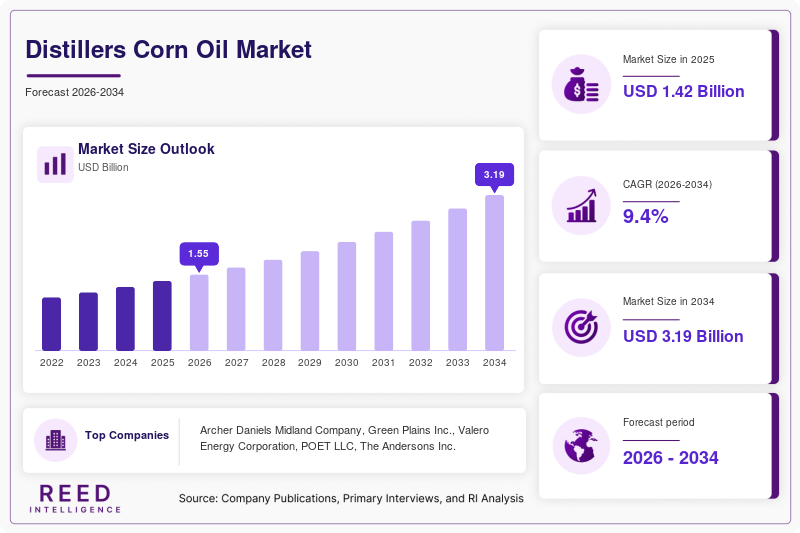
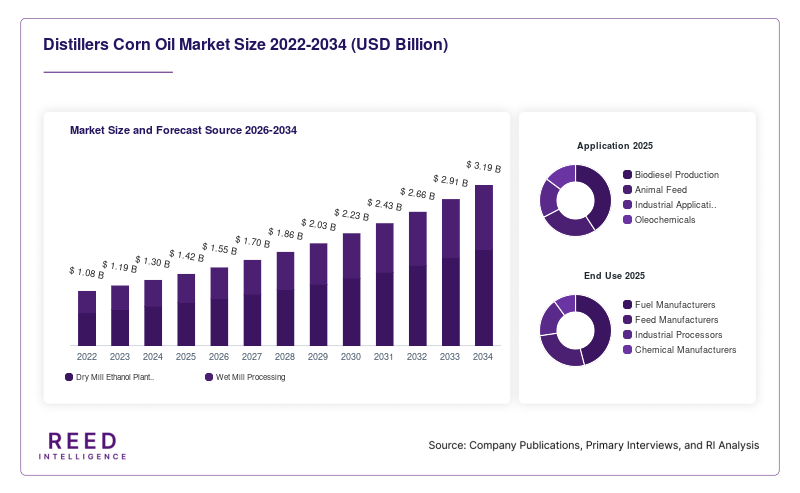
The global Distillers Corn Oil Market size was valued at USD 1.42 billion in 2026 and is projected to reach USD 2.91 billion by 2034, expanding at a CAGR of 9.4% during the forecast period from 2026 to 2034. The market continues to gain traction due to the increasing use of distillers corn oil in biodiesel production, livestock feed applications, and industrial processing. Distillers corn oil is extracted as a co-product during ethanol manufacturing, making it an economically viable and resource-efficient ingredient across several downstream industries. Rising investments in renewable fuel production and the growing emphasis on sustainable agricultural by-products have further strengthened market demand across developed and emerging economies.
The expansion of the global biofuel industry has remained a major factor supporting the growth of the Distillers Corn Oil Market. Governments in North America, Europe, and Asia Pacific have introduced fuel blending mandates and renewable energy targets that encourage the use of biodiesel feedstocks. Distillers corn oil has become a preferred feedstock because of its lower production cost compared to vegetable oils and animal fats. In addition, ethanol plants are adopting advanced extraction technologies to improve oil yield and production efficiency. Growing demand from animal nutrition manufacturers is also contributing to market expansion, as distillers corn oil is widely used to enhance the energy content of feed formulations.
Key Highlights
- North America dominated the market with a 36.8% share in 2025, while Asia Pacific is expected to grow at the fastest CAGR of 11.6% during 2026–2034.
- By source, dry mill ethanol plants accounted for the largest share of 62.4%, while wet mill processing is projected to grow at a CAGR of 10.9%.
- By application, biodiesel production led with a 44.3% share, whereas animal feed applications are expected to expand at a CAGR of 10.8%.
- By end use, fuel manufacturers held the dominant share of 39.1%, while feed manufacturers are anticipated to witness a CAGR of 11.2% through 2034.
- The United States remained the dominant country, with market values of USD 510 million in 2024 and USD 563 million in 2025.
Market Trends
Expansion of Biodiesel Production Facilities
The growing establishment of biodiesel production facilities across major agricultural economies is influencing the growth trajectory of the Distillers Corn Oil Market. Fuel manufacturers are increasingly utilizing distillers corn oil as a cost-efficient feedstock to reduce dependence on soybean oil and other vegetable oils. Several ethanol producers are integrating oil extraction systems directly into their production lines to maximize profitability and support renewable energy objectives. This trend is particularly visible in North America and parts of Europe, where government incentives for renewable diesel production are encouraging refiners to diversify feedstock sourcing strategies. Rising fuel blending targets and investments in low-carbon transportation fuels are expected to sustain demand for distillers corn oil over the coming years.
Technological Improvements in Corn Oil Extraction
The market is witnessing significant technological developments aimed at improving extraction efficiency and product quality. Ethanol processing companies are adopting centrifugation systems, membrane separation technologies, and enzyme-assisted extraction methods to increase oil recovery rates from corn mash. These advancements are helping manufacturers reduce operational waste while improving profit margins. Improved extraction technologies also enable producers to supply higher-purity distillers corn oil suitable for industrial applications and feed processing. In addition, automation in ethanol facilities is improving production consistency and reducing energy consumption. The increasing availability of advanced extraction systems is expected to support the long-term competitiveness of distillers corn oil against alternative feedstocks in global industrial markets.
Market Drivers
Rising Demand for Renewable and Low-Carbon Fuels
The increasing focus on renewable and low-carbon energy sources is one of the primary drivers supporting the Distillers Corn Oil Market. Governments across several countries are implementing regulations aimed at reducing greenhouse gas emissions from transportation fuels. Distillers corn oil is widely used as a biodiesel feedstock because it offers lower costs and favorable carbon intensity compared to conventional vegetable oils. Renewable fuel standards in the United States and Europe continue to support demand for biodiesel blending components, creating steady consumption for distillers corn oil suppliers. The availability of corn-based ethanol infrastructure also ensures a stable supply chain, enabling biodiesel manufacturers to secure consistent feedstock volumes for long-term production requirements.
Increasing Utilization in Animal Nutrition Applications
The growing livestock industry and rising focus on feed efficiency are contributing to the increased use of distillers corn oil in animal nutrition formulations. Feed manufacturers utilize distillers corn oil to improve the energy density of poultry, swine, and cattle feed products. The ingredient supports weight gain and feed conversion efficiency while offering cost advantages over some traditional feed oils. Expanding meat consumption in emerging economies is driving investments in commercial livestock production, which in turn supports demand for high-energy feed additives. Ethanol producers are also benefiting from the ability to monetize co-products more effectively through feed sector partnerships. Rising awareness regarding nutrient optimization in animal diets is expected to maintain strong growth prospects for the market.
Market Restraint
Volatility in Corn Prices and Ethanol Production Output
Fluctuations in corn prices and variability in ethanol production output remain major restraints affecting the Distillers Corn Oil Market. Distillers corn oil production is directly linked to ethanol manufacturing activities, making supply levels sensitive to changes in fuel demand, agricultural yields, and commodity pricing trends. Sharp increases in corn prices can reduce ethanol production margins, limiting investments in oil extraction capacity and affecting product availability. Weather-related disruptions, drought conditions, and supply chain interruptions can further influence corn supply stability across key producing regions. In addition, changes in government biofuel policies may alter ethanol production economics, creating uncertainty for downstream distillers corn oil buyers. For example, periods of lower fuel consumption can reduce ethanol output, leading to temporary shortages of distillers corn oil and pricing instability across biodiesel and feed industries.
Market Opportunities
Growing Adoption in Industrial and Oleochemical Applications
The increasing use of distillers corn oil in industrial processing and oleochemical production is creating new opportunities for market participants. Manufacturers are exploring applications in lubricants, soaps, surfactants, and chemical intermediates due to the oil’s favorable fatty acid composition and cost competitiveness. Industrial users are seeking renewable raw materials that align with sustainability objectives and reduce dependence on petroleum-derived inputs. Distillers corn oil offers advantages in terms of availability and processing flexibility, particularly in regions with established ethanol production infrastructure. The shift toward bio-based industrial products is expected to encourage additional investments in refining and purification technologies, enabling suppliers to expand their presence in higher-value application segments over the forecast period.
Expansion of Ethanol Production Capacity in Emerging Economies
Emerging economies are increasingly investing in ethanol production capacity to improve energy security and reduce fossil fuel imports. Countries in Asia Pacific and Latin America are implementing ethanol blending mandates and supporting agricultural processing infrastructure development. As ethanol production expands, the availability of distillers corn oil as a co-product is also expected to rise significantly. This trend presents opportunities for local biodiesel manufacturers, feed processors, and industrial users to access competitively priced feedstocks. Governments are also encouraging the utilization of agricultural by-products to improve resource efficiency and support rural economic development. Expanding corn cultivation and rising investments in integrated biorefineries are likely to strengthen long-term growth opportunities for the Distillers Corn Oil Market.
Segmental Analysis
By Source
Dry mill ethanol plants accounted for the largest share of the Distillers Corn Oil Market in 2024, representing approximately 62.4% of total revenue. The dominance of this subsegment is primarily attributed to the widespread adoption of dry milling processes in ethanol production facilities, particularly in North America. Dry mill operations generate substantial quantities of distillers corn oil as a co-product, making them an important supply source for biodiesel and feed manufacturers. Ethanol producers prefer dry milling because it offers lower capital investment requirements and efficient processing capabilities. In addition, technological improvements in oil extraction systems have enabled dry mill facilities to enhance recovery rates and improve profitability. The strong presence of corn ethanol infrastructure across major agricultural economies continues to support the dominance of this subsegment.
Wet mill processing is projected to register the fastest CAGR of 10.9% during the forecast period due to increasing investments in integrated corn processing facilities. Wet milling enables producers to manufacture multiple value-added products, including starch, sweeteners, ethanol, and corn oil, thereby improving overall operational efficiency. Companies are adopting advanced separation and refining technologies to increase oil extraction yields and support industrial-grade applications. Growing demand for specialized corn derivatives from food, feed, and chemical industries is encouraging investments in wet milling capacity expansion. In addition, rising emphasis on resource optimization and sustainable manufacturing practices is expected to strengthen the adoption of wet mill processing technologies across emerging and developed markets.
By Application
Biodiesel production represented the leading application segment in the Distillers Corn Oil Market in 2024, accounting for nearly 44.3% of global revenue. The increasing demand for renewable transportation fuels and supportive government regulations have significantly contributed to the dominance of this subsegment. Distillers corn oil is widely utilized by biodiesel producers due to its lower cost compared to refined vegetable oils and favorable carbon reduction potential. Renewable fuel blending mandates across the United States and Europe have encouraged fuel refiners to diversify feedstock sourcing strategies, supporting stable demand growth. Ethanol plants are also enhancing oil recovery capabilities to meet rising biodiesel industry requirements. The growing expansion of renewable diesel production facilities is expected to further strengthen the utilization of distillers corn oil in fuel applications.
Animal feed applications are anticipated to witness the fastest CAGR of 10.8% during the forecast period owing to increasing global livestock production and rising demand for cost-effective feed ingredients. Distillers corn oil is commonly added to poultry, swine, and cattle feed formulations to improve energy density and support animal growth performance. Feed manufacturers are increasingly utilizing the ingredient to optimize feed conversion efficiency while managing raw material costs. Rapid urbanization, rising disposable income levels, and growing meat consumption in emerging economies are contributing to higher demand for commercial feed products. In addition, advancements in feed formulation technologies and expanding industrial livestock farming operations are expected to create substantial growth opportunities for this subsegment through 2034.
By End Use
Fuel manufacturers held the dominant share in the Distillers Corn Oil Market in 2024, contributing approximately 39.1% of overall revenue. The segment’s leadership is supported by rising investments in biodiesel and renewable diesel production infrastructure across developed economies. Fuel manufacturers are increasingly incorporating distillers corn oil into feedstock portfolios to reduce production costs and improve compliance with low-carbon fuel regulations. The growing transition toward cleaner transportation fuels and the expansion of renewable energy policies are further supporting segment growth. Ethanol producers are also entering long-term supply agreements with biodiesel refiners to ensure stable feedstock availability. Increasing global focus on carbon emission reduction targets is expected to maintain strong demand from fuel manufacturing companies over the forecast period.
Feed manufacturers are projected to register the fastest CAGR of 11.2% between 2026 and 2034 due to rising global demand for protein-rich food products and efficient livestock nutrition solutions. Commercial feed producers are adopting distillers corn oil as a high-energy additive to improve the nutritional profile of animal feed formulations. The segment is benefiting from the rapid expansion of poultry and swine industries in Asia Pacific and Latin America, where meat consumption continues to increase steadily. Feed companies are also focusing on cost optimization strategies, encouraging greater utilization of economical agricultural co-products. In addition, rising awareness regarding animal health and productivity is driving investments in advanced feed formulation technologies, supporting the long-term growth of this segment.
Regional Analysis
North America
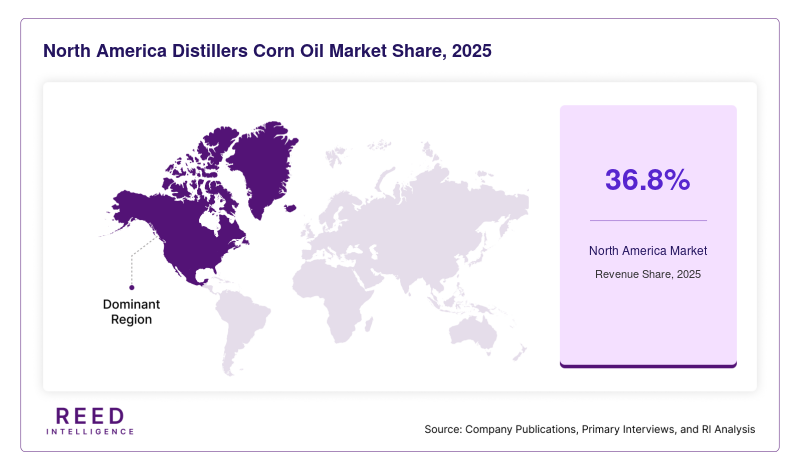
North America accounted for the largest share of the Distillers Corn Oil Market in 2025, representing 36.8% of global revenue. The region is projected to expand at a CAGR of 8.7% during the forecast period due to strong ethanol production infrastructure and rising biodiesel demand. The United States and Canada continue to support renewable fuel adoption through regulatory frameworks and blending mandates. Increasing investments in renewable diesel facilities and advanced biofuel technologies are contributing to consistent demand for distillers corn oil. The region also benefits from large-scale corn cultivation, established agricultural supply chains, and extensive processing capabilities.
The United States remained the dominant country within North America due to its large ethanol manufacturing industry and significant corn production capacity. Ethanol producers across Midwestern states are investing in enhanced oil recovery systems to maximize co-product revenues and improve operational efficiency. The presence of integrated agricultural processing networks supports stable feedstock availability for biodiesel and feed manufacturers. In addition, the increasing production of renewable diesel across the country is creating new demand avenues for distillers corn oil suppliers. Growing collaboration between ethanol producers and fuel refiners is expected to strengthen regional market expansion through 2034.
Europe
Europe represented a significant share of the global Distillers Corn Oil Market in 2025 and is anticipated to register a CAGR of 8.9% during the forecast period. The region is witnessing increasing demand for sustainable biofuel feedstocks as governments strengthen environmental regulations and decarbonization initiatives. European biodiesel manufacturers are increasingly incorporating alternative oils to diversify raw material sourcing and manage feedstock costs. The expansion of renewable fuel standards and the transition toward low-emission transportation systems are supporting regional demand growth. In addition, industrial users are adopting bio-based oils in lubricants and specialty chemical manufacturing processes.
Germany emerged as the dominant country in the European market due to its advanced biofuel sector and strong focus on renewable energy adoption. The country continues to invest in fuel blending infrastructure and sustainable industrial production methods. German feed manufacturers are also increasing the use of distillers corn oil in livestock formulations to improve energy efficiency and cost management. The growing emphasis on circular economy principles is encouraging industrial companies to utilize agricultural co-products more effectively. Increasing collaboration between agricultural cooperatives, biodiesel producers, and ethanol processors is expected to support long-term market development across the country.
Asia Pacific
Asia Pacific is projected to witness the fastest growth in the Distillers Corn Oil Market, expanding at a CAGR of 11.6% between 2026 and 2034. The region is benefiting from rising investments in ethanol production, growing livestock populations, and increasing adoption of renewable fuels. Countries including China, India, and Thailand are implementing policies aimed at reducing fuel import dependence and supporting domestic biofuel production. The rapid expansion of the feed industry is also contributing to market demand, as feed manufacturers seek affordable high-energy ingredients. Improving agricultural infrastructure and rising corn cultivation are expected to strengthen regional supply capabilities.
China remained the dominant country in the Asia Pacific market due to its large agricultural processing sector and expanding renewable energy initiatives. The country is investing heavily in ethanol production facilities and industrial biofuel development programs. Growing demand for poultry and swine feed products is encouraging feed manufacturers to increase the use of distillers corn oil in nutritional formulations. In addition, industrial manufacturers are exploring bio-based feedstocks to align with sustainability targets and environmental regulations. Expanding domestic production capacity and rising investments in integrated biorefineries are expected to accelerate market growth in China during the forecast period.
Middle East & Africa
The Middle East & Africa region accounted for a smaller share of the Distillers Corn Oil Market in 2025 but is expected to register a CAGR of 7.8% through 2034. The market is gradually gaining momentum due to increasing awareness regarding renewable energy sources and industrial sustainability initiatives. Several countries are investing in agricultural processing infrastructure and biofuel feasibility programs to diversify energy sources and improve food security. Growing demand for animal feed products in commercial livestock operations is also supporting regional market expansion. Rising urbanization and industrialization are contributing to higher consumption of processed agricultural products.
South Africa emerged as the dominant country in the region due to its relatively developed agricultural and food processing industries. The country is witnessing growing demand for high-energy livestock feed ingredients, particularly in poultry and cattle production. Feed manufacturers are increasingly adopting distillers corn oil to improve production efficiency and manage feed costs. In addition, government efforts to strengthen domestic agricultural processing capabilities are supporting the development of ethanol-related by-product industries. Increasing private sector investments in feed manufacturing and bio-based industrial applications are expected to create favorable market conditions in the coming years.
Latin America
Latin America held a notable share of the Distillers Corn Oil Market in 2025 and is projected to grow at a CAGR of 9.2% during the forecast period. The region benefits from strong agricultural production and expanding ethanol manufacturing activities, particularly in countries with established biofuel industries. Biodiesel producers are increasingly utilizing alternative feedstocks to reduce costs and improve supply flexibility. Growing livestock production and rising exports of meat products are supporting demand for high-energy feed ingredients. In addition, favorable climatic conditions for corn cultivation contribute to stable feedstock availability across several Latin American economies.
Brazil dominated the Latin American market due to its advanced biofuel infrastructure and large-scale agricultural sector. The country continues to invest in ethanol production expansion and renewable energy integration to strengthen energy security and reduce carbon emissions. Brazilian feed manufacturers are also increasing the use of distillers corn oil in commercial livestock formulations to improve nutritional value and operational efficiency. The growing adoption of sustainable agricultural practices and expanding export-oriented meat production are supporting long-term market growth. Increasing partnerships between ethanol producers and biodiesel refiners are expected to enhance supply chain efficiency across the country.
Competitive Landscape
The Distillers Corn Oil Market is moderately consolidated, with leading participants focusing on production efficiency, supply chain integration, and strategic partnerships to strengthen market presence. Major companies are investing in advanced extraction technologies to improve oil recovery rates and expand their biodiesel and feed application portfolios. The market is characterized by collaborations between ethanol producers, biodiesel refiners, and agricultural processing companies to secure stable raw material supply and improve operational margins.
Archer Daniels Midland Company remains one of the leading players in the market due to its extensive agricultural processing network and diversified biofuel operations. The company continues to invest in sustainable processing technologies and integrated refining systems to improve production efficiency. Green Plains Inc., Valero Energy Corporation, POET LLC, and The Andersons Inc. are also actively expanding extraction capacities and strengthening distribution networks. Several market participants are focusing on technological innovation to improve product quality and enhance profitability.
Key Players
- Archer Daniels Midland Company
- Green Plains Inc.
- Valero Energy Corporation
- POET LLC
- The Andersons Inc.
- Flint Hills Resources
- White Energy Company Limited
- Alto Ingredients Inc.
- Big River Resources
- Marquis Energy
- Corn Plus
- United Wisconsin Grain Producers LLC
- Tharaldson Ethanol
- Lincolnway Energy LLC
- Guardian Energy Management LLC
Recent Developments
- Archer Daniels Midland Company expanded its corn processing and oil recovery capabilities at selected ethanol facilities in North America to improve biodiesel feedstock supply efficiency in 2025.
- Green Plains Inc. announced the deployment of advanced separation technology across multiple processing sites to enhance distillers corn oil extraction yield and reduce operational energy consumption in 2025.
- POET LLC entered into a long-term renewable feedstock supply agreement with a biodiesel producer in 2024 to support the growing demand for low-carbon fuel inputs.
- Valero Energy Corporation increased investments in renewable diesel infrastructure and strengthened sourcing agreements for agricultural co-products, including distillers corn oil, during 2025.
- The Andersons Inc. expanded feed ingredient distribution operations in Asia Pacific and Latin America to strengthen market access for distillers corn oil-based livestock nutrition products in 2024.
Distillers Corn Oil Market Segments
Source
- Dry Mill Ethanol Plants
- Wet Mill Processing
Application
- Biodiesel Production
- Animal Feed
- Industrial Applications
- Oleochemicals
End Use
- Fuel Manufacturers
- Feed Manufacturers
- Industrial Processors
- Chemical Manufacturers
By Region
- North America
- Europe
- APAC
- Middle East and Africa
- LATAM