Distributed Database Market Size, Share & Demand Report By Database Type (NoSQL Databases, NewSQL Databases, Relational Distributed Databases), By Deployment Model (Cloud-Based, On-Premises, Hybrid), By End-Use Industry (BFSI, Retail & E-commerce, Healthcare, IT & Telecommunications, Manufacturing, Government, Media & Entertainment, Others), By Region & Segment Forecasts, 2026–2034
USD 3950
Market Overview
The global Distributed Database Market size was valued at approximately USD 18.7 billion in 2026 and is projected to reach USD 43.9 billion by 2034, expanding at a CAGR of 11.3% during 2026–2034. Distributed databases have become a critical component of modern digital infrastructure as enterprises increasingly require scalable, resilient, and geographically dispersed data management solutions. Organizations across industries are adopting distributed database architectures to support real-time analytics, cloud-native applications, high-volume transaction processing, and multi-region business operations.
A major factor supporting market growth is the continued expansion of cloud computing and digital transformation initiatives worldwide. Businesses are generating unprecedented volumes of structured and unstructured data, creating demand for database systems capable of ensuring high availability, fault tolerance, and seamless scalability. Distributed databases address these requirements by enabling data replication across multiple nodes while maintaining operational continuity even during hardware failures or network disruptions. The increasing adoption of artificial intelligence, Internet of Things ecosystems, edge computing, and data-intensive applications is further strengthening market demand.
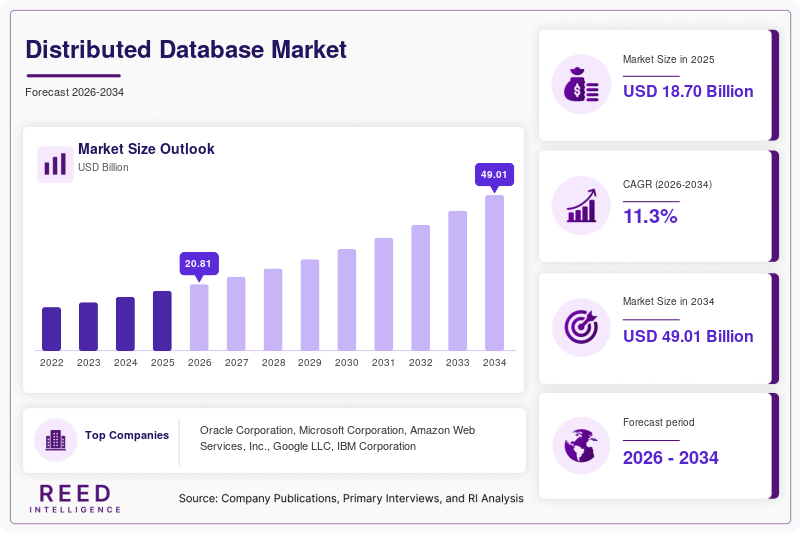
Key Highlights
- North America dominated the market with a 36.4% share in 2025, while Asia Pacific is expected to grow at the fastest CAGR of 13.1% during 2026–2034.
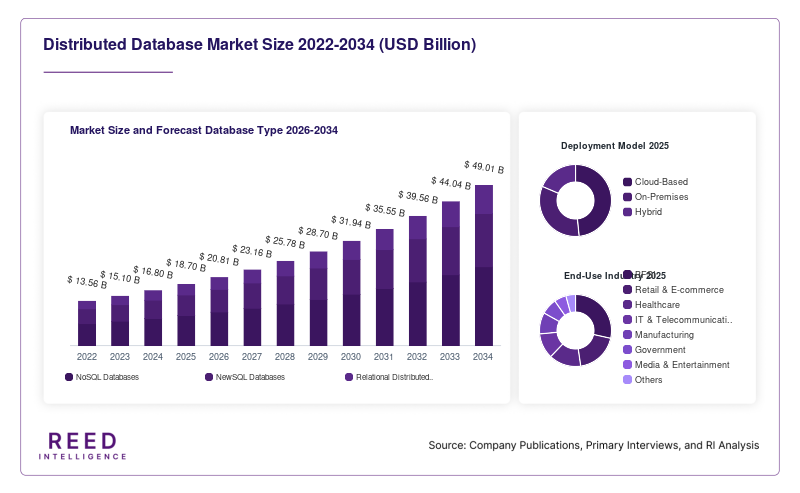
- By database type, NoSQL distributed databases accounted for the largest share of 42.8%, while NewSQL databases are projected to grow at a CAGR of 14.2%.
- By deployment model, cloud-based deployment led with a 61.3% share, whereas hybrid deployment is expected to expand at a CAGR of 13.8%.
- By end-use industry, BFSI held the largest share of 27.6%, while healthcare is projected to grow at a CAGR of 13.6%.
- The United States remained the dominant country, with market values of USD 4.9 billion in 2024 and USD 5.6 billion in 2025.
Market Trends
Growing Integration of Distributed Databases with Cloud-Native Architectures
One of the most significant trends influencing the Distributed Database Market is the increasing adoption of cloud-native architectures. Organizations are developing applications using containers, microservices, and Kubernetes-based environments that require highly scalable and resilient database platforms. Distributed databases provide automatic data distribution, workload balancing, and elastic scaling capabilities that align closely with cloud-native requirements. As businesses modernize legacy systems, demand for database platforms capable of supporting geographically distributed workloads continues to rise. Enterprises are increasingly prioritizing solutions that simplify infrastructure management while maintaining high availability and performance across multiple regions. This trend is accelerating adoption among technology firms, financial institutions, retail companies, and digital service providers seeking operational flexibility and enhanced application responsiveness.
Rising Demand for Real-Time Data Processing and Analytics
Another notable trend is the growing need for real-time analytics and instant access to business-critical information. Modern enterprises operate in highly dynamic environments where rapid decision-making depends on continuous data availability. Distributed databases enable organizations to process large data volumes across multiple nodes while reducing latency and improving response times. Industries such as e-commerce, telecommunications, banking, and healthcare increasingly rely on real-time insights to optimize customer experiences and operational efficiency. The integration of artificial intelligence, machine learning, and predictive analytics platforms is creating additional demand for distributed database systems capable of supporting high-speed transactions and complex analytical workloads. As data-driven business strategies become more widespread, investment in distributed database technologies is expected to strengthen significantly.
Market Drivers
Expansion of Digital Transformation Initiatives Across Industries
Digital transformation remains a major driver of the Distributed Database Market. Organizations across virtually every industry are investing heavily in technologies that improve operational efficiency, customer engagement, and business intelligence. These initiatives generate substantial amounts of data that must be stored, processed, and accessed across multiple locations. Distributed databases offer scalability, resilience, and performance advantages that support evolving business requirements. Enterprises transitioning to digital business models require database systems capable of handling increasing transaction volumes without compromising reliability. The need for uninterrupted operations, especially among financial institutions, retailers, and telecommunications providers, continues to accelerate adoption. As organizations modernize IT infrastructure and prioritize digital innovation, distributed database deployments are becoming increasingly common across global markets.
Growing Adoption of Multi-Cloud and Hybrid Cloud Strategies
The rising implementation of multi-cloud and hybrid cloud environments is another key growth driver. Enterprises are increasingly avoiding dependence on a single cloud provider and instead distributing workloads across multiple platforms. This strategy improves flexibility, risk management, and business continuity while creating demand for database solutions capable of operating seamlessly across diverse infrastructures. Distributed databases support synchronized data access, replication, and consistency across different environments, making them well suited for modern enterprise architectures. Organizations seeking improved disaster recovery capabilities and global data availability are investing in distributed systems to support strategic cloud initiatives. The continued expansion of cloud ecosystems and enterprise migration projects is expected to create substantial growth opportunities for market participants throughout the forecast period.
Market Restraint
Complexity Associated with Deployment, Management, and Data Consistency
Despite strong growth prospects, the Distributed Database Market faces challenges related to deployment complexity and operational management. Distributed database systems often require sophisticated configuration, monitoring, and maintenance processes compared to traditional centralized databases. Organizations must manage data synchronization, replication policies, network latency issues, and consistency requirements across multiple nodes and geographic locations. These technical challenges can increase implementation costs and extend deployment timelines, particularly for enterprises with limited expertise in distributed computing environments.
The complexity becomes more significant when organizations operate across multiple cloud providers and regional infrastructures. Maintaining strong data consistency while ensuring high performance can be difficult, especially in applications involving mission-critical transactions. Regulatory requirements regarding data sovereignty and privacy can also complicate deployment strategies. For example, multinational organizations may need to maintain specific datasets within designated geographic regions while simultaneously ensuring global accessibility. Such requirements often increase operational overhead and infrastructure expenses. Small and medium-sized enterprises may encounter budget constraints and skills shortages that limit adoption. Although vendors continue to develop automation and management tools, deployment complexity remains an important restraint affecting broader market penetration.
Market Opportunities
Increasing Adoption of Edge Computing Infrastructure
The rapid expansion of edge computing presents substantial opportunities for the Distributed Database Market. Businesses are increasingly processing data closer to its source to reduce latency, improve application performance, and support real-time decision-making. Distributed databases are naturally aligned with edge computing environments because they enable data storage and processing across geographically dispersed locations. Industries such as manufacturing, logistics, telecommunications, and autonomous transportation are deploying edge infrastructure to manage growing data volumes generated by connected devices. As organizations seek efficient ways to coordinate information between edge locations and central systems, demand for distributed database platforms is expected to increase significantly. Vendors offering optimized edge-ready database solutions are likely to benefit from this expanding market opportunity throughout the forecast period.
Rising Demand from Healthcare and Life Sciences Sectors
Healthcare and life sciences organizations are generating rapidly increasing amounts of patient, clinical, genomic, and operational data. This creates significant opportunities for distributed database providers. Modern healthcare systems require secure, scalable, and highly available data management platforms capable of supporting electronic health records, telemedicine applications, research databases, and real-time monitoring systems. Distributed databases enable healthcare providers to improve data accessibility while maintaining operational resilience. The growing adoption of digital health technologies and advanced analytics platforms further strengthens market potential. Research institutions and pharmaceutical companies are also leveraging distributed architectures to manage large datasets used in drug discovery and clinical trials. As healthcare digitization accelerates globally, demand for sophisticated distributed database solutions is expected to expand considerably.
Segmental Analysis
By Database Type
NoSQL distributed databases accounted for the largest market share of approximately 42.8% in 2024. Their dominance is primarily attributed to flexibility in handling diverse data formats and large-scale workloads. Organizations managing structured, semi-structured, and unstructured data increasingly prefer NoSQL solutions due to their scalability and performance advantages. Industries including e-commerce, social media, telecommunications, and digital entertainment generate massive volumes of information that require distributed architectures capable of processing data efficiently. The ability to support rapid application development and dynamic data models has further strengthened adoption. Growing use of big data analytics and cloud-native applications continues to reinforce the leadership position of NoSQL distributed databases across global markets.
NewSQL databases represent the fastest-growing subsegment and are expected to register a CAGR of 14.2% during 2026–2034. These solutions combine traditional relational database capabilities with the scalability advantages of distributed architectures. Enterprises requiring strong transactional consistency alongside horizontal scalability increasingly view NewSQL platforms as an attractive alternative. Financial institutions, online service providers, and large enterprises benefit from the ability to process high transaction volumes while maintaining reliability. Growing demand for real-time applications, advanced analytics, and mission-critical workloads is accelerating adoption. Vendors continue introducing innovations that improve performance, fault tolerance, and cloud compatibility, supporting rapid growth within this segment.
By Deployment Model
Cloud-based deployment held the largest market share of approximately 61.3% in 2024. Organizations increasingly prefer cloud environments because they provide scalability, flexibility, and reduced infrastructure management requirements. Cloud-deployed distributed databases allow enterprises to expand storage and processing capabilities rapidly without substantial capital investments. Businesses adopting digital transformation strategies benefit from the ability to access data across geographically dispersed operations while maintaining high availability. The expansion of software-as-a-service platforms, cloud-native applications, and remote work environments has strengthened demand for cloud deployment models. Continuous investments by cloud service providers in infrastructure modernization further support market growth and reinforce the dominance of this segment.
Hybrid deployment is anticipated to be the fastest-growing subsegment with a projected CAGR of 13.8% through 2034. Many enterprises seek to balance the benefits of cloud scalability with the control and compliance advantages offered by on-premises infrastructure. Hybrid deployments enable organizations to optimize workload distribution while addressing regulatory requirements and security concerns. Industries such as healthcare, government, and financial services increasingly adopt hybrid architectures to manage sensitive information efficiently. The growing need for disaster recovery, business continuity, and flexible IT operations continues to support adoption. As enterprises pursue multi-cloud strategies and complex data management requirements, demand for hybrid distributed database solutions is expected to increase substantially.
By End-Use Industry
The BFSI segment accounted for the largest share of approximately 27.6% in 2024. Financial institutions generate extensive volumes of transactional and customer data that require highly reliable and scalable management systems. Distributed databases support real-time transaction processing, fraud detection, risk analysis, and customer engagement initiatives. Banks, insurance providers, and payment service companies increasingly invest in distributed architectures to improve operational efficiency and maintain continuous service availability. The rapid growth of digital banking platforms and mobile payment ecosystems further strengthens demand. Regulatory compliance requirements and the need for secure data management also contribute to widespread adoption within the BFSI sector.
The healthcare segment is projected to grow at the fastest CAGR of 13.6% during the forecast period. Healthcare organizations increasingly rely on digital systems to manage patient records, telemedicine platforms, diagnostic information, and research data. Distributed databases provide the scalability and reliability necessary to support these data-intensive environments. Growing adoption of connected medical devices and advanced analytics platforms further increases demand. Healthcare providers seek solutions that enable seamless access to critical information across multiple locations while maintaining security and compliance standards. Continued investment in healthcare digitization, precision medicine, and data-driven clinical decision-making is expected to drive significant growth within this segment.
Regional Analysis
North America
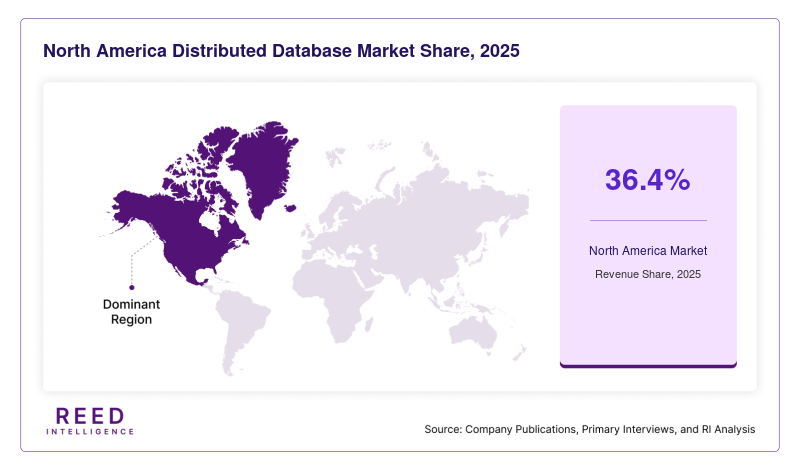
North America accounted for approximately 36.4% of the Distributed Database Market in 2025 and is expected to maintain a strong position throughout the forecast period. The region is projected to expand at a CAGR of 10.4% between 2026 and 2034. High levels of cloud adoption, advanced IT infrastructure, and significant enterprise technology spending continue to support market growth. Organizations across banking, retail, healthcare, and telecommunications sectors are investing heavily in distributed data management platforms to improve scalability, resilience, and real-time analytics capabilities.
The United States remains the dominant country within the region. A key growth factor is the widespread adoption of cloud-native application development practices. Enterprises increasingly deploy microservices-based applications requiring highly scalable distributed databases capable of supporting dynamic workloads. Continued investment in artificial intelligence infrastructure and digital business transformation programs further supports demand across the country.
Europe
Europe represented approximately 27.8% of the global market in 2025 and is anticipated to register a CAGR of 10.8% during the forecast period. Organizations across the region are modernizing legacy data infrastructure to support growing digital service requirements. Financial institutions, manufacturing companies, and public-sector organizations are increasingly adopting distributed database solutions to improve operational efficiency and ensure business continuity. Strong emphasis on data governance and enterprise modernization initiatives continues to contribute to market expansion.
Germany leads the European market due to its strong industrial base and advanced technology ecosystem. A unique growth factor is the rapid adoption of Industry 4.0 initiatives across manufacturing operations. Industrial enterprises increasingly require distributed data platforms capable of supporting real-time production monitoring, predictive maintenance, and interconnected factory environments, driving sustained demand for distributed database technologies.
Asia Pacific
Asia Pacific held approximately 24.1% market share in 2025 and is projected to achieve the fastest CAGR of 13.1% from 2026 to 2034. The region benefits from rapid digitalization, expanding cloud infrastructure, and growing internet penetration. Enterprises are increasingly investing in scalable database platforms to support e-commerce growth, digital payments, telecommunications expansion, and mobile application ecosystems. Rising investments in smart city initiatives and digital government programs also contribute to market growth.
China dominates the regional market due to its large digital economy and extensive technology investments. A major growth factor is the increasing deployment of large-scale online platforms handling enormous transaction volumes daily. Businesses require highly available distributed database systems to support digital commerce, financial services, and data-intensive consumer applications, creating significant market opportunities.
Middle East & Africa
The Middle East & Africa accounted for approximately 6.1% of the global market in 2025 and is expected to grow at a CAGR of 11.0% through 2034. Governments and enterprises across the region are investing in digital infrastructure modernization programs designed to improve economic diversification and technological competitiveness. Growing adoption of cloud services, data centers, and enterprise software solutions is supporting demand for distributed database technologies.
The United Arab Emirates serves as the dominant market within the region. A unique growth factor is the government's continued investment in smart city development and digital transformation programs. Public-sector organizations and private enterprises increasingly require scalable database infrastructure capable of supporting connected services, digital citizen platforms, and data-intensive applications, contributing to market growth.
Latin America
Latin America captured approximately 5.6% of the Distributed Database Market in 2025 and is forecast to expand at a CAGR of 10.6% during the study period. Increasing digitalization among enterprises, expanding cloud adoption, and growth in online commerce are supporting market development. Businesses across retail, financial services, and telecommunications sectors are investing in distributed database platforms to improve customer experiences and operational efficiency while supporting rapidly growing digital workloads.
Brazil remains the leading country in the region. A significant growth factor is the accelerating adoption of digital banking and financial technology services. Financial institutions require resilient and scalable database infrastructures capable of supporting high transaction volumes, regulatory compliance requirements, and real-time customer interactions. This trend continues to stimulate demand for advanced distributed database solutions.
Competitive Landscape
The Distributed Database Market remains highly competitive, with established technology providers and emerging cloud-native vendors competing through innovation, scalability improvements, and strategic partnerships. Companies continue investing in artificial intelligence integration, cloud optimization, security enhancements, and multi-region deployment capabilities to strengthen market positioning.
Among leading participants, Oracle Corporation maintains a strong market presence due to its extensive enterprise customer base, broad database portfolio, and global infrastructure capabilities. The company continues expanding distributed database functionalities designed for hybrid and multi-cloud environments. Other significant competitors include Microsoft Corporation, Amazon Web Services, IBM Corporation, and Google LLC, all of which offer advanced distributed database solutions tailored to enterprise workloads.
Key Players
- Oracle Corporation
- Microsoft Corporation
- Amazon Web Services
- Google LLC
- IBM Corporation
- MongoDB Inc.
- DataStax Inc.
- Couchbase Inc.
- Redis Inc.
- Cockroach Labs
- Yugabyte Inc.
- Snowflake Inc.
- SAP SE
- Alibaba Cloud
- Tencent Cloud
Recent Developments
- In 2025, a leading database technology provider expanded its distributed database platform with enhanced multi-cloud deployment capabilities to improve scalability, resilience, and cross-region data synchronization.
- In 2025, a major cloud services company launched advanced automated database management features designed to simplify distributed workload orchestration and reduce operational complexity for enterprises.
- In 2024, a prominent software vendor introduced real-time distributed analytics integration tools to support high-volume transaction processing and faster business intelligence applications.
- In 2024, a global technology company expanded its regional cloud infrastructure network to enhance distributed database performance, reduce latency, and support data sovereignty requirements.
- In 2025, a large enterprise software provider invested in artificial intelligence-driven database optimization technologies to improve query performance, resource utilization, and predictive system management across distributed environments.
Distributed Database Market Segments
Database Type
- NoSQL Databases
- NewSQL Databases
- Relational Distributed Databases
Deployment Model
- Cloud-Based
- On-Premises
- Hybrid
End-Use Industry
- BFSI
- Retail & E-commerce
- Healthcare
- IT & Telecommunications
- Manufacturing
- Government
- Media & Entertainment
- Others
By Region
- North America
- Europe
- APAC
- Middle East and Africa
- LATAM