Distribution Surge Arrester Market Size, Share & Demand Report By Type (Polymer Surge Arresters, Porcelain Surge Arresters, Smart Surge Arresters), By Application (Transformer Protection, Transmission Line Protection, Busbar Protection), By End-Use (Utilities, Industrial, Commercial), By Region & Segment Forecasts, 2026–2034
USD 3950
Market Overview
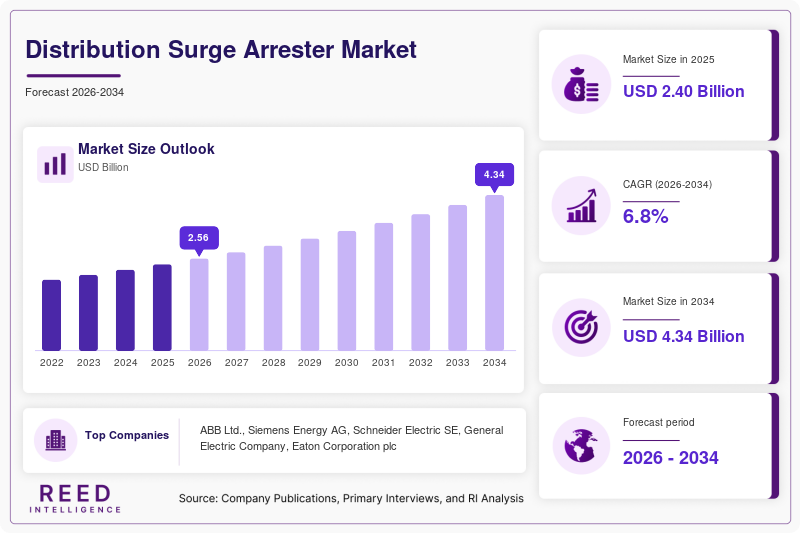
The Distribution Surge Arrester Market size was valued at approximately USD 2.4 billion in 2026 and is projected to reach USD 4.1 billion by 2034, expanding at a CAGR of 6.8% during 2026–2034. The market continues to evolve as utilities and industries prioritize grid reliability and equipment protection against voltage surges. Distribution surge arresters play a critical role in safeguarding transformers, switchgear, and transmission infrastructure from lightning strikes and switching surges, thereby reducing downtime and maintenance costs.
A major global factor supporting market growth is the accelerated expansion of renewable energy infrastructure. As solar and wind installations increase, especially in emerging economies, the need for reliable surge protection systems has grown significantly. These installations are often exposed to fluctuating electrical conditions, making surge arresters essential for stable grid operations. In addition, modernization of aging power grids and investments in smart grid technologies are further contributing to the demand for advanced distribution surge arresters with improved performance and monitoring capabilities.
Key Highlights
- Dominant region: Asia Pacific held 38% market share, while it is also the fastest-growing region with a CAGR of 7.5%
- Leading subsegments: Polymer-based surge arresters led the type segment with 62% share, while smart surge arresters are the fastest-growing with a CAGR of 8.2%
- Dominant country: The United States recorded USD 420 million in 2024 and USD 445 million in 2025
Market Trends
Increasing Adoption of Smart Surge Arresters
The integration of digital monitoring capabilities into surge arresters is becoming a notable trend in the Distribution Surge Arrester Market. Utilities are increasingly adopting smart surge arresters equipped with sensors and communication modules that allow real-time monitoring of performance and fault conditions. These systems provide predictive maintenance insights, helping utilities reduce operational costs and avoid unexpected failures. The shift toward smart grid infrastructure has accelerated this trend, particularly in developed regions where utilities aim to improve grid resilience. In addition, data-driven asset management strategies are encouraging the deployment of intelligent surge protection devices. Manufacturers are responding by developing advanced products that integrate IoT capabilities, enhancing visibility across power distribution networks.
Rising Preference for Polymer Housing Materials
Polymer-based surge arresters are gaining traction due to their superior performance compared to traditional porcelain variants. These arresters are lightweight, resistant to environmental stress, and less prone to catastrophic failure. The increasing demand for durable and maintenance-friendly components in harsh environments, such as coastal or industrial areas, is driving this trend. Polymer materials also offer better contamination resistance, making them suitable for regions with high pollution levels. Utilities are gradually replacing aging porcelain arresters with polymer alternatives to improve operational efficiency. This shift is also supported by cost advantages over the product lifecycle, further reinforcing the adoption of polymer-based solutions.
Market Drivers
Expansion of Power Distribution Infrastructure
The ongoing expansion of power distribution networks across developing and developed economies is a primary driver of the Distribution Surge Arrester Market. Governments are investing heavily in electrification projects to meet rising energy demand and improve grid accessibility. Rural electrification initiatives and urban infrastructure development are creating significant opportunities for surge arrester deployment. As new substations and transmission lines are installed, the need for reliable protection against voltage surges increases. Furthermore, industrial growth in sectors such as manufacturing and mining requires stable power supply systems, boosting demand for surge protection equipment. These factors collectively contribute to sustained market growth.
Increasing Frequency of Power Disturbances
The rising occurrence of power disturbances caused by extreme weather events and grid instability is driving the adoption of surge arresters. Lightning strikes, switching operations, and faults can lead to voltage spikes that damage critical equipment. Climate change has intensified the frequency and severity of such events, making surge protection a necessity rather than an option. Utilities and industrial operators are investing in advanced surge arresters to mitigate risks and ensure uninterrupted operations. In addition, regulatory standards for grid safety are becoming stricter, further encouraging the installation of surge protection devices across power distribution systems.
Market Restraint
High Initial Installation and Maintenance Costs
One of the primary challenges in the Distribution Surge Arrester Market is the relatively high initial cost associated with installation and system integration. Advanced surge arresters, especially those with smart monitoring capabilities, require significant investment in both hardware and supporting infrastructure. This cost factor can limit adoption among small utilities and organizations with constrained budgets. Additionally, maintenance and periodic replacement of surge arresters add to the overall lifecycle cost, particularly in regions with harsh environmental conditions where equipment degradation occurs faster.
The impact of this restraint is more evident in developing regions where infrastructure funding is limited. Utilities may opt for lower-cost alternatives or delay upgrades, which can compromise grid reliability. For example, older porcelain arresters may continue to be used despite their higher failure risk due to cost considerations. This creates a gap in the adoption of advanced technologies. While long-term benefits such as reduced downtime and maintenance costs exist, the upfront investment remains a barrier for widespread adoption. Manufacturers are attempting to address this challenge by offering cost-effective solutions and flexible financing options.
Market Opportunities
Growth in Renewable Energy Installations
The rapid expansion of renewable energy projects presents a significant opportunity for the Distribution Surge Arrester Market. Solar and wind farms require robust surge protection systems to handle voltage fluctuations and environmental exposure. As countries transition toward cleaner energy sources, the installation of distributed generation systems is increasing. These systems often operate in remote locations, making reliable surge protection essential for maintaining performance. The integration of renewable energy into existing grids also creates additional complexity, requiring advanced surge arresters to ensure stability. This trend is expected to drive demand for innovative and durable surge protection solutions.
Development of Smart Grid Infrastructure
The shift toward smart grid systems offers substantial growth potential for surge arrester manufacturers. Smart grids rely on advanced communication and automation technologies to optimize energy distribution and improve efficiency. Surge arresters with integrated monitoring capabilities are becoming a critical component of these systems. Utilities are investing in digital transformation initiatives to enhance grid resilience and reduce operational risks. This creates opportunities for manufacturers to develop smart surge arresters that align with evolving grid requirements. The adoption of such technologies is expected to increase, particularly in developed regions, contributing to market expansion.
Segmental Analysis
By Type
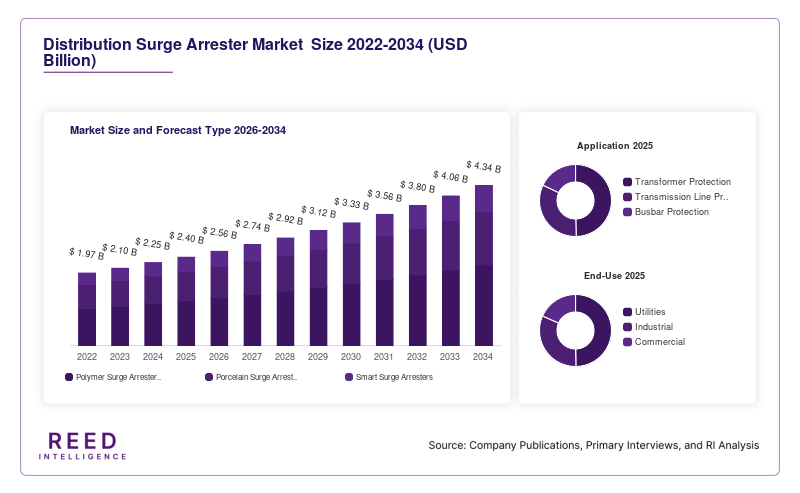
The polymer surge arrester segment dominated the market, accounting for 62% share in 2024. These arresters are widely preferred due to their lightweight design, superior mechanical strength, and resistance to environmental stress. Utilities are increasingly adopting polymer-based solutions as they offer better performance in contaminated and high-humidity environments. The reduced risk of explosion and ease of installation further contribute to their dominance. In addition, the growing replacement of aging porcelain arresters with polymer variants is supporting segment growth.
The smart surge arrester segment is expected to grow at the fastest CAGR of 8.2%. The integration of sensors and communication technologies enables real-time monitoring and predictive maintenance. This feature is particularly valuable for utilities aiming to enhance grid reliability and reduce operational costs. The increasing adoption of smart grid systems is a key factor driving the growth of this segment. Manufacturers are focusing on developing advanced solutions to meet evolving market demands.
By Application
The transformer protection segment held the largest share, accounting for 48% in 2024. Surge arresters are essential for protecting transformers from voltage spikes caused by lightning and switching operations. Transformers are critical components of power distribution systems, and their failure can lead to significant disruptions. Utilities are prioritizing the protection of these assets, driving demand for surge arresters. The increasing installation of distribution transformers in urban and rural areas further supports segment growth.
The transmission line protection segment is projected to grow at a CAGR of 7.3%. The expansion of power transmission networks and the integration of renewable energy sources are key factors driving this growth. Transmission lines are exposed to environmental conditions that can cause voltage surges, making surge protection essential. The development of long-distance transmission infrastructure is expected to increase demand for advanced surge arresters.
By End-Use
The utilities segment dominated the market with 55% share in 2024. Utilities are the primary users of surge arresters, as they are responsible for maintaining power distribution networks. The need to ensure reliable electricity supply and protect infrastructure from damage drives demand in this segment. Government investments in grid modernization and electrification projects further support growth. Utilities are also adopting advanced surge arresters to improve operational efficiency.
The industrial segment is expected to grow at a CAGR of 7.0%. Industries require stable power supply to maintain operations and avoid costly downtime. The increasing adoption of automation and digital technologies in industrial processes is driving demand for surge protection solutions. Manufacturers are investing in advanced equipment that requires reliable power, further boosting the need for surge arresters. This trend is expected to continue during the forecast period.
Regional Analysis
North America
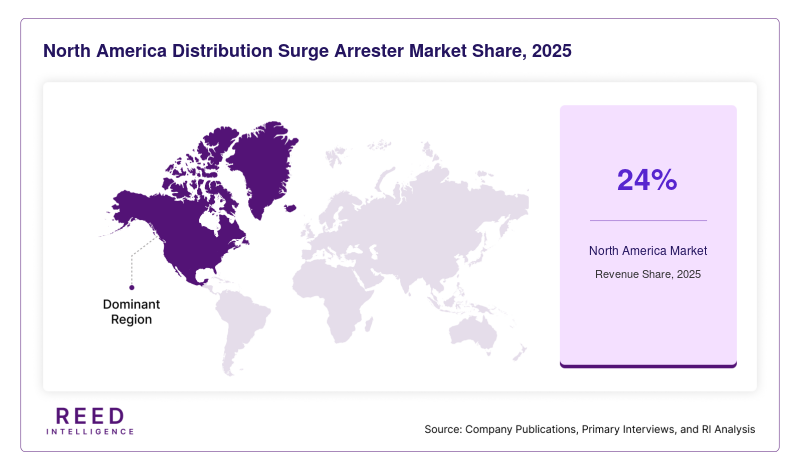
North America accounted for approximately 24% of the Distribution Surge Arrester Market share in 2025 and is projected to grow at a CAGR of 6.2% during the forecast period. The region benefits from well-established power infrastructure and ongoing investments in grid modernization. Utilities are focusing on upgrading aging systems to improve reliability and efficiency. The adoption of advanced surge protection technologies is supported by regulatory frameworks that emphasize grid safety and resilience. In addition, the increasing integration of renewable energy sources is driving demand for surge arresters.
The United States dominates the regional market, supported by significant investments in smart grid development. A unique growth factor in the country is the increasing frequency of extreme weather events, which has heightened the need for robust surge protection systems. Utilities are deploying advanced surge arresters to protect critical infrastructure and ensure uninterrupted power supply. This trend is expected to continue as climate-related risks increase.
Europe
Europe held around 22% market share in 2025 and is expected to grow at a CAGR of 6.5%. The region is characterized by strong regulatory support for energy efficiency and grid reliability. Investments in renewable energy projects, particularly wind and solar, are driving the demand for surge protection solutions. European utilities are adopting advanced technologies to enhance grid stability and reduce operational risks. The transition toward decentralized energy systems is further contributing to market growth.
Germany leads the European market due to its extensive renewable energy infrastructure. A unique growth factor in the country is the high penetration of distributed energy resources, which increases the need for surge protection devices. Utilities are focusing on integrating renewable energy into the grid while maintaining stability, driving demand for advanced surge arresters.
Asia Pacific
Asia Pacific dominated the market with 38% share in 2025 and is projected to grow at the fastest CAGR of 7.5%. Rapid urbanization, industrialization, and infrastructure development are key factors driving market growth in the region. Governments are investing heavily in power distribution networks to meet rising energy demand. The expansion of renewable energy projects is also contributing to increased demand for surge arresters.
China is the leading country in the region, supported by large-scale investments in power infrastructure. A unique growth factor is the government’s focus on rural electrification and smart grid development. These initiatives are creating significant opportunities for surge arrester manufacturers, as new installations require reliable surge protection systems.
Middle East & Africa
The Middle East & Africa region accounted for approximately 9% market share in 2025 and is expected to grow at a CAGR of 6.7%. The region is witnessing increasing investments in power infrastructure to support economic development. The expansion of industrial sectors and urban areas is driving demand for reliable electricity supply. Surge arresters are essential for protecting equipment in harsh environmental conditions, such as high temperatures and sandstorms.
Saudi Arabia leads the regional market, driven by infrastructure development projects. A unique growth factor is the increasing adoption of renewable energy initiatives, particularly solar power. These projects require advanced surge protection systems to ensure reliability, contributing to market growth.
Latin America
Latin America held around 7% market share in 2025 and is projected to grow at a CAGR of 6.4%. The region is experiencing gradual improvements in power infrastructure, supported by government initiatives. Investments in renewable energy and electrification projects are driving demand for surge arresters. Utilities are focusing on enhancing grid reliability to support economic growth.
Brazil is the dominant country in the region, supported by its large power generation capacity. A unique growth factor is the increasing frequency of lightning-related power disturbances, which necessitates the use of surge protection devices. Utilities are investing in advanced solutions to mitigate risks and improve system reliability.
Competitive Landscape
The Distribution Surge Arrester Market is moderately fragmented, with several global and regional players competing based on product quality, innovation, and pricing. Key companies are focusing on expanding their product portfolios and enhancing technological capabilities to gain a competitive edge. Strategic partnerships and acquisitions are also common as companies aim to strengthen their market presence.
ABB Ltd. is a leading player in the market, known for its advanced surge protection solutions and strong global presence. The company recently introduced a new range of smart surge arresters designed for digital substations, enhancing monitoring capabilities and operational efficiency. Other major players are also investing in research and development to develop innovative products that meet evolving customer requirements. The competitive landscape is expected to remain dynamic as new technologies emerge and market demand continues to grow.
Key Players
- ABB Ltd.
- Siemens Energy AG
- Schneider Electric SE
- General Electric Company
- Eaton Corporation plc
- Mitsubishi Electric Corporation
- Toshiba Corporation
- Hitachi Energy Ltd.
- Hubbell Incorporated
- CG Power and Industrial Solutions Ltd.
- Meidensha Corporation
- Tridelta Meidensha GmbH
- DEHN SE
- Elpro International Ltd.
- Lamco Industries Pvt. Ltd.
Recent Developments
- In 2025, ABB Ltd. launched a new series of smart surge arresters with integrated IoT capabilities for real-time monitoring.
- Siemens Energy AG expanded its manufacturing capacity for polymer surge arresters to meet increasing demand in Asia Pacific.
- Schneider Electric SE introduced eco-friendly surge protection solutions designed for renewable energy applications.
Distribution Surge Arrester Market Segments
Type
- Polymer Surge Arresters
- Porcelain Surge Arresters
- Smart Surge Arresters
Application
- Transformer Protection
- Transmission Line Protection
- Busbar Protection
End-Use
- Utilities
- Industrial
- Commercial
By Region
- North America
- Europe
- APAC
- Middle East and Africa
- LATAM