Diving Compressor Market Size, Share & Demand Report By Type (Portable Diving Compressors, High-Pressure Diving Compressors, Stationary Diving Compressors), By Application (Commercial Diving, Recreational Diving, Rescue and Emergency Services), By End-Use (Industrial, Defense, Diving Centers & Training Institutes), By Region & Segment Forecasts, 2026–2034
USD 3950
Market Overview
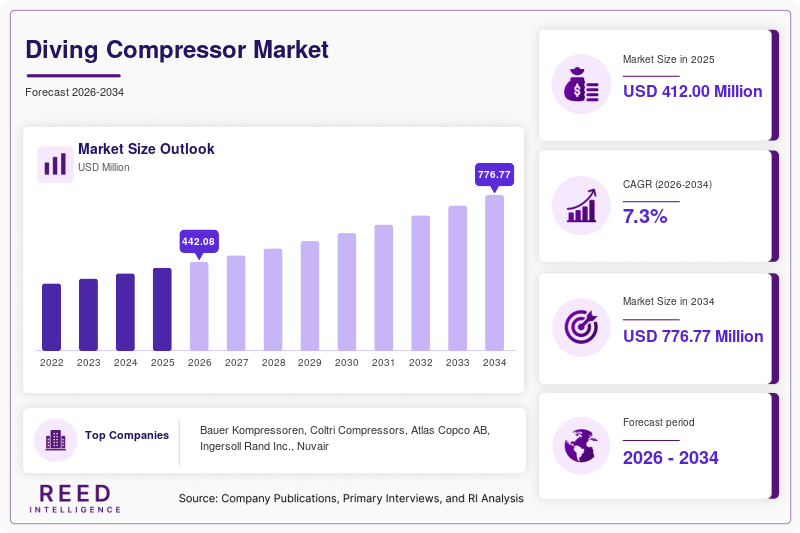
The global Diving Compressor Market size was valued at approximately USD 412 million in 2026 and is projected to reach USD 725 million by 2034, expanding at a CAGR of 7.3% during the forecast period (2026–2034). This steady growth trajectory reflects increasing demand for compressed air systems in recreational diving, commercial offshore operations, and defense applications. Diving compressors are essential for supplying breathable air at controlled pressure levels, making them a critical component in underwater exploration, rescue missions, and marine construction activities.
One key global factor supporting market growth is the rising popularity of marine tourism and scuba diving across coastal economies. Countries with established tourism industries are witnessing consistent demand for high-performance and portable diving compressors, particularly in training centers and diving resorts. In addition, technological improvements such as oil-free compression systems and energy-efficient designs are enhancing equipment reliability and reducing maintenance costs, which further supports adoption across both developed and emerging markets.
Key Highlights
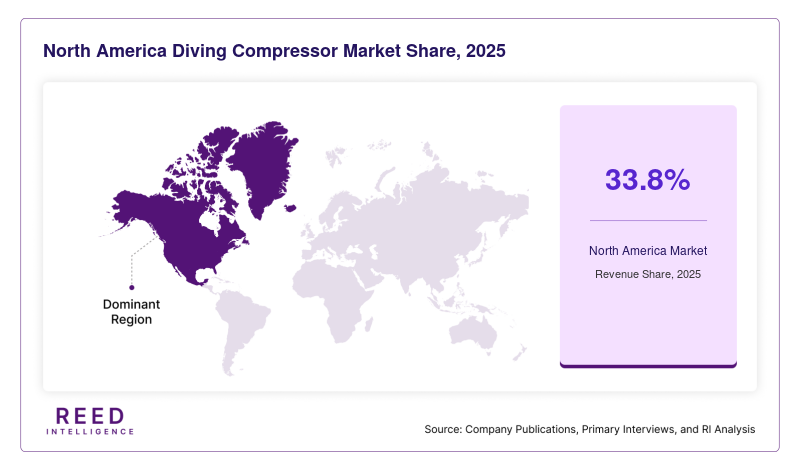
- North America dominated the market with a 33.8% share in 2025.
- Asia Pacific is expected to grow at the fastest CAGR of 9.1% during 2026–2034.
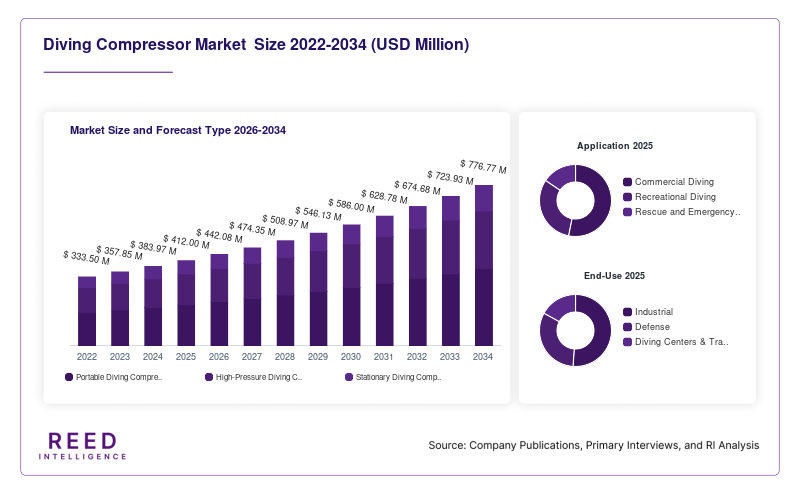
- By type, portable diving compressors accounted for the largest share of 46.7%, while high-pressure compressors are projected to grow at a CAGR of 8.5%.
- By application, commercial diving led with a 44.3% share, whereas rescue and emergency services are expected to expand at a CAGR of 8.9%.
- The United States remained the dominant country, with market values of USD 138 million in 2024 and USD 150 million in 2025.
Market Trends
Increasing Adoption of Portable and Compact Diving Compressors
A prominent trend shaping the Diving Compressor Market is the growing adoption of portable and compact compressor units. These systems are gaining traction among recreational divers, small diving schools, and mobile service providers due to their ease of transportation and reduced installation requirements. Manufacturers are focusing on lightweight materials, modular construction, and user-friendly interfaces to improve accessibility for non-industrial users. This shift is particularly visible in coastal tourism hubs where operators require flexible solutions to serve multiple diving sites. Additionally, advancements in battery-assisted and hybrid-powered compressors are further enhancing portability, enabling usage in remote or off-grid environments. This trend is expected to drive product innovation and expand the customer base beyond traditional commercial users.
Integration of Advanced Filtration and Air Quality Monitoring Systems
Another key trend is the integration of advanced filtration technologies and real-time air quality monitoring systems in diving compressors. Ensuring breathable air quality is critical for diver safety, and regulatory bodies are increasingly enforcing strict standards. As a result, manufacturers are incorporating multi-stage filtration systems, moisture separators, and carbon monoxide sensors into compressor units. Digital monitoring dashboards and IoT-enabled systems are also being introduced to provide real-time alerts and maintenance insights. This technological shift is improving operational reliability and reducing health risks associated with contaminated air supply. The demand for such intelligent systems is rising across both commercial diving operations and defense sectors, where safety compliance is a top priority.
Market Drivers
Expansion of Marine Tourism and Recreational Diving Activities
The expansion of marine tourism is a major driver of the Diving Compressor Market. Coastal regions across Southeast Asia, the Caribbean, and parts of Europe are experiencing steady growth in scuba diving tourism. Diving schools, resorts, and adventure travel companies require reliable compressor systems to support training and recreational diving sessions. The increasing number of certified divers globally has also contributed to higher demand for equipment, including compressors. Governments and tourism boards are investing in underwater attractions such as artificial reefs and marine parks, further boosting diving activities. This growing ecosystem creates consistent demand for both stationary and portable diving compressors, particularly those designed for ease of use and durability in high-humidity environments.
Rising Demand from Offshore Oil & Gas and Marine Construction Industries
Another significant driver is the rising demand for diving compressors in offshore oil & gas exploration and marine construction projects. Commercial divers rely heavily on high-pressure compressors for underwater welding, inspection, and maintenance tasks. With ongoing investments in offshore infrastructure and renewable energy projects such as offshore wind farms, the need for professional diving equipment continues to increase. These applications require robust and high-capacity compressor systems capable of operating in harsh marine environments. Additionally, stringent safety standards in industrial diving operations are pushing companies to invest in advanced compressor systems with enhanced reliability and redundancy features, thereby supporting market growth.
Market Restraint
High Initial Investment and Maintenance Costs
One of the primary restraints affecting the Diving Compressor Market is the high initial investment and ongoing maintenance costs associated with advanced compressor systems. High-pressure and industrial-grade compressors require significant capital expenditure, which can be a barrier for small diving operators and independent service providers. In addition to the purchase cost, regular maintenance, filter replacements, and compliance with safety standards add to the total cost of ownership. These expenses can limit adoption in price-sensitive markets, particularly in developing regions where budget constraints are more pronounced. For example, small diving schools in emerging economies may opt for lower-capacity or refurbished equipment instead of investing in new systems, which can impact overall market growth. Furthermore, improper maintenance can lead to equipment failure and safety risks, making cost management a critical concern for end users.
Market Opportunities
Growth in Defense and Naval Applications
The increasing focus on naval modernization and underwater defense capabilities presents a significant opportunity for the Diving Compressor Market. Military diving operations require highly reliable and efficient air supply systems for missions such as underwater surveillance, mine clearance, and rescue operations. Governments across various regions are investing in advanced diving equipment to enhance operational readiness. This includes the adoption of high-performance compressors with integrated safety and monitoring features. The demand for specialized compressors designed for military use is expected to grow steadily, providing opportunities for manufacturers to develop customized solutions tailored to defense requirements.
Technological Advancements in Energy-Efficient Compressors
Technological advancements in energy-efficient and environmentally friendly compressor systems offer another promising opportunity. Manufacturers are increasingly focusing on reducing energy consumption and minimizing environmental impact through innovative designs. Oil-free compressors, variable speed drives, and improved cooling systems are being introduced to enhance efficiency and sustainability. These innovations not only reduce operational costs but also align with global environmental regulations. As industries and governments prioritize sustainability, the demand for energy-efficient diving compressors is expected to increase. This creates opportunities for companies to differentiate their products and capture a larger share of the market.
Segmental Analysis
By Type
Portable diving compressors dominated the market, accounting for a 46.7% share in 2024. Their popularity is attributed to their flexibility, ease of transport, and suitability for small-scale operations. These compressors are widely used by recreational divers and small diving centers, particularly in tourist destinations. The compact design and relatively lower cost make them accessible to a broader customer base. Additionally, advancements in lightweight materials and battery-powered systems have further enhanced their usability. As a result, portable compressors continue to maintain a strong presence in the market, especially in regions with high tourism activity.
High-pressure diving compressors are the fastest-growing subsegment, expected to expand at a CAGR of 8.5% during the forecast period. These compressors are essential for commercial and industrial diving applications, where high air pressure is required for deep-sea operations. The growth of offshore industries and underwater construction projects is driving demand for these systems. Furthermore, improvements in durability and safety features are making high-pressure compressors more reliable, encouraging their adoption across various sectors.
By Application
Commercial diving accounted for the largest share of 44.3% in 2024, driven by its extensive use in offshore oil & gas, marine construction, and underwater maintenance activities. These applications require high-capacity and reliable compressor systems to ensure continuous air supply for divers. The increasing number of offshore projects and infrastructure developments is sustaining demand in this segment. Additionally, strict safety regulations necessitate the use of advanced compressor systems, further supporting market growth.
Rescue and emergency services represent the fastest-growing application segment, with a projected CAGR of 8.9%. The rising need for underwater rescue operations, disaster response, and emergency preparedness is driving demand for specialized diving equipment. Governments and emergency response agencies are investing in modern diving systems to enhance operational efficiency. The integration of advanced monitoring and safety features in compressors is also contributing to the growth of this segment.
By End-Use
The industrial sector dominated the market with a 49.1% share in 2024, primarily due to the widespread use of diving compressors in offshore and marine construction activities. Industries require robust and high-capacity systems capable of operating in challenging environments. The demand for reliable equipment in industrial applications ensures consistent growth in this segment.
The defense sector is the fastest-growing end-use segment, expected to grow at a CAGR of 8.7%. Increasing investments in naval capabilities and underwater defense operations are driving demand for advanced diving compressors. Military applications require highly reliable and efficient systems, prompting manufacturers to develop specialized products tailored to defense needs.
Regional Analysis
North America
North America accounted for a significant share of the Diving Compressor Market, holding approximately 33.8% in 2025. The region is expected to grow at a CAGR of 6.8% during the forecast period, supported by strong demand from commercial diving and defense sectors. The presence of established marine infrastructure and advanced technology adoption contributes to steady market growth.
The United States dominates the regional market due to its extensive offshore operations and well-developed recreational diving industry. A key growth factor is the increasing investment in offshore renewable energy projects, particularly wind farms, which require underwater inspection and maintenance activities supported by diving compressors.
Europe
Europe held a market share of around 26.5% in 2025 and is projected to grow at a CAGR of 6.5% through 2034. The region benefits from a strong maritime heritage and a well-regulated diving industry, which ensures consistent demand for high-quality compressor systems.
Germany leads the European market, driven by its engineering expertise and manufacturing capabilities. A unique growth factor is the region’s emphasis on environmental sustainability, encouraging the adoption of energy-efficient and oil-free compressor technologies.
Asia Pacific
Asia Pacific is the fastest-growing region, with a projected CAGR of 9.1% from 2026 to 2034 and a market share of 21.7% in 2025. Rapid industrialization and expanding tourism sectors are key contributors to this growth.
China dominates the region due to its large-scale marine construction activities and growing tourism industry. A major growth factor is the increasing number of coastal tourism projects and diving training centers, which drive demand for affordable and portable compressor systems.
Middle East & Africa
The Middle East & Africa region held a share of 9.3% in 2025 and is expected to grow at a CAGR of 7.0%. The market is supported by offshore oil & gas activities and emerging tourism sectors in coastal regions.
The United Arab Emirates is the leading country in this region. A unique growth factor is the development of luxury marine tourism and artificial diving attractions, which require advanced diving infrastructure and equipment.
Latin America
Latin America accounted for 8.7% of the market in 2025 and is projected to grow at a CAGR of 6.9% during the forecast period. The region shows steady growth due to increasing tourism and marine exploration activities.
Brazil leads the market, supported by its extensive coastline and growing diving tourism industry. A key growth factor is the expansion of eco-tourism initiatives that promote underwater exploration, thereby increasing demand for diving compressors.
Competitive Landscape
The Diving Compressor Market is moderately competitive, with several established players focusing on product innovation and geographic expansion. Key companies are investing in research and development to introduce energy-efficient and technologically advanced compressor systems. The market is characterized by a mix of global manufacturers and regional players catering to specific end-use industries.
A leading player in the market is Bauer Kompressoren, known for its extensive product portfolio and strong global presence. The company recently introduced a new range of high-efficiency compressors with integrated monitoring systems, aimed at improving operational safety and performance. Other major companies are also focusing on strategic partnerships and product diversification to strengthen their market position. Continuous innovation and adherence to safety standards remain critical factors for success in this market.
Key Players
- Bauer Kompressoren
- Coltri Compressors
- Atlas Copco AB
- Ingersoll Rand Inc.
- Nuvair
- Lenhardt & Wagner GmbH
- MCH (Submarine Systems)
- Sauer Compressors
- L&W Compressors
- Gardner Denver Holdings
- Paramina Compressors
- RIX Industries
- Brownie’s Marine Group
- Dive Rite
- Oceanic Systems
Recent Developments
- In 2025, Bauer Kompressoren launched a new series of energy-efficient compressors with advanced filtration systems.
- In 2024, Atlas Copco expanded its compressor manufacturing facility to enhance production capacity for marine applications.
- In 2025, Coltri Compressors introduced a compact portable compressor designed for remote diving operations.
Diving Compressor Market Segments
Type
- Portable Diving Compressors
- High-Pressure Diving Compressors
- Stationary Diving Compressors
Application
- Commercial Diving
- Recreational Diving
- Rescue and Emergency Services
End-Use
- Industrial
- Defense
- Diving Centers & Training Institutes
By Region
- North America
- Europe
- APAC
- Middle East and Africa
- LATAM