Divinylbenzene Market Size, Share & Demand Report By Purity Grade (Technical Grade, High-Purity Grade, Ultra-High Purity Grade), By Application (Ion Exchange Resins, Specialty Polymers, Catalyst Carriers, Adsorbents), By End-Use Industry (Water Treatment, Pharmaceutical & Biotechnology, Chemical Processing, Electronics, Energy) By Region & Segment Forecasts, 2026–2034
USD 3950
Market Overview
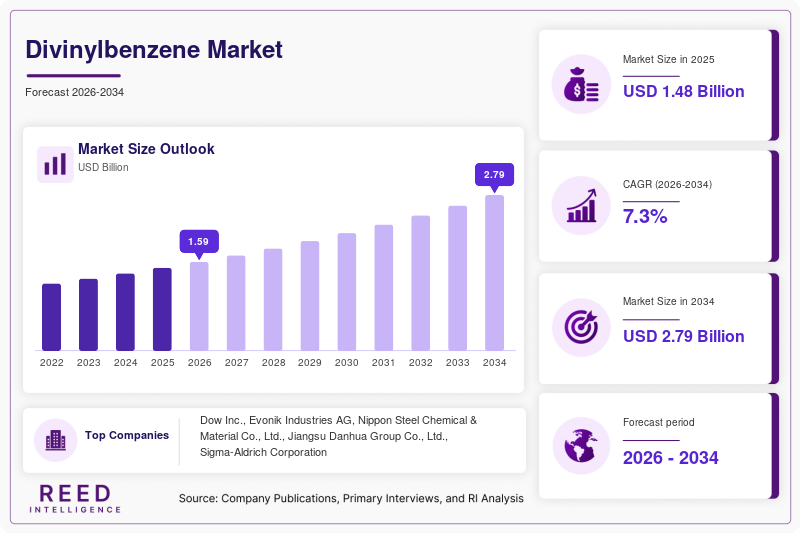
The global Divinylbenzene Market size was valued at USD 1.48 billion in 2026 and is projected to reach USD 2.61 billion by 2034, expanding at a CAGR of 7.3% during the forecast period from 2026 to 2034. Divinylbenzene (DVB), a key cross-linking monomer widely used in ion exchange resins, specialty polymers, adsorbents, and chromatography materials, continues to gain strategic importance across chemical processing, water purification, pharmaceutical manufacturing, and electronics sectors. Rising industrial emphasis on water treatment infrastructure and high-performance polymer production has played a major role in expanding demand globally. Increasing investments in ultrapure water systems, especially in semiconductor and power industries, have accelerated consumption of DVB-based ion exchange resins due to their thermal stability, porosity control, and mechanical strength. In addition, advancements in specialty polymer engineering and catalyst carriers have broadened application diversity. Manufacturers are also focusing on purity enhancement and process optimization to serve stringent industrial standards, which supports long-term market expansion. Strong industrialization in emerging economies and replacement demand in mature economies further sustain market penetration.
Key Highlights
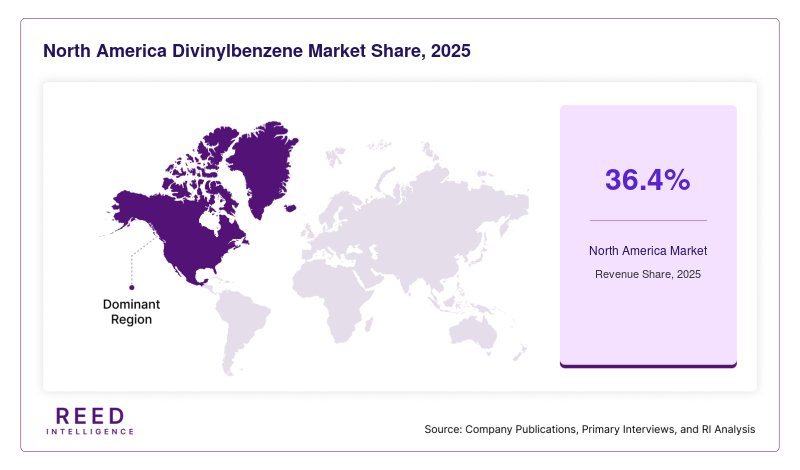
- North America dominated the market with a 36.4% share in 2025.
- Asia Pacific is expected to grow at the fastest CAGR of 8.9% during 2026–2034.
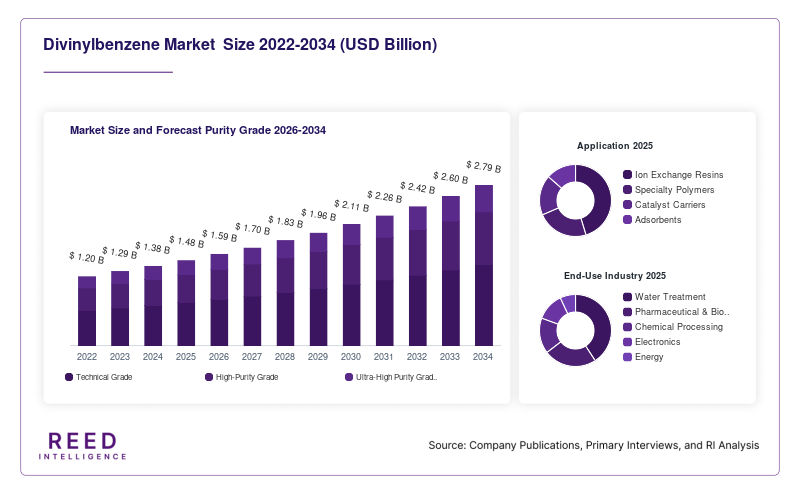
- By purity grade, technical grade accounted for the largest share of 44.8%, while high-purity grade is projected to grow at a CAGR of 8.7%.
- By application, ion exchange resins led with a 46.2% share, whereas specialty polymers are expected to expand at a CAGR of 8.5%.
- The United States remained the dominant country, with market values of USD 402 million in 2024 and USD 435 million in 2025.
Market Trends
Expansion of high-performance ion exchange resin manufacturing
A major trend shaping the Divinylbenzene Market is the increasing production of advanced ion exchange resins for water purification, power generation, and electronics manufacturing. DVB is a critical component in resin cross-linking, enabling durability and selectivity. Demand for ultrapure water in semiconductor fabs, pharmaceutical processing, and industrial wastewater recycling has strengthened resin consumption. As environmental regulations tighten globally, resin manufacturers are expanding DVB utilization to improve performance efficiency. This trend is particularly strong in North America and Asia Pacific, where investments in desalination, municipal treatment, and industrial recycling continue to rise, pushing suppliers toward capacity expansion and product innovation.
Rising adoption in specialty polymer and catalyst applications
Divinylbenzene is increasingly used in specialty polymers, adsorbent materials, and catalyst support systems due to its structural stability and customizable porosity. Chemical manufacturers are integrating DVB into engineered polymers for chromatography columns, coatings, and high-value industrial separation technologies. Growth in pharmaceutical synthesis and biotechnology research has increased demand for DVB-based polymer matrices. Additionally, petrochemical and refining sectors are using DVB-derived catalyst supports to improve operational efficiency. This trend reflects a broader shift toward value-added materials rather than commodity chemical dependence, allowing producers to diversify revenue streams and improve profitability through specialized applications.
Market Drivers
Growth in global water treatment and purification infrastructure
The rapid expansion of global water treatment systems remains a primary driver for the Divinylbenzene Market. DVB-based ion exchange resins are essential for demineralization, purification, and contaminant removal in industrial and municipal settings. Rising freshwater scarcity, stricter discharge standards, and industrial wastewater mandates are encouraging infrastructure modernization. Countries across Asia, the Middle East, and North America are investing heavily in desalination and wastewater recycling plants, which directly increases resin demand. Since DVB enhances resin durability and regeneration cycles, manufacturers benefit from recurring demand as water systems expand, particularly in energy-intensive and technology-driven industries.
Expansion of pharmaceutical and biotechnology processing
The pharmaceutical and biotechnology industries increasingly rely on DVB for chromatography resins and purification media used in drug development and biologics production. As biopharmaceutical pipelines grow globally, demand for stable polymer supports with consistent separation capabilities rises. DVB offers chemical resistance and pore customization, making it suitable for precision purification systems. Growing biologics manufacturing in the U.S., Europe, India, and China has amplified this requirement. Moreover, increasing vaccine and biosimilar production has strengthened investments in purification technologies, creating a dependable downstream market for high-purity Divinylbenzene products.
Market Restraint
Volatility in raw material pricing and environmental compliance pressures
Fluctuating prices of petrochemical feedstocks such as ethylbenzene and styrene derivatives create cost instability for Divinylbenzene manufacturers. Since DVB production is heavily dependent on upstream petrochemical economics, changes in crude oil prices and supply chain disruptions can significantly affect production margins. In addition, stringent environmental regulations concerning VOC emissions, hazardous waste, and chemical processing safety increase operational expenses. Producers in Europe and North America often face higher compliance costs related to emission controls and plant modernization. Smaller manufacturers may struggle to absorb these costs, potentially limiting market entry and reducing price competitiveness. For example, compliance upgrades for emission reduction systems can delay expansion projects, particularly in regions with strict industrial sustainability targets.
Market Opportunities
Growth potential in semiconductor-grade water systems
The global semiconductor industry presents a major opportunity for Divinylbenzene suppliers due to the growing requirement for ultrapure water systems. Semiconductor fabrication plants use highly specialized ion exchange systems where DVB-based resins play a crucial role in maintaining purity. As chip manufacturing expands in Asia Pacific and North America, especially with public and private investments in domestic fabrication, DVB demand is expected to increase significantly. Suppliers capable of producing higher-purity grades and customized formulations may benefit from premium pricing and long-term contracts, strengthening market expansion in advanced manufacturing ecosystems.
Emerging use in advanced adsorbents and carbon capture materials
Divinylbenzene is increasingly being explored for advanced adsorbent systems, including gas separation, carbon capture, and specialty filtration technologies. DVB-based polymer structures offer customizable porosity, making them suitable for environmental engineering applications. As industries prioritize decarbonization and industrial gas purification, new material science innovations could unlock broader uses beyond traditional resin markets. Research in carbon dioxide capture polymers and specialty absorbents creates opportunities for manufacturers to participate in sustainability-focused industrial transitions. This diversification could support higher margins while reducing dependence on conventional water treatment sectors.
Segmental Analysis
By Purity Grade
Technical grade Divinylbenzene accounted for the largest market share of 44.8% in 2024 due to its broad use in industrial ion exchange resins, adsorbents, and polymer manufacturing. This grade remains widely preferred because it balances performance and affordability, making it suitable for water treatment, catalyst carriers, and bulk industrial applications. Large-volume sectors such as municipal water systems and conventional resin production continue to prioritize technical grade products.
High-purity grade Divinylbenzene is projected to expand at the fastest CAGR of 8.7% through 2034. Growth is driven by pharmaceutical chromatography, semiconductor-grade water purification, and biotechnology applications requiring stricter contamination controls. As industries adopt higher-performance materials, demand for refined DVB formulations is increasing, especially where purity directly impacts product reliability and regulatory compliance.
By Application
Ion exchange resins dominated the Divinylbenzene Market in 2024, securing 46.2% of global share. DVB’s essential role in cross-linking resin structures makes it indispensable in water purification, power generation, and chemical processing systems. Industrial and municipal sectors rely heavily on these resins for contaminant removal, making this application the market’s largest revenue contributor.
Specialty polymers are expected to grow at the fastest CAGR of 8.5% over the forecast period. This growth stems from expanding use in chromatography, catalyst supports, engineered adsorbents, and advanced material science. As pharmaceutical and industrial separation technologies advance, specialty polymers are emerging as a lucrative segment for manufacturers seeking diversification and margin expansion.
By End-Use Industry
Water treatment remained the dominant end-use segment in 2024, accounting for 39.6% of market revenue. DVB-based resins are widely used in municipal systems, industrial recycling, and desalination plants due to their efficiency and chemical resilience. Global freshwater scarcity and tightening wastewater regulations continue to reinforce this segment’s leadership.
Pharmaceutical and biotechnology applications are forecast to grow at the fastest CAGR of 8.8% from 2026 to 2034. Rising biologics manufacturing, vaccine production, and advanced purification technologies are driving this expansion. DVB’s role in chromatography and high-performance purification systems positions it as a strategic material for precision healthcare manufacturing.
Regional Analysis
North America
North America held the largest share of the Divinylbenzene Market in 2025, accounting for 36.4% of global revenue, and is projected to maintain steady growth at a CAGR of 6.8% through 2034. Strong industrial water treatment demand, advanced pharmaceutical manufacturing, and extensive specialty polymer production support regional dominance. The region benefits from mature infrastructure, established resin manufacturing capacity, and stable downstream industries.
The United States dominates the regional market due to strong investments in semiconductor manufacturing, biotechnology, and municipal water purification systems. A unique growth factor is the expansion of domestic electronics and chip fabrication facilities, which require ultrapure water systems. This industrial shift is increasing demand for premium-grade DVB-based ion exchange solutions.
Europe
Europe represented 24.7% of the global Divinylbenzene Market in 2025 and is expected to expand at a CAGR of 6.5% during the forecast period. Regional demand is supported by stringent environmental regulations, advanced pharmaceutical sectors, and a strong chemical manufacturing base. Sustainable industrial practices are encouraging modernization of water purification systems and specialty polymer production.
Germany leads the European market due to its robust chemical industry and leadership in industrial engineering. A unique growth factor is the region’s focus on circular industrial water systems, where advanced ion exchange technologies are increasingly integrated into manufacturing processes to reduce waste and improve resource efficiency.
Asia Pacific
Asia Pacific accounted for 22.8% of the global market in 2025 and is forecast to register the fastest CAGR of 8.9% through 2034. Rapid industrialization, urban water infrastructure expansion, and pharmaceutical manufacturing growth in China, India, South Korea, and Southeast Asia are driving regional momentum. Rising electronics production further supports DVB demand.
China remains the dominant country in Asia Pacific due to large-scale chemical production and industrial water treatment investments. A unique growth factor is aggressive expansion in semiconductor and electronics manufacturing, which requires advanced purification systems and increases demand for high-performance DVB applications.
Middle East & Africa
Middle East & Africa held 8.3% of the global Divinylbenzene Market in 2025 and is projected to grow at a CAGR of 7.1% through 2034. Water scarcity challenges and desalination investments are major growth contributors. The region’s petrochemical sector also supports DVB consumption for industrial separation applications.
Saudi Arabia leads regional demand due to extensive desalination infrastructure and industrial diversification programs. A unique growth factor is government-backed expansion of water recycling and desalination plants, creating sustained need for ion exchange resin materials that depend on Divinylbenzene chemistry.
Latin America
Latin America captured 7.8% of the global market in 2025 and is expected to grow at a CAGR of 6.9% during the forecast period. Growth is supported by improving industrial water treatment capabilities, mining applications, and chemical sector modernization. Economic development in manufacturing and municipal infrastructure also supports adoption.
Brazil dominates the Latin American market due to its large industrial base and increasing water treatment investments. A unique growth factor is the modernization of mining and industrial processing systems, where resin purification technologies are gaining broader operational importance.
Competitive Landscape
The Divinylbenzene Market is moderately consolidated, with leading players focusing on purity enhancement, regional expansion, and downstream integration. Major companies include Dow, Evonik Industries, Jiangsu Danhua Group, Nippon Steel Chemical & Material, and Sigma-Aldrich. Dow remains a leading market participant due to its extensive specialty chemical portfolio and strong presence in ion exchange resin applications. Recent developments include capacity upgrades for high-performance resin feedstocks to support advanced purification industries. Asian manufacturers are expanding aggressively to meet rising domestic demand, while European companies emphasize sustainable processing technologies. Competition is increasingly centered on product customization, environmental compliance, and specialty-grade production capabilities.
Key Players
- Dow Inc.
- Evonik Industries AG
- Nippon Steel Chemical & Material Co., Ltd.
- Jiangsu Danhua Group Co., Ltd.
- Sigma-Aldrich Corporation
- Tokyo Chemical Industry Co., Ltd.
- Alfa Aesar
- LANXESS AG
- SABIC
- Merck KGaA
- Chemours Company
- Mitsubishi Chemical Group
- Shandong Xingshun New Material
- LG Chem
- Eastman Chemical Company
Recent Developments
- Dow expanded specialty resin feedstock optimization in 2025 to support advanced purification sectors.
- Evonik increased investment in high-purity cross-linking monomer technologies for specialty polymer markets in 2024.
- Jiangsu Danhua Group announced regional production capacity enhancements targeting Asia Pacific industrial water treatment demand in 2025.
Divinylbenzene Market Segments
Purity Grade
- Technical Grade
- High-Purity Grade
- Ultra-High Purity Grade
Application
- Ion Exchange Resins
- Specialty Polymers
- Catalyst Carriers
- Adsorbents
End-Use Industry
- Water Treatment
- Pharmaceutical & Biotechnology
- Chemical Processing
- Electronics
- Energy
By Region
- North America
- Europe
- APAC
- Middle East and Africa
- LATAM