DJ Equipment Market Size, Share & Trends Analysis Report By Product Type (DJ Controllers, DJ Mixers, DJ Players & Media Players, Turntables, DJ Headphones & Accessories), By Application (Professional DJs, Hobbyist & Amateur DJs, Mobile & Event DJs, Clubs & Entertainment Venues), By Distribution Channel (Online, Offline) Forecasts, 2026–2034
USD 3950
DJ Equipment Market Size
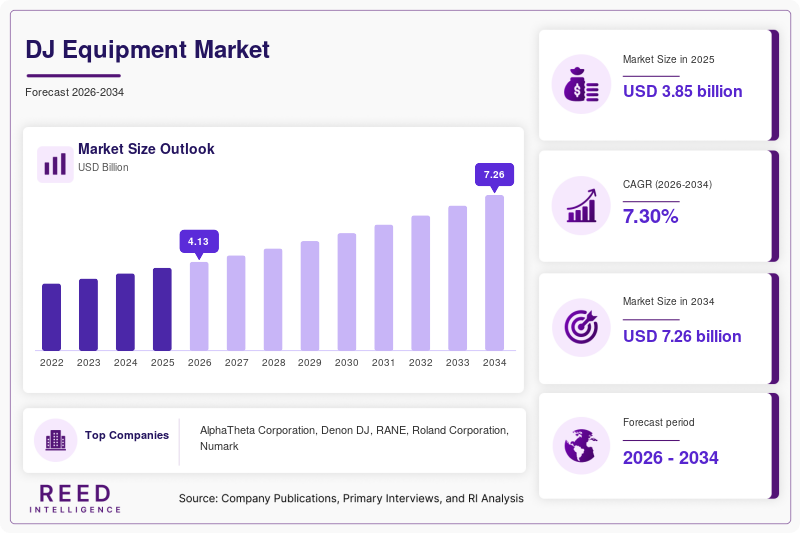
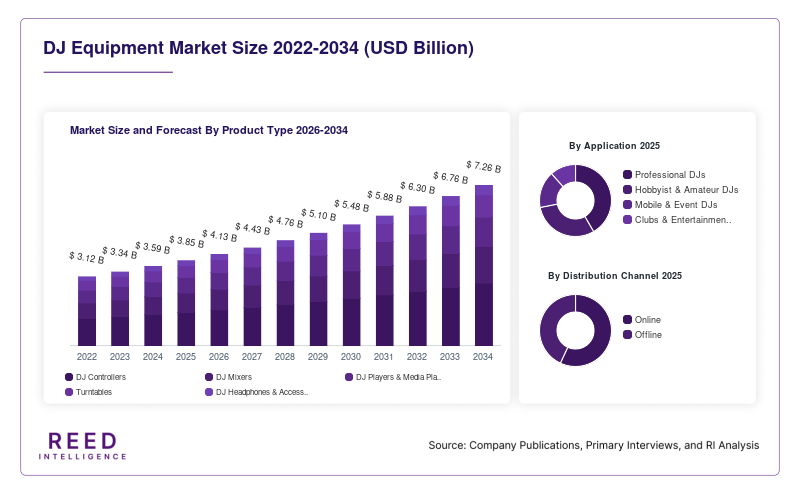
The global DJ equipment market size was valued at USD 3.85 billion in 2025 and is projected to grow from USD 4.13 billion in 2026 to USD 7.26 billion by 2034, registering a CAGR of 7.30% during the forecast period from 2026 to 2034.
The DJ equipment market is shifting from hardware centered on traditional club setups toward connected, software-integrated and multi-purpose performance systems. Current products increasingly combine DJ hardware with streaming access, cloud libraries, mobile devices, wireless monitoring, music discovery and performance effects. AlphaTheta's recent product portfolio illustrates this transition through DJ controllers, all-in-one systems, professional players, mixers, headphones and software-linked workflows.
The underlying music ecosystem also continues to expand. IFPI reported that global recorded-music revenues reached USD 31.7 billion in 2025, up 6.4%, while streaming revenues increased 7.7% and represented 69.6% of recorded-music revenue. Paid subscription streaming increased 8.8%. These changes matter for DJ equipment because DJs increasingly need hardware that can manage large digital libraries, streaming catalogs and cloud-based music collections.
DJ Equipment Market Drivers
Integration of DJ hardware with streaming and cloud music
DJ workflows are moving away from dependence on locally stored music files toward connected libraries and streaming-enabled equipment. AlphaTheta's CDJ-3000X provides Wi-Fi, cloud-library access, streaming compatibility and NFC-based connectivity, while the XDJ-AN can directly access Apple Music, Beatport Streaming and Tidal. This changes equipment requirements because users increasingly expect hardware to support multiple music sources without requiring separate preparation workflows. For manufacturers, connectivity creates opportunities to differentiate products through software compatibility, cloud services and ecosystem integration rather than hardware specifications alone. It also expands the addressable user base because beginners can start with streaming-supported systems instead of first building large personal music libraries.
Growth of digital music consumption and DJ-oriented content creation
Streaming has become the dominant revenue format in recorded music, accounting for 69.6% of global recorded-music revenues in 2025. This creates a large digital content environment from which DJs discover, prepare and perform music. DJ equipment is also increasingly used beyond clubs, including livestreaming, content creation, private events and hybrid entertainment. Roland's DJ-707M, for example, integrates DJ control, livestreaming functions, multiple microphone inputs, audio routing and loudspeaker management into one system. The commercial mechanism is broader equipment utilization: a controller or mixer can serve multiple revenue-generating activities rather than being restricted to nightclub performances.
Product innovation is lowering the barrier between beginner and professional equipment
Manufacturers are increasingly designing products that allow home DJs to progress toward club-style setups. AlphaTheta's XDJ-AN was introduced specifically to create a transition between home DJing and club environments, while the DDJ-GRV6 combines four-channel control with rekordbox and Serato compatibility and features such as Stems and performance-oriented remixing. This creates a wider upgrade path: a beginner can purchase a compact controller, develop skills, and later move into all-in-one or professional player-and-mixer systems without completely changing the underlying workflow. Manufacturers benefit from retaining users within their hardware and software ecosystems.
DJ Equipment Market Restraints
High prices for professional equipment
Professional DJ players, mixers and integrated systems can require substantial upfront investment, particularly for club-standard configurations. The cost of multiple players, a mixer, headphones, monitors, cases and accessories can make professional setups expensive for independent DJs and smaller venues. This creates a split market between premium professional systems and lower-cost controllers. Manufacturers therefore need to balance advanced features with portability and affordability. AlphaTheta's development of products such as the compact CDJ-1500X and XDJ-AN illustrates the industry's response to space and accessibility constraints.
Hardware dependence on software, operating systems and connectivity
Modern DJ equipment increasingly relies on firmware, DJ applications, cloud services, streaming accounts and operating-system compatibility. AlphaTheta publishes continuing compatibility and firmware updates for its hardware, while its current products support combinations of rekordbox, Serato and mobile applications. This creates additional technical dependencies. Connectivity failures, software updates, security vulnerabilities or incompatibility between hardware and applications can affect professional workflows. AlphaTheta issued a security notice in August 2026 concerning a vulnerability in PRO DJ LINK, demonstrating that connected equipment introduces cybersecurity considerations alongside traditional hardware reliability.
DJ Equipment Market Opportunities
Connected and Streaming-Enabled DJ Systems
Connected DJ systems provide manufacturers with an opportunity to move from standalone hardware toward broader ecosystems. The XDJ-AN demonstrates this model by combining USB, PC/Mac, mobile applications, streaming services and cloud libraries in one device. The CDJ-3000X similarly integrates cloud storage and streaming into a professional player. The commercial opportunity extends beyond hardware sales because software subscriptions, cloud storage, music-service compatibility, accessories and ecosystem services can become part of the customer relationship. Manufacturers that make these integrations reliable and simple can address both new DJs and established professionals while reducing the friction associated with managing large music libraries.
Expansion of Portable and Multi-Purpose Equipment
Mobile DJs, livestreamers, content creators and event professionals need equipment that performs multiple audio functions without requiring large setups. Roland's DJ-707M combines DJ performance, audio routing, microphone management, livestreaming and loudspeaker-management functions. AlphaTheta's compact XDJ-AN similarly targets flexible setups and smaller DJ environments. This creates an opportunity for manufacturers to design lighter equipment with professional connectivity, wireless monitoring, battery-friendly workflows and multi-device compatibility. The addressable customer base therefore extends beyond clubs to weddings, corporate events, hospitality, creator studios and private entertainment.
Segmental Analysis
By Product Type
DJ Controllers represent approximately 38% of the global market in 2025, making them the dominant product category. Controllers combine deck control, mixing functions and software integration in a comparatively compact form factor, making them relevant to beginners, mobile DJs, creators and experienced performers. AlphaTheta's current portfolio includes the DDJ-FLX2 and DDJ-GRV6, with the latter supporting rekordbox and Serato DJ Pro and providing four-channel performance control.
All-in-One DJ Systems are the fastest-growing product category, with a projected CAGR of approximately 9.1%. These systems combine player and mixer functions while increasingly adding Wi-Fi, cloud libraries, streaming, wireless monitoring and mobile-device support. AlphaTheta's XDJ-AZ and XDJ-AN illustrate the shift toward integrated systems that can serve home, mobile and professional environments.
By Application
Professional DJs account for approximately 41% of the global market in 2025, making them the largest application group. Professional users place greater emphasis on reliability, sound quality, workflow speed, connectivity and compatibility with club-standard systems. AlphaTheta describes its professional DJ products around reliability, usability and performance requirements across clubs and other professional environments.
Mobile & Event DJs are the fastest-growing application, with a projected CAGR of approximately 8.5%. Their equipment requirements extend beyond mixing into microphones, livestreaming, sound management and portability. Roland's DJ-707M demonstrates this multi-purpose model by combining DJ control with livestreaming, microphone processing, audio routing and loudspeaker management.
By Distribution Channel
Online channels account for approximately 57% of the global market in 2025. Online purchasing is supported by the standardized nature of many controllers, headphones, accessories and entry-level systems, allowing buyers to compare technical specifications and pricing before purchase.
Online distribution is also the fastest-growing channel, with a projected CAGR of approximately 8.4%. Manufacturers increasingly operate direct online stores while specialist music retailers use e-commerce to reach customers beyond physical stores. AlphaTheta's current website provides online purchasing alongside product discovery and support resources.
Regional Analysis
North America DJ Equipment Market
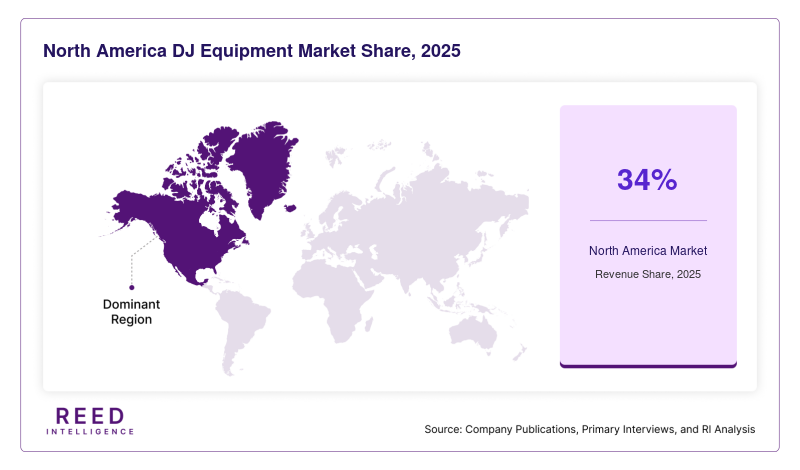
North America represents approximately 34% of the global DJ equipment market in 2025, supported by a large entertainment industry, extensive club and festival infrastructure, strong consumer electronics distribution and a mature professional-DJ community. The United States remains a major market for professional equipment, controllers, headphones, mixers and mobile-DJ systems.
The region also has strong demand from content creators and livestreamers. Products such as Roland's DJ-707M are designed around the broader responsibilities of mobile DJs, including livestreaming, event production and microphone management.
North America is projected to grow at approximately 6.7% CAGR through 2034. Demand will be supported by replacement purchases, professional venue upgrades and creator-oriented applications. However, mature penetration and relatively high professional-equipment prices limit the pace compared with developing DJ markets.
Europe DJ Equipment Market
Europe accounts for approximately 27% of the global market in 2025, supported by a dense network of clubs, festivals, electronic-music events, DJs, producers and specialist music retailers. The region is particularly important for electronic dance music, which creates a strong installed base for professional players, mixers, controllers and monitoring equipment.
The broader European music economy remains substantial. IFPI reported that Europe generated 30.4% of global recorded-music revenue in 2025 and grew 5.6%. This provides a large commercial ecosystem around professional music production and performance.
Europe is projected to register approximately 6.5% CAGR. Growth will be supported by club equipment replacement, festival activity, home-DJ adoption and increasingly connected hardware. The market remains competitive, with consumers able to choose between specialist professional systems and lower-cost software-controller combinations.
APAC DJ Equipment Market
APAC represents approximately 24% of the global market in 2025 and is the fastest-growing region, with a projected CAGR of approximately 9.2%. China, Japan, South Korea, India and Australia represent important demand centers, supported by expanding entertainment markets, electronic music communities, festivals, hospitality venues and growing adoption of digital music.
Japan has particular importance because AlphaTheta is headquartered there and has operated in DJ equipment since the introduction of the CDJ-500 in 1994. The company also maintains a DJ Lab in Yokohama and continues to develop DJ equipment, software and digital services.
Asia also recorded strong growth in the broader music economy. IFPI reported that recorded-music revenue in Asia increased 10.9% in 2025, while China grew 20.1%. This creates a broader consumer and professional ecosystem for DJ equipment.
Growth will be supported by entry-level controllers, mobile DJing, all-in-one systems and professional venue development. Price sensitivity remains an important counterbalance, particularly outside premium urban markets.
Middle East and Africa DJ Equipment Market
Middle East and Africa account for approximately 6% of the global market in 2025, with demand concentrated in major cities, hospitality markets, entertainment venues, festivals and professional event production.
The region's recorded-music economy is expanding quickly. IFPI reported that MENA recorded 15.2% revenue growth in 2025, while Sub-Saharan Africa also grew 15.2%. Streaming represented 97.5% of MENA's recorded-music revenue. This high level of digital music engagement supports demand for equipment capable of handling digital libraries, streaming-linked workflows and mobile performance.
The region is projected to grow at approximately 8.0% CAGR. Expansion of hospitality and entertainment infrastructure can increase professional-equipment demand, while import costs, distribution coverage and premium hardware pricing remain constraints.
LATAM DJ Equipment Market
LATAM represents approximately 9% of the global DJ equipment market in 2025, supported by strong music cultures, clubs, festivals, mobile entertainment and expanding digital music consumption. Brazil and Mexico are major regional markets for music and entertainment equipment.
The wider recorded-music industry provides a strong demand signal. IFPI reported that Latin American recorded-music revenue increased 17.1% in 2025, with streaming representing 88.1% of regional recorded-music revenues. Brazil grew 14.1% and Mexico 13.3%.
LATAM is projected to grow at approximately 8.3% CAGR through 2034. Increasing access to online music, creator tools and affordable controllers should support equipment adoption. Currency volatility, import costs and uneven retail infrastructure can nevertheless affect premium-equipment purchases.
Competitive Landscape
The DJ equipment market is characterized by strong competition across controllers, professional players, mixers, all-in-one systems, headphones, and connected software ecosystems. Product differentiation increasingly depends on the integration of hardware, software, and digital music services.
AlphaTheta remains a major professional DJ equipment supplier, with its portfolio spanning CDJ players, DJM mixers, controllers, all-in-one systems, headphones, effects and software. Its current strategy emphasizes cloud connectivity, streaming, mobile compatibility and professional workflows. The CDJ-3000X and XDJ-AN demonstrate this move toward connected equipment.
Roland competes through multifunctional DJ controllers that combine DJ performance with broader event-audio capabilities. Its DJ-707M integrates Serato DJ Pro, microphone processing, audio routing, livestreaming and loudspeaker management, positioning the product for mobile and event applications.
Key Market Players
Recent Market Developments
- September 2026 – AlphaTheta: VirtualDJ officially added support for OneLibrary, expanding interoperability within AlphaTheta's connected music-management ecosystem.
- 2025–2026 – Music industry: IFPI reported that global recorded-music revenue increased 6.4% in 2025 to USD 31.7 billion, with paid subscription streaming revenue growing 8.8%. This provides a favorable underlying digital-music environment for connected DJ hardware.
DJ Equipment Market Segments
By Product Type
- DJ Controllers
- DJ Mixers
- DJ Players & Media Players
- Turntables
- DJ Headphones & Accessories
By Application
- Professional DJs
- Hobbyist & Amateur DJs
- Mobile & Event DJs
- Clubs & Entertainment Venues
By Distribution Channel
- Online
- Offline
By Region
- North America
- Europe
- APAC
- Middle East and Africa
- LATAM