Docks Market Size, Share Demand Report By Type (Fixed Docks, Floating Docks, Pipe Docks, Crib Docks), By Material (Concrete, Steel, Wood, Composite Materials), By Application (Commercial Ports, Marinas & Recreational Facilities, Industrial Facilities), By End User (Transportation & Logistics Operators, Government Authorities, Tourism & Recreation Operators, Industrial Enterprises, Defense Organizations) By Region & Segment Forecasts, 2026–2034
USD 3950
Market Overview
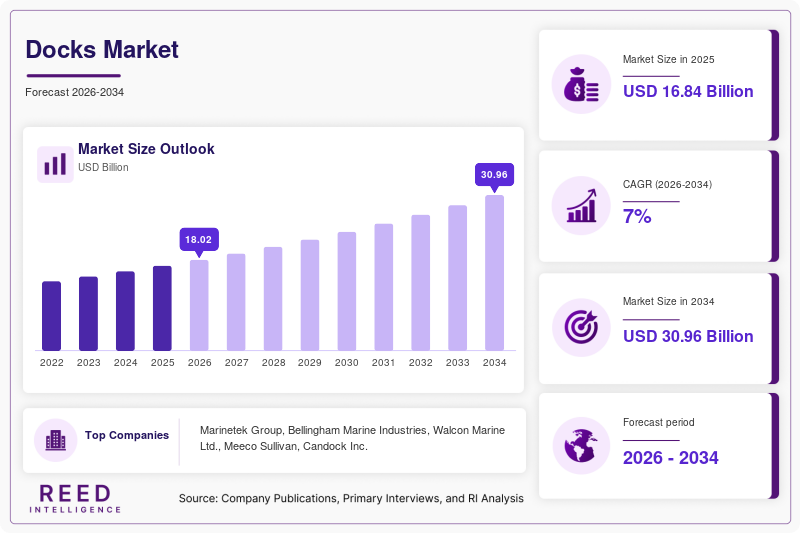
The Docks Market size was valued at USD 16.84 billion in 2026 and is projected to reach USD 28.96 billion by 2034, registering a CAGR of 7.0% during the forecast period (2026–2034). A major factor supporting market growth globally has been the steady expansion of international seaborne trade and cargo transportation networks. Governments and private operators are investing heavily in upgrading existing port infrastructure while developing new marine facilities to accommodate larger vessels, improve operational efficiency, and strengthen logistics connectivity. Increasing demand for resilient waterfront infrastructure capable of supporting commercial, industrial, and recreational activities has accelerated dock construction and modernization projects worldwide. Furthermore, urban waterfront redevelopment initiatives and growing marine tourism activities continue to strengthen long-term demand for advanced docking systems across both developed and emerging economies.
Technological advancements in dock engineering, modular floating structures, corrosion-resistant materials, and smart monitoring systems are transforming the industry. Modern docks increasingly incorporate automated monitoring technologies, sustainable construction materials, and adaptable designs capable of withstanding changing environmental conditions. Growing investments in maritime logistics, offshore energy projects, and waterfront real estate developments are expected to sustain market expansion throughout the forecast period.
Key Highlights
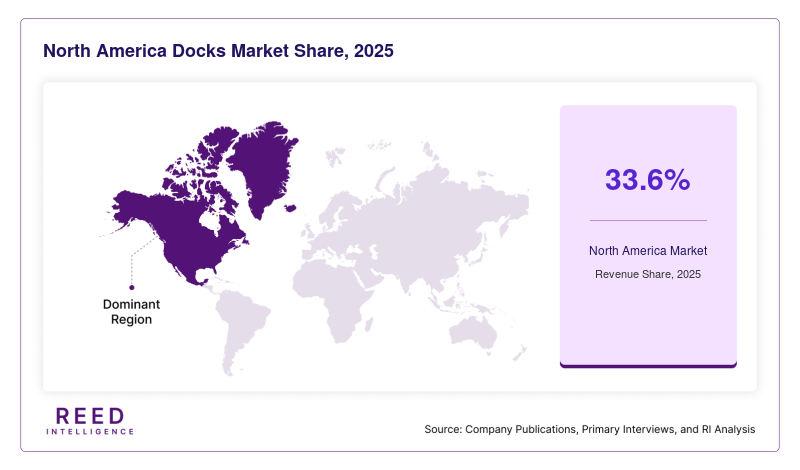
- North America accounted for the largest market share of 33.6% in 2025, while Asia Pacific is projected to register the fastest CAGR of 8.4% during 2026–2034.
- By Type, Fixed Docks held the dominant share of 58.9% in 2025, whereas Floating Docks are expected to expand at a CAGR of 8.9% through 2034.
- By Material, Concrete Docks represented 39.4% market share in 2025, while Composite Docks are forecast to grow at a CAGR of 9.2%.
- By Application, Commercial Ports captured 42.1% of the market in 2025, while Marinas & Recreational Facilities are anticipated to record a CAGR of 8.8%.
- By End User, Transportation & Logistics Operators remained the leading segment with 37.5% share in 2025, whereas Tourism & Recreation Operators are forecast to grow at 9.0% CAGR.
- The United States remained the dominant country, with market values of USD 2.74 billion in 2024 and USD 2.93 billion in 2025.
Market Trends
Growing Adoption of Modular Floating Dock Systems
The Docks Market is increasingly witnessing the adoption of modular floating dock systems across marinas, waterfront developments, and commercial facilities. Floating docks provide flexibility, ease of installation, and adaptability to fluctuating water levels, making them suitable for diverse environmental conditions. Property developers, marina operators, and local governments are utilizing modular dock solutions to reduce installation time while enhancing operational versatility. The trend is particularly visible in coastal tourism destinations and inland recreational waterways where flexible docking infrastructure supports growing boating activities and waterfront recreation.
Integration of Smart Monitoring and Asset Management Technologies
Dock operators are increasingly incorporating smart technologies into infrastructure management strategies. Sensors, remote monitoring systems, predictive maintenance platforms, and digital asset management tools are being deployed to improve operational visibility and infrastructure reliability. These technologies help operators monitor structural integrity, environmental conditions, vessel traffic, and maintenance requirements in real time. The growing focus on infrastructure efficiency and lifecycle optimization is encouraging adoption of intelligent dock management systems across commercial and industrial facilities.
Market Drivers
Expansion of Global Maritime Cargo Transportation
The steady increase in containerized shipping, bulk cargo transportation, and international trade volumes continues to create demand for expanded docking infrastructure. Port authorities and logistics operators require larger and more efficient dock facilities to handle increasing vessel traffic and cargo throughput. Investments in berth expansion, terminal modernization, and waterfront logistics infrastructure are driving market growth. The need to accommodate next-generation cargo vessels further supports demand for advanced docking solutions.
Rising Investments in Waterfront Development Projects
Governments and private developers are investing heavily in waterfront revitalization projects that combine commercial, residential, tourism, and recreational functions. Modern dock infrastructure serves as a critical component of these developments by providing access for transportation, recreation, and marine services. Increasing urbanization near coastal regions and growing interest in mixed-use waterfront destinations are contributing significantly to market expansion.
Market Restraint
High Capital Requirements for Dock Construction
Dock construction projects often require substantial investments in engineering, materials, environmental assessments, permitting processes, and long-term maintenance programs. The significant upfront capital expenditure associated with large-scale dock infrastructure may delay project implementation, particularly in regions with budget constraints or uncertain economic conditions.
Market Opportunities
Development of Climate-Resilient Marine Infrastructure
Rising attention toward environmental resilience is creating opportunities for advanced dock systems designed to withstand extreme weather events, sea-level changes, and coastal erosion. Infrastructure developers are increasingly seeking durable and adaptive dock solutions capable of supporting long-term operational stability under changing environmental conditions.
Growth of Recreational Boating and Marina Networks
The increasing popularity of recreational boating, yacht tourism, and waterfront leisure activities presents significant opportunities for dock manufacturers and marina developers. Expanding marina networks and investments in recreational waterfront facilities are expected to generate substantial demand for modern docking systems across numerous coastal and inland destinations.
Segmental Analysis
By Type
The market is segmented into:
- Fixed Docks
- Floating Docks
- Pipe Docks
- Crib Docks
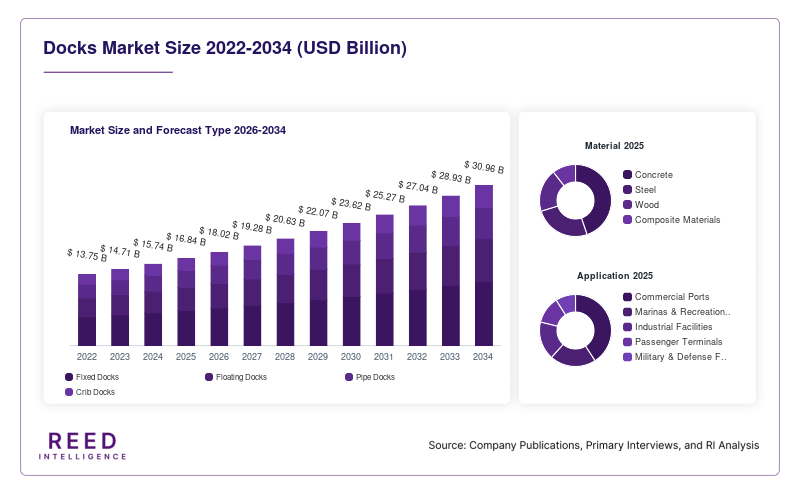
Fixed Docks dominated the market with 58.9% share in 2025 due to their structural stability, long operational lifespan, and suitability for commercial port environments. These systems remain widely utilized across cargo terminals, industrial facilities, and transportation infrastructure projects.
Floating Docks are projected to witness the fastest growth at a CAGR of 8.9% during the forecast period. Their adaptability to changing water levels and simplified installation requirements will encourage broader adoption in recreational marinas, tourism facilities, and residential waterfront developments.
By Material
The market includes:
- Concrete
- Steel
- Wood
- Composite Materials
Concrete Docks accounted for 39.4% market share in 2025 owing to their durability, load-bearing capacity, and resistance to harsh marine environments. Commercial and industrial operators continue to prefer concrete structures for long-term infrastructure applications.
Composite Docks are expected to record the highest CAGR of 9.2% through 2034. Lightweight construction, corrosion resistance, and reduced maintenance requirements will support increasing adoption across recreational and commercial installations.
By Application
The market is categorized into:
- Commercial Ports
- Marinas & Recreational Facilities
- Industrial Facilities
- Passenger Terminals
- Military & Defense Facilities
Commercial Ports represented 42.1% market share in 2025 because of growing cargo handling requirements and ongoing investments in maritime logistics infrastructure. Expanding trade volumes continue to support extensive dock construction and modernization activities.
Marinas & Recreational Facilities are forecast to expand at a CAGR of 8.8% during the assessment period. Rising recreational boating participation and increasing investments in waterfront tourism infrastructure will accelerate demand for specialized docking systems.
By End User
The market is segmented into:
- Transportation & Logistics Operators
- Government Authorities
- Tourism & Recreation Operators
- Industrial Enterprises
- Defense Organizations
Transportation & Logistics Operators held 37.5% market share in 2025 due to extensive utilization of dock infrastructure for cargo transportation, shipping operations, and logistics management activities. Growing maritime trade volumes continue to support segment dominance.
Tourism & Recreation Operators are anticipated to register the fastest growth at a CAGR of 9.0% through 2034. Expansion of marina developments, yacht tourism facilities, and waterfront leisure destinations will contribute significantly to segment growth.
Regional Analysis
North America
North America held 33.6% of the Docks Market share in 2025 and is projected to expand at a CAGR of 6.4% during 2026–2034. The region benefits from extensive commercial port infrastructure, mature marina networks, and significant investments in waterfront redevelopment projects. Ongoing modernization initiatives across cargo terminals and recreational marine facilities continue to support market growth.
The United States remained the dominant country due to large-scale port modernization programs and continued investments in coastal infrastructure development. Increasing recreational boating participation and extensive waterfront property development have further strengthened demand for docking systems throughout the country.
Europe
Europe accounted for 27.2% market share in 2025 and is expected to grow at a CAGR of 6.6% through 2034. The region is characterized by extensive maritime transportation networks and strong investments in sustainable port infrastructure. Governments are increasingly prioritizing modernization initiatives that improve operational efficiency and environmental performance across marine facilities.
Germany emerged as the leading country owing to its extensive logistics infrastructure and strategic position within European maritime trade networks. Continuous investment in port efficiency enhancement projects continues to support regional market expansion.
Asia Pacific
Asia Pacific represented 25.8% of the global Docks Market in 2025 and is forecast to register the fastest CAGR of 8.4% during the assessment period. Rapid industrialization, increasing trade activity, and substantial investments in transportation infrastructure are contributing to strong market development. Regional governments are expanding port capacities and developing new maritime facilities to support economic growth.
China dominated the regional market due to large-scale investments in port construction, coastal infrastructure projects, and maritime logistics expansion. Ongoing development of international shipping corridors continues to generate significant demand for docking infrastructure.
Middle East & Africa
The Middle East & Africa captured 7.0% market share in 2025 and is projected to grow at a CAGR of 6.8% during 2026–2034. Investments in logistics diversification, industrial ports, and tourism-oriented waterfront developments are contributing to market growth across the region.
Saudi Arabia maintained regional leadership owing to substantial investments in maritime infrastructure and economic diversification initiatives. Development of industrial ports and coastal tourism projects continues to strengthen demand for docking solutions.
Latin America
Latin America accounted for 6.4% share of the market in 2025 and is expected to expand at a CAGR of 6.9% through 2034. The region is witnessing increasing investments in port modernization, tourism infrastructure, and marine transportation facilities. Growing international trade activity continues to support demand for upgraded dock infrastructure.
Brazil remained the dominant country due to its extensive coastline, expanding port operations, and increasing focus on logistics infrastructure development. Continued investment in cargo handling capacity improvements is expected to support future market growth.
Competitive Landscape
The Docks Market remains moderately consolidated, with participants focusing on infrastructure innovation, material advancements, modular construction technologies, and strategic project partnerships. Companies continue investing in sustainable dock solutions, smart monitoring technologies, and climate-resilient engineering capabilities to strengthen market positioning.
Marinetek Group remained a leading participant due to its extensive portfolio of floating marina systems and waterfront infrastructure solutions. In 2025, the company introduced a next-generation modular floating dock platform designed to improve durability, operational flexibility, and environmental performance across marina applications.
Other significant market participants include Bellingham Marine Industries, Walcon Marine Ltd., Meeco Sullivan, and Candock Inc., all of which continue expanding product portfolios and geographic presence through infrastructure development projects and strategic collaborations.
Key Players List
- Marinetek Group
- Bellingham Marine Industries
- Walcon Marine Ltd.
- Meeco Sullivan
- Candock Inc.
- SF Marina Systems AB
- Ingemar Srl
- EZ Dock, Inc.
- Poralu Marine
- AccuDock
- Maricorp U.S.
- Technomarine Manufacturing Inc.
- Martini Alfredo S.p.A.
- Flotation Systems Inc.
- Jet Dock Systems, Inc.
Recent Developments
- In 2025, multiple dock manufacturers introduced modular floating dock systems with enhanced durability and simplified installation features for marina developments.
- Several port authorities initiated large-scale dock modernization projects to improve cargo handling efficiency and accommodate larger commercial vessels.
- New composite material dock platforms were launched to reduce maintenance requirements and improve long-term structural performance.
- Smart monitoring technologies featuring real-time structural assessment and predictive maintenance capabilities gained wider adoption across commercial marine facilities.
- Strategic partnerships between dock manufacturers and waterfront developers accelerated deployment of integrated marina and tourism infrastructure projects.
Docks Market Segments
Type
- Fixed Docks
- Floating Docks
- Pipe Docks
- Crib Docks
Material
- Concrete
- Steel
- Wood
- Composite Materials
Application
- Commercial Ports
- Marinas & Recreational Facilities
- Industrial Facilities
- Passenger Terminals
- Military & Defense Facilities
End User
- Transportation & Logistics Operators
- Government Authorities
- Tourism & Recreation Operators
- Industrial Enterprises
- Defense Organizations
By Region
- North America
- Europe
- APAC
- Middle East and Africa
- LATAM