Global Doll Market Size, Share, Demand Report By Type (Fashion Dolls, Plush Dolls, Action and Collectible Dolls), By Application (Children, Collectors, Gifting), By Region & Segment Forecasts, 2026–2034
USD 3950
Doll Market Size
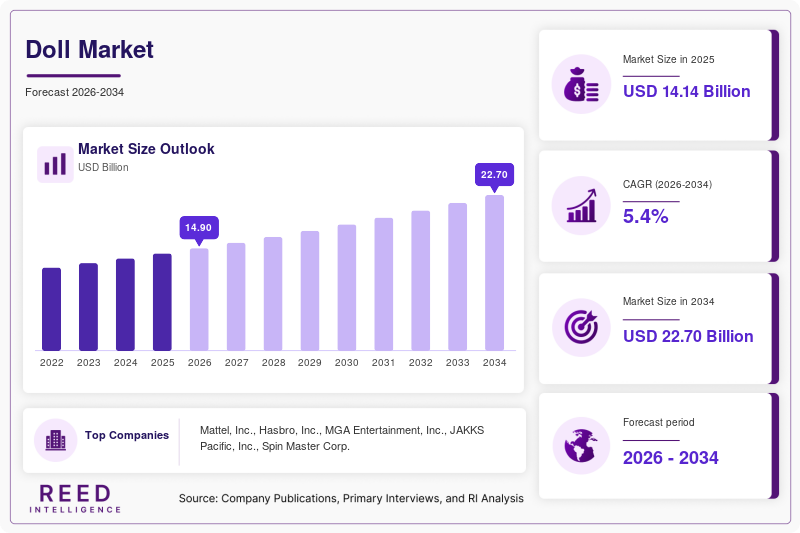
Global Doll market size is projected at USD 14.9 billion in 2026 and is expected to hit USD 22.70 billion by 2034, with a CAGR of 5.4%. Growing demand for character-based toys, collectible products, personalized dolls, and digitally connected play experiences is increasing the need for detailed market data. Comprehensive segmentation and competitive-landscape analysis help manufacturers identify high-growth product categories, regional opportunities, pricing strategies, and evolving consumer preferences.
Key takeaways
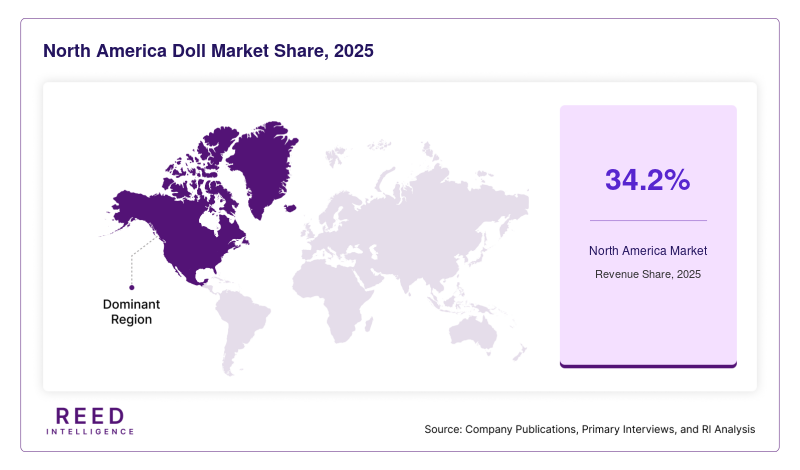
- North America dominated the market with an estimated 34.2% share in 2025, while Asia Pacific is projected to be the fastest-growing region at approximately 6.7% CAGR through 2034.
- Fashion Dolls accounted for approximately 42.5% of global revenue in 2025, while Action and Collectible Dolls are expected to record the fastest growth at around 6.2% CAGR.
- The Children application segment held approximately 61.8% of the market in 2025, while the collector segment is projected to expand at nearly 7.0% CAGR through 2034.
- China is estimated to remain one of the largest production and consumption markets, while India is emerging as a high-growth market with an estimated CAGR of approximately 8.1% during 2026–2034.
- The global doll industry produced an estimated 1.65 billion units in 2025, with fashion and traditional play dolls representing the largest production categories.
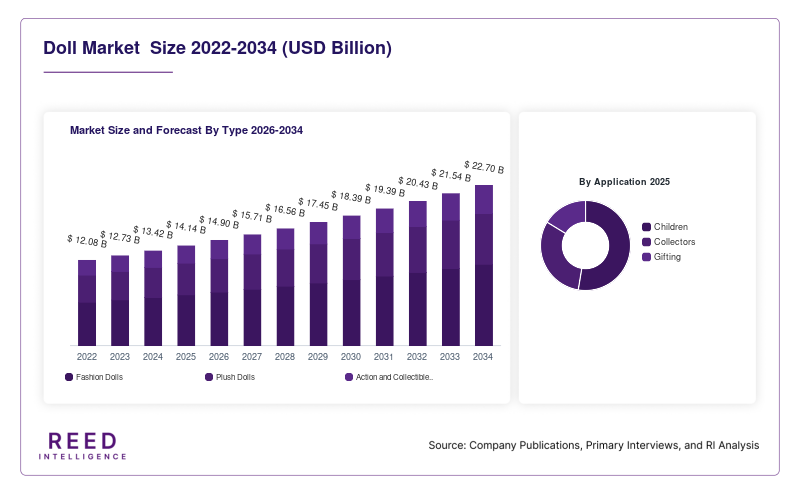
The global doll market comprises products designed for children's play, entertainment, gifting, education, collecting, and character-based engagement. The industry includes traditional dolls, fashion dolls, plush dolls, action figures, collectible dolls, baby dolls, character dolls, and customized products. In 2025, the market generated approximately USD 14.2 billion in revenue and produced an estimated 1.65 billion units worldwide. North America and Europe remain important premium markets, while Asia Pacific represents a major manufacturing and consumption base. Growing interest in licensed characters, limited editions, inclusive representation, interactive features, and customized designs is influencing product development. Fashion dolls contributed approximately 42.5% of market revenue in 2025, followed by plush dolls at around 31.0% and action and collectible dolls at approximately 26.5%. Children's applications represented the largest demand base, while collector-oriented products are gaining importance because of limited-edition releases and secondary-market value.
Doll Market Trends
Technology Integration and Character-Based Product Innovation
Technology is increasingly influencing doll design through interactive voice features, app connectivity, embedded sensors, augmented-reality experiences, and digitally enhanced storytelling. Manufacturers are combining physical products with digital content to extend engagement beyond conventional play. Customization is also becoming more important, with consumers increasingly seeking dolls featuring different hairstyles, skin tones, clothing options, accessories, and personalized attributes. Collectible dolls are incorporating sophisticated packaging, articulated bodies, interchangeable components, and limited-production formats to appeal to older consumers.
Sector-specific demand is shifting toward entertainment-linked and character-driven products. Dolls associated with movies, streaming programs, gaming franchises, social-media personalities, and established entertainment brands are gaining visibility. Premium collector products are benefiting from adult consumer participation, while educational dolls and culturally representative products are supporting demand among parents seeking more diverse play experiences. Sustainability is also influencing material selection, packaging, and manufacturing processes, particularly in developed markets where consumers increasingly consider environmental attributes when purchasing toys.
Doll Market Drivers
Expansion of Licensed Characters and Collectible Culture
Growing demand for entertainment-based merchandise is a major driver of the global doll market. Licensed characters from films, television programs, digital entertainment, and gaming franchises create strong product recognition and encourage repeat purchases. Collectible culture is further expanding the addressable customer base beyond children, with adult collectors purchasing limited editions, premium dolls, fashion collaborations, and highly detailed character products. Social-media communities and online marketplaces also improve product discovery and encourage collection-based purchasing.
Doll Market Restraints
Rising Manufacturing and Material Costs
Higher costs for plastics, textiles, packaging materials, labor, transportation, and compliance are putting pressure on manufacturers and retailers. Premium dolls require greater design complexity, detailed accessories, specialized materials, and sophisticated packaging, which can increase production costs substantially. Price-sensitive consumers may shift toward lower-cost alternatives when inflation reduces discretionary spending, limiting premium product penetration in several emerging markets.
Doll Market Opportunities
Growth of Personalized and Digitally Enhanced Dolls
Personalization represents a significant opportunity for manufacturers seeking differentiation. Custom facial features, clothing, accessories, names, hairstyles, and culturally relevant designs can create higher-value products and stronger consumer engagement. Digital customization platforms can allow customers to configure products before purchase, while interactive dolls connected to mobile applications can combine physical play with digital storytelling. Emerging markets, particularly India and Southeast Asia, also offer opportunities as organized retail, e-commerce penetration, and household spending on children's products continue to expand.
Challenges in Doll Market
Safety Regulations, Counterfeiting, and Rapid Consumer Preference Changes
Manufacturers face strict safety requirements concerning materials, small components, chemicals, paints, mechanical parts, and age-specific product design. Compliance can increase development and testing costs, particularly for products sold across multiple regulatory jurisdictions. Counterfeit dolls and unauthorized character merchandise also affect brand owners and retailers by reducing legitimate sales. At the same time, consumer preferences can change rapidly because of entertainment trends, social-media influence, and short product life cycles, requiring manufacturers to continuously refresh portfolios.
Doll Market Segmentation Analysis
By type, fashion dolls represented the dominant segment with approximately 42.5% of global market revenue in 2025, supported by strong brand recognition, extensive accessories, and repeat-purchase behavior. By application, children accounted for approximately 61.8% of revenue, followed by collectors and gifting. The collector segment is expected to demonstrate the strongest growth as premium, limited-edition, and character-based products attract adult consumers.
By Type
Fashion Dolls: Fashion dolls accounted for approximately 42.5% of the global market in 2025, representing about USD 6.0 billion in revenue and an estimated 580 million units produced. The category includes articulated fashion dolls, miniature fashion products, celebrity-inspired dolls, and character-led products. Modern products increasingly feature multiple articulation points, interchangeable clothing, detailed accessories, and diverse physical characteristics. Fashion dolls remain highly dependent on brand strength, seasonal launches, entertainment licensing, and accessory sales. Demand is particularly strong in North America and Europe, while Asia Pacific is expanding through localized character designs and affordable product formats.
Plush Dolls: Plush dolls generated approximately 31.0% of market revenue in 2025, equivalent to around USD 4.4 billion and nearly 650 million units. These products generally use textile exteriors, polyester or similar fiber fillings, embroidered or printed facial details, and soft-body construction. The segment benefits from demand for comfort products, animal characters, cartoon figures, and licensed entertainment properties. Plush products are widely purchased for young children and gifting occasions, while oversized and premium collectible plush formats are attracting older consumers. Their relatively lightweight construction also supports efficient e-commerce distribution.
Action and Collectible Dolls: Action and collectible dolls represented approximately 26.5% of revenue in 2025, with estimated revenue of USD 3.8 billion and approximately 420 million units produced. Products typically incorporate articulated joints, molded components, interchangeable accessories, detailed costumes, character-specific features, and premium packaging. The segment is projected to grow at approximately 6.2% CAGR through 2034 because of adult collecting, limited releases, entertainment licensing, gaming franchises, and community-driven demand. Premium editions can command substantially higher average selling prices than mass-market children's dolls.
By Application
Children: The children's segment accounted for approximately 61.8% of global revenue in 2025, generating about USD 8.8 billion and representing nearly 1.05 billion units. The category includes dolls designed for imaginative play, role-playing, storytelling, social development, and entertainment. Baby dolls, fashion dolls, plush dolls, educational dolls, and character dolls remain important product groups. Manufacturers are increasingly incorporating inclusive designs, washable fabrics, durable components, and age-appropriate mechanisms. Retail availability through supermarkets, specialty toy stores, department stores, and e-commerce platforms supports broad consumer access.
Collectors: Collectors represented approximately 22.7% of revenue in 2025, equivalent to around USD 3.2 billion and approximately 270 million units. Collector products typically include limited editions, premium fashion dolls, celebrity-inspired dolls, entertainment characters, historical designs, and highly articulated figures. Detailed sculpting, premium materials, numbered editions, certificates, specialized packaging, and exclusive distribution are common characteristics. Demand is particularly strong among adult consumers who value rarity, design quality, nostalgia, and franchise affiliation. Online collector communities and auction platforms continue to support category growth.
Gifting: The gifting application contributed approximately 15.5% of market revenue in 2025, representing nearly USD 2.2 billion and approximately 330 million units. Dolls purchased as gifts include plush characters, fashion dolls, baby dolls, collectible figures, holiday editions, and customized products. Seasonal periods, birthdays, festivals, cultural celebrations, and entertainment launches create significant demand fluctuations. Premium packaging and bundled accessories are increasingly used to improve gift appeal, while e-commerce has expanded the availability of personalized and direct-to-consumer gifting options.
Doll Market Regional Analysis
North America Doll Market
North America held approximately 34.2% of the global market in 2025, making it the largest regional market. The United States contributes the majority of regional revenue through strong demand for fashion dolls, licensed characters, collectible products, and premium children's toys. Canada provides additional demand through established toy retail and e-commerce channels. The regional sector split is led by children's products, followed by collectors and gifting. Adult collectible culture, entertainment licensing, and premium product launches are expected to support continued growth.
Europe Doll Market
Europe represented approximately 27.1% of global revenue in 2025. Germany, the United Kingdom, France, Italy, and Spain are important country markets, with Germany and the UK contributing significant retail and collector demand. Children's dolls account for the largest sector share, while premium fashion and collectible products have strong positions in developed Western European markets. Sustainability, product safety, recyclable packaging, and ethical manufacturing are increasingly influential purchasing considerations.
Asia Pacific Doll Market
Asia Pacific accounted for approximately 25.8% of the global market in 2025 and is projected to achieve the fastest regional CAGR of approximately 6.7% through 2034. China represents the largest regional production base, while Japan and South Korea have strong demand for character merchandise and collectible products. India is emerging rapidly, supported by urbanization, increasing disposable income, e-commerce expansion, and organized toy retail. Children's products remain the largest sector, although collectors and licensed character merchandise are expanding rapidly.
Latin America Doll Market
Latin America contributed approximately 7.1% of global revenue in 2025. Brazil and Mexico account for a substantial proportion of regional demand, supported by large child populations, gifting occasions, and expanding modern retail. Children's dolls dominate the regional sector split, while affordable plush and character products are gaining traction through e-commerce and mass-market retail. Pricing remains an important purchasing factor, encouraging manufacturers to introduce value-oriented product ranges.
Middle East & Africa Doll Market
The Middle East & Africa region represented approximately 5.8% of global revenue in 2025. The UAE, Saudi Arabia, South Africa, and other major urban markets contribute substantially to regional sales. The region has increasing demand for premium dolls, branded character merchandise, gifting products, and educational toys. Children's products remain dominant, while premium gifting and collector categories are expected to expand as organized retail and digital commerce develop.
Top players in the Doll Market
- Mattel, Inc.
- Hasbro, Inc.
- MGA Entertainment, Inc.
- JAKKS Pacific, Inc.
- Spin Master Corp.
- Bandai Namco Holdings Inc.
- Moose Toys Pty Ltd.
- Jakks Pacific, Inc.
- Madame Alexander Doll Company
- Integrity Toys, Inc.
- Hape International
- Symbiote Studios
Recent Developments in Doll Market
- January 2026: Doll manufacturers expanded new-season collections featuring broader character representation, interchangeable accessories, and customizable styling options.
- March 2026: Collectible-doll launches increasingly incorporated premium packaging, limited-edition production runs, enhanced articulation, and franchise-based designs targeting adult collectors.
- May 2026: E-commerce-focused doll brands increased direct-to-consumer customization capabilities, allowing consumers to select product attributes and accessories before purchase.
- July 2026: Manufacturers increased the use of recycled and lower-material packaging formats in response to retailer sustainability requirements and consumer demand for more environmentally responsible products.
- September 2026: The industry continued expanding entertainment-linked doll portfolios, with character-based products, digital storytelling, and social-media-led launches becoming increasingly important components of product strategies.
Doll Market Segments
By Type
- Fashion Dolls
- Plush Dolls
- Action and Collectible Dolls
By Application
- Children
- Collectors
- Gifting
By Region
- North America
- Europe
- APAC
- Middle East and Africa
- LATAM