Domestic Courier Market Size, Share Demand Report By Product Type (Standard Delivery, Express Delivery, Same-Day Delivery), By Application (E-commerce, Business-to-Business, Government, Personal), By Delivery Mode (Ground/Road, Air, Rail) & Segment Forecasts, 2026–2034
USD 3950
Domestic Courier Market Size
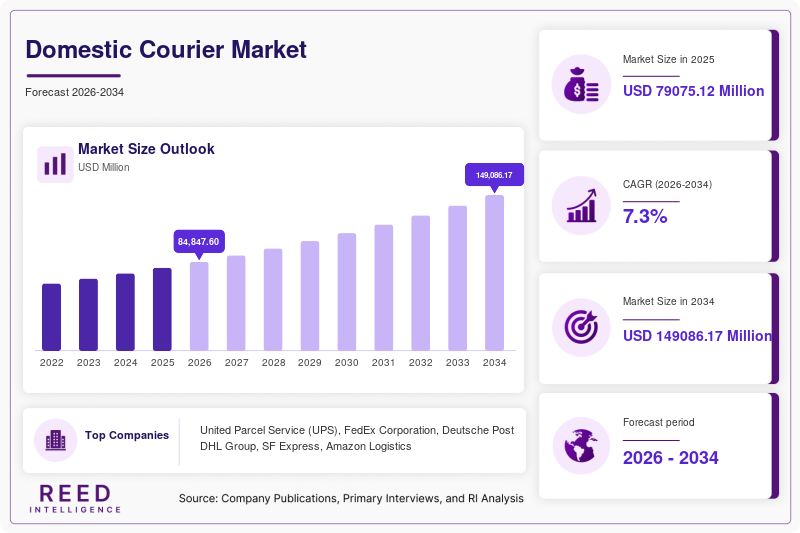
Domestic Courier market size is projected at USD 84,847.6 million in 2026 and is expected to hit USD 148,847.5 million by 2034 with a CAGR of 7.3% during the forecast period. The increasing volume of e-commerce transactions, the growing demand for faster and more reliable delivery services, and the expansion of logistics infrastructure, underpins market expansion. This report delivers a comprehensive analysis of the Domestic Courier market, including segmentation by type and application, competitive dynamics, and regional growth patterns, equipping stakeholders with critical intelligence. The Domestic Courier market continues to demonstrate strong growth potential, fueled by the rapid digitalization of retail, the increasing consumer expectation for convenience, and continuous innovation in delivery technologies and last-mile logistics.
Domestic courier services refer to the delivery of parcels, documents, and goods within a single country's borders. This market encompasses a wide range of services, from standard postal deliveries to express and same-day courier services, catering to businesses, governments, and individuals. The global domestic courier market is substantial, with the total number of domestic parcels exceeding 45 billion in 2025, reflecting a 9% increase from 2023, driven by the explosive growth of e-commerce and the increasing need for business logistics. Adoption patterns reveal that the Standard Delivery type dominates the market, accounting for 45% of total demand by volume, followed by Express Delivery at 35%, and Same-Day Delivery at 20%. The Domestic Courier market's trajectory is closely linked to the growth of the global e-commerce market, which is projected to reach USD 6 trillion by 2028, and the increasing demand for seamless and efficient last-mile delivery solutions.
Domestic Courier Market Trends
Adoption of Advanced Technology and Automation
The Domestic Courier market is witnessing a significant trend toward the adoption of advanced technology and automation, driven by the need for operational efficiency, real-time tracking, and enhanced customer experience. The revenue from technology-enabled courier services grew to USD 35 billion in 2025, a year-on-year increase of 15%, as 50% of new parcel shipments in 2025 were tracked using advanced GPS and IoT-based systems. Adoption rates of automated sorting and robotic warehousing in major courier hubs reached 35%, with this figure projected to exceed 60% by 2030. The Domestic Courier market's trend toward technology adoption is reinforced by the need for speed and accuracy, the increasing complexity of logistics, and the continuous innovation in AI, robotics, and data analytics.
Growing Focus on Sustainability and Green Delivery
The increasing focus on sustainability and green delivery is a major trend shaping the Domestic Courier market, with the development of eco-friendly packaging and the use of electric and alternative-fuel vehicles for last-mile delivery. The market has seen a 20% increase in the demand for sustainable courier services since 2022, with 30% of new delivery fleets in 2025 featuring electric or hybrid vehicles. The use of carbon-neutral shipping options and recyclable packaging has also gained significant traction. The Domestic Courier market's trend toward sustainability is reinforced by the growing consumer and regulatory pressure to reduce carbon emissions, the increasing focus on corporate social responsibility, and the continuous innovation in electric vehicle and sustainable packaging technologies.
Domestic Courier Market Drivers
The Domestic Courier market's expansion is primarily driven by the explosive growth of e-commerce, with global e-commerce sales exceeding USD 5 trillion in 2025 and continuing to grow at a rapid pace. The need for reliable, efficient, and fast parcel delivery to meet consumer expectations has been a major driver. The increasing demand for business-to-business (B2B) logistics and the expansion of supply chains have also fueled market growth. Additionally, the rising trend of online shopping and the convenience of home delivery have spurred demand. The Domestic Courier market's growth is further reinforced by the continuous improvement in logistics infrastructure, leading to better connectivity and faster transit times.
Domestic Courier Market Restraints
Despite favorable growth prospects, the Domestic Courier market faces significant constraints, primarily related to the high operational costs, including fuel, labor, and last-mile delivery expenses, which can impact profitability. The intense competition and price pressure, particularly in the express and same-day delivery segments, can also be a limitation. The Domestic Courier market's growth is also tempered by the challenges of managing delivery in congested urban areas, and the regulatory hurdles and infrastructure gaps in some regions.
Domestic Courier Market Opportunities
The Domestic Courier market presents significant opportunities in the rapidly expanding market for hyperlocal and on-demand delivery, where speed is of the essence. The development of automated micro-fulfillment centers and the use of drones and autonomous vehicles for delivery is expected to grow at a CAGR of 12% through 2034. Emerging opportunities also exist in the integration of courier services with advanced data analytics for route optimization and customer insights. The Domestic Courier market's opportunity profile is further enhanced by the growing trend of omnichannel retail and the increasing demand for personalized delivery experiences.
Challenges in Domestic Courier Market
The Domestic Courier market faces persistent challenges related to the need for continuous investment in technology and infrastructure to remain competitive. The complexity of managing last-mile logistics in diverse geographic and urban environments can also be a challenge. The market is also contending with the challenge of attracting and retaining skilled labor, including delivery drivers. Additionally, the Domestic Courier market is challenged by the need to manage the environmental impact of its operations and the increasing cost pressures from fuel and labor.
Domestic Courier Market Segmentation
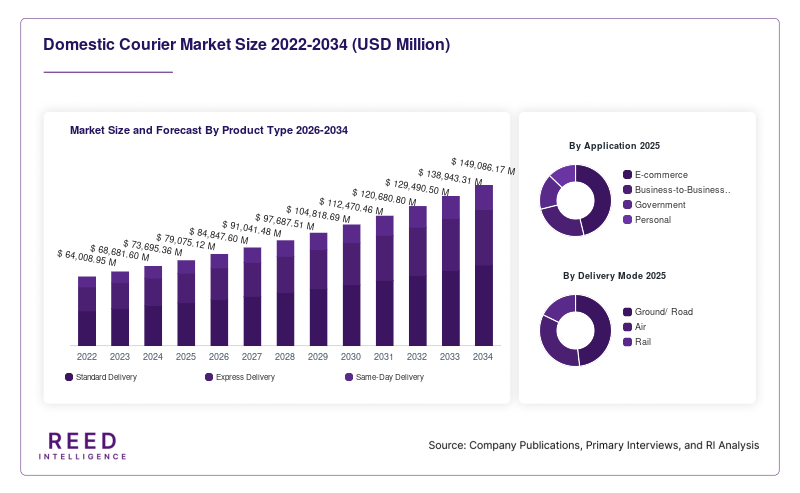
The Domestic Courier market is segmented by Type and Application to provide a comprehensive market perspective. By Type, Standard Delivery dominates with a 45% share, driven by its cost-effectiveness for non-urgent shipments. The Application segment is led by E-commerce, which accounts for 55% of the market, followed by Business-to-Business (B2B) at 25%, Personal at 12%, and Government at 8%.
By Type
Standard Delivery represent the largest segment in the Domestic Courier market by volume, commanding a 45% share, with the number of parcels exceeding 20.25 billion in 2025. These are characterized by their cost-effective, non-urgent delivery, typically taking 2-5 business days. Technical specifications include tracking, delivery confirmation, and various service levels. The Domestic Courier market's Standard segment is driven by its use in e-commerce and general business mail.
Express Delivery capture a 35% share of the Domestic Courier market, with parcels exceeding 15.75 billion in 2025. These are characterized by their faster delivery times, often within 24 hours. Technical specifications include priority handling, real-time tracking, and guaranteed delivery windows. The Domestic Courier market's Express segment is driven by its use in time-sensitive business and personal deliveries.
Same-Day Delivery represent the remaining 20% of the Domestic Courier market by volume, with parcels exceeding 9 billion in 2025. These are characterized by their ultra-fast delivery, often within hours. Technical specifications include real-time location tracking, specialized courier fleets, and integration with local dispatch. The Domestic Courier market's Same-Day segment is driven by its use in urgent e-commerce, food delivery, and essential medical logistics.
By Application
E-commerce dominates the Domestic Courier market, accounting for 55% of parcel volume, representing 24.75 billion parcels in 2025. This segment includes use in online retail and marketplace deliveries. Usage penetration exceeds 60% in the sector. The Domestic Courier market's E-commerce segment is characterized by its focus on speed, reliability, and customer satisfaction.
Business-to-Business (B2B) accounts for 25% of the Domestic Courier market, with parcel volume of 11.25 billion in 2025. This segment encompasses use in corporate logistics, supply chain, and document exchange. The segment is growing at a steady CAGR, driven by business operations. The Domestic Courier market's B2B segment is characterized by its focus on reliability, security, and efficiency.
Personal represents 12% of the Domestic Courier market, with parcel volume of 5.4 billion in 2025. This segment includes use by individuals for personal shipments. The segment is growing at a moderate rate. The Domestic Courier market's Personal segment is characterized by its focus on convenience and affordability.
Government comprises the remainder of the Domestic Courier market, accounting for 8% of total parcel volume, with 3.6 billion in 2025. This includes use for official documents and government logistics. The segment is projected to grow at a steady CAGR through 2034. The Domestic Courier market's Government segment is characterized by its focus on security and reliability.
Domestic Courier Market Regional Outlook
Asia-Pacific Domestic Courier Market
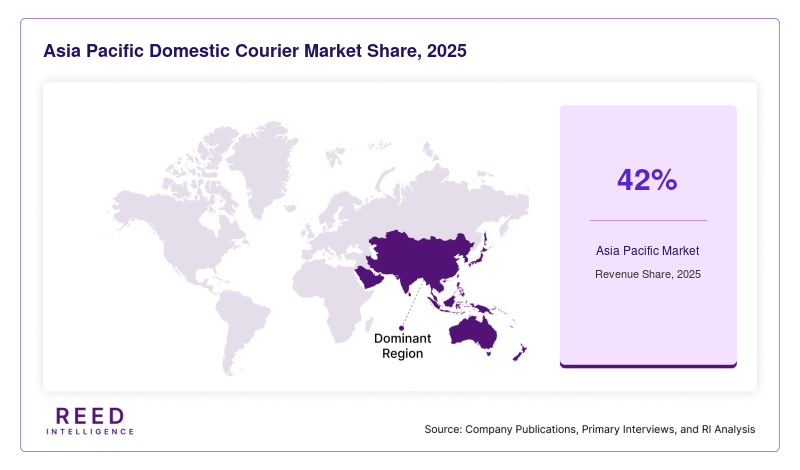
Leads the Domestic Courier market, commanding a 42% share of global parcel volume, with a revenue of USD 35.6 billion in 2025. China is the primary driver, accounting for 60% of regional demand, driven by the massive e-commerce market, rapid urbanization, and strong logistics infrastructure. The Asia-Pacific Domestic Courier market is characterized by its focus on high-volume, cost-effective solutions.
North America Domestic Courier Market
Represents the second-largest market, capturing a 25% share with a revenue of USD 21.2 billion in 2025. The United States is the primary driver, accounting for 85% of regional demand, driven by the mature e-commerce market, high consumer spending, and a well-developed logistics network. The North American Domestic Courier market is characterized by its focus on speed, technology, and premium services.
Europe Domestic Courier Market
Accounts for 20% of the global Domestic Courier market, with a revenue of USD 16.9 billion in 2025. The UK, Germany, and France are the primary drivers, collectively accounting for 60% of regional demand, driven by a strong e-commerce sector, dense population, and high logistics standards. The European Domestic Courier market is projected to grow at a CAGR of 6% through 2034.
Middle East & Africa and Latin America Domestic Courier Market
Together account for the remaining 13% of the Domestic Courier market, with the UAE leading the Middle East market and Brazil leading the Latin American market. Both regions are projected to grow at CAGRs exceeding 8%, driven by e-commerce growth and logistics infrastructure development.
Top players in Domestic Courier Market
- United Parcel Service (UPS)
- FedEx Corporation
- Deutsche Post DHL Group
- SF Express
- Amazon Logistics
- Royal Mail
- USPS (United States Postal Service)
- La Poste
- Japan Post
- China Post
- DPD Group (GeoPost)
- Hermes (Otto Group)
- Yodel
- Blue Dart (DHL)
- FedEx Office
United Parcel Service (UPS)
UPS holds a dominant position in the Domestic Courier market, with an estimated 15% global market share, particularly strong in the North American and European express and standard delivery segments. The company's portfolio of domestic courier services is widely recognized for its reliability, global reach, and innovative technology. UPS's market leadership is reinforced by its significant investment in logistics infrastructure, its strong brand reputation, and its comprehensive service offerings. UPS commands over 20% of the North American market and 12% of the European market, positioning it as a key player in the Domestic Courier market.
FedEx Corporation
FedEx Corporation is a leading player in the Domestic Courier market, commanding approximately 12% of the global market share through its comprehensive portfolio of express and ground delivery services. The company's expertise in logistics and its focus on speed and technology have solidified its position. FedEx's domestic courier services are known for their reliability, tracking capabilities, and global network. The company's commitment to innovation and its strong presence in the North American and European markets have enhanced its competitive advantage.
Deutsche Post DHL Group holds a significant 10% market share, with particular strength in the European and global logistics market. SF Express is a major player in the Chinese domestic courier market, holding an 8% share.
Recent Developments in Domestic Courier Market
- 2025: UPS announced a major expansion of its electric delivery fleet, targeting sustainable last-mile delivery in urban areas.
- 2025: FedEx launched a new AI-powered route optimization system to improve delivery efficiency and reduce fuel consumption.
Domestic Courier Market Segments
By Product Type
- Standard Delivery
- Express Delivery
- Same-Day Delivery
By Application
- E-commerce
- Business-to-Business (B2B)
- Government
- Personal
By Delivery Mode
- Ground/ Road
- Air
- Rail
By Region
- North America
- Europe
- APAC
- Middle East and Africa
- LATAM