Domestic Refrigerator Sales Market Size, Share & Demand Report By Product Type (Top Freezer Refrigerators, Bottom Freezer Refrigerators, Side-by-Side Refrigerators, French Door Refrigerators, Smart Refrigerators), By Distribution Channel (Offline Retail, Online Retail), By Capacity (Below 250 Liters, 250–500 Liters, Above 500 Liters), By Region & Segment Forecasts, 2026–2034
USD 3950
Market Overview
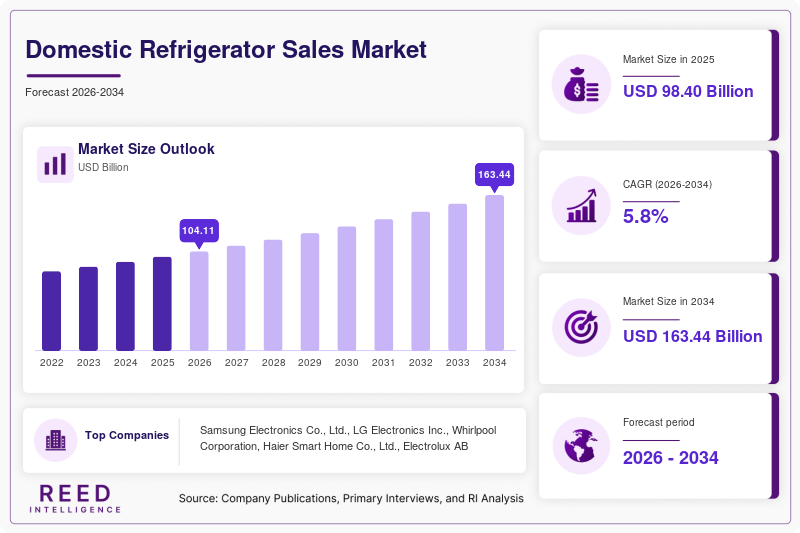
The global Domestic Refrigerator Sales Market size was valued at USD 98.4 billion in 2026 and is projected to reach USD 154.7 billion by 2034, expanding at a CAGR of 5.8% during the forecast period. Rising urbanization, growing household electrification, and increasing consumer preference for energy-efficient appliances continue to support steady market expansion across developed and emerging economies. Refrigerators have evolved from basic cooling appliances into connected and multifunctional household systems that support food preservation, smart inventory tracking, and energy optimization. This transformation has encouraged replacement purchases and increased adoption among middle-income households.
The market has also benefited from rapid growth in residential construction activity and higher disposable income levels across Asia Pacific, Latin America, and parts of the Middle East. Manufacturers are introducing inverter-based compressors, AI-enabled temperature controls, and eco-friendly refrigerants to comply with evolving environmental standards and improve operational efficiency. The increasing penetration of e-commerce platforms has further enhanced product visibility and expanded consumer access to premium refrigerator models. In addition, demand for compact refrigerators in urban apartments and premium side-by-side models in developed countries has diversified the overall product mix.
Key Highlights
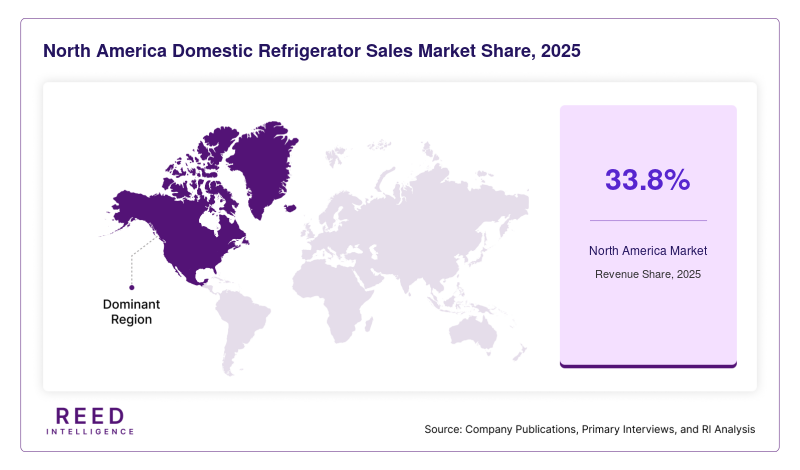
- North America dominated the market with a 33.8% share in 2025, while Asia Pacific is expected to grow at the fastest CAGR of 7.4% during 2026–2034.
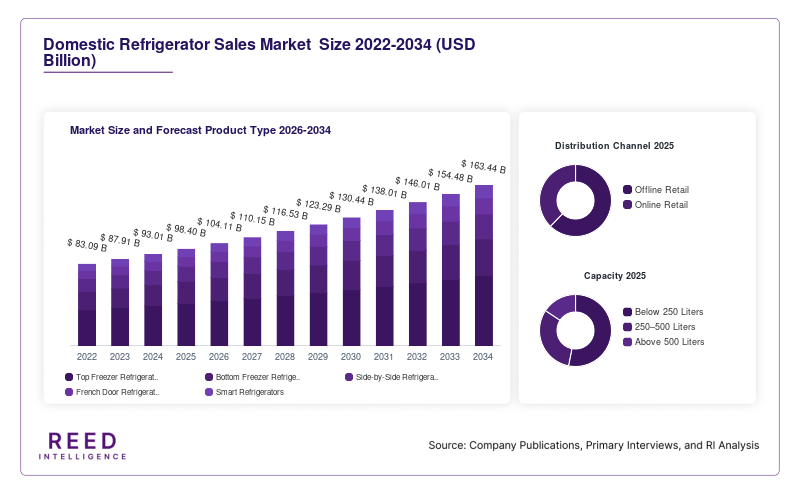
- By product type, top freezer refrigerators accounted for the largest share of 36.9%, while smart refrigerators are projected to grow at a CAGR of 9.2%.
- By distribution channel, offline retail led with a 71.4% share, whereas online retail is expected to expand at a CAGR of 10.1%.
- By capacity, 250–500 liters held the leading share of 44.3%, while above 500 liters is anticipated to grow at a CAGR of 8.1%.
- The United States remained the dominant country, with market values of USD 18.7 billion in 2024 and USD 19.6 billion in 2025.
Market Trends
Smart refrigerator integration reshaping consumer purchasing patterns
The Domestic Refrigerator Sales Market is witnessing strong momentum from the integration of smart home technologies into household appliances. Consumers are increasingly adopting refrigerators equipped with touchscreen interfaces, voice assistant compatibility, inventory management systems, and remote temperature monitoring capabilities. These features provide convenience and improve energy management, making smart refrigerators more attractive among urban consumers. Manufacturers are focusing on connected ecosystems that synchronize with smartphones and other kitchen appliances, supporting wider adoption across premium residential segments. The trend is particularly visible in North America, South Korea, Japan, and China, where consumers show strong interest in intelligent home automation products.
Retailers are also promoting premium refrigerator categories through digital campaigns and bundled smart appliance packages, encouraging replacement purchases. The inclusion of AI-driven cooling systems and predictive maintenance alerts is improving appliance efficiency and extending product life cycles. Increasing internet penetration and consumer familiarity with connected devices are likely to sustain demand for technologically advanced refrigerators over the forecast period. As competition intensifies, companies are differentiating products through software upgrades, personalized cooling settings, and enhanced food preservation technologies.
Demand for energy-efficient appliances driving product innovation
Growing environmental awareness and stricter energy consumption regulations are accelerating the shift toward energy-efficient refrigerators. Governments in several countries are implementing labeling programs and efficiency standards that encourage households to replace older appliances with low-power alternatives. Consumers are increasingly prioritizing long-term electricity savings, leading to higher adoption of inverter compressor refrigerators and eco-friendly refrigerants. Manufacturers are responding by introducing appliances designed to reduce energy usage while maintaining high cooling performance.
The trend is particularly strong in Europe and parts of Asia Pacific where sustainability regulations are influencing appliance purchasing decisions. Refrigerator producers are investing in advanced insulation technologies, variable-speed compressors, and recyclable materials to improve product efficiency and reduce environmental impact. Energy-efficient models are also gaining traction in emerging economies due to rising electricity costs and increasing awareness of sustainable living practices. This shift is creating opportunities for premium product categories while encouraging continuous innovation across the Domestic Refrigerator Sales Market.
Market Drivers
Expanding urban population and residential infrastructure development
Rapid urbanization and residential construction activity are major factors supporting growth in the Domestic Refrigerator Sales Market. Growing migration toward urban centers has increased the number of nuclear families and apartment households, creating sustained demand for essential kitchen appliances. Developing economies across Asia Pacific, Latin America, and Africa are experiencing rising household formation rates, which continue to support refrigerator sales in both affordable and mid-range product categories. Real estate expansion and improved access to electricity in semi-urban regions are further contributing to broader appliance adoption.
Consumers are also seeking refrigerators that align with modern interior designs and space-efficient kitchens. This has increased demand for compact refrigerators, double-door systems, and modular storage configurations. Appliance manufacturers are partnering with retail chains and real estate developers to strengthen market penetration and improve product accessibility. Financing options, exchange offers, and seasonal discounts are encouraging first-time buyers and replacement purchases, especially in price-sensitive markets. The steady increase in disposable income among middle-class consumers is expected to maintain positive growth momentum during the forecast period.
Growth of organized retail and e-commerce distribution channels
The expansion of organized retail networks and online shopping platforms has significantly improved accessibility in the Domestic Refrigerator Sales Market. Consumers now have access to wider product selections, competitive pricing, product comparisons, and doorstep delivery services. E-commerce platforms have become increasingly important in driving refrigerator sales, especially among younger consumers and urban households. Online retailers are using digital marketing campaigns, customer reviews, and financing schemes to influence purchasing decisions and accelerate product adoption.
Large appliance brands are strengthening omnichannel strategies to improve customer engagement and maintain consistent sales growth. Offline retailers continue to dominate total sales due to the importance of product demonstrations and installation support, but digital channels are expanding rapidly across emerging markets. Improved logistics infrastructure and same-day delivery capabilities are further supporting online appliance purchases. Seasonal promotional campaigns during festive periods and shopping events have also contributed to higher sales volumes. These developments are helping manufacturers increase market reach and strengthen consumer trust across multiple distribution platforms.
Market Restraint
Volatility in raw material prices and supply chain disruptions
Fluctuations in the prices of raw materials such as steel, aluminum, copper, and plastics remain a major challenge for manufacturers operating in the Domestic Refrigerator Sales Market. Production costs are highly sensitive to changes in global commodity pricing, which can reduce profit margins and increase retail prices for consumers. In recent years, transportation delays, semiconductor shortages, and disruptions in component sourcing have affected production schedules and inventory availability across several appliance manufacturers.
Supply chain instability has also impacted the availability of compressors, electronic control systems, and insulation materials required for advanced refrigerator models. Smaller manufacturers often face greater financial pressure because they have limited capacity to absorb rising procurement and logistics costs. Higher production expenses can discourage price-sensitive consumers from purchasing premium or energy-efficient refrigerators, particularly in emerging markets. In addition, geopolitical tensions and trade restrictions may affect cross-border supply networks and increase operational uncertainty. These factors create challenges for maintaining stable pricing structures and consistent product availability within the global Domestic Refrigerator Sales Market.
Market Opportunities
Rising adoption of premium and multi-door refrigerator categories
The increasing preference for premium kitchen appliances is creating significant opportunities within the Domestic Refrigerator Sales Market. Consumers with higher disposable incomes are showing strong interest in side-by-side, French door, and multi-door refrigerators that offer larger storage capacity and advanced cooling technologies. Premium models are gaining traction due to features such as customizable compartments, humidity control systems, touch displays, and smart connectivity. Demand is especially strong in metropolitan regions where consumers prioritize convenience, modern aesthetics, and high-performance appliances.
Manufacturers are introducing differentiated product portfolios to capture premium household segments and strengthen brand positioning. The integration of antimicrobial coatings, beverage centers, and flexible storage configurations is encouraging consumers to upgrade existing appliances. Growing awareness regarding food preservation and reduced food wastage is also contributing to demand for technologically advanced refrigerators. As urban lifestyles evolve and consumers invest more in home improvement products, premium refrigerator categories are expected to create profitable growth opportunities for industry participants.
Expansion potential in emerging rural and semi-urban markets
Emerging rural and semi-urban regions present considerable long-term growth opportunities for the Domestic Refrigerator Sales Market. Increasing electrification, rising household income, and government initiatives supporting rural infrastructure development are improving access to consumer appliances in underserved areas. Many households in developing countries are purchasing refrigerators for the first time, particularly in India, Indonesia, Brazil, and parts of Africa. Manufacturers are responding by launching affordable and energy-efficient models tailored to local purchasing power and electricity availability.
Distribution expansion through regional dealers, mobile retail outlets, and digital commerce platforms is helping brands penetrate previously untapped markets. Localized manufacturing strategies are also reducing product costs and improving supply chain efficiency. Seasonal demand for refrigeration during warmer climates and growing awareness of food safety are further encouraging adoption in rural communities. Companies that invest in durable products, flexible financing schemes, and after-sales service networks are likely to strengthen their competitive position and capture substantial future demand across emerging economies.
Segmental Analysis
By Product Type
Top freezer refrigerators accounted for the largest share of the Domestic Refrigerator Sales Market in 2024, representing 36.9% of total revenue. The segment maintains strong popularity because of its affordability, simple design, and broad availability across developed and emerging markets. Consumers in price-sensitive regions continue to prefer top freezer models due to lower upfront costs and reduced maintenance requirements. Manufacturers are enhancing these products with inverter compressors, improved storage compartments, and better cooling performance to maintain competitiveness. The segment is particularly strong among first-time buyers and households seeking reliable refrigeration solutions for everyday food storage. Retail chains continue to promote top freezer refrigerators through seasonal discounts and financing options, further supporting widespread adoption.
Smart refrigerators are projected to witness the fastest CAGR of 9.2% during the forecast period due to rising demand for connected household appliances and advanced food management features. Consumers increasingly value refrigerators with Wi-Fi connectivity, touchscreen displays, internal cameras, and voice assistant integration. Premium households are adopting these appliances to improve convenience and support smart home ecosystems. Manufacturers are investing heavily in software upgrades and AI-enabled cooling technologies that optimize temperature settings and energy consumption. The growth of digital lifestyles and increasing consumer familiarity with connected devices are supporting adoption across urban markets. Rising competition among premium appliance brands is also accelerating innovation and reducing prices for smart refrigerator models.
By Distribution Channel
Offline retail dominated the Domestic Refrigerator Sales Market in 2024 with a share of 71.4% due to strong consumer preference for physical product evaluation before purchase. Appliance showrooms, electronic retail stores, and hypermarkets continue to attract customers because they provide hands-on demonstrations, installation guidance, and immediate customer support. Consumers often compare refrigerator sizes, storage layouts, and cooling features in person before making purchasing decisions. Retailers are strengthening customer engagement through promotional discounts, exchange programs, and financing solutions that encourage higher sales volumes. Established distribution partnerships between manufacturers and retail chains also ensure product availability across urban and semi-urban markets. The offline segment remains particularly important for premium refrigerator categories where consumers seek personalized consultations.
Online retail is expected to expand at the fastest CAGR of 10.1% during 2026–2034 owing to increasing internet penetration and rapid growth in e-commerce adoption. Consumers are increasingly purchasing refrigerators online due to convenience, competitive pricing, and access to extensive product information. Digital platforms allow customers to compare specifications, customer reviews, and energy ratings before finalizing purchases. Online retailers are improving delivery logistics, installation services, and return policies to strengthen customer confidence. Flash sales, festive discounts, and digital financing schemes are further supporting growth in online appliance sales. The expansion of smartphone usage and digital payment infrastructure across emerging economies is likely to accelerate online refrigerator purchases over the forecast period.
By Capacity
Refrigerators with capacities ranging from 250–500 liters held the leading share of 44.3% in the Domestic Refrigerator Sales Market in 2024. This segment remains highly preferred among medium-sized households because it offers balanced storage capacity, affordability, and energy efficiency. Consumers view these refrigerators as suitable for daily food storage requirements while maintaining manageable electricity consumption. Manufacturers are introducing flexible shelving systems, convertible compartments, and frost-free technologies within this category to improve consumer appeal. The segment performs strongly in urban apartments and suburban households where kitchen space and storage needs are moderate. Retailers also promote 250–500 liter refrigerators aggressively due to high consumer demand and broad price range availability.
The above 500 liters segment is anticipated to register the fastest CAGR of 8.1% throughout the forecast period due to increasing demand for premium and large-capacity refrigeration systems. Growing consumer interest in bulk food storage, luxury kitchen designs, and multifunctional appliances is supporting demand for larger refrigerator models. Side-by-side and French door refrigerators are becoming increasingly popular among higher-income households and large families. Manufacturers are equipping these appliances with advanced cooling systems, smart connectivity, and customizable storage configurations to strengthen product differentiation. Rising disposable income levels and expanding residential kitchen spaces in urban areas are expected to support long-term growth for high-capacity refrigerators within the global market.
Regional Analysis
North America
North America accounted for 33.8% of the global Domestic Refrigerator Sales Market in 2025 and is expected to maintain steady growth at a CAGR of 4.9% through 2034. The region benefits from high household appliance penetration, strong consumer purchasing power, and stable replacement demand. Consumers increasingly prefer smart and energy-efficient refrigerator models equipped with advanced cooling technologies and integrated digital features. Strong adoption of premium kitchen appliances and established retail infrastructure continue to support consistent sales growth across the United States and Canada.
The United States remained the dominant country within the regional market due to high replacement rates and widespread adoption of connected home appliances. Growing interest in sustainable living and energy-efficient appliances is encouraging consumers to replace older refrigeration systems with inverter-based models. The presence of major manufacturers and organized retail chains further supports innovation and product availability. Increasing renovation activities and demand for luxury kitchen designs are also contributing to higher sales of premium refrigerator categories.
Europe
Europe represented 24.1% of the Domestic Refrigerator Sales Market in 2025 and is projected to expand at a CAGR of 4.7% during the forecast period. The regional market is influenced by strict energy efficiency regulations and growing consumer awareness regarding environmentally sustainable appliances. Demand for refrigerators with low energy consumption and eco-friendly refrigerants has increased significantly across residential households. Manufacturers are focusing on compact and integrated refrigerator models designed for modern urban kitchens and smaller living spaces.
Germany remained the leading country in the European market due to strong appliance manufacturing capabilities and high consumer spending on technologically advanced home products. The country's emphasis on sustainable energy consumption has accelerated the adoption of premium refrigerators with improved insulation and smart cooling systems. Retailers are increasingly promoting energy-rated appliances through government-backed awareness campaigns. Continuous innovation in product design and the growing popularity of built-in kitchen appliances are supporting market expansion across the region.
Asia Pacific
Asia Pacific held 28.6% of the global Domestic Refrigerator Sales Market in 2025 and is expected to record the fastest CAGR of 7.4% from 2026 to 2034. Rapid urbanization, expanding middle-class populations, and increasing residential construction activity are driving refrigerator demand across the region. Rising disposable income and changing consumer lifestyles are encouraging higher adoption of double-door and smart refrigerator models. E-commerce growth and expanding retail networks are also improving accessibility to branded appliances in emerging economies.
China dominated the Asia Pacific market due to large-scale appliance manufacturing capacity and strong domestic consumer demand. The country's growing focus on smart homes and energy-efficient appliances has encouraged continuous innovation in refrigerator technologies. Government incentives supporting energy-saving products and rising urban housing projects are further strengthening market growth. In addition, local manufacturers are expanding exports and introducing competitively priced refrigerators to meet increasing regional demand.
Middle East & Africa
The Middle East & Africa accounted for 6.2% of the Domestic Refrigerator Sales Market in 2025 and is projected to grow at a CAGR of 5.6% during the forecast period. Increasing urbanization, expanding retail infrastructure, and rising residential development projects are contributing to refrigerator demand across the region. Consumers are gradually shifting toward energy-efficient and larger-capacity appliances due to changing lifestyles and increasing household income levels. High temperatures across several countries also support consistent demand for refrigeration products.
Saudi Arabia emerged as the dominant country within the regional market due to strong residential construction activity and growing consumer expenditure on home appliances. Government initiatives supporting economic diversification and infrastructure development are creating favorable conditions for appliance sales. The expansion of organized retail outlets and online commerce platforms is improving access to international refrigerator brands. Rising tourism-related residential projects and smart city developments are also supporting long-term demand growth.
Latin America
Latin America captured 7.3% of the Domestic Refrigerator Sales Market in 2025 and is anticipated to grow at a CAGR of 5.3% through 2034. Demand for household refrigeration appliances is increasing due to improving economic conditions and higher urban household formation rates. Consumers are increasingly replacing outdated refrigerators with energy-efficient models to reduce electricity expenses. Manufacturers are expanding affordable product offerings and strengthening regional distribution channels to improve market penetration.
Brazil remained the dominant country in Latin America because of its large consumer base and expanding middle-income population. The country has experienced growing demand for frost-free refrigerators and mid-capacity appliances suited for urban households. Government energy-efficiency initiatives and improving retail financing options are encouraging consumers to purchase modern appliances. In addition, rising awareness regarding food preservation and convenience-oriented kitchen products continues to support refrigerator sales growth across the Brazilian market.
Competitive Landscape
The Domestic Refrigerator Sales Market is characterized by strong competition among multinational appliance manufacturers focusing on technological innovation, energy efficiency, and expanded retail presence. Leading companies are investing in smart refrigerator technologies, sustainable refrigerants, and advanced compressor systems to strengthen product differentiation and maintain market share. Competition is also increasing in emerging economies where local manufacturers are introducing cost-effective refrigeration solutions tailored to regional consumer preferences.
Samsung Electronics Co., Ltd. remained a leading participant in the market due to its strong smart appliance portfolio and global retail network. The company recently expanded its AI-enabled refrigerator lineup featuring connected kitchen management systems and enhanced energy optimization capabilities. Other major companies including LG Electronics, Whirlpool Corporation, Haier Smart Home, and Electrolux AB continue to invest in premium product development and regional manufacturing expansion. Companies are increasingly adopting omnichannel distribution strategies and strengthening after-sales service capabilities to improve customer retention and long-term competitiveness.
Key Players
- Samsung Electronics Co., Ltd.
- LG Electronics Inc.
- Whirlpool Corporation
- Haier Smart Home Co., Ltd.
- Electrolux AB
- Panasonic Holdings Corporation
- Hitachi, Ltd.
- Godrej Appliances
- Bosch Home Appliances
- Midea Group
- Sharp Corporation
- Toshiba Lifestyle Products & Services Corporation
- Hisense Group
- Arcelik A.S.
- GE Appliances
Recent Developments
- Samsung Electronics Co., Ltd. introduced a new AI-powered refrigerator series in 2025 featuring energy monitoring systems and integrated smart kitchen connectivity.
- LG Electronics expanded its manufacturing capacity in Southeast Asia in 2025 to improve regional supply chain efficiency and support rising refrigerator demand.
- Whirlpool Corporation launched an advanced inverter-based refrigerator portfolio in 2024 focused on reducing household energy consumption and improving cooling performance.
- Haier Smart Home announced a strategic partnership with regional e-commerce platforms in 2025 to strengthen online appliance sales across emerging markets.
- Electrolux AB introduced refrigerators using low-global-warming-potential refrigerants in 2024 to align with evolving environmental sustainability regulations.
Domestic Refrigerator Sales Market Segments
Product Type
- Top Freezer Refrigerators
- Bottom Freezer Refrigerators
- Side-by-Side Refrigerators
- French Door Refrigerators
- Smart Refrigerators
Distribution Channel
- Offline Retail
- Online Retail
Capacity
- Below 250 Liters
- 250–500 Liters
- Above 500 Liters
By Region
- North America
- Europe
- APAC
- Middle East and Africa
- LATAM