Door Stopper Market Size, Share & Demand Report By Product Type (Wall-Mounted Door Stoppers, Floor-Mounted Door Stoppers, Magnetic Door Stoppers, Hinge Pin Door Stoppers, Others), By Material (Stainless Steel, Rubber, Silicone, Aluminum, Others), By End Use (Residential, Commercial, Industrial), By Region & Segment Forecasts, 2026–2034
USD 3950
Market Overview
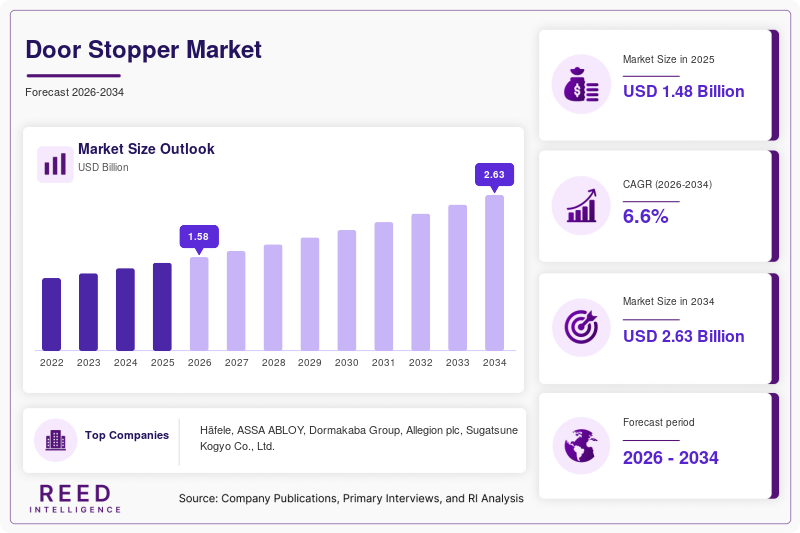
The global Door Stopper Market size was valued at USD 1.48 billion in 2026 and is projected to reach USD 2.46 billion by 2034, expanding at a CAGR of 6.6% during the forecast period from 2026 to 2034. The market continues to witness steady demand due to rising construction activities, increasing investments in commercial infrastructure, and growing consumer focus on interior safety and convenience products. Door stoppers are widely used across residential, hospitality, healthcare, educational, and industrial facilities to prevent wall damage, reduce noise, and improve operational safety. Demand has also increased with the expansion of modern housing projects and renovation activities across urban areas.
One of the major global factors supporting market growth is the rapid increase in smart and modular infrastructure development. Builders and property developers are increasingly integrating durable and aesthetically designed hardware accessories into residential and commercial spaces. Door stoppers made from stainless steel, rubber, magnetic alloys, and smart sensor-based materials are gaining wider acceptance due to their durability and compatibility with modern interiors. Manufacturers are also introducing antimicrobial and noise-reduction door stoppers for hospitals, offices, and educational institutions, which is creating additional revenue opportunities across developed and emerging economies.
Key Highlights
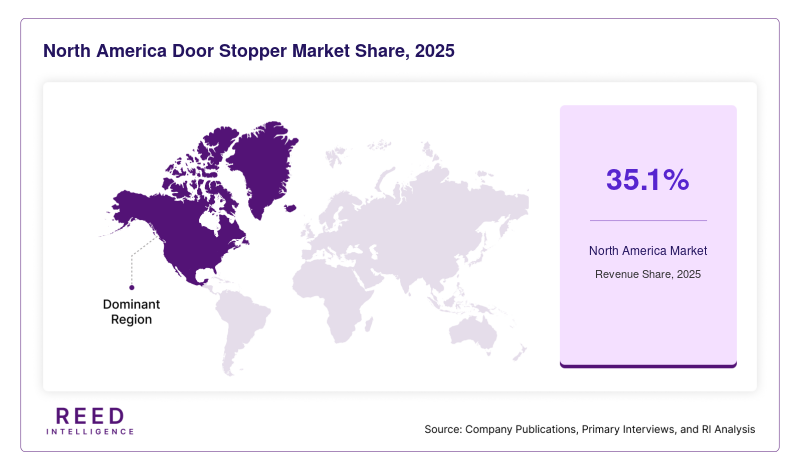
- North America dominated the market with a 35.1% share in 2025.
- Asia Pacific is expected to grow at the fastest CAGR of 8.4% during 2026–2034.
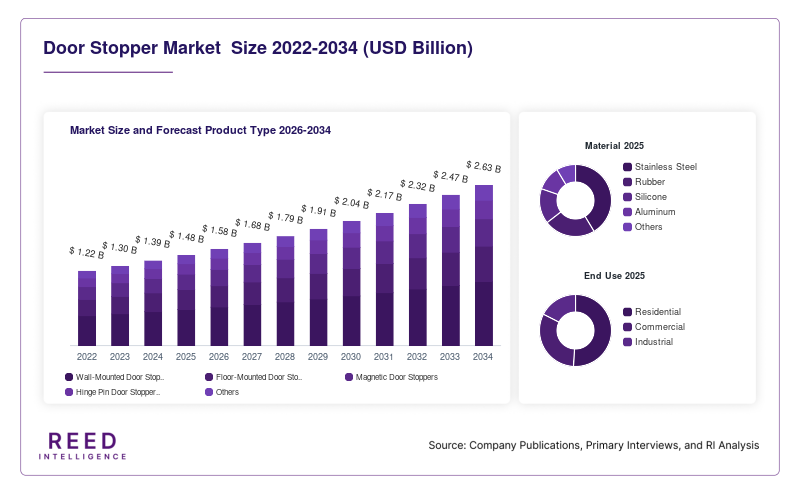
- By product type, wall-mounted door stoppers accounted for the largest share of 39.4%, while magnetic door stoppers are projected to grow at a CAGR of 9.1%.
- By material, stainless steel led with a 42.8% share, whereas silicone-based door stoppers are expected to expand at a CAGR of 8.8%.
- The United States remained the dominant country, with market values of USD 392 million in 2024 and USD 418 million in 2025.
Market Trends
Rising Preference for Aesthetic and Designer Hardware Accessories
Consumer preferences in residential and commercial construction projects are shifting toward visually appealing and premium-quality hardware products. Door stoppers are no longer viewed only as functional accessories but are increasingly becoming part of modern interior design strategies. Manufacturers are introducing compact, concealed, and decorative door stopper designs that align with luxury housing and office interiors. Stainless steel finishes, matte black coatings, brushed nickel textures, and minimalist magnetic variants are witnessing strong demand among architects and interior designers. This trend is especially visible in urban residential projects, hotels, and premium office spaces where appearance and functionality are equally important. Increasing spending on remodeling activities and smart home upgrades is expected to maintain demand for aesthetically advanced door stopper products over the coming years.
Increasing Adoption of Smart and Noise-Reduction Door Stoppers
The integration of smart technologies into home and commercial hardware products is influencing the Door Stopper Market significantly. Smart magnetic door stoppers equipped with soft-close mechanisms and motion-sensitive functions are gaining traction in commercial buildings and healthcare facilities. Demand for silent and shock-absorbing door stopper systems has increased due to the growing focus on reducing indoor noise pollution in hospitals, educational institutions, and office environments. Manufacturers are also developing antimicrobial and eco-friendly door stoppers to address hygiene concerns in healthcare infrastructure. The expansion of smart building projects and increasing awareness regarding indoor safety solutions are encouraging consumers and builders to invest in technologically advanced door stopper products with improved durability and operational efficiency.
Market Drivers
Expansion of Residential and Commercial Construction Activities
Rapid urbanization and infrastructure expansion are major factors driving the Door Stopper Market globally. Governments and private investors are increasing spending on residential complexes, office buildings, hotels, hospitals, and educational institutions, which is directly supporting demand for interior hardware products. Door stoppers are considered essential components for preventing wall damage, protecting furniture, and improving safety within indoor environments. Emerging economies in Asia Pacific, Latin America, and the Middle East are witnessing rising housing development projects, leading to higher installation volumes of door accessories. In addition, increasing renovation and remodeling activities across mature markets such as the United States, Germany, and Japan are contributing to replacement demand for modern and durable door stopper systems.
Growing Demand for Safety and Convenience Solutions
Consumers and commercial property owners are placing greater emphasis on safety, accessibility, and operational convenience within indoor spaces. Door stoppers help reduce accidental door slamming, protect children and elderly individuals from injuries, and improve accessibility in healthcare and hospitality facilities. This growing awareness regarding preventive safety measures is increasing the adoption of high-quality and shock-resistant door stopper products. Industrial facilities are also deploying heavy-duty door stoppers to protect equipment and improve workplace safety standards. Furthermore, regulations related to accessibility and public safety in commercial buildings are encouraging contractors and facility managers to install efficient door control accessories. The increasing focus on functional interior products is expected to support long-term market demand across multiple end-use sectors.
Market Restraint
Availability of Low-Cost Unorganized Products Affecting Premium Sales
The presence of low-cost and unorganized manufacturers remains a major challenge for the Door Stopper Market. Several regional suppliers offer inexpensive products made from low-quality rubber, plastic, or lightweight metals, creating intense pricing pressure for established manufacturers. These products often compromise on durability, corrosion resistance, and design quality, yet continue to attract price-sensitive consumers in developing economies. The availability of counterfeit and imitation products through local retail channels further affects brand positioning and profitability for organized companies. In addition, fluctuating raw material prices for stainless steel, aluminum, and silicone create cost-related challenges for premium product manufacturers. This pricing imbalance limits the adoption of advanced and technologically enhanced door stopper products, particularly in cost-sensitive construction projects. The growing competition from inexpensive imports also reduces the market share of established companies that invest heavily in innovation, branding, and product quality improvements.
Market Opportunities
Growth Potential in Smart Home Infrastructure Development
The rapid expansion of smart home ecosystems presents significant growth opportunities for the Door Stopper Market. Consumers are increasingly adopting automated and connected home accessories that improve convenience, safety, and energy efficiency. Smart door stoppers integrated with magnetic sensors, automated locking systems, and soft-close mechanisms are gaining popularity among urban homeowners and commercial property developers. These products help reduce noise, prevent wall damage, and improve accessibility while supporting modern smart interior concepts. The increasing penetration of IoT-enabled home devices and rising disposable incomes in emerging economies are encouraging manufacturers to develop technologically advanced product lines. Strategic collaborations between hardware manufacturers and smart home solution providers are also expected to create new revenue opportunities during the forecast period.
Increasing Demand for Sustainable and Eco-Friendly Materials
Sustainability trends are creating favorable opportunities for manufacturers focusing on eco-friendly door stopper products. Consumers and commercial developers are becoming more conscious about environmentally responsible construction materials and interior accessories. As a result, demand for recyclable silicone, biodegradable rubber compounds, and low-emission metal products is increasing steadily. Green building certifications and sustainable construction practices are further encouraging builders to adopt environmentally compliant hardware accessories. Manufacturers investing in recycled materials and energy-efficient production processes are expected to strengthen their market position over the coming years. In addition, governments across Europe and North America are promoting sustainable infrastructure development, which is likely to accelerate the adoption of eco-friendly door stopper products in residential and commercial applications.
Segmental Analysis
By Product Type
Wall-mounted door stoppers accounted for the largest share of the Door Stopper Market in 2024, representing approximately 39.4% of total revenue. These products are widely preferred across residential and commercial applications due to their compact design, ease of installation, and ability to prevent wall damage effectively. Wall-mounted variants are commonly used in hotels, hospitals, educational institutions, and office spaces where controlled door movement is essential for operational safety. Manufacturers are increasingly offering stainless steel and decorative wall-mounted products with modern finishes to match contemporary interior designs. Their durability, affordability, and compatibility with various door materials continue to support widespread adoption across both developed and emerging economies.
Magnetic door stoppers are expected to witness the fastest growth during the forecast period, expanding at a CAGR of 9.1%. These products are gaining popularity due to their advanced functionality, silent operation, and improved safety features. Magnetic systems are increasingly used in smart homes, premium apartments, healthcare facilities, and commercial buildings where noise reduction and operational convenience are important considerations. Manufacturers are integrating soft-close and sensor-based technologies into magnetic door stoppers to improve user experience and product efficiency. The growing adoption of smart building infrastructure and increasing consumer preference for premium hardware accessories are expected to accelerate demand for technologically enhanced magnetic door stopper systems globally.
By Material
Stainless steel emerged as the dominant material segment in 2024, accounting for nearly 42.8% of the global market share. Stainless steel door stoppers are widely preferred due to their durability, corrosion resistance, and compatibility with modern architectural designs. Commercial facilities, hotels, healthcare institutions, and luxury residential projects frequently utilize stainless steel variants because of their long service life and low maintenance requirements. Manufacturers continue to introduce brushed, polished, and matte-finish stainless steel products to address rising consumer demand for premium interior accessories. The material’s strength and resistance to environmental conditions also make it suitable for high-traffic areas and industrial applications, contributing to sustained market leadership.
Silicone-based door stoppers are projected to record the fastest CAGR of 8.8% during the forecast period. Consumers are increasingly choosing silicone products because of their flexibility, shock absorption capability, and environmentally friendly characteristics. Silicone variants are especially popular in households with children and elderly individuals as they reduce noise and minimize injury risks. Growing awareness regarding sustainable and recyclable materials is also supporting adoption across residential and commercial sectors. Manufacturers are launching colorful, lightweight, and decorative silicone door stoppers designed for modern interior applications. Rising demand for non-toxic and antimicrobial materials in healthcare and educational facilities is expected to further strengthen segment growth over the coming years.
By End Use
The residential segment held the largest share of the Door Stopper Market in 2024, contributing approximately 46.3% of total revenue. Increasing urban housing projects, apartment construction, and home renovation activities are supporting strong product demand across residential applications. Consumers are increasingly investing in modern interior accessories that improve functionality and aesthetics within living spaces. Door stoppers are widely used in bedrooms, kitchens, bathrooms, and balconies to prevent wall damage and reduce operational noise. E-commerce growth and improved product availability have further encouraged residential consumers to adopt decorative and premium-quality door stopper products. Rising disposable incomes and smart home adoption trends are expected to continue supporting residential segment dominance.
The commercial segment is anticipated to expand at the fastest CAGR of 8.2% through 2034 due to increasing infrastructure development across offices, hotels, hospitals, retail centers, and educational institutions. Commercial facilities require durable and heavy-duty door stopper systems capable of handling high operational traffic and improving safety standards. Demand for magnetic, floor-mounted, and concealed door stopper products is rising steadily within corporate buildings and hospitality projects. The growing emphasis on accessibility compliance, workplace safety, and modern interior architecture is encouraging facility managers to upgrade traditional hardware systems. Expansion of healthcare and tourism infrastructure across developing economies is also expected to create strong long-term opportunities for commercial door stopper manufacturers.
Regional Analysis
North America
North America accounted for 35.1% of the global Door Stopper Market share in 2025 and is expected to maintain stable growth at a CAGR of 5.8% through 2034. The region benefits from strong residential renovation activities, high consumer spending on interior hardware, and widespread adoption of premium home improvement products. Demand for magnetic and designer door stoppers remains high across residential and hospitality sectors. Commercial infrastructure modernization projects in the United States and Canada are also contributing to increased installations of advanced door safety accessories across office buildings and healthcare facilities.
The United States remained the dominant country within North America due to large-scale housing renovations and strong demand for smart home accessories. Rising investments in luxury apartments, hotels, and healthcare infrastructure continue to support market expansion. A unique growth factor in the country is the increasing adoption of noise-reduction and antimicrobial door stoppers in hospitals and educational institutions. Builders are focusing on functional interior accessories that improve safety while maintaining modern design standards, creating additional opportunities for premium product manufacturers.
Europe
Europe represented a considerable share of the global Door Stopper Market in 2025 and is projected to expand at a CAGR of 5.9% during the forecast period. Demand for durable and aesthetically appealing door accessories is increasing steadily due to strong renovation trends across residential and commercial properties. Countries such as Germany, France, and the United Kingdom are witnessing higher adoption of stainless steel and concealed door stopper systems. Growing investments in green buildings and sustainable construction practices are also supporting the use of recyclable and corrosion-resistant hardware products throughout the region.
Germany dominated the European market owing to its advanced construction sector and strong manufacturing capabilities in architectural hardware products. The country continues to experience rising demand for premium interior fittings across commercial offices, hotels, and healthcare facilities. A unique growth factor driving the German market is the strong preference for minimalist and smart interior designs integrated with durable functional accessories. Manufacturers are introducing compact magnetic and floor-mounted door stoppers tailored to modern architectural requirements, supporting long-term market development.
Asia Pacific
Asia Pacific is expected to register the fastest CAGR of 8.4% from 2026 to 2034 due to rapid urbanization, infrastructure expansion, and rising residential construction activities. The region is witnessing significant demand for affordable and durable door accessories across emerging economies such as China, India, Indonesia, and Vietnam. Increasing middle-class populations and rising disposable incomes are encouraging consumers to invest in better interior products. E-commerce growth and expanding retail distribution networks are also improving the availability of door stopper products in urban and semi-urban areas.
China remained the dominant country in Asia Pacific due to its large construction industry and high manufacturing output for architectural hardware products. Residential apartment projects, commercial complexes, and industrial facilities continue to generate substantial product demand. A unique growth factor in China is the rapid expansion of smart building infrastructure integrated with automated and sensor-based hardware accessories. Domestic manufacturers are increasing production capacities for magnetic and soft-close door stopper systems to meet rising demand from modern housing and office projects.
Middle East & Africa
The Middle East & Africa Door Stopper Market is witnessing steady expansion supported by infrastructure modernization and hospitality sector development. The region recorded moderate market share in 2025 and is expected to grow at a CAGR of 6.2% through 2034. Investments in luxury hotels, airports, healthcare facilities, and commercial complexes are increasing demand for durable and premium-quality door accessories. Gulf countries are particularly focusing on modern architectural designs that incorporate advanced hardware products with enhanced durability and corrosion resistance suitable for harsh climatic conditions.
Saudi Arabia dominated the regional market due to rapid urban infrastructure projects and large-scale commercial developments. Government-backed smart city initiatives and tourism expansion programs are contributing to rising installations of modern door hardware systems. A unique growth factor in the country is the growing adoption of high-end interior accessories in luxury hospitality projects and mixed-use developments. Manufacturers supplying stainless steel and designer door stopper products are benefiting from the increasing focus on premium infrastructure construction across the region.
Latin America
Latin America accounted for a developing share of the Door Stopper Market in 2025 and is projected to grow at a CAGR of 5.7% during the forecast period. Rising residential construction activities, urban housing demand, and commercial infrastructure investments are supporting market growth across Brazil, Mexico, and Argentina. Consumers are increasingly replacing traditional hardware accessories with modern and durable products that improve interior aesthetics and functionality. Organized retail expansion and online distribution platforms are further improving consumer access to a wider range of door stopper products throughout the region.
Brazil emerged as the dominant country within Latin America due to increasing urban housing projects and commercial real estate development. Demand for cost-effective yet durable door stopper products remains strong among residential consumers and small commercial establishments. A unique growth factor supporting the Brazilian market is the rising renovation activity in metropolitan areas where homeowners are investing in upgraded interior accessories. Local manufacturers are introducing affordable silicone and rubber-based products designed to meet regional consumer preferences and budget requirements.
Competitive Landscape
The Door Stopper Market is moderately fragmented, with global and regional manufacturers competing through product innovation, material quality, pricing strategies, and distribution expansion. Companies are increasingly focusing on premium finishes, smart magnetic systems, and eco-friendly materials to strengthen their competitive position. Strategic partnerships with construction firms, interior designers, and online retail platforms are helping manufacturers expand their customer base across residential and commercial sectors.
Häfele remained one of the leading companies in the market due to its extensive architectural hardware portfolio and strong international distribution network. The company continues to introduce modern magnetic and concealed door stopper systems designed for smart building applications. ASSA ABLOY, Dormakaba, Sugatsune, and Allegion are also key participants investing in advanced door hardware technologies and durable product innovations.
Key Players
- Häfele
- ASSA ABLOY
- Dormakaba Group
- Allegion plc
- Sugatsune Kogyo Co., Ltd.
- Hettich Holding GmbH
- Deltana Enterprises
- Stanley Black & Decker
- FSB Franz Schneider Brakel GmbH
- Baldwin Hardware
- Rockwood Manufacturing
- Emtek Products Inc.
- Carlisle Brass
- IVES Hardware
- Kason Industries
Recent Developments
- In February 2025, Häfele introduced a new range of magnetic soft-close door stoppers designed for premium residential and hospitality projects.
- In July 2025, ASSA ABLOY expanded its architectural hardware manufacturing capacity in Asia Pacific to address rising regional demand.
- In November 2024, Dormakaba launched antimicrobial stainless steel door stopper solutions targeted at healthcare and educational infrastructure applications.
Door Stopper Market Segments
Product Type
- Wall-Mounted Door Stoppers
- Floor-Mounted Door Stoppers
- Magnetic Door Stoppers
- Hinge Pin Door Stoppers
- Others
Material
- Stainless Steel
- Rubber
- Silicone
- Aluminum
- Others
End Use
- Residential
- Commercial
- Industrial
By Region
- North America
- Europe
- APAC
- Middle East and Africa
- LATAM