Doughnuts Market Size, Share & Demand Report By Product Type (Yeast Doughnuts, Cake Doughnuts, Filled Doughnuts, Specialty Doughnuts), By Distribution Channel (Quick-Service Restaurants, Bakery Stores, Supermarkets & Hypermarkets, Convenience Stores, Online Delivery Platforms), By End User (Individual Consumers, Corporate & Institutional Buyers, Hospitality Sector) By Region & Segment Forecasts, 2026–2034
USD 3950
Market Overview
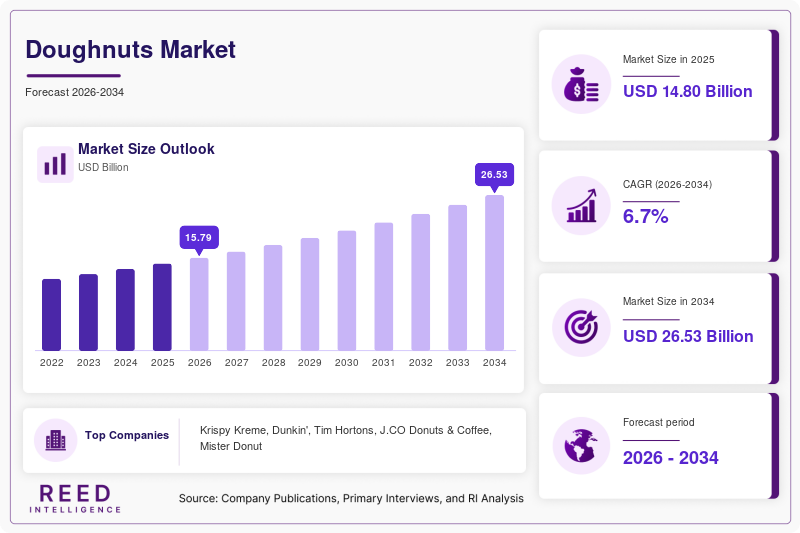
The global Doughnuts Market size was valued at approximately USD 14.8 billion in 2026 and is projected to reach USD 24.9 billion by 2034, expanding at a CAGR of 6.7% during 2026–2034. The market continues to evolve as consumer preferences shift toward premium bakery products, innovative flavors, and convenient snack options. Doughnuts remain a widely consumed indulgent bakery item across developed and emerging economies, supported by growing urbanization, changing eating habits, and increasing demand for on-the-go food products.
A major factor supporting market growth is the global expansion of quick-service restaurants, coffee chains, and specialty bakery outlets. These establishments have integrated doughnuts into broader breakfast and snack menus, increasing accessibility and consumer exposure. In addition, manufacturers are introducing healthier variants featuring reduced sugar, gluten-free ingredients, plant-based formulations, and functional toppings to appeal to health-conscious consumers without compromising taste.
Key Highlights
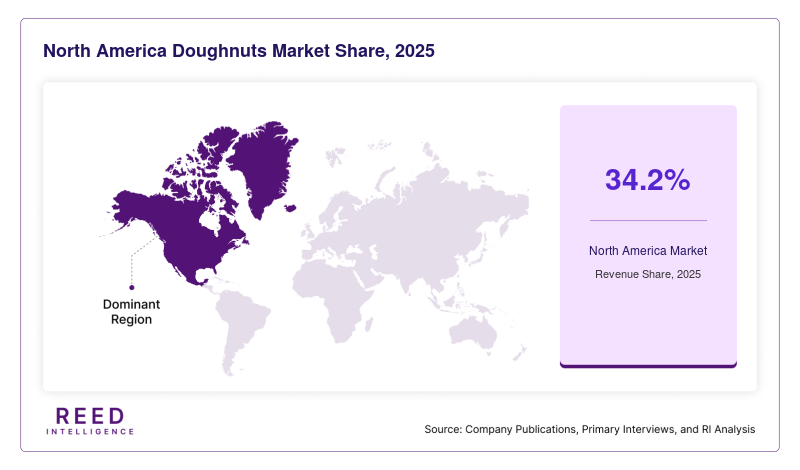
- North America dominated the market with a 34.2% share in 2025, while Asia Pacific is expected to grow at the fastest CAGR of 8.9% during 2026–2034.
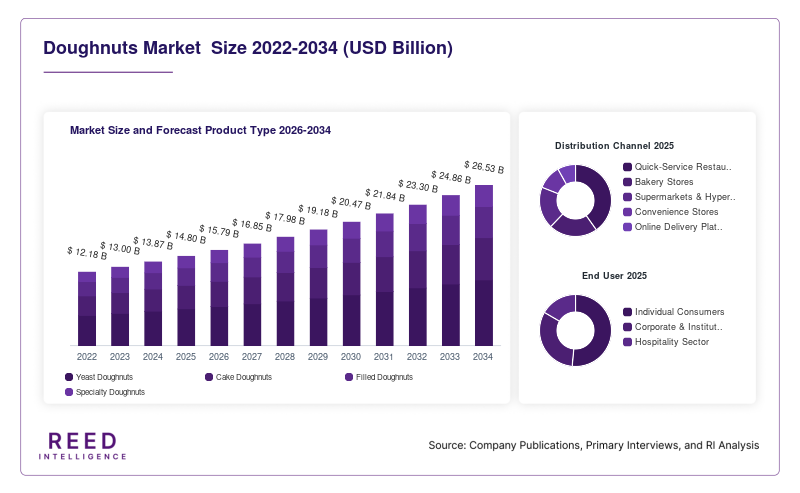
- By product type, Yeast Doughnuts accounted for the largest share of 42.8%, while Filled Doughnuts are projected to grow at a CAGR of 9.4%.
- By distribution channel, Quick-Service Restaurants (QSRs) led with a 46.3% share, whereas Online Delivery Platforms are expected to expand at a CAGR of 10.7%.
- By end user, Individual Consumers held the largest share of 71.5%, while Corporate and Institutional Buyers are expected to grow at a CAGR of 8.5%.
- The United States remained the dominant country, with market values of USD 3.92 billion in 2024 and USD 4.15 billion in 2025.
Market Trends
Premiumization and Artisanal Product Innovation
The Doughnuts Market is witnessing substantial growth in premium and artisanal product offerings. Consumers increasingly seek unique taste experiences, encouraging bakery operators to introduce handcrafted doughnuts featuring gourmet ingredients, specialty fillings, and visually appealing designs. Premium variants containing imported chocolates, exotic fruits, organic ingredients, and customized toppings have gained popularity among urban consumers. Social media platforms have amplified this trend by making visually distinctive products highly shareable. As a result, bakery chains are investing in product innovation and limited-edition launches to maintain consumer interest. The trend is particularly strong among younger demographics who value novelty and are willing to pay higher prices for differentiated bakery products. This shift toward premiumization is improving average selling prices and supporting revenue growth across developed and emerging markets.
Expansion of Digital Ordering and Delivery Ecosystems
Digital transformation is reshaping how consumers purchase doughnuts worldwide. Mobile applications, food delivery platforms, and direct-to-consumer ordering systems have become important sales channels for bakery brands. The convenience of online ordering allows consumers to access fresh bakery products without visiting physical stores. Companies are increasingly implementing digital loyalty programs, personalized promotions, and subscription-based offerings to enhance customer retention. Cloud kitchens dedicated to bakery products are also emerging in densely populated urban centers. The integration of real-time delivery tracking and contactless payment systems has improved customer experience and operational efficiency. As internet penetration and smartphone adoption continue to increase globally, digital commerce is expected to remain a significant contributor to Doughnuts Market growth throughout the forecast period.
Market Drivers
Rising Demand for Convenient Snack and Breakfast Products
Busy lifestyles and increasing urbanization have significantly influenced consumer eating habits. Many consumers now prefer convenient food products that can be consumed quickly during commutes, work breaks, or between meals. Doughnuts fit this demand profile due to their portability, affordability, and availability through multiple retail formats. Coffee shops, convenience stores, supermarkets, and quick-service restaurants have expanded their bakery assortments to include various doughnut options. The growing preference for ready-to-eat breakfast items has further strengthened demand. Manufacturers are responding by offering mini doughnuts, packaged varieties, and multipack formats that appeal to households and office environments. These developments continue to enhance product accessibility and consumption frequency, contributing to sustained market expansion across diverse demographic groups.
Growth of Organized Bakery and Quick-Service Restaurant Networks
The expansion of organized bakery chains and quick-service restaurant networks is another major growth driver for the Doughnuts Market. International and regional bakery brands are increasing their store footprints across metropolitan and secondary cities. Franchise-based business models have enabled rapid market penetration while maintaining operational consistency. Large chains benefit from established supply networks, marketing capabilities, and strong brand recognition, helping attract a broader customer base. Furthermore, partnerships with coffee retailers and food delivery platforms have expanded distribution opportunities. Continuous investment in menu diversification, seasonal promotions, and customer engagement initiatives has strengthened sales performance. As organized retail infrastructure continues to develop globally, doughnut consumption is expected to increase significantly in both mature and emerging markets.
Market Restraint
Growing Consumer Concerns Regarding Sugar and Calorie Consumption
One of the primary challenges facing the Doughnuts Market is increasing consumer awareness regarding sugar intake, calorie consumption, and overall dietary health. Public health campaigns and nutritional labeling regulations have encouraged consumers to scrutinize ingredient content more closely than in previous years. Traditional doughnuts are often perceived as indulgent products containing high levels of sugar, refined carbohydrates, and fats. This perception may limit purchase frequency among health-conscious consumers seeking balanced diets and wellness-focused food choices.
The impact is particularly noticeable in developed markets where obesity prevention initiatives and healthier eating trends continue to gain momentum. Retailers and foodservice operators face pressure to reformulate products, reduce sugar content, and introduce alternative ingredients without compromising flavor or texture. Such modifications can increase production costs and require additional research and development investments. For example, bakery brands introducing low-sugar or protein-enriched doughnuts often encounter formulation challenges related to taste consistency and shelf stability. Although innovation is helping address these concerns, health-related perceptions remain a significant restraint that could moderate long-term market growth in certain consumer segments.
Market Opportunities
Development of Health-Oriented and Functional Doughnut Variants
The emergence of health-conscious consumer segments presents significant opportunities for market participants. Manufacturers are increasingly developing doughnuts with reduced sugar, high-protein formulations, whole-grain ingredients, and plant-based alternatives. Functional ingredients such as fiber, probiotics, and vitamin-enriched components are also gaining attention. These innovations enable companies to attract consumers who may have previously avoided traditional bakery products due to nutritional concerns. The demand for gluten-free and vegan bakery products continues to rise across North America, Europe, and parts of Asia Pacific. By positioning doughnuts as occasional indulgences with improved nutritional profiles, companies can expand their addressable customer base while enhancing brand differentiation. Continued investment in ingredient innovation is expected to unlock substantial growth opportunities during the forecast period.
Expansion Across Emerging Urban Markets
Emerging economies present considerable untapped potential for Doughnuts Market participants. Rising disposable incomes, expanding middle-class populations, and increasing exposure to international food trends are driving demand for Western-style bakery products. Urban consumers in countries across Asia Pacific, Latin America, and the Middle East are increasingly visiting coffee chains and specialty bakery outlets where doughnuts are prominently featured. The growth of modern retail infrastructure and food delivery platforms further supports product accessibility. Localized flavor development tailored to regional preferences can help brands strengthen consumer acceptance. As international franchises and domestic bakery operators continue expanding into secondary and tertiary cities, market penetration rates are expected to increase significantly. This geographic expansion provides opportunities for both established brands and emerging regional players.
Segmental Analysis
By Product Type
Yeast Doughnuts represented the dominant subsegment, accounting for approximately 42.8% of the Doughnuts Market share in 2024. Their popularity stems from their light texture, broad flavor compatibility, and widespread availability across bakery chains and quick-service restaurants. Yeast-based products can accommodate a variety of glazes, toppings, and fillings, making them attractive to both consumers and manufacturers. Their versatility enables operators to introduce seasonal products and limited-edition offerings with minimal production adjustments. In addition, yeast doughnuts are commonly featured in breakfast menus and coffee pairings, contributing to sustained consumer demand. The segment benefits from strong brand recognition and remains a staple offering across established bakery networks globally.
Filled Doughnuts are anticipated to be the fastest-growing subsegment, registering a CAGR of 9.4% through 2034. Increasing consumer interest in indulgent and premium bakery experiences is supporting demand for products featuring cream, fruit, chocolate, and specialty fillings. Manufacturers continue introducing innovative flavor profiles that appeal to younger demographics seeking novelty and customization. The premium pricing associated with filled variants also contributes positively to revenue growth. Social media exposure has enhanced product visibility, particularly for visually distinctive offerings with layered fillings and decorative finishes. Continued experimentation with ingredients and regional flavor adaptations is expected to drive strong expansion within this category.
By Distribution Channel
Quick-Service Restaurants held the dominant position within the distribution channel segment, accounting for approximately 46.3% market share in 2024. These establishments provide consumers with convenient access to fresh doughnuts alongside complementary beverage offerings. Established chains benefit from extensive store networks, strong brand loyalty, and efficient supply chains that support consistent product quality. Frequent promotional campaigns and seasonal menu additions further encourage repeat purchases. The integration of bakery items into breakfast and snack menus has strengthened sales volumes across multiple regions. Additionally, franchise expansion continues to increase product availability in both mature and developing markets, reinforcing the segment's leadership position.
Online Delivery Platforms are projected to register the fastest CAGR of 10.7% during the forecast period. Consumer demand for convenience, coupled with expanding smartphone penetration, is accelerating digital bakery purchases. Delivery aggregators and direct-to-consumer applications provide brands with opportunities to reach broader customer bases without significant physical infrastructure investments. Real-time promotions, personalized recommendations, and subscription programs are enhancing customer engagement. Cloud kitchen models dedicated to bakery products are also contributing to channel growth. As digital commerce ecosystems continue evolving, online platforms are expected to become increasingly important revenue contributors within the Doughnuts Market.
By End User
Individual Consumers accounted for the largest share of approximately 71.5% in 2024, making them the dominant end-user segment. Household purchases remain the primary source of demand due to the widespread popularity of doughnuts as snacks, breakfast items, and occasional treats. Consumer preferences for convenient ready-to-eat bakery products continue supporting segment growth. Retail stores, supermarkets, convenience outlets, and foodservice establishments collectively provide extensive access to products across different price points. Product variety, promotional activities, and seasonal offerings further encourage household consumption. Growing urban populations and busy lifestyles also contribute to higher purchase frequency among individual consumers worldwide.
Corporate and Institutional Buyers are expected to record the fastest growth rate with a CAGR of 8.5% through 2034. Demand from offices, educational institutions, hospitality venues, and event organizers is increasing steadily. Doughnuts are frequently included in meetings, celebrations, conferences, and employee engagement programs due to their convenience and broad consumer appeal. Bulk purchasing agreements and customized packaging solutions are enhancing segment attractiveness. Furthermore, expanding corporate catering services and hospitality sector growth are creating additional sales opportunities. As businesses increasingly utilize food products for workplace engagement and customer events, institutional demand is expected to rise substantially.
Regional Analysis
North America
North America accounted for approximately 34.2% of the Doughnuts Market in 2025 and remains the largest regional market globally. The region is projected to register a CAGR of 5.8% through 2034. Strong consumer familiarity with doughnuts, extensive quick-service restaurant networks, and widespread availability across retail channels continue to support market leadership. Premium offerings, seasonal product launches, and innovative flavor combinations contribute to stable demand. The presence of large bakery chains and established distribution systems also strengthens market performance across the region.
The United States remains the dominant country within North America. A unique growth factor is the integration of doughnuts into coffee culture and breakfast consumption habits. Consumers frequently purchase doughnuts alongside specialty beverages, creating recurring demand throughout the year. Strong digital ordering capabilities and widespread food delivery adoption further support sales growth. Continuous product innovation by national bakery brands also contributes to market expansion and consumer retention.
Europe
Europe represented approximately 26.1% of the global Doughnuts Market in 2025 and is expected to grow at a CAGR of 5.9% during the forecast period. The market benefits from increasing consumer interest in premium bakery products and artisanal food experiences. Demand for gourmet fillings, organic ingredients, and handcrafted products continues to rise across major European economies. Specialty bakery stores and café chains are expanding their offerings to capitalize on evolving consumer preferences.
The United Kingdom serves as the dominant country in the regional market. A unique growth factor is the strong demand for premium and customized bakery products among younger consumers. Bakery operators increasingly launch limited-edition flavors inspired by local desserts and seasonal events. The growing popularity of food delivery services and online bakery ordering platforms has also improved accessibility, enabling broader market penetration throughout urban and suburban locations.
Asia Pacific
Asia Pacific held approximately 22.7% market share in 2025 and is projected to record the fastest CAGR of 8.9% through 2034. Rapid urbanization, rising disposable income, and growing exposure to international foodservice brands are driving regional demand. Consumers increasingly seek convenient snack products, while café culture expansion supports bakery product consumption. Major cities across the region have become key markets for premium and specialty doughnut offerings.
China dominates the regional market due to its large consumer base and expanding organized foodservice sector. A unique growth factor is the rapid adoption of mobile commerce and food delivery ecosystems. Consumers frequently purchase bakery products through digital channels, allowing brands to scale operations efficiently. Local flavor innovation and increasing acceptance of Western-style snacks further support growth. These factors position Asia Pacific as a major contributor to future Doughnuts Market expansion.
Middle East & Africa
The Middle East & Africa accounted for approximately 8.4% of the Doughnuts Market in 2025 and is expected to expand at a CAGR of 6.6% during 2026–2034. The region is experiencing increasing demand for premium bakery products driven by urban population growth and expanding retail infrastructure. International bakery chains continue establishing new outlets across major metropolitan areas, enhancing product visibility and consumer awareness.
The United Arab Emirates represents the leading country within the region. A unique growth factor is the strong tourism and hospitality sector, which creates consistent demand for bakery products in hotels, cafés, and airports. International visitors contribute significantly to consumption levels, while local consumers increasingly embrace premium snack options. The development of modern shopping centers and foodservice venues further supports market growth and brand expansion.
Latin America
Latin America captured approximately 8.6% of the Doughnuts Market in 2025 and is forecast to grow at a CAGR of 6.3% through 2034. The region benefits from rising urbanization, improving retail infrastructure, and growing consumer interest in affordable indulgent snacks. Bakery chains and convenience stores continue expanding product assortments, increasing accessibility across both urban and semi-urban areas. Economic development in several countries is also supporting higher discretionary spending on packaged food products.
Brazil remains the dominant country in the regional market. A unique growth factor is the increasing popularity of localized flavor combinations that align with regional taste preferences. Bakery operators frequently incorporate tropical fruits, chocolate varieties, and traditional dessert inspirations into product development. Growing adoption of delivery applications and franchise expansion strategies further contributes to market growth and consumer reach throughout the country.
Competitive Landscape
The Doughnuts Market is moderately consolidated, with international bakery chains competing alongside regional specialty brands and independent operators. Market participants focus on product innovation, franchise expansion, digital ordering capabilities, and premium product development to strengthen their competitive positions. Flavor innovation, seasonal offerings, and localized menu adaptations remain important strategies for customer acquisition and retention.
Among leading companies, Krispy Kreme maintains a strong market position through extensive international operations, brand recognition, and continuous product innovation. A recent development involved the expansion of its digital ordering infrastructure and enhanced partnerships with retail distribution channels to increase consumer accessibility.
Key Players
- Krispy Kreme
- Dunkin'
- Tim Hortons
- J.CO Donuts & Coffee
- Mister Donut
- Duck Donuts
- Shipley Do-Nuts
- Daylight Donuts
- Honey Dew Donuts
- Winchell's Donut House
- LaMar's Donuts
- Mad Over Donuts
- Doughnut Time
- Randy's Donuts
- Voodoo Doughnut
Recent Developments
- In 2025, a major international doughnut chain expanded its automated production facility to increase manufacturing capacity and support growing demand across retail and foodservice channels.
- In 2025, a leading bakery products company launched a new range of high-protein and reduced-sugar doughnuts aimed at health-conscious consumers seeking better-for-you indulgent snacks.
- In 2024, several regional bakery operators introduced premium filled doughnut collections featuring locally inspired flavors to strengthen customer engagement and product differentiation.
- In 2024, a global quick-service restaurant brand expanded its digital ordering and delivery network, improving customer accessibility and enhancing online doughnut sales across key metropolitan markets.
- In 2025, a large foodservice company invested in advanced bakery production technologies and smart packaging solutions to improve product freshness, operational efficiency, and supply chain performance.
Doughnuts Market Segments
Product Type
- Yeast Doughnuts
- Cake Doughnuts
- Filled Doughnuts
- Specialty Doughnuts
Distribution Channel
- Quick-Service Restaurants
- Bakery Stores
- Supermarkets & Hypermarkets
- Convenience Stores
- Online Delivery Platforms
End User
- Individual Consumers
- Corporate & Institutional Buyers
- Hospitality Sector
By Region
- North America
- Europe
- APAC
- Middle East and Africa
- LATAM