Drainage Catheters Market Size, Share & Demand Report By Product Type (Nephrostomy Drainage Catheters, Biliary Drainage Catheters, Abscess Drainage Catheters, External Ventricular Drainage Catheters, Thoracic Drainage Catheters, Others), By Application (Urology, Oncology, Gastroenterology, Neurology, Cardiology, Postoperative Care), By End Use (Hospitals, Ambulatory Surgical Centers, Specialty Clinics, Diagnostic and Imaging Centers), By Region & Segment Forecasts, 2026–2034
USD 3950
Market Overview
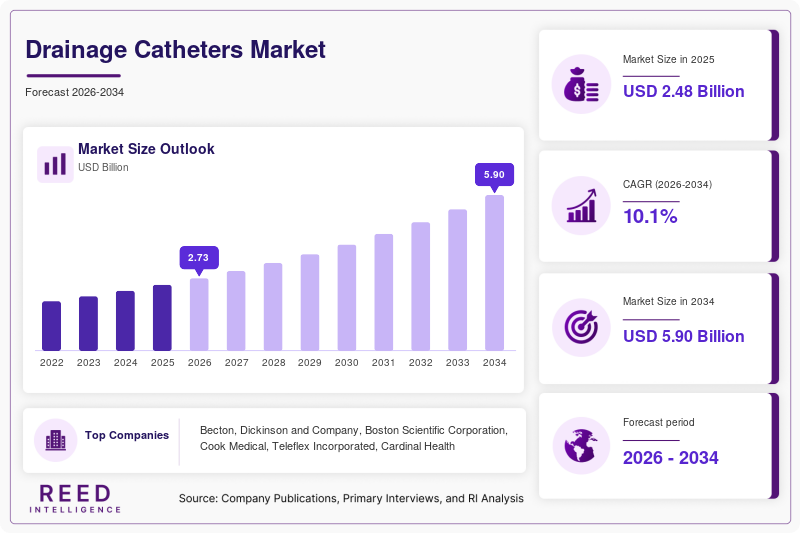
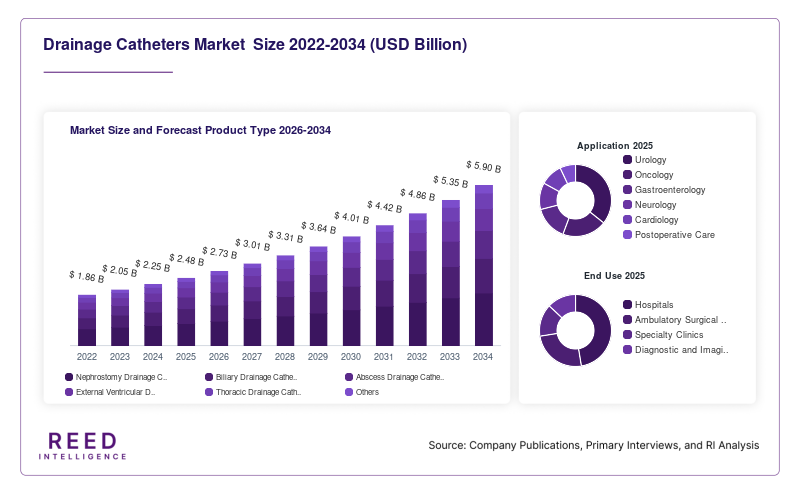
The global Drainage Catheters Market size was valued at USD 2.48 billion in 2026 and is projected to reach USD 5.36 billion by 2034, expanding at a CAGR of 10.1% during the forecast period from 2026 to 2034. The market continues to witness stable expansion due to the increasing incidence of chronic diseases, rising surgical procedures, and growing demand for minimally invasive treatment methods across healthcare systems worldwide. Drainage catheters are widely used for removing fluid accumulation, abscesses, and infected materials from different body regions, making them essential in interventional radiology, urology, cardiology, and gastrointestinal procedures.
A major global factor supporting market growth is the rising adoption of image-guided minimally invasive procedures in both developed and emerging healthcare markets. Hospitals and ambulatory surgical centers are increasingly integrating ultrasound-guided and CT-guided drainage catheter placements to reduce hospital stays, improve patient recovery, and lower procedural risks. In addition, healthcare providers are focusing on advanced catheter materials with antimicrobial coatings, improved flexibility, and enhanced drainage efficiency. The increasing elderly population, particularly vulnerable to kidney disorders, liver diseases, cancer-related fluid accumulation, and postoperative complications, is also contributing to sustained demand.
Key Highlights
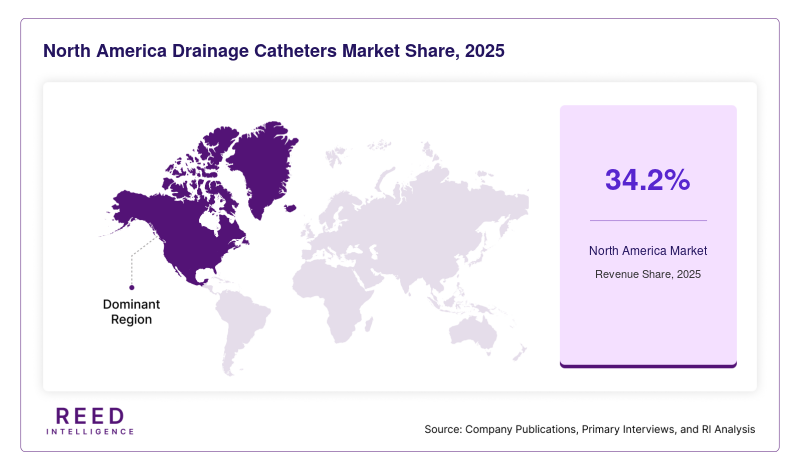
- North America dominated the market with a 34.2% share in 2025.
- Asia Pacific is expected to grow at the fastest CAGR of 11.8% during 2026–2034.
- By product type, nephrostomy drainage catheters accounted for the largest share of 36.7%.
- while external ventricular drainage catheters are projected to grow at a CAGR of 12.3%.
- By application, urology procedures led with a 39.8% share/
- whereas oncology-related drainage applications are expected to expand at a CAGR of 11.9%.
- The United States remained the dominant country, with market values of USD 690 million in 2024 and USD 748 million in 2025.
Market Trends
Increasing Integration of Antimicrobial and Biocompatible Materials
Manufacturers operating in the Drainage Catheters Market are increasingly focusing on advanced biomaterials and antimicrobial technologies to improve patient safety and reduce hospital-acquired infections. Healthcare facilities are under pressure to lower catheter-associated complications, which has accelerated demand for silicone-based, hydrophilic-coated, and antimicrobial-treated drainage catheters. These products help reduce bacterial colonization, improve patient comfort, and extend catheter usability during long-term drainage procedures. Medical device companies are also investing in multilayer catheter designs that improve drainage efficiency while minimizing tissue irritation and procedural discomfort. The growing use of biocompatible polymers is improving clinical outcomes in nephrostomy, abscess drainage, and thoracic drainage procedures. Hospitals are prioritizing infection-control protocols, which is encouraging physicians to adopt premium catheter systems with higher safety performance and procedural precision.
Growing Shift Toward Outpatient and Ambulatory Drainage Procedures
The expansion of outpatient healthcare services is emerging as a major trend influencing the Drainage Catheters Market. Healthcare providers are increasingly shifting minimally invasive drainage procedures from inpatient hospital environments to ambulatory surgical centers and specialty clinics. This transition is supported by technological advances in imaging systems, portable drainage equipment, and simplified catheter insertion techniques. Patients and insurers are also favoring outpatient procedures due to lower treatment costs, shorter recovery periods, and reduced hospitalization rates. In developed healthcare markets, physicians are performing image-guided catheter placements under local anesthesia, improving procedural efficiency and patient turnover. Emerging economies are also witnessing greater investment in ambulatory care infrastructure, particularly in urban healthcare centers. As healthcare systems continue focusing on cost optimization and procedural efficiency, outpatient drainage catheter adoption is expected to rise steadily across multiple therapeutic applications.
Market Drivers
Rising Prevalence of Chronic Kidney and Liver Disorders
The increasing prevalence of chronic kidney disease, liver disorders, and urinary tract complications is significantly supporting growth in the Drainage Catheters Market. Patients suffering from kidney obstruction, hydronephrosis, bile duct blockages, and postoperative fluid accumulation often require drainage procedures for effective disease management. Aging populations and lifestyle-related diseases such as diabetes and hypertension are contributing to higher hospitalization rates and increasing the need for nephrostomy and biliary drainage catheters. Healthcare systems are also reporting a growing number of patients requiring long-term drainage support during cancer treatment and transplant procedures. The expansion of diagnostic imaging capabilities has improved early disease detection, leading to greater procedural volumes in interventional radiology departments. As chronic disease prevalence continues increasing globally, healthcare providers are expected to maintain stable demand for advanced drainage catheter solutions.
Expansion of Minimally Invasive Surgical Procedures
The rapid growth of minimally invasive surgical procedures is another important factor driving the Drainage Catheters Market. Surgeons and interventional radiologists increasingly prefer catheter-based drainage procedures because they reduce trauma, shorten hospital stays, and improve recovery outcomes compared to conventional open surgeries. Image-guided interventions using fluoroscopy, ultrasound, and CT imaging are becoming standard practice across hospitals and specialty centers. This transition is increasing demand for flexible, durable, and precision-engineered drainage catheters suitable for complex procedures. Healthcare providers are also investing in advanced catheter systems that improve fluid drainage accuracy and reduce procedural complications. In emerging healthcare economies, expanding surgical infrastructure and rising physician training programs are improving access to minimally invasive interventions. These developments are expected to sustain market growth across gastrointestinal, thoracic, neurological, and urological drainage applications during the forecast period.
Market Restraint
High Risk of Catheter-Associated Complications and Product Recalls
Despite strong market expansion, the Drainage Catheters Market faces challenges associated with catheter-related complications and product safety concerns. Improper catheter placement, infections, catheter blockages, and tissue damage can lead to additional medical interventions and prolonged hospitalization. In some healthcare facilities, limited access to skilled interventional specialists increases the risk of procedural errors during catheter insertion and maintenance. Product recalls related to material defects, leakage risks, and manufacturing inconsistencies also create operational and financial pressures for medical device manufacturers. Regulatory authorities in North America and Europe continue enforcing strict product quality standards, which may increase development costs and delay product approvals. Smaller healthcare facilities in developing countries often struggle with limited sterilization infrastructure and inconsistent procedural training, further affecting patient outcomes. These concerns may slow adoption in price-sensitive healthcare markets where hospitals prioritize lower-cost alternatives instead of technologically advanced catheter systems.
Market Opportunities
Rising Healthcare Investments Across Emerging Economies
Emerging economies are creating substantial opportunities for companies operating in the Drainage Catheters Market. Governments in Asia Pacific, Latin America, and parts of the Middle East are increasing healthcare investments to improve surgical care, diagnostic imaging capabilities, and hospital infrastructure. Public and private hospitals are expanding interventional radiology departments, which is increasing demand for drainage procedures across oncology, nephrology, and gastrointestinal treatment applications. Growing medical tourism activity in countries such as India, Thailand, and Brazil is also supporting demand for minimally invasive procedures using advanced drainage catheters. Manufacturers are responding by introducing cost-effective product lines tailored for developing healthcare systems. Local distribution partnerships and regional manufacturing strategies are helping companies improve product accessibility and reduce supply chain costs. These developments are expected to generate long-term revenue opportunities across emerging healthcare markets.
Increasing Adoption of Personalized and Procedure-Specific Catheters
The growing focus on personalized treatment approaches is creating new growth opportunities within the Drainage Catheters Market. Healthcare providers are increasingly selecting procedure-specific catheter designs based on patient anatomy, disease condition, and procedural complexity. Manufacturers are developing customized catheter sizes, enhanced locking mechanisms, and multi-lumen configurations to improve drainage precision and procedural safety. Technological advances in catheter flexibility and imaging compatibility are helping physicians perform complex interventions with greater control and efficiency. Hospitals are also showing increased interest in disposable drainage systems that reduce cross-contamination risks and simplify postoperative management. As precision medicine and patient-centered care continue influencing healthcare delivery models, demand for specialized drainage catheter systems is expected to rise significantly. Companies investing in product innovation and physician-focused training programs are likely to strengthen their competitive position during the forecast period.
Segmental Analysis
By Product Type
Nephrostomy drainage catheters represented the dominant subsegment within the Drainage Catheters Market in 2024, accounting for approximately 36.7% of global revenue. These catheters are widely used for urinary drainage procedures associated with kidney obstruction, hydronephrosis, and urinary tract complications. The growing prevalence of chronic kidney disease, kidney stones, and cancer-related urinary obstruction is supporting demand across hospitals and specialty clinics. Healthcare providers prefer nephrostomy catheters because they provide effective long-term drainage management while reducing complications associated with open surgical interventions. Technological improvements in catheter flexibility, locking systems, and antimicrobial coatings are further improving clinical outcomes. The increasing use of image-guided nephrostomy procedures across outpatient settings is also contributing to strong product adoption in both developed and emerging healthcare markets.
External ventricular drainage catheters are projected to witness the fastest growth during the forecast period, expanding at a CAGR of 12.3% from 2026 to 2034. Rising neurological disorders, traumatic brain injuries, and increasing neurosurgical procedures are supporting segment expansion globally. Hospitals are increasingly using external ventricular drainage systems to manage intracranial pressure and cerebrospinal fluid accumulation in critical care settings. The growing availability of advanced neuroimaging technologies and specialized neurosurgical centers is also increasing procedural volumes. Manufacturers are introducing enhanced catheter systems with infection-resistant materials and pressure-monitoring compatibility to improve patient safety and monitoring accuracy. In addition, expanding healthcare investments in neurological care across Asia Pacific and the Middle East are expected to create strong demand for advanced ventricular drainage solutions over the coming years.
By Application
Urology procedures accounted for the largest share of the Drainage Catheters Market in 2024, contributing nearly 39.8% of total revenue. The segment benefits from the increasing prevalence of kidney disorders, urinary tract obstructions, and postoperative drainage requirements. Healthcare providers widely use nephrostomy and ureteral drainage catheters to manage fluid accumulation and improve urinary flow in patients undergoing complex urological treatments. Rising elderly populations and increasing rates of diabetes and hypertension are contributing to higher incidences of kidney-related complications worldwide. Hospitals are also expanding minimally invasive urology services, increasing demand for precision-engineered drainage catheter systems. Technological advancements in fluoroscopy-guided and ultrasound-guided procedures are improving procedural success rates, further strengthening segment growth across developed and emerging healthcare markets.
Oncology-related drainage applications are expected to expand at the fastest CAGR of 11.9% during the forecast period. Cancer patients frequently require drainage procedures to manage pleural effusion, biliary obstruction, abscess formation, and postoperative fluid accumulation during treatment. The rising global burden of liver cancer, pancreatic cancer, and metastatic diseases is increasing the need for advanced drainage catheter interventions across oncology centers. Healthcare providers are increasingly using minimally invasive drainage techniques to improve patient comfort and reduce hospitalization periods during chemotherapy and palliative care. In addition, specialized cancer treatment centers are adopting image-guided drainage systems to improve treatment efficiency and reduce procedural complications. Growing investments in oncology infrastructure across Asia Pacific and Europe are expected to support long-term segment expansion.
By End Use
Hospitals remained the dominant end-use segment in the Drainage Catheters Market during 2024, accounting for approximately 58.4% of global revenue. Large hospitals continue performing high volumes of drainage procedures associated with emergency care, oncology treatment, postoperative management, and critical care interventions. The availability of advanced imaging systems, trained interventional radiologists, and multidisciplinary surgical teams supports widespread catheter utilization across hospital settings. In developed healthcare markets, hospitals are investing in advanced drainage catheter systems integrated with imaging compatibility and infection-control technologies. The increasing number of complex surgeries and chronic disease admissions is also contributing to strong procedural demand. Furthermore, government healthcare investments in tertiary hospitals across developing economies are improving patient access to advanced catheter-based treatment procedures.
Ambulatory surgical centers are expected to register the fastest growth in the market, expanding at a CAGR of 12.1% during the forecast period. Healthcare systems are increasingly shifting minimally invasive drainage procedures toward outpatient environments to reduce treatment costs and improve operational efficiency. Ambulatory centers provide faster patient turnover, shorter recovery periods, and lower hospitalization expenses compared to traditional inpatient settings. Technological improvements in portable imaging equipment and simplified catheter insertion methods are supporting this transition. In North America and Europe, insurers and healthcare providers are encouraging outpatient interventions to optimize healthcare spending. Emerging economies are also witnessing rapid expansion of specialty outpatient clinics in urban areas, which is expected to increase the use of drainage catheters across ambulatory healthcare facilities.
Regional Analysis
North America
North America accounted for the largest share of the Drainage Catheters Market in 2025, representing approximately 34.2% of global revenue. The regional market is projected to expand at a CAGR of 9.4% during the forecast period due to advanced healthcare infrastructure, strong reimbursement frameworks, and high adoption of minimally invasive procedures. Hospitals and ambulatory surgical centers across the United States and Canada continue integrating image-guided drainage interventions into standard treatment pathways. The presence of major medical device manufacturers and continuous investments in interventional radiology technologies are also supporting market expansion.
The United States remains the dominant country within the North American market due to rising surgical volumes and increasing chronic disease prevalence. Healthcare providers are reporting growing demand for nephrostomy, thoracic, and abscess drainage procedures among elderly patients and cancer populations. Another important growth factor is the rapid expansion of outpatient intervention centers offering cost-efficient catheter-based procedures. Strong physician training programs and faster adoption of antimicrobial-coated drainage catheters are also contributing to stable product demand across hospitals and specialty clinics.
Europe
Europe held a substantial share of the Drainage Catheters Market in 2025 and is expected to grow at a CAGR of 8.9% through 2034. The region benefits from a well-established healthcare ecosystem, strong public healthcare funding, and rising adoption of minimally invasive surgical techniques. Countries such as Germany, France, and the United Kingdom continue investing in advanced imaging technologies and catheter-based intervention systems. Increasing awareness regarding infection prevention and postoperative care is also encouraging healthcare facilities to upgrade drainage catheter technologies.
Germany continues to lead the European market due to its advanced hospital infrastructure and growing interventional radiology capacity. The country is witnessing increased demand for drainage catheters in oncology and urology procedures, particularly among aging patient populations. A unique growth factor supporting the German market is the integration of digital imaging and robotic-assisted intervention systems in tertiary healthcare facilities. These technological improvements are helping physicians improve procedural precision, which is increasing the use of premium drainage catheter products across complex clinical applications.
Asia Pacific
Asia Pacific is projected to register the fastest growth in the Drainage Catheters Market, expanding at a CAGR of 11.8% from 2026 to 2034. Rapid healthcare infrastructure development, rising healthcare expenditure, and increasing patient awareness regarding minimally invasive procedures are driving regional expansion. Countries including China, India, Japan, and South Korea are witnessing strong growth in surgical procedures and interventional radiology services. Expanding private hospital networks and growing access to diagnostic imaging technologies are further supporting procedural demand.
China remains the dominant country within the Asia Pacific region due to its large patient population and continuous healthcare modernization initiatives. The country is experiencing increased demand for drainage catheters across nephrology, oncology, and gastrointestinal treatment segments. One unique factor driving Chinese market growth is the expansion of domestic medical device manufacturing capabilities, which is improving affordability and product availability. Government support for local medical technology innovation and hospital upgrades is also accelerating the adoption of advanced catheter systems across urban healthcare facilities.
Middle East & Africa
The Middle East & Africa region is witnessing gradual growth in the Drainage Catheters Market and is expected to expand at a CAGR of 7.8% during the forecast period. Healthcare investments across Gulf countries are improving access to minimally invasive procedures and modern surgical care. Hospitals in the United Arab Emirates and Saudi Arabia are increasingly adopting advanced drainage catheter systems for oncology, cardiology, and postoperative applications. Rising awareness regarding infection control and expanding healthcare insurance coverage are also contributing to regional market development.
Saudi Arabia remains the dominant country within the regional market due to continuous healthcare infrastructure investments and increasing surgical procedure volumes. Government healthcare transformation programs are encouraging hospitals to modernize diagnostic imaging and interventional radiology departments. Another unique growth factor is the increasing number of specialized cancer treatment centers across the country, which is driving demand for biliary and abscess drainage procedures. International partnerships with medical device manufacturers are also improving access to advanced catheter technologies across tertiary healthcare institutions.
Latin America
Latin America accounted for a moderate share of the Drainage Catheters Market in 2025 and is projected to grow at a CAGR of 8.3% through 2034. The regional market is benefiting from improving healthcare accessibility, rising chronic disease prevalence, and increasing adoption of minimally invasive surgical techniques. Brazil, Mexico, and Argentina are witnessing higher investments in hospital modernization and outpatient care services. Healthcare providers are also focusing on reducing hospitalization periods, which is encouraging broader use of catheter-based drainage procedures.
Brazil continues to dominate the Latin American market due to its large healthcare network and increasing procedural demand in public and private hospitals. The country is witnessing growth in nephrostomy and thoracic drainage procedures associated with cancer treatment and postoperative care. A distinctive growth factor supporting the Brazilian market is the expansion of medical tourism and private healthcare investments in metropolitan regions. This trend is encouraging hospitals to adopt advanced catheter technologies and improve interventional radiology capabilities for both domestic and international patients.
Competitive Landscape
The Drainage Catheters Market remains moderately consolidated, with several multinational medical device manufacturers competing through product innovation, geographic expansion, and strategic partnerships. Leading companies are focusing on antimicrobial catheter technologies, improved imaging compatibility, and minimally invasive procedure support to strengthen their market position. Manufacturers are also investing in physician training programs and regional distribution networks to improve adoption across emerging healthcare markets.
Becton, Dickinson and Company remains one of the leading participants in the global market due to its broad interventional product portfolio and strong global distribution presence. The company continues expanding its drainage catheter offerings through advanced material technologies and procedure-specific product designs. Cook Medical, Boston Scientific Corporation, Cardinal Health, and Teleflex Incorporated also maintain significant market shares through continuous product development and healthcare partnerships.
Recent industry developments include the introduction of infection-resistant catheter coatings, expansion of manufacturing facilities in Asia Pacific, and increased mergers focused on interventional radiology technologies. Several companies are also strengthening digital imaging integration capabilities to improve procedural precision during catheter placement. Market participants are expected to continue focusing on outpatient healthcare solutions and customized catheter systems to address evolving clinical requirements.
Key Players
- Becton, Dickinson and Company
- Boston Scientific Corporation
- Cook Medical
- Teleflex Incorporated
- Cardinal Health
- Medtronic plc
- B. Braun SE
- AngioDynamics
- Merit Medical Systems
- ConvaTec Group plc
- Smiths Medical
- Romsons Group
- Argon Medical Devices
- Coloplast A/S
- ICU Medical Inc.
Recent Developments
- In February 2026, Boston Scientific Corporation introduced an advanced antimicrobial biliary drainage catheter system designed to reduce catheter-associated infection risks during long-term procedures.
- In September 2025, Cook Medical expanded its manufacturing operations in Southeast Asia to strengthen regional supply chain capabilities and improve product accessibility across emerging healthcare markets.
- In June 2025, Teleflex Incorporated launched a next-generation thoracic drainage catheter integrated with enhanced imaging visibility technology for minimally invasive procedures.
- In January 2026, Becton, Dickinson and Company announced a strategic partnership with hospital networks in Europe to expand training programs focused on image-guided catheter placement procedures.
Drainage Catheters Market Segments
Product Type
- Nephrostomy Drainage Catheters
- Biliary Drainage Catheters
- Abscess Drainage Catheters
- External Ventricular Drainage Catheters
- Thoracic Drainage Catheters
- Others
Application
- Urology
- Oncology
- Gastroenterology
- Neurology
- Cardiology
- Postoperative Care
End Use
- Hospitals
- Ambulatory Surgical Centers
- Specialty Clinics
- Diagnostic and Imaging Centers
By Region
- North America
- Europe
- APAC
- Middle East and Africa
- LATAM