Dredging Equipment Market Size, Share & Demand Report By Equipment Type (Cutter Suction Dredgers, Trailing Suction Hopper Dredgers, Bucket Dredgers, Grab Dredgers, Backhoe Dredgers, Others), By Application (Maintenance Dredging, Capital Dredging, Coastal Protection Dredging, Land Reclamation, Mining Dredging, Others), By End Use (Government & Public Infrastructure, Commercial Ports, Offshore Energy Projects, Mining Industry, Construction Industry, Others), By Region & Segment Forecasts, 2026–203
USD 3950
Market Overview
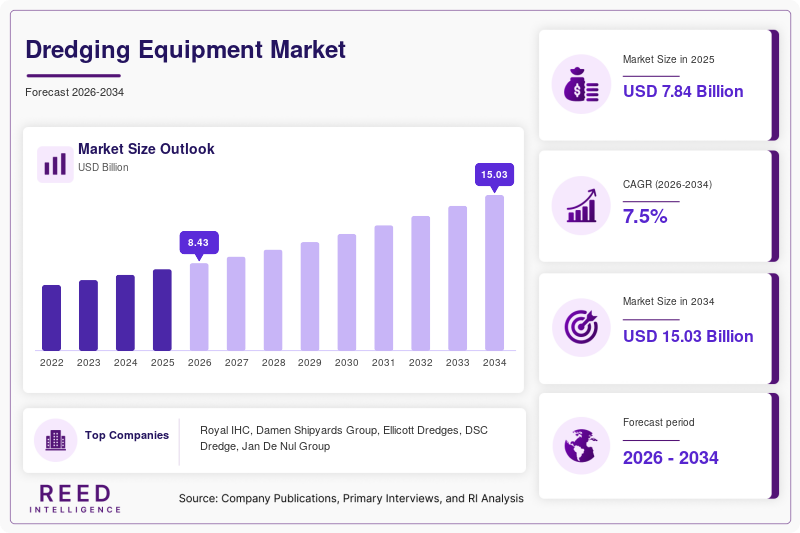
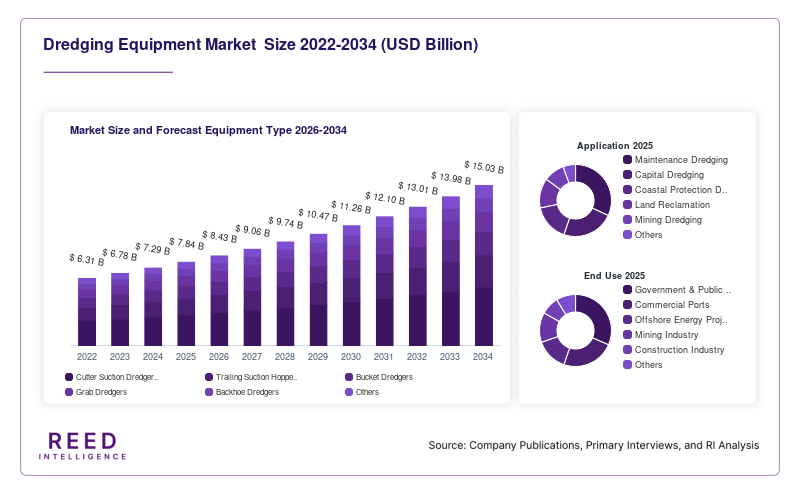
The global Dredging Equipment Market size was valued at USD 7.84 billion in 2026 and is projected to reach USD 13.96 billion by 2034, expanding at a CAGR of 7.5% during 2026–2034. The market continues to witness steady expansion due to increasing investments in maritime infrastructure, port modernization projects, coastal protection initiatives, and inland waterway development across both developed and emerging economies. Governments and private operators are allocating substantial resources toward maintaining navigable waterways, expanding cargo-handling capacity, and improving flood resilience, creating sustained demand for advanced dredging equipment.
A major global factor supporting market growth is the rise in international maritime trade. Growing cargo volumes have increased the need for deeper ports, wider shipping channels, and regular maintenance dredging operations. Many countries are upgrading existing port infrastructure to accommodate larger vessels, which has accelerated procurement of technologically advanced dredgers, pumps, cutters, and support equipment. Furthermore, urbanization in coastal regions and climate adaptation projects are contributing to long-term demand for dredging services and equipment.
Key Highlights
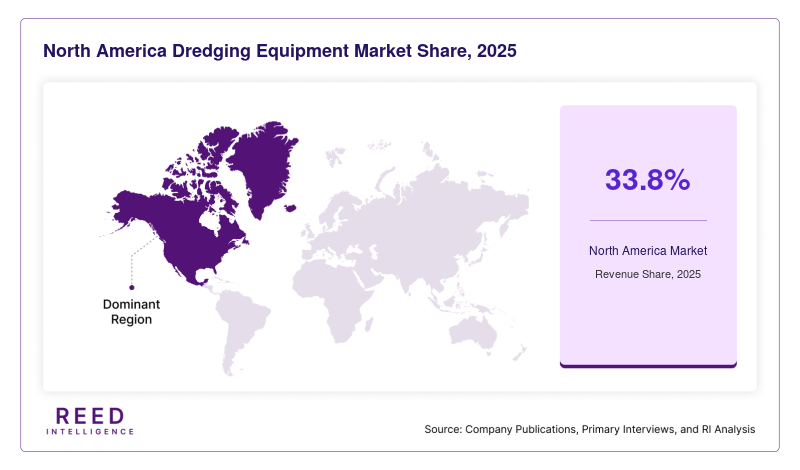
- North America dominated the market with a 33.8% share in 2025, while Asia Pacific is expected to grow at the fastest CAGR of 9.3% during 2026–2034.
- By equipment type, cutter suction dredgers accounted for the largest share of 39.4%, while trailing suction hopper dredgers are projected to grow at a CAGR of 8.7%.
- By application, maintenance dredging led with a 44.6% share, whereas coastal protection dredging is expected to expand at a CAGR of 9.1%.
- By end use, government and public infrastructure projects represented the largest share of 47.2%, while offshore energy projects are forecast to grow at a CAGR of 8.9%.
- The United States remained the dominant country, with market values of USD 1.82 billion in 2024 and USD 1.95 billion in 2025.
Market Trends
Automation and Digital Integration Across Dredging Operations
Automation is becoming a defining trend in the Dredging Equipment Market as operators seek higher productivity, improved accuracy, and reduced operational costs. Modern dredging fleets increasingly incorporate GPS-guided navigation systems, real-time monitoring platforms, remote-control capabilities, and predictive maintenance software. These technologies help operators optimize dredging depth, improve fuel efficiency, and minimize downtime. Automated systems also support compliance with environmental regulations by providing accurate data regarding sediment movement and water quality. The adoption of digital tools is particularly strong in large-scale port expansion projects where project timelines and operational precision are critical. As governments and contractors prioritize efficiency, automated dredging solutions are expected to become standard components of future dredging projects.
Growing Preference for Environmentally Sustainable Equipment
Environmental sustainability is influencing equipment purchasing decisions across the dredging industry. Contractors and public authorities are increasingly selecting equipment designed to reduce emissions, lower fuel consumption, and minimize ecosystem disruption. Hybrid-powered dredgers, electric auxiliary systems, and advanced sediment management technologies are gaining market attention. Many coastal restoration projects require equipment capable of executing precise dredging activities while protecting marine habitats. Equipment manufacturers are responding by investing in cleaner propulsion systems and innovative dredging technologies that limit turbidity and sediment dispersion. This trend is expected to strengthen as environmental regulations become more stringent and sustainability targets continue to shape infrastructure development strategies worldwide.
Market Drivers
Expansion of Global Port Infrastructure and Maritime Trade
The continuous growth of international trade remains a primary growth driver for the Dredging Equipment Market. Global shipping networks depend on well-maintained ports and waterways to accommodate increasing cargo volumes and larger vessels. Governments are investing heavily in deepening shipping channels, expanding port terminals, and improving logistics infrastructure. These projects require extensive dredging operations and create substantial demand for dredging equipment. In addition, many aging ports require periodic maintenance dredging to sustain operational efficiency. Emerging economies are also developing new port facilities to strengthen trade competitiveness and support industrial expansion. The combination of modernization projects and ongoing maintenance activities continues to create stable demand for advanced dredging systems across multiple regions.
Rising Investments in Coastal Protection and Flood Management
Climate-related challenges are driving significant investments in coastal resilience projects worldwide. Rising sea levels, shoreline erosion, and extreme weather events have increased the need for dredging activities that support beach nourishment, coastal reinforcement, and flood prevention programs. Governments are allocating larger infrastructure budgets to protect vulnerable coastal communities and critical economic assets. Dredging equipment plays an essential role in transporting sediment, restoring beaches, and maintaining drainage systems. Urban expansion near coastlines further amplifies the need for protective infrastructure. As climate adaptation initiatives gain momentum, demand for specialized dredging equipment capable of supporting environmental restoration and flood mitigation projects is expected to increase steadily throughout the forecast period.
Market Restraint
High Capital Requirements and Operational Costs
The Dredging Equipment Market faces challenges associated with substantial capital investment requirements and high operating expenses. Advanced dredgers, support vessels, pumping systems, and navigation technologies involve considerable acquisition costs that may limit adoption among smaller contractors. In addition to initial investments, operators must manage expenses related to fuel consumption, maintenance, workforce training, regulatory compliance, and equipment upgrades. Economic uncertainty and fluctuating commodity prices can further affect purchasing decisions and project financing. For example, smaller regional dredging companies may postpone fleet modernization due to budget constraints, reducing equipment replacement rates. Furthermore, public infrastructure projects often depend on government funding cycles, which can delay procurement activities. These financial barriers may slow market expansion in certain regions despite growing demand for dredging services and infrastructure development.
Market Opportunities
Increasing Development of Inland Waterway Transportation Networks
The modernization of inland waterways presents a significant opportunity for the Dredging Equipment Market. Governments are investing in river transportation systems to reduce logistics costs, ease road congestion, and support sustainable freight movement. Navigable waterways require regular dredging to maintain adequate depth and safe vessel passage. Countries across Asia, Europe, and Latin America are expanding inland transportation corridors and upgrading river ports to strengthen trade connectivity. These projects create long-term demand for maintenance dredging equipment, sediment removal systems, and support vessels. As transportation authorities focus on improving waterborne logistics efficiency, manufacturers can benefit from increased procurement activity and recurring maintenance requirements across inland navigation networks.
Expansion of Offshore Energy and Marine Construction Projects
The growth of offshore energy developments is creating new opportunities for dredging equipment suppliers. Offshore wind farms, subsea cable installations, coastal energy terminals, and marine infrastructure projects require extensive seabed preparation and sediment management activities. Dredging equipment is frequently used to create access channels, prepare foundations, and support construction operations in challenging marine environments. Increasing investments in renewable energy infrastructure are expected to accelerate demand for specialized dredging solutions capable of operating efficiently in offshore locations. Equipment manufacturers that develop technologically advanced and environmentally compliant solutions are likely to benefit from growing project activity within the offshore energy and marine construction sectors.
Segmental Analysis
By Equipment Type
Cutter suction dredgers represented the dominant equipment category and accounted for approximately 39.4% of market revenue in 2024. Their widespread adoption is attributed to their versatility, efficiency, and ability to handle compacted sediments in a variety of environments. These dredgers are commonly used in port construction, land reclamation, river maintenance, and coastal engineering projects. Contractors favor cutter suction dredgers because they offer high production capacity and operational flexibility. Growing investments in infrastructure development across emerging economies have further strengthened demand. Their ability to perform effectively in both maintenance and capital dredging projects continues to support their leading market position.
Trailing suction hopper dredgers are expected to register the fastest CAGR of 8.7% through 2034. These vessels are increasingly preferred for offshore dredging operations, beach nourishment projects, and large-scale channel maintenance activities. Their capacity to transport dredged material over long distances enhances project efficiency and reduces operational complexity. Rising investments in coastal protection programs and offshore infrastructure development are key growth drivers. Technological advancements, including automated dredging controls and fuel-efficient propulsion systems, are further improving operational performance. As environmental regulations encourage efficient sediment handling practices, demand for modern hopper dredgers is expected to increase significantly throughout the forecast period.
By Application
Maintenance dredging accounted for the largest market share of approximately 44.6% in 2024. Ports, harbors, rivers, and navigation channels require regular sediment removal to maintain safe operating depths and support uninterrupted transportation activities. Growing international trade volumes have increased the importance of maintenance dredging across major shipping corridors. Public authorities and port operators continue to allocate substantial budgets toward preserving navigational efficiency and minimizing vessel delays. The recurring nature of maintenance dredging creates consistent demand for equipment, making this application segment a major contributor to overall market revenue.
Coastal protection dredging is projected to grow at the fastest CAGR of 9.1% during the forecast period. Increasing concerns regarding shoreline erosion, rising sea levels, and extreme weather events are driving investments in beach nourishment and coastal restoration projects. Governments and environmental agencies are implementing long-term resilience strategies that depend heavily on dredging activities. Advanced dredging equipment enables efficient sediment relocation while minimizing environmental disruption. The growing emphasis on climate adaptation and infrastructure protection is expected to support strong demand for specialized dredging equipment dedicated to coastal defense initiatives worldwide.
By End Use
Government and public infrastructure projects held the largest share of approximately 47.2% in 2024. Public agencies remain among the largest purchasers of dredging equipment and services due to their responsibility for maintaining waterways, ports, flood control systems, and coastal infrastructure. Large-scale infrastructure programs often involve extensive dredging activities that require advanced equipment and specialized operational capabilities. Stable government funding and long-term development plans continue to support demand across this segment. Additionally, public-sector investments in climate resilience and transportation modernization further reinforce market expansion.
Offshore energy projects are expected to witness the fastest growth, advancing at a CAGR of 8.9% through 2034. Expanding offshore wind developments, subsea cable installations, and marine energy infrastructure projects are generating increased demand for dredging equipment. These projects require seabed preparation, trenching, and sediment management operations before construction activities can proceed. The transition toward renewable energy sources is accelerating offshore project development across multiple regions. Equipment manufacturers capable of delivering specialized solutions for challenging offshore environments are expected to benefit from rising project activity and increasing capital investments in marine energy infrastructure.
Regional Analysis
North America
North America accounted for approximately 33.8% of the global Dredging Equipment Market in 2025 and continues to represent the largest regional market. The region is projected to expand at a CAGR of 6.8% through 2034, supported by extensive investments in maritime infrastructure and waterway maintenance programs. Major ports along the Atlantic, Pacific, and Gulf coasts regularly undertake dredging activities to accommodate increasing cargo volumes and larger commercial vessels. Continuous modernization of transportation infrastructure also supports steady equipment demand.
The United States remains the dominant country within the region due to its extensive port network and substantial public infrastructure investments. A unique growth factor is the increasing focus on coastal resilience projects designed to address erosion, flooding, and climate-related risks. Federal and state authorities continue to fund shoreline restoration programs, creating long-term demand for advanced dredging equipment and specialized sediment management solutions.
Europe
Europe represented approximately 27.1% of global market revenue in 2025 and is expected to register a CAGR of 6.5% during the forecast period. Demand is supported by established maritime trade routes, extensive inland waterway networks, and continuous port modernization activities. Countries throughout the region are investing in infrastructure upgrades to improve logistics efficiency and maintain competitiveness within global shipping markets. Environmental restoration initiatives also contribute to ongoing dredging activity.
The Netherlands remains the leading country in the European market due to its strong maritime engineering capabilities and global dredging expertise. A unique growth factor is the region’s emphasis on sustainable water management. Governments increasingly utilize dredging operations to support flood control systems, wetland restoration programs, and climate adaptation projects, creating stable demand for innovative and environmentally responsible equipment.
Asia Pacific
Asia Pacific held approximately 24.6% of the Dredging Equipment Market in 2025 and is forecast to achieve the fastest CAGR of 9.3% through 2034. Rapid urbanization, expanding seaborne trade, and large-scale infrastructure projects are driving market growth throughout the region. Several countries are investing heavily in new ports, industrial corridors, and logistics hubs to support economic development. These projects require substantial dredging activities for channel development and land reclamation.
China dominates the regional market owing to extensive investments in port expansion and coastal infrastructure. A unique growth factor is the increasing number of land reclamation projects associated with urban and industrial development. Large coastal cities continue to expand infrastructure capacity, creating significant demand for cutter suction dredgers, hopper dredgers, and associated support equipment across both public and private sectors.
Middle East & Africa
The Middle East & Africa accounted for around 8.2% of global market revenue in 2025 and is anticipated to grow at a CAGR of 7.4% through 2034. Regional governments are investing in maritime infrastructure to diversify economic activity and strengthen trade capabilities. Major port development projects, coastal tourism investments, and industrial expansion initiatives are supporting demand for dredging equipment. Growing energy-related infrastructure projects also contribute to market growth.
The United Arab Emirates represents the dominant national market due to its strategic position in international trade and logistics. A unique growth factor is the continued development of artificial islands, waterfront projects, and marine tourism infrastructure. These large-scale developments require extensive dredging operations, supporting demand for advanced equipment capable of operating efficiently in complex marine environments.
Latin America
Latin America captured approximately 6.3% of the global Dredging Equipment Market in 2025 and is projected to expand at a CAGR of 7.1% during the forecast period. The region is witnessing increasing investments in transportation infrastructure, mining exports, and port modernization. Governments are prioritizing waterway maintenance to improve trade efficiency and facilitate larger vessel access. These developments are generating steady demand for dredging equipment across commercial and public infrastructure projects.
Brazil remains the leading country within the regional market due to its extensive coastline and growing export activities. A unique growth factor is the expansion of bulk commodity transportation networks serving agriculture and mining industries. Maintaining navigable waterways and port access channels is essential for export competitiveness, encouraging sustained investments in dredging equipment and operational capabilities.
Competitive Landscape
The Dredging Equipment Market is moderately consolidated, with several global manufacturers competing through technology innovation, equipment reliability, and project-specific customization capabilities. Companies are investing in automation technologies, fuel-efficient systems, and environmentally sustainable solutions to strengthen their market position. Strategic partnerships, fleet modernization programs, and regional expansion initiatives remain common competitive strategies.
Royal IHC maintains a leading position due to its extensive product portfolio, strong engineering expertise, and global project presence. The company recently expanded its focus on digital dredging solutions that improve operational efficiency and project monitoring capabilities. Other major participants continue to invest in advanced cutter suction dredgers, hopper dredgers, and integrated dredging systems designed to meet evolving customer requirements. Competition is expected to intensify as governments increase infrastructure spending and environmental regulations encourage adoption of modern, efficient equipment. Manufacturers that successfully combine sustainability, automation, and operational performance are likely to strengthen their competitive standing during the forecast period.
Key Players
- Royal IHC
- Damen Shipyards Group
- Ellicott Dredges
- DSC Dredge
- Jan De Nul Group
- Van Oord
- Great Lakes Dredge & Dock Corporation
- Boskalis
- Rohr-Idreco Dredge Systems
- Vosta LMG
- HID Dredging Equipment
- Mud Cat Dredges
- Bell Dredging Pumps
- Italdraghe
- IMS Dredges
Recent Developments
- In 2025, a major dredging equipment manufacturer introduced an automated fleet management platform designed to improve dredging accuracy and reduce fuel consumption across large-scale projects.
- In 2025, several industry participants expanded production capacity for cutter suction dredgers to address growing demand from port modernization and coastal infrastructure projects.
- In 2024, a leading equipment supplier launched a hybrid-powered dredger featuring lower emissions and enhanced operational efficiency for environmentally sensitive projects.
- In 2024, multiple contractors invested in advanced sediment monitoring technologies to improve compliance with environmental regulations and project reporting requirements.
Dredging Equipment Market Segments
Equipment Type
- Cutter Suction Dredgers
- Trailing Suction Hopper Dredgers
- Bucket Dredgers
- Grab Dredgers
- Backhoe Dredgers
- Others
Application
- Maintenance Dredging
- Capital Dredging
- Coastal Protection Dredging
- Land Reclamation
- Mining Dredging
- Others
End Use
- Government & Public Infrastructure
- Commercial Ports
- Offshore Energy Projects
- Mining Industry
- Construction Industry
- Others
By Region
- North America
- Europe
- APAC
- Middle East and Africa
- LATAM