Drilling Jar Market Size, Share Demand Report By Product Type (Hydraulic Drilling Jars, Mechanical Drilling Jars, Hydraulic-Mechanical Hybrid Jars, Electronic Smart Jars), By Application (Onshore Oil & Gas Drilling, Offshore Oil & Gas Drilling, Geothermal Drilling, Mining Exploration, Water Well Drilling), By End Use (Operators, Service Contractors, Rental Companies, Mining Operators), By Region & Segment Forecasts, 2026–2034
USD 3950
Market Overview
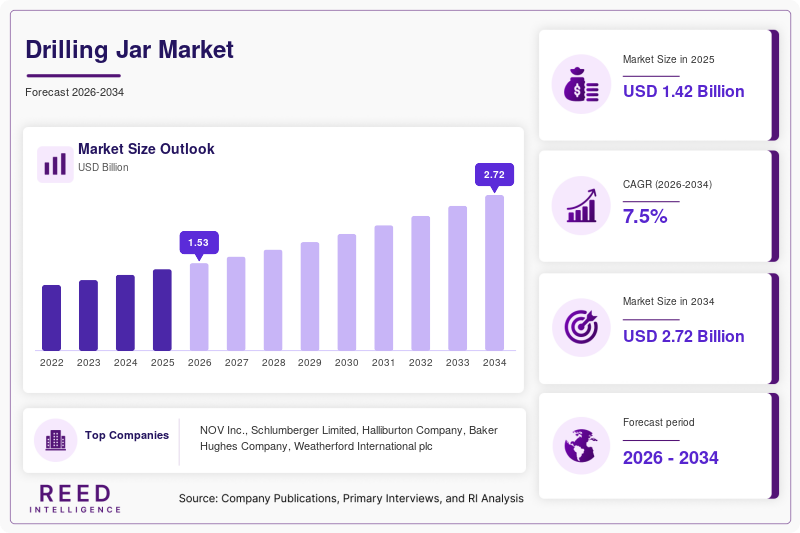
The Drilling Jar Market size was valued at USD 1.42 billion in 2026 and is projected to reach USD 2.54 billion by 2034, expanding at a CAGR of 7.5% during 2026–2034. Drilling jars are critical downhole tools used to deliver impact force when drill strings become stuck during oil & gas, geothermal, mining, and directional drilling operations. These tools help reduce non-productive time, lower retrieval costs, and improve drilling efficiency across complex well environments. Demand remains supported by rising drilling depth, extended-reach wells, and increasing pressure to improve rig economics.
A major global factor supporting market growth is the continued shift toward deeper and technically challenging reservoirs. Operators are moving into shale basins, offshore assets, high-pressure high-temperature wells, and geothermal projects where stuck pipe risk is higher. In these settings, drilling jars are increasingly viewed as standard risk-mitigation equipment rather than optional accessories. The market is also benefiting from replacement demand, rental fleet expansion, and adoption of premium hydraulic and mechanical jars with higher durability.
Key Highlights
- North America dominated the market with a 35.1% share in 2025.
- while Asia Pacific is expected to grow at the fastest CAGR of 9.4% during 2026–2034.
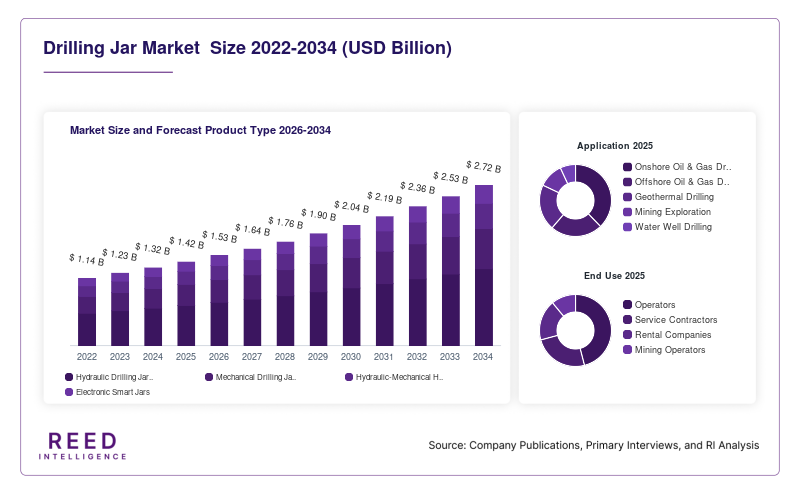
- By product type, hydraulic drilling jars accounted for the largest share of 46.8%, while electronic smart jars are projected to grow at a CAGR of 10.8%.
- By application, onshore oil & gas drilling led with a 52.6% share, whereas geothermal drilling is expected to expand at a CAGR of 11.1%.
- By end use, service contractors held the leading share of 48.3%, while mining operators are forecast to grow at a CAGR of 8.7%.
- The United States remained the dominant country, with market values of USD 412 million in 2024 and USD 448 million in 2025.
Market Trends
Smart Downhole Tool Integration
The market is seeing rising demand for drilling jars integrated with digital monitoring features. Operators increasingly want tools that provide load data, shock history, and maintenance alerts to reduce unexpected failures. Smart jars support predictive servicing and improve fleet utilization for rental companies. These tools are gaining attention in offshore and horizontal wells where retrieval costs are high. Manufacturers are pairing traditional jar systems with sensors and communication-ready housings. As drilling programs become data driven, buyers prefer equipment that can connect with broader rig analytics platforms and performance dashboards.
Growth of Rental and Refurbishment Models
Rental-led procurement is becoming a visible trend across the Drilling Jar Market. Smaller operators and short-duration drilling campaigns often avoid direct capital purchases and instead lease tools through oilfield service providers. This model helps manage costs and ensures access to the latest specifications. At the same time, refurbishment programs are expanding because many customers seek lower-cost alternatives to new equipment. Re-machining, seal replacement, recertification, and pressure testing extend product life while maintaining operational reliability. The trend is particularly strong in mature markets where operators focus on cost discipline.
Market Drivers
Expansion of Complex Well Architectures
Longer lateral wells, ultra-deep drilling, and directional programs are creating stronger demand for reliable jar systems. Complex well paths increase friction, torque, and differential sticking risks, making pipe release tools more important. Operators now include drilling jars in planning stages rather than adding them after problems occur. Hydraulic jars are widely used in horizontal shale wells because controlled impact force can protect adjacent bottom-hole assemblies. As exploration moves into technically difficult reservoirs, spending on premium drilling tools is rising, supporting market size and long-term growth.
Focus on Reducing Non-Productive Time
Every hour of rig downtime can create significant cost pressure, especially offshore and high-rate land rigs. Drilling jars help restore operations quickly when drill strings become stuck, reducing fishing operations and sidetrack risk. This economic value is a major driver for adoption across regions. Service companies promote jars as efficiency tools because they lower trip time losses and improve project scheduling. Operators also use jars to limit expensive equipment abandonment events. With tighter capital budgets across the energy sector, tools that directly reduce non-productive time continue to gain preference.
Market Restraint
Volatile Drilling Activity and Budget Cycles
The primary restraint affecting the Drilling Jar Market is volatility in upstream drilling activity tied to commodity prices and capital expenditure cycles. When oil, gas, or metals prices decline, operators often delay new wells, reduce rig counts, and defer tool purchases. This directly affects demand for new drilling jars and lowers rental utilization. Smaller manufacturers can face uneven order flows, while distributors may hold excess inventory during downturns. Price competition also intensifies when drilling activity slows, compressing margins across the supply chain. For example, a sudden reduction in shale drilling programs can quickly weaken replacement demand in North America. Because drilling jars are linked to active well construction, cyclical investment patterns remain a meaningful constraint on steady revenue growth.
Market Opportunities
Rising Geothermal Drilling Investments
Geothermal energy development is creating a strong opportunity for drilling jar suppliers. Geothermal wells often involve hard rock formations, high temperatures, and stuck tool risks that require robust impact tools. Governments in Asia Pacific, Europe, and North America are supporting renewable heat and baseload clean power projects, increasing drilling activity. Manufacturers that design high-temperature seals, corrosion-resistant materials, and specialized jars for geothermal environments can access a growing niche. As geothermal projects scale commercially, demand for reliable downhole intervention tools is expected to rise steadily.
Emerging Mining and Water Well Applications
Beyond oil and gas, drilling jars are finding wider use in mining exploration, quarrying, and deep water well drilling. Mineral demand linked to batteries, electrification, and infrastructure is increasing global exploration budgets. Remote drilling programs in hard formations often need jar systems to release stuck assemblies and reduce downtime. Water security projects in arid regions also support deeper borehole drilling where tool sticking risks rise. Suppliers that diversify into these adjacent sectors can reduce dependence on energy cycles and build broader revenue streams.
Segmental Analysis
By Product Type
Hydraulic drilling jars held the dominant share of 46.8% in 2024. These tools are widely preferred because they provide controlled impact force, smoother activation, and better compatibility with directional drilling assemblies. Operators use hydraulic jars in shale, offshore, and deep wells where precision is important. Their ability to deliver repeatable upward or downward blows helps reduce damage risk to nearby tools. Many contractors also prefer hydraulic systems because maintenance procedures are well established and replacement parts are widely available. Demand remains strong in regions with advanced drilling practices and high-value well programs.
Electronic smart jars are projected to be the fastest-growing subsegment, expanding at a CAGR of 10.8% through 2034. Growth is linked to digital oilfield adoption and demand for real-time operational visibility. These tools can support performance logging, activation tracking, and predictive maintenance planning. Rental fleets are testing smart tools to improve utilization and lower unexpected failures. Premium offshore and geothermal projects are early adopters because downtime costs justify higher upfront pricing. As sensor costs decline and connectivity improves, smart jars are expected to gain wider commercial acceptance.
By Application
Onshore oil & gas drilling accounted for the leading 52.6% share in 2024. Large land rig fleets, especially in shale and conventional basins, create recurring demand for drilling jars. Onshore wells often operate under aggressive time targets, making downtime reduction a top priority. Jars help release stuck strings caused by cuttings accumulation, key seating, and differential sticking. Contractors frequently standardize tool packages across multiple rigs, which supports consistent reorder activity. High drilling volumes in North America, the Middle East, and Asia continue to sustain this segment’s revenue base.
Geothermal drilling is expected to record the fastest growth at a CAGR of 11.1% during the forecast period. Geothermal wells commonly encounter abrasive formations, high temperature zones, and complex casing programs that elevate sticking risks. Specialized jars with heat-resistant seals and corrosion-resistant metallurgy are increasingly required. Public incentives for renewable energy are accelerating drilling campaigns in countries such as Indonesia, Japan, Iceland, Kenya, and the United States. As project pipelines expand, geothermal applications are becoming an important demand center for premium drilling jars.
By End Use
Service contractors held the largest 48.3% share in 2024. Many operators rely on third-party drilling service companies for tool supply, maintenance, field support, and rental access. Contractors manage large fleets and rotate tools across customer sites, creating steady demand for new purchases and refurbishment. Their procurement scale allows adoption of mixed fleets containing hydraulic, mechanical, and specialty jars. Since contractors are measured on uptime and operational efficiency, they prioritize reliable products with rapid servicing support. This keeps the segment dominant across most active drilling regions.
Mining operators are forecast to be the fastest-growing end-use segment, registering a CAGR of 8.7% through 2034. Rising exploration budgets for copper, lithium, gold, and rare earth resources are increasing deep drilling activity in remote locations. Stuck tool incidents in hard rock programs can create major schedule delays, making jars valuable productivity tools. Mining companies are also adopting ruggedized equipment with simplified maintenance due to limited field service availability. As critical mineral supply chains expand globally, this segment is expected to contribute meaningful incremental market growth.
Regional Analysis
North America
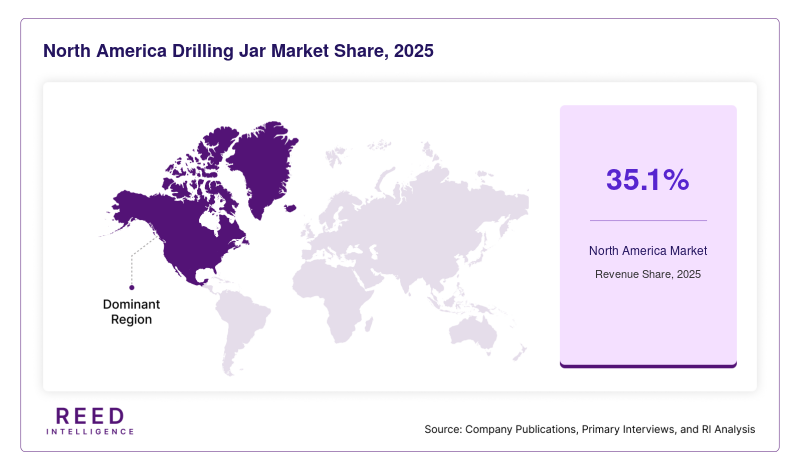
North America accounted for 35.1% of the Drilling Jar Market in 2025 and is forecast to expand at a CAGR of 7.1% through 2034. The region benefits from high drilling intensity, strong rental networks, and rapid replacement cycles. Horizontal shale wells in the United States and Canada create recurring demand for hydraulic jars, accelerator tools, and premium service support. Mature oilfield infrastructure also supports aftermarket sales.
The United States remains the dominant country in the region. A unique growth factor is the continued optimization of shale pad drilling, where multi-well programs require dependable tools that minimize downtime. Operators prioritize faster drilling cycles and standardized bottom-hole assemblies, increasing repeat demand for jar systems designed for long laterals and frequent rig moves.
Europe
Europe represented 18.6% market share in 2025 and is expected to register a CAGR of 6.5% during the forecast period. Demand is concentrated in offshore North Sea activity, geothermal developments, and selective onshore projects. Environmental standards in the region encourage use of durable equipment with lower failure rates, which supports premium product adoption and certified refurbishment services.
The Norway market leads Europe due to offshore drilling sophistication and high-value well economics. A unique growth factor is strong investment in mature field recovery, where intervention and redevelopment wells need dependable downhole tools. Operators favor equipment that reduces costly rig delays in offshore environments with strict operating schedules.
Asia Pacific
Asia Pacific held 24.3% of the global market in 2025 and is projected to grow at the fastest CAGR of 9.4% through 2034. The region is supported by rising energy demand, national exploration programs, and expanding geothermal activity. New drilling campaigns across Southeast Asia, China, India, and Australia are increasing demand for both standard and premium jar systems.
China is the dominant country within Asia Pacific. A unique growth factor is the government-backed expansion of domestic energy security projects, including shale gas and deep conventional wells. Large-scale drilling programs create demand for locally supplied jars, maintenance services, and imported high-performance tools for difficult reservoirs.
Middle East & Africa
The Middle East & Africa captured 14.2% share in 2025 and is expected to advance at a CAGR of 7.8% by 2034. National oil companies continue investing in capacity expansion, sour gas development, and deeper reservoirs. These drilling conditions increase the value of robust jar systems capable of handling high torque and harsh downhole environments.
Saudi Arabia leads the regional market. A unique growth factor is sustained investment in large integrated upstream expansion programs. Long-term field development plans create consistent demand for drilling consumables and specialty downhole tools. Buyers also prefer vendors with local servicing capability and fast turnaround support.
Latin America
Latin America accounted for 7.8% of market share in 2025 and is forecast to grow at a CAGR of 6.9% over the study period. Offshore projects in Brazil, onshore redevelopment in Argentina, and mining exploration in Chile support equipment demand. Market growth is gradual but supported by increasing private investment and field modernization.
Brazil is the dominant country in Latin America. A unique growth factor is pre-salt offshore drilling activity, where complex wells require reliable stuck-pipe mitigation tools. High offshore operating costs encourage operators to invest in quality jar systems that reduce downtime and protect drilling schedules.
Competitive Landscape
The Drilling Jar Market is moderately consolidated, with competition centered on product reliability, metallurgy, service footprint, and rental fleet availability. Leading companies focus on strategic partnerships with drilling contractors, regional repair centers, and customized jar configurations for difficult wells. Price remains important in standard applications, while premium segments prioritize tool life and predictable activation performance.
NOV Inc. is viewed as a market leader due to its broad drilling tools portfolio and global service network. A recent development includes expansion of digitally enabled downhole tool monitoring solutions integrated with selected jar systems. Other notable participants include Schlumberger, Halliburton, Weatherford, and Baker Hughes, each leveraging field presence and customer relationships. Mid-sized specialists compete through niche engineering, fast turnaround refurbishment, and regional inventory availability. Competitive intensity is expected to rise as geothermal and mining opportunities attract diversified tool manufacturers.
Key Players List
- NOV Inc.
- Schlumberger Limited
- Halliburton Company
- Baker Hughes Company
- Weatherford International plc
- Odfjell Technology
- Knight Oil Tools
- Fishing Tools & Services
- Bilco Tools Inc.
- Stabil Drill
- Drilling Tools International
- Wenzel Downhole Tools
- Workstrings International
- Jindal Drilling Tools
- RDT USA Inc.
Recent Developments
- A leading manufacturer launched a high-temperature hydraulic jar series designed for geothermal wells exceeding conventional seal limits.
- A major oilfield service company expanded its North American rental fleet with digitally trackable drilling jars to improve maintenance scheduling.
- A regional supplier in the Middle East opened a new refurbishment center focused on faster turnaround for national oil company contracts.
Drilling Jar Market Segments
Product Type
- Hydraulic Drilling Jars
- Mechanical Drilling Jars
- Hydraulic-Mechanical Hybrid Jars
- Electronic Smart Jars
Application
- Onshore Oil & Gas Drilling
- Offshore Oil & Gas Drilling
- Geothermal Drilling
- Mining Exploration
- Water Well Drilling
End Use
- Operators
- Service Contractors
- Rental Companies
- Mining Operators
By Region
- North America
- Europe
- APAC
- Middle East and Africa
- LATAM