Drilling Lubricant Market Size, Share & Demand Report By Product Type (Water-Based Drilling Lubricants, Oil-Based Drilling Lubricants, Synthetic-Based Drilling Lubricants, Specialty Lubricants), By Application (Onshore Drilling, Offshore Drilling), By End-Use Industry (Oil & Gas Exploration, Mining, Geothermal Drilling, Water Well Drilling), By Distribution Channel (Direct Sales, Third-Party Distributors), By Region & Segment Forecasts, 2026–2034
USD 3950
Key Highlights
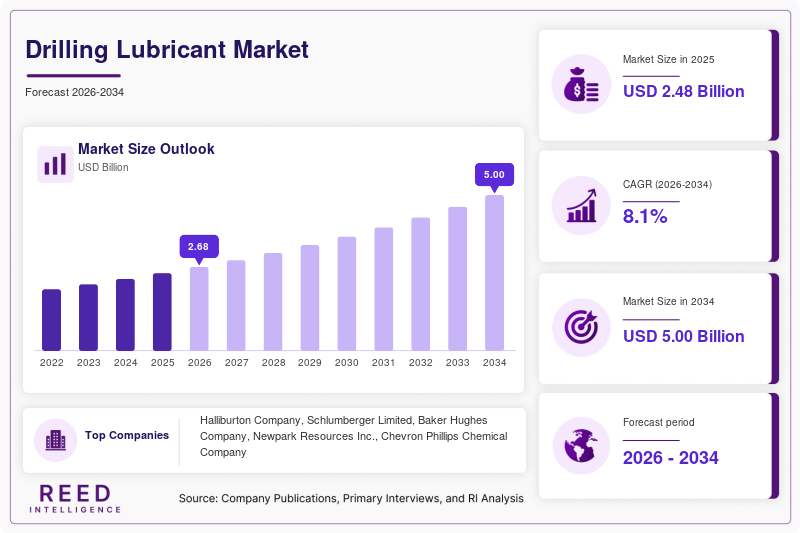
- North America accounted for nearly 38.6% of the global Drilling Lubricant Market share in 2025, while the Middle East & Africa is projected to register the fastest CAGR of 9.3% during the forecast period.
- By product type, water-based drilling lubricants held the leading share of 44.7% in 2025, whereas synthetic-based drilling lubricants are anticipated to expand at a CAGR of 9.8% through 2034.
- By application, onshore drilling remained the dominant segment with 63.2% market share in 2025, while offshore drilling is expected to witness the fastest growth rate of 9.6%.
- By end-use industry, oil & gas exploration accounted for 71.4% of the global market share in 2025, whereas geothermal drilling applications are forecast to grow at a CAGR of 8.9%.
- The United States represented the dominant country market with values of USD 482 million in 2024 and USD 521 million in 2025 due to increasing shale drilling activities and expanding unconventional oil exploration projects.
Market Trends
Rising Adoption of Environmentally Friendly Lubricants
The increasing demand for environmentally compatible drilling fluids has emerged as a major trend shaping the Drilling Lubricant Market. Regulatory authorities and energy companies are increasingly focusing on reducing environmental impact during drilling operations, particularly in offshore and ecologically sensitive regions.
Biodegradable and low-toxicity drilling lubricants are gaining strong demand because they help minimize contamination risks while maintaining operational performance. Manufacturers are developing advanced water-based and synthetic lubricant formulations that comply with stricter environmental standards and improve drilling efficiency. This trend is expected to continue influencing product innovation and market growth during the forecast period.
Increasing Deployment of Advanced Horizontal Drilling Technologies
Another important trend influencing the Drilling Lubricant Market is the growing deployment of horizontal and directional drilling technologies. Modern oil and gas extraction techniques require drilling lubricants capable of reducing torque and drag over extended lateral drilling distances.
Advanced lubricant formulations improve drill string mobility and reduce mechanical stress during complex drilling operations. The increasing use of automated drilling systems and high-performance drilling tools has further accelerated demand for specialty lubricant additives capable of operating under extreme pressure and temperature conditions.
Market Drivers
Expansion of Global Oil and Gas Exploration Activities
The increasing expansion of oil and gas exploration projects has remained one of the primary drivers supporting the Drilling Lubricant Market. Rising global energy demand and declining output from mature oil fields have encouraged energy companies to invest in new exploration and drilling operations.
Drilling lubricants play a critical role in improving drilling speed, minimizing equipment damage, and reducing operational downtime. Their ability to optimize drilling efficiency in challenging geological formations has increased their importance across both conventional and unconventional drilling projects.
Growing Demand for High-Performance Drilling Fluids
The increasing complexity of modern drilling environments has significantly contributed to the growth of the Drilling Lubricant Market. Deepwater exploration, shale extraction, and geothermal drilling operations require advanced drilling fluid systems capable of maintaining stability under extreme operational conditions.
High-performance drilling lubricants improve heat dissipation, reduce friction, and enhance borehole cleaning efficiency. The rising focus on operational productivity and cost optimization is expected to continue driving demand for advanced lubricant technologies.
Market Restraint
Fluctuations in Crude Oil Prices
One of the major restraints affecting the Drilling Lubricant Market is the volatility in crude oil prices. Sharp fluctuations in global oil prices can influence exploration investments and drilling activity levels across the energy sector.
Periods of lower oil prices may lead energy companies to delay or reduce drilling projects, which can directly impact demand for drilling lubricants. Uncertainty in energy market conditions may also create pricing pressure and operational challenges for lubricant manufacturers.
Market Opportunities
Increasing Investments in Geothermal Energy Projects
The growing focus on renewable energy development presents substantial opportunities for the Drilling Lubricant Market. Geothermal energy projects require specialized drilling operations involving high-temperature environments and abrasive geological conditions.
Drilling lubricants designed for geothermal applications provide improved thermal stability and operational performance under extreme conditions. Rising investments in renewable energy infrastructure and clean energy transition strategies are expected to support future market opportunities.
Expansion of Deepwater Drilling Operations
The increasing expansion of deepwater and ultra-deepwater drilling projects is creating new growth opportunities within the Drilling Lubricant Market. Offshore drilling environments require advanced lubricant formulations capable of supporting high-pressure and high-temperature drilling conditions.
Energy companies are increasingly investing in specialized drilling fluid systems to improve operational reliability and reduce equipment wear in offshore projects. This trend is expected to encourage continued innovation and market expansion.
Segmental Analysis
By Product Type
Based on product type, the Drilling Lubricant Market is segmented into water-based drilling lubricants, oil-based drilling lubricants, synthetic-based drilling lubricants, and specialty lubricants.
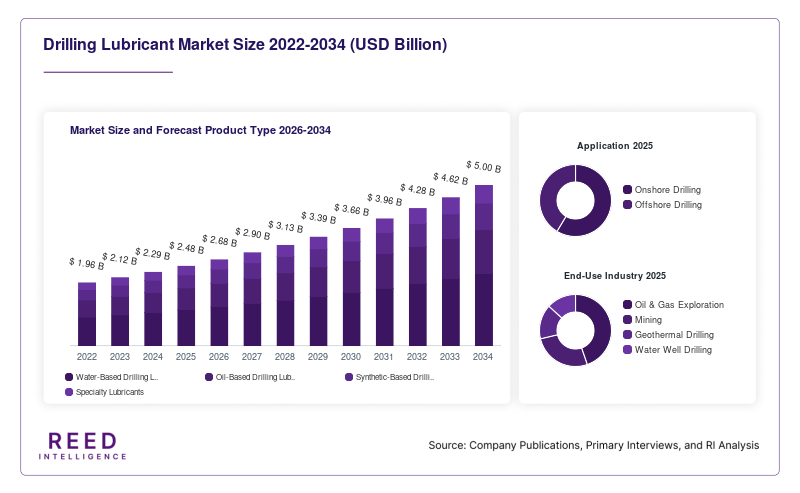
Water-based drilling lubricants dominated the market with a share of 44.7% in 2025. Their extensive use in conventional drilling operations and lower environmental impact contributed significantly to segment growth. Operators increasingly preferred water-based formulations because of cost efficiency and regulatory compliance advantages.
Synthetic-based drilling lubricants are expected to witness the fastest CAGR of 9.8% during the forecast period. Increasing demand for high-performance lubricants in deepwater and horizontal drilling projects will support future segment growth. These lubricants offer improved thermal stability and enhanced lubrication under extreme operational conditions.
By Application
Based on application, the market is categorized into onshore drilling and offshore drilling.
Onshore drilling accounted for the largest market share of 63.2% in 2025 due to extensive shale exploration activities and increasing land-based drilling projects worldwide. Drilling lubricants are widely utilized in onshore operations to improve drilling efficiency and reduce equipment wear.
Offshore drilling is projected to grow at the fastest CAGR of 9.6% through 2034. Increasing investments in deepwater and ultra-deepwater exploration projects are expected to support future segment expansion. Offshore drilling environments require advanced lubricant systems capable of operating under high-pressure conditions.
By End-Use Industry
Based on end-use industry, the Drilling Lubricant Market is segmented into oil & gas exploration, mining, geothermal drilling, and water well drilling.
Oil & gas exploration remained the dominant end-use segment with 71.4% market share in 2025. Rising global energy demand and increasing upstream investments contributed significantly to segment dominance.
Geothermal drilling is expected to register the fastest CAGR of 8.9% during the forecast period. Increasing renewable energy investments and expansion of geothermal power generation projects will support future segment growth. Geothermal drilling operations require specialized lubricants capable of withstanding high-temperature environments.
By Distribution Channel
Based on distribution channel, the market is segmented into direct sales and third-party distributors.
Direct sales held the largest share of 69.1% in 2025 because major oilfield service providers and drilling operators preferred long-term procurement agreements with lubricant manufacturers. Direct supply arrangements improved operational reliability and technical support capabilities.
Third-party distributors are anticipated to grow at the fastest CAGR of 8.3% during the forecast period due to increasing regional drilling activities and expanding access to specialty drilling chemicals in emerging markets. Distribution network expansion is expected to support segment growth.
Regional Analysis
North America
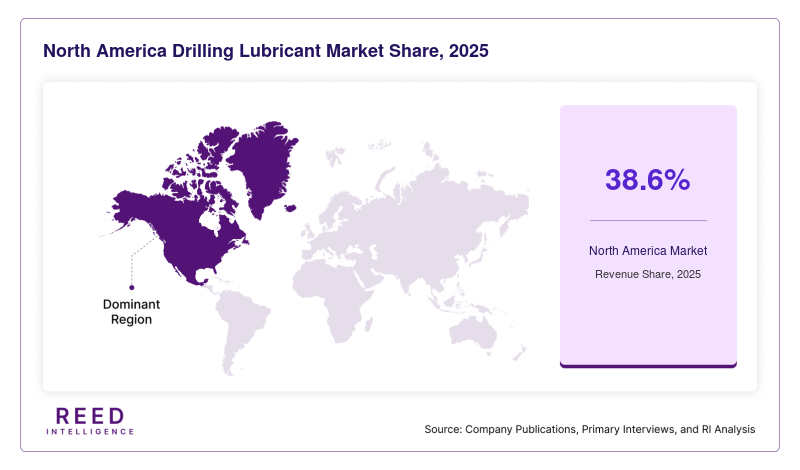
North America held approximately 38.6% of the global Drilling Lubricant Market share in 2025. The region benefited from strong shale gas production, increasing unconventional drilling activities, and advanced oilfield infrastructure. The United States remained the dominant country due to expanding horizontal drilling projects and rising investments in shale oil exploration.
The regional market is expected to grow at a CAGR of 7.8% during the forecast period. Increasing drilling automation and continued investments in unconventional energy production are expected to support future market growth across North America.
Europe
Europe accounted for nearly 19.4% of the global Drilling Lubricant Market share in 2025. The market benefited from offshore drilling activities in the North Sea and increasing focus on environmentally sustainable drilling practices.
The regional market is projected to expand at a CAGR of 7.5% through 2034. Norway emerged as the dominant country due to advanced offshore exploration capabilities and increasing adoption of environmentally friendly drilling fluid technologies. Growing investments in energy security projects are expected to strengthen regional demand.
Asia Pacific
Asia Pacific represented around 24.1% of the global Drilling Lubricant Market share in 2025. Rapid industrialization, rising energy demand, and increasing exploration activities contributed significantly to regional market growth.
The region is forecast to witness a CAGR of 8.5% during the forecast period. China remained the leading country market because of increasing investments in domestic oil and gas production and expanding shale exploration projects. Government initiatives supporting energy independence are expected to support future demand.
Middle East & Africa
The Middle East & Africa accounted for approximately 12.7% of the global market share in 2025. The region benefited from extensive crude oil reserves, rising drilling activities, and ongoing energy infrastructure expansion.
The market is anticipated to grow at the fastest CAGR of 9.3% through 2034. Saudi Arabia emerged as the dominant country due to increasing offshore and onshore exploration projects and rising investments in advanced drilling technologies. Expansion of upstream oilfield operations is expected to contribute to future regional growth.
Latin America
Latin America captured nearly 5.2% of the global Drilling Lubricant Market share in 2025. Increasing offshore oil exploration and expanding energy investments supported regional market development.
The market is projected to register a CAGR of 7.9% during the forecast period. Brazil remained the leading country market because of growing deepwater drilling projects and rising offshore oil production activities. Investments in pre-salt exploration fields are expected to support future regional demand.
Competitive Landscape
The competitive landscape of the Drilling Lubricant Market remains moderately competitive, with leading companies focusing on product innovation, sustainable lubricant technologies, and expansion of oilfield chemical portfolios. Manufacturers are increasingly investing in high-performance drilling fluid additives capable of improving operational efficiency and environmental compliance.
Halliburton Company remained one of the leading market participants due to its extensive drilling fluid technologies portfolio and strong global oilfield service network. The company recently expanded its environmentally compatible drilling lubricant solutions designed for offshore and unconventional drilling operations.
Other manufacturers are increasingly focusing on strategic collaborations with energy companies and drilling contractors. Product differentiation through thermal stability, biodegradability, and high-pressure performance has become an important competitive strategy across the industry.
Key Players List
- Halliburton Company
- Schlumberger Limited
- Baker Hughes Company
- Newpark Resources Inc.
- Chevron Phillips Chemical Company
- Weatherford International plc
- National Oilwell Varco
- Croda International Plc
- Lubrizol Corporation
- Innospec Inc.
- Scomi Group
- Global Drilling Fluids & Chemicals Limited
- Aubin Group
- TETRA Technologies Inc.
- CES Energy Solutions
Recent Developments
- In 2025, Halliburton Company expanded its environmentally compatible drilling fluid lubricant portfolio for offshore applications.
- In 2024, Schlumberger Limited introduced advanced synthetic drilling lubricant solutions for high-temperature drilling environments.
- In 2025, Baker Hughes Company increased investments in sustainable oilfield chemical technologies for unconventional drilling projects.
- In 2024, Newpark Resources Inc. expanded drilling fluid manufacturing capabilities across North America.
- In 2025, Lubrizol Corporation partnered with regional drilling operators to develop specialty lubricant additives for geothermal drilling applications.
Drilling Lubricant Market Segments
Product Type
- Water-Based Drilling Lubricants
- Oil-Based Drilling Lubricants
- Synthetic-Based Drilling Lubricants
- Specialty Lubricants
Application
- Onshore Drilling
- Offshore Drilling
End-Use Industry
- Oil & Gas Exploration
- Mining
- Geothermal Drilling
- Water Well Drilling
Distribution Channel
- Direct Sales
- Third-Party Distributors
By Region
- North America
- Europe
- APAC
- Middle East and Africa
- LATAM