Driving School Scheduling Software Market Size, Share & Demand Report By Deployment Mode (Cloud-Based, On-Premise, AI-Enabled Scheduling Platforms), By Application (Lesson Scheduling & Calendar Management, Student Performance Analytics, Payment & Billing Management, Instructor Management, Customer Relationship Management), By End User (Independent Driving Schools, Multi-Location Driving School Chains, Franchise Driving Schools, Corporate Driver Training Centers), By Region & Segment Forecasts, 2
USD 3950
Market Overview
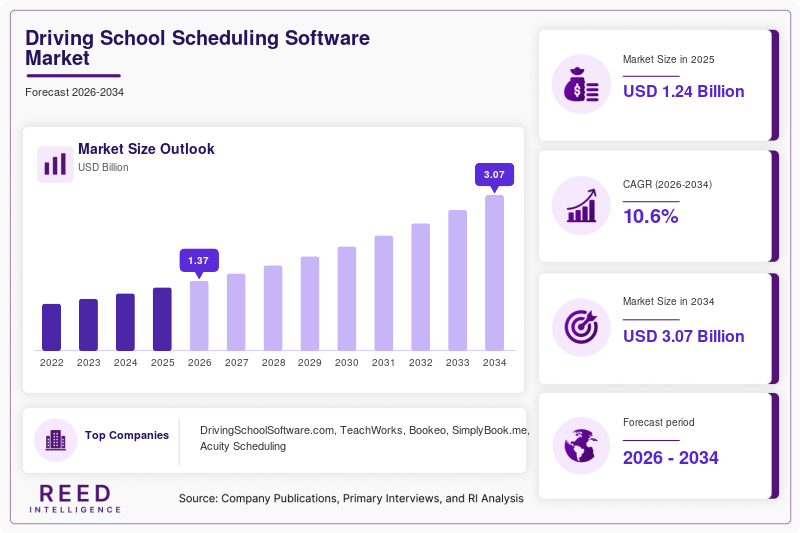
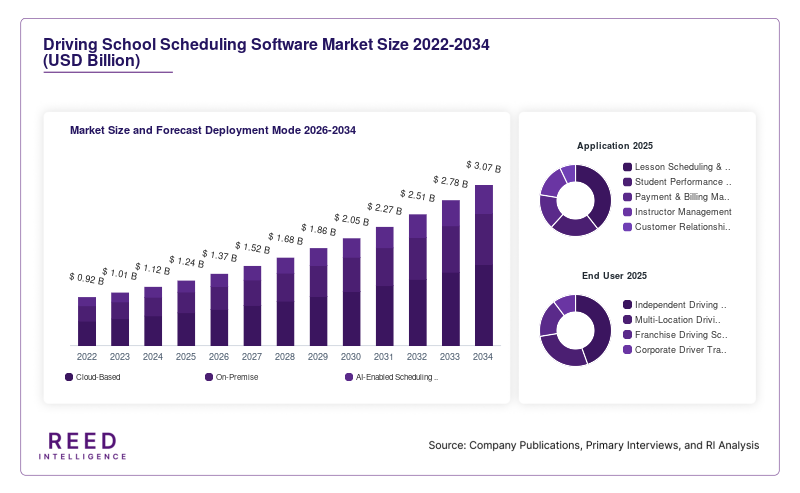
The Driving School Scheduling Software Market size was valued at approximately USD 1.24 billion in 2026 and is projected to reach USD 2.78 billion by 2034, expanding at a CAGR of 10.6% during 2026–2034. The market is experiencing steady growth as driving schools increasingly adopt digital management platforms to streamline instructor allocation, lesson scheduling, student enrollment, payment processing, and compliance tracking. The transition from manual scheduling systems toward cloud-based and mobile-enabled platforms has significantly improved operational efficiency across driving education providers worldwide.
One of the primary factors supporting global market growth is the rapid digitalization of small and medium-sized educational service providers. Driving schools are increasingly seeking automated scheduling solutions to reduce administrative workload, improve customer experience, and optimize instructor utilization. The growing penetration of smartphones and online booking systems has also encouraged students to prefer digital appointment management over traditional phone-based scheduling methods.
Key Highlights
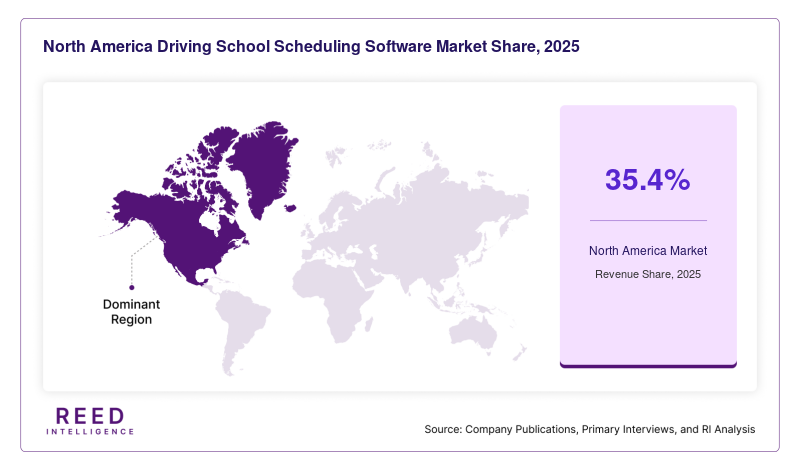
- North America dominated the market with a 35.4% share in 2025, while Asia Pacific is expected to grow at the fastest CAGR of 12.1% during 2026–2034.
- By deployment mode, cloud-based software accounted for the largest share of 63.8%, while AI-enabled scheduling platforms are projected to grow at a CAGR of 13.7%.
- By application, lesson scheduling and calendar management led with a 44.2% share, whereas student performance analytics is expected to expand at a CAGR of 12.9%.
- The United States remained the dominant country, with market values of USD 338 million in 2024 and USD 371 million in 2025.
Market Trends
Expansion of AI-Powered Scheduling and Resource Optimization
Artificial intelligence is becoming a significant trend in the Driving School Scheduling Software Market. Software providers are increasingly integrating AI algorithms capable of automatically assigning instructors, vehicles, and lesson times based on availability, geographic proximity, student preferences, and instructor qualifications. These intelligent systems help driving schools minimize idle time, reduce scheduling conflicts, and improve fleet utilization rates. As schools handle growing student volumes, automated scheduling capabilities provide measurable operational benefits. AI-driven tools also support predictive demand forecasting, enabling businesses to allocate resources more efficiently during seasonal enrollment peaks. The integration of machine learning technologies is expected to become a standard feature among premium scheduling platforms during the forecast period.
Growing Adoption of Mobile-First and Self-Service Platforms
Mobile accessibility continues to transform how driving schools interact with students and instructors. Modern scheduling platforms increasingly provide dedicated mobile applications that allow learners to book lessons, track progress, receive notifications, and manage payments directly through smartphones. Instructors can simultaneously update lesson completion records and availability in real time. This trend is being driven by changing consumer expectations for convenience and instant access to services. Mobile-first solutions improve communication, reduce administrative overhead, and increase booking efficiency. Vendors are also enhancing user experiences through automated reminders, digital documentation, and integrated messaging features. As smartphone penetration rises globally, mobile-based scheduling solutions are expected to remain a major growth catalyst.
Market Drivers
Increasing Digital Transformation Across Driving Education Businesses
The widespread digital transformation of service-based businesses is a major driver supporting the Driving School Scheduling Software Market. Traditional paper-based scheduling systems often lead to administrative inefficiencies, booking errors, and limited visibility into operations. Driving schools are increasingly investing in digital platforms to centralize scheduling, billing, instructor management, and customer communications. Cloud-based software enables administrators to monitor operations from any location while providing real-time updates across multiple branches. The ability to automate repetitive administrative tasks significantly reduces labor costs and improves service quality. As educational institutions continue embracing digital technologies, demand for advanced scheduling software is expected to rise steadily across both developed and emerging markets.
Rising Demand for Enhanced Student Experience and Operational Efficiency
Driving schools face increasing pressure to deliver convenient and flexible learning experiences. Students now expect online booking capabilities, automated reminders, digital payment options, and transparent lesson tracking systems. Scheduling software helps schools meet these expectations while simultaneously improving operational efficiency. Automated systems reduce missed appointments, improve instructor productivity, and streamline customer support processes. The ability to personalize scheduling options and provide instant confirmations contributes to higher student satisfaction levels. Furthermore, competitive pressures are encouraging driving schools to adopt technologies that differentiate their services. These factors collectively contribute to strong software adoption rates and sustained market growth throughout the forecast period.
Market Restraint
Budget Constraints and Technology Adoption Challenges Among Small Operators
Despite growing demand, the Driving School Scheduling Software Market faces challenges related to implementation costs and technology adoption barriers among smaller driving schools. Many independent operators continue to rely on manual scheduling methods due to limited financial resources and concerns regarding subscription fees, training expenses, and system integration requirements. Smaller businesses may also encounter difficulties in migrating historical records and adapting existing workflows to digital platforms. Resistance to organizational change can further delay software adoption, particularly in regions where digital literacy levels remain relatively low. In some developing economies, inadequate internet infrastructure may limit the effectiveness of cloud-based solutions. These challenges can slow market penetration and create disparities in adoption rates across different business sizes. Vendors must therefore focus on offering affordable pricing structures, simplified onboarding processes, and scalable deployment models to attract cost-sensitive customers while maintaining sustainable growth.
Market Opportunities
Expansion of Driving Education Services in Emerging Economies
Emerging economies present significant growth opportunities for the Driving School Scheduling Software Market. Rapid urbanization, rising vehicle ownership rates, and expanding middle-class populations are contributing to increased demand for driving education services. Countries across Asia Pacific, Latin America, and parts of Africa are witnessing a growing number of driving schools seeking operational modernization. As these institutions scale their services, digital scheduling platforms become essential for managing larger student populations and instructor networks. Government initiatives aimed at improving road safety and licensing standards are also encouraging professionalization within the sector. Software vendors that offer localized language support, flexible pricing models, and region-specific compliance features are well positioned to capture emerging market demand.
Integration of Advanced Analytics and Business Intelligence Features
The integration of analytics and business intelligence capabilities creates substantial opportunities for software developers. Driving schools increasingly require data-driven insights to improve business performance, monitor instructor productivity, evaluate student progress, and optimize marketing strategies. Advanced reporting dashboards can help administrators identify scheduling inefficiencies, forecast demand trends, and improve resource allocation. Predictive analytics can further support retention initiatives by identifying students at risk of discontinuing lessons. As driving schools become more focused on measurable outcomes and operational transparency, demand for software platforms offering robust analytical capabilities is expected to increase significantly. Vendors that successfully combine scheduling functionality with strategic decision-support tools may gain competitive advantages in the evolving market landscape.
Segmental Analysis
By Deployment Mode
Cloud-based software represented the dominant subsegment, accounting for approximately 63.8% of market share in 2024. The widespread adoption of cloud solutions is driven by their flexibility, scalability, and cost-effectiveness compared with traditional on-premise systems. Driving schools increasingly prefer cloud deployments because they enable remote access to scheduling information, student records, instructor calendars, and payment systems from any internet-connected device. These platforms reduce infrastructure requirements and simplify software maintenance through automatic updates. Multi-location driving school operators particularly benefit from centralized management capabilities offered by cloud-based solutions. Growing confidence in cloud security and expanding internet accessibility further support the continued dominance of this deployment segment across global markets.
AI-enabled scheduling platforms are projected to emerge as the fastest-growing deployment category, advancing at a CAGR of 13.7% during 2026–2034. These solutions leverage artificial intelligence to automate instructor assignments, optimize scheduling patterns, and reduce resource conflicts. Driving schools are increasingly recognizing the value of intelligent scheduling systems in improving operational efficiency and customer satisfaction. AI-powered platforms can analyze historical booking data, predict demand fluctuations, and recommend optimized lesson schedules. The ability to enhance productivity while minimizing administrative workload represents a key growth factor. Continuous improvements in machine learning capabilities are expected to accelerate adoption across both large and medium-sized driving education providers.
By Application
Lesson scheduling and calendar management held the largest market share at approximately 44.2% in 2024. This dominance reflects the fundamental importance of scheduling functionality within driving school operations. Schools rely heavily on software platforms to coordinate instructor availability, vehicle allocation, lesson timing, and student bookings. Efficient scheduling processes help reduce missed appointments, improve instructor utilization, and enhance customer satisfaction. The increasing complexity of managing large student populations further reinforces demand for robust scheduling capabilities. Software vendors continue introducing features such as automated reminders, online booking systems, and real-time calendar synchronization to strengthen the value proposition of scheduling-focused applications.
Student performance analytics is anticipated to register the fastest CAGR of 12.9% through 2034. Driving schools increasingly seek tools that provide detailed insights into learner progress, lesson outcomes, and skill development trends. Performance analytics platforms help instructors personalize training approaches while enabling administrators to monitor educational effectiveness. The growing emphasis on measurable outcomes and data-driven decision-making supports adoption of these solutions. Advanced analytics capabilities also facilitate regulatory reporting and quality assurance initiatives. As educational service providers prioritize performance optimization, demand for sophisticated analytics applications is expected to increase substantially throughout the forecast period.
By End User
Independent driving schools accounted for the largest share of approximately 58.4% in 2024. These institutions represent the majority of driving education providers globally and increasingly adopt scheduling software to compete with larger organizations. Independent operators benefit from digital platforms that streamline administrative tasks, automate communications, and improve customer service. Cloud-based subscription models have made software solutions more accessible to smaller businesses by reducing upfront investment requirements. Growing awareness of operational efficiency benefits continues to encourage adoption among independent schools seeking sustainable growth and improved profitability in competitive markets.
Multi-location driving school chains are projected to record the fastest CAGR of 12.5% during the forecast period. These organizations require sophisticated scheduling systems capable of managing large instructor networks, multiple facilities, and extensive student populations. Centralized software platforms provide real-time visibility across operations while ensuring consistent service delivery standards. Expansion through franchising and regional acquisitions is increasing the complexity of operational management, creating strong demand for scalable scheduling solutions. The need for integrated reporting, performance monitoring, and resource optimization remains a key factor supporting rapid adoption among large driving school networks worldwide.
Regional Analysis
North America
North America accounted for approximately 35.4% of the Driving School Scheduling Software Market in 2025, making it the largest regional market. The region is expected to maintain strong momentum with a projected CAGR of 9.8% through 2034. High digital adoption rates, widespread cloud infrastructure availability, and the presence of established software vendors contribute to market leadership. Driving schools throughout the region increasingly utilize integrated management platforms to improve operational efficiency, automate scheduling tasks, and enhance customer engagement across competitive educational environments.
The United States remains the dominant country within the region. A major growth factor is the increasing emphasis on operational automation among multi-location driving school networks. Organizations are deploying centralized scheduling platforms to manage instructors, vehicles, and student bookings across multiple facilities. Rising consumer demand for online service accessibility further supports software investments, encouraging schools to adopt comprehensive digital management solutions that improve service delivery and administrative performance.
Europe
Europe represented approximately 27.1% of global market revenue in 2025 and is anticipated to expand at a CAGR of 9.6% during the forecast period. The region benefits from strong regulatory frameworks, advanced digital infrastructure, and widespread adoption of software solutions within educational service industries. Driving schools are increasingly implementing scheduling software to maintain compliance records, improve administrative efficiency, and support evolving learner expectations. The market is also supported by ongoing investments in educational technology modernization initiatives.
Germany remains the leading national market within Europe. One unique growth factor is the country's emphasis on structured driver education standards and documentation requirements. Driving schools increasingly rely on software platforms to manage lesson records, student progress tracking, and instructor scheduling while ensuring compliance with regulatory obligations. This operational need continues to support steady demand for advanced scheduling solutions throughout the country.
Asia Pacific
Asia Pacific held approximately 22.8% of the global market share in 2025 and is forecast to achieve the fastest CAGR of 12.1% through 2034. Rapid urbanization, increasing vehicle ownership, and expanding digital adoption among small businesses contribute significantly to market growth. Driving schools across major economies are modernizing operations through cloud-based platforms that improve scheduling efficiency and customer service. Growing internet penetration and smartphone usage further strengthen software adoption trends throughout the region.
China represents the largest country-level market in Asia Pacific. A key growth factor is the expanding number of licensed drivers and driving schools serving urban populations. As competition intensifies, schools increasingly deploy digital scheduling systems to streamline operations and improve student satisfaction. Government initiatives supporting digital transformation among service providers further accelerate market development and encourage software investments across the country.
Middle East & Africa
The Middle East & Africa accounted for approximately 7.2% of global market revenue in 2025 and is projected to register a CAGR of 10.4% during the forecast period. Although relatively smaller in size, the region demonstrates growing demand for educational technology solutions. Expanding transportation sectors, increasing vehicle ownership, and broader digitalization initiatives are encouraging driving schools to adopt scheduling software. Cloud-based deployment models are particularly attractive due to their scalability and lower upfront infrastructure requirements.
Saudi Arabia remains the dominant country within the regional market. A distinctive growth factor is the ongoing modernization of transportation and educational services under national digital transformation programs. Driving schools are increasingly investing in software platforms that automate scheduling, improve customer interactions, and enhance operational transparency. These developments are creating favorable conditions for market expansion across the country.
Latin America
Latin America captured approximately 7.5% of the Driving School Scheduling Software Market in 2025 and is expected to grow at a CAGR of 10.0% through 2034. Rising demand for driver training services and growing awareness of operational efficiency benefits are supporting software adoption throughout the region. Educational service providers are increasingly transitioning away from manual scheduling systems toward cloud-based alternatives that improve administrative productivity and customer experience.
Brazil leads the regional market due to its large population and extensive network of driving schools. A significant growth factor is the increasing adoption of digital payment systems and online service platforms. Driving schools are integrating scheduling software with payment processing and communication tools to improve convenience for students while reducing administrative burdens. These factors continue to support sustained market growth across the Brazilian market.
Competitive Landscape
The Driving School Scheduling Software Market is moderately fragmented, with a mix of specialized scheduling software providers and broader educational management platform developers competing for market share. Vendors are focusing on cloud-based deployments, mobile accessibility, automation features, and integrated payment solutions to strengthen their competitive positions. Product innovation, customer support quality, and platform scalability remain critical differentiating factors.
Among market participants, DrivingSchoolSoftware.com maintains a leading position due to its extensive feature portfolio and strong presence across North America. The company recently introduced enhanced AI-assisted scheduling capabilities designed to improve instructor allocation efficiency and reduce booking conflicts.
Other notable competitors include TeachWorks, Bookeo, SimplyBook.me, and Acuity Scheduling, all of which continue investing in platform enhancements and mobile-first functionality. Strategic partnerships, software integrations, and regional expansion initiatives remain common growth strategies. As digital adoption accelerates globally, competition is expected to intensify, encouraging vendors to develop increasingly comprehensive and user-friendly solutions tailored to the operational requirements of driving schools.
Key Players
- DrivingSchoolSoftware.com
- TeachWorks
- Bookeo
- SimplyBook.me
- Acuity Scheduling
- Driving School Manager
- ScheduleOnce
- Omnify
- Appointy
- BookingLive
- Setmore
- Reservio
- Zen Planner
- Picktime
- Skedda
Recent Developments
- In 2025, DrivingSchoolSoftware.com launched an AI-powered instructor allocation engine designed to improve scheduling accuracy and reduce administrative workload for large driving schools.
- In 2025, TeachWorks introduced enhanced mobile application functionality enabling real-time lesson tracking, automated notifications, and integrated payment processing.
- In 2024, SimplyBook.me expanded its educational services suite with advanced student management and analytics capabilities tailored for driving education providers.
- In 2024, Bookeo released predictive scheduling features utilizing historical booking data to improve lesson planning and resource allocation.
- In 2025, Acuity Scheduling introduced expanded API integration options that allow driving schools to connect scheduling workflows with CRM and accounting platforms.
Driving School Scheduling Software Market Segments
Deployment Mode
- Cloud-Based
- On-Premise
- AI-Enabled Scheduling Platforms
Application
- Lesson Scheduling & Calendar Management
- Student Performance Analytics
- Payment & Billing Management
- Instructor Management
- Customer Relationship Management
End User
- Independent Driving Schools
- Multi-Location Driving School Chains
- Franchise Driving Schools
- Corporate Driver Training Centers
By Region
- North America
- Europe
- APAC
- Middle East and Africa
- LATAM