Dry Bulk Shipping Market Size, Share Demand Report By Vessel Type (Capesize Vessels, Panamax Vessels, Supramax/Handymax Vessels, Handysize Vessels), By Application (Iron Ore, Coal, Grain, Fertilizers, Others), By Voyage Type (Tramp Shipping, Industrial Shipping) & Segment Forecasts, 2026–2034
USD 3950
Dry Bulk Shipping Market Size
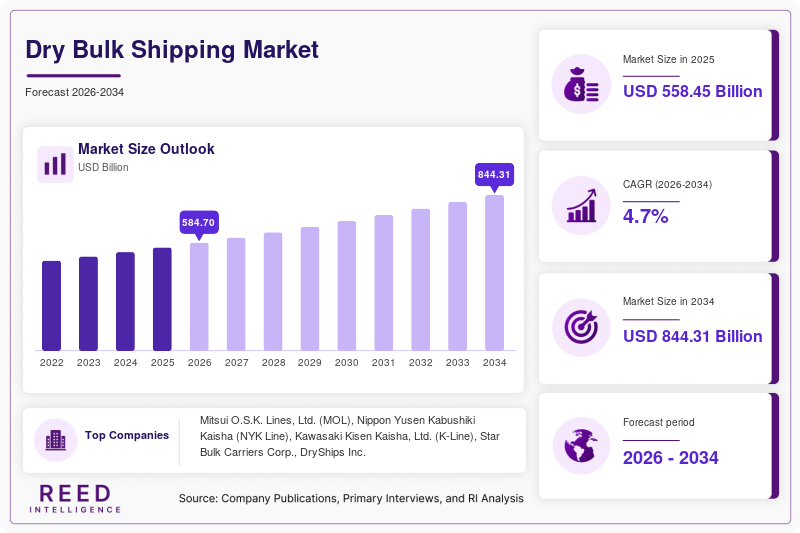
Dry Bulk Shipping market size is projected at USD 584.7 billion in 2026 and is expected to hit USD 847.3 billion by 2034 with a CAGR of 4.7% during the forecast period. The increasing global demand for essential commodities such as iron ore, coal, and grain, coupled with the growth of international trade and the need for efficient maritime transport, underpins market expansion. This report delivers a comprehensive analysis of the Dry Bulk Shipping market, including segmentation by vessel type and application, competitive dynamics, and regional growth patterns, equipping stakeholders with critical intelligence. The Dry Bulk Shipping market continues to demonstrate steady growth potential, fueled by the global economic expansion, the increasing demand for raw materials in developing countries, and continuous innovation in vessel design and operational efficiency.
Dry bulk shipping is the transport of unpackaged, dry, and homogeneous cargo in large quantities, such as iron ore, coal, grain, and cement. It is a vital component of global trade, moving essential raw materials and food commodities across the world's oceans. The global dry bulk shipping market involves over 12,000 vessels, with a combined deadweight tonnage (DWT) exceeding 900 million tons in 2025, reflecting a 4% increase from 2023. Adoption patterns reveal that the Cap-size Vessels type dominates the market, accounting for 38% of total tonnage, followed by Panamax at 25%, Supramax/Handymax at 22%, and Handysize at 15%. The Dry Bulk Shipping market's trajectory is closely linked to the growth of the global economy, which is projected to reach USD 120 trillion by 2028, and the increasing demand for commodities driven by urbanization and industrialization.
Dry Bulk Shipping Market Trends
Shift Towards Larger and More Efficient Vessels
The Dry Bulk Shipping market is witnessing a significant trend toward the deployment of larger and more efficient vessels, driven by the need for economies of scale and reduced fuel consumption. The revenue from new Cap-size vessel deliveries grew to USD 18 billion in 2025, a year-on-year increase of 8%, as 40% of new orders in 2025 specified Cap-size vessels. Adoption rates of larger vessels in the iron ore and coal trades reached 45%, with this figure projected to exceed 60% by 2030. The Dry Bulk Shipping market's trend toward larger vessels is reinforced by the need for cost reduction, the increasing demand for raw materials, and the continuous innovation in ship design and propulsion systems.
Increasing Focus on Decarbonization and Sustainable Shipping
The increasing focus on decarbonization and sustainable shipping is a major trend shaping the Dry Bulk Shipping market, with the development of vessels using alternative fuels and energy-efficient technologies. The market has seen a 15% increase in the demand for eco-friendly vessels since 2022, with 25% of new ship orders in 2025 featuring LNG or alternative fuel capabilities. The use of energy-saving technologies such as wind-assisted propulsion and hull optimization has also gained significant traction. The Dry Bulk Shipping market's trend toward sustainability is reinforced by the IMO's GHG strategy, the increasing pressure from consumers for green supply chains, and the continuous innovation in maritime technologies.
Dry Bulk Shipping Market Drivers
The Dry Bulk Shipping market's expansion is primarily driven by the increasing global demand for commodities, with the global population exceeding 8 billion in 2025, driving demand for food, energy, and infrastructure. The need for efficient and cost-effective transport of raw materials has been a major driver, with sea freight being the most economical option. The rising demand from developing nations, particularly in Asia, for iron ore, coal, and grain has also fueled market growth. Additionally, the increasing consumption of steel and energy globally has spurred demand. The Dry Bulk Shipping market's growth is further reinforced by the continuous expansion of port infrastructure and improvements in logistics.
Dry Bulk Shipping Market Restraints
Despite favorable growth prospects, the Dry Bulk Shipping market faces significant constraints, primarily related to the volatility of freight rates, which are influenced by global economic conditions and supply-demand imbalances. The overcapacity in certain vessel segments can also be a limitation. The Dry Bulk Shipping market's growth is also tempered by the high capital intensity of the industry, the cyclical nature of commodity markets, and the challenge of meeting stringent environmental regulations.
Dry Bulk Shipping Market Opportunities
The Dry Bulk Shipping market presents significant opportunities in the rapidly expanding market for green shipping, where vessels with lower emissions can command premiums. The adoption of digital technologies and AI for route optimization and fuel efficiency is expected to grow at a CAGR of 12% through 2034. Emerging opportunities also exist in the development of autonomous shipping and the use of alternative fuels like ammonia and hydrogen. The Dry Bulk Shipping market's opportunity profile is further enhanced by the growing trend of supply chain diversification and the expansion of trade routes.
Challenges in Dry Bulk Shipping Market
The Dry Bulk Shipping market faces persistent challenges related to the need for continuous investment in fleet renewal and modernization to meet environmental standards. The complexity of managing operational costs, including fuel and crew expenses, can also be a challenge. The market is also contending with the challenge of geopolitical risks affecting trade routes and commodity flows. Additionally, the Dry Bulk Shipping market is challenged by the need to attract and retain skilled seafarers in a competitive labor market.
Dry Bulk Shipping Market Segmentation
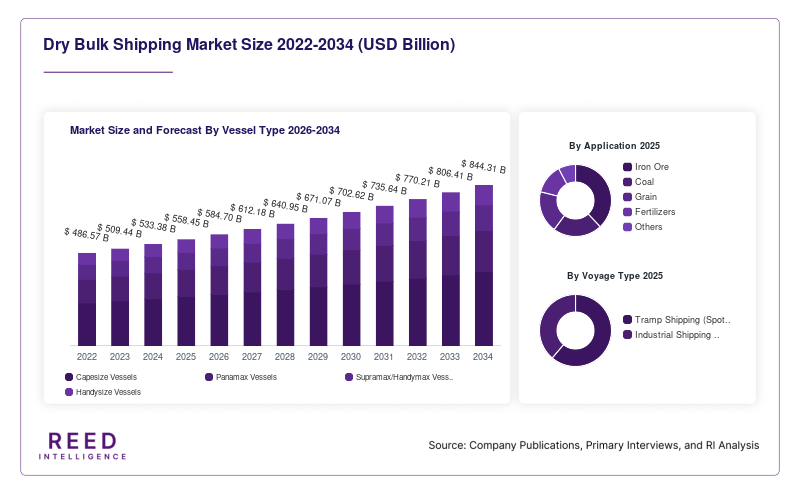
The Dry Bulk Shipping market is segmented by Type and Application to provide a comprehensive market perspective. By Type, Cap-size Vessels dominate with a 38% share of global tonnage, driven by their efficiency in transporting large volumes of iron ore and coal. The Application segment is led by Iron Ore, which accounts for 28% of the market, followed by Coal at 25%, Grain at 18%, Fertilizers at 12%, and Others at 17%.
By Type
Cap-size Vessels represent the largest segment in the Dry Bulk Shipping market by tonnage, commanding a 38% share, with total capacity exceeding 342 million DWT in 2025. These vessels are characterized by their large size (typically over 150,000 DWT) and are used primarily for transporting iron ore and coal. Technical specifications include large cargo holds, deep drafts, and efficient propulsion systems. The Dry Bulk Shipping market's Cap-size segment is driven by its use in the major iron ore and coal trades.
Panamax Vessels capture a 25% share of the Dry Bulk Shipping market, with capacity of 225 million DWT in 2025. These vessels are characterized by their size (typically 65,000-85,000 DWT), designed to fit the Panama Canal locks. Technical specifications include versatility, ability to carry a range of dry bulk cargoes, and good efficiency. The Dry Bulk Shipping market's Panamax segment is driven by its use in grain, coal, and other commodity trades.
Supramax/Handymax Vessels represent 22% of the Dry Bulk Shipping market, with capacity of 198 million DWT in 2025. These vessels are characterized by their medium size (typically 50,000-65,000 DWT) and versatility. Technical specifications include gear for self-loading/discharging, flexibility in port access, and suitability for a wide range of cargoes. The Dry Bulk Shipping market's Supramax segment is driven by its use in regional trades and niche cargoes.
Handysize Vessels comprise the remaining 15% of the Dry Bulk Shipping market, with capacity of 135 million DWT in 2025. These vessels are characterized by their small size (typically 10,000-40,000 DWT), offering access to smaller ports and diverse cargoes. Technical specifications include high flexibility, ability to carry various bulk goods, and shallow draft. The Dry Bulk Shipping market's Handysize segment is driven by its use in short-sea trades and specialized cargoes.
By Application
Iron Ore dominates the Dry Bulk Shipping market, accounting for 28% of total tonnage, representing over 252 million DWT in 2025. This segment includes the transport of iron ore from major exporting countries like Australia and Brazil to steel-producing nations. Usage penetration exceeds 35% in the sector. The Dry Bulk Shipping market's Iron Ore segment is characterized by its use of large vessels, long-haul routes, and importance to the global steel industry.
Coal accounts for 25% of the Dry Bulk Shipping market, with tonnage of 225 million DWT in 2025. This segment encompasses the transport of thermal and coking coal for power generation and steel production. The segment is growing at a moderate rate, with challenges from the energy transition. The Dry Bulk Shipping market's Coal segment is characterized by its importance to energy and industrial sectors, with both long and short-haul routes.
Grain represents 18% of the Dry Bulk Shipping market, with tonnage of 162 million DWT in 2025. This segment includes the transport of wheat, corn, soybeans, and other agricultural commodities. The segment is growing at a steady CAGR, driven by global food demand. The Dry Bulk Shipping market's Grain segment is characterized by its seasonality and use of medium-sized vessels.
Fertilizers accounts for 12% of the Dry Bulk Shipping market, with tonnage of 108 million DWT in 2025. This segment includes the transport of potash, phosphate, and nitrogen-based fertilizers. The segment is growing at a robust pace, driven by the need to feed a growing population. The Dry Bulk Shipping market's Fertilizers segment is characterized by its use of versatile vessels and importance to agriculture.
Others comprises the remainder of the Dry Bulk Shipping market, accounting for 17% of total tonnage, with 153 million DWT in 2025. This segment includes the transport of cement, steel products, minerals, and other bulk commodities. The segment is projected to grow at a moderate CAGR through 2034. The Dry Bulk Shipping market's Others segment is characterized by its diversity of cargoes and vessel requirements.
Dry Bulk Shipping Market Regional Outlook
Asia-Pacific Dry Bulk Shipping Market
Leads the Dry Bulk Shipping market, commanding a 55% share of global dry bulk trade by volume, with a revenue of USD 321.6 billion in 2025. China is the primary driver, accounting for 65% of regional demand, driven by its massive imports of iron ore, coal, and grain to fuel its industrial economy. The Asia-Pacific Dry Bulk Shipping market is characterized by its focus on large-scale commodity imports and high shipping volumes.
North America Dry Bulk Shipping Market
Represents a major importing region, capturing a 15% share of global trade volume with a revenue of USD 87.7 billion in 2025. The United States is a key driver, both as an importer and exporter, particularly of grain and coal. The North American Dry Bulk Shipping market is characterized by its role in agricultural exports and energy transport.
Europe Dry Bulk Shipping Market
Accounts for 14% of the global Dry Bulk Shipping market, with a revenue of USD 81.9 billion in 2025. The Netherlands, Germany, and the UK are key drivers, collectively accounting for 50% of regional demand, driven by major import ports and industrial demand. The European Dry Bulk Shipping market is characterized by its focus on efficiency and environmental regulations.
Middle East & Africa and Latin America Dry Bulk Shipping Market
Together account for the remaining 16% of the Dry Bulk Shipping market, with Brazil, Australia (often grouped with Asia-Pacific for trade) and South Africa being key exporters. Both regions are projected to grow at CAGRs exceeding 5%, driven by commodity exports and economic development.

Top players in Dry Bulk Shipping Market
- Mitsui O.S.K. Lines, Ltd. (MOL)
- Nippon Yusen Kabushiki Kaisha (NYK Line)
- Kawasaki Kisen Kaisha, Ltd. (K-Line)
- Star Bulk Carriers Corp.
- DryShips Inc.
- Genco Shipping & Trading Limited
- Safe Bulkers, Inc.
- Eagle Bulk Shipping Inc.
- Pacific Basin Shipping Limited
- Scorpio Bulkers Inc.
- Oldendorff Carriers GmbH & Co. KG
- Classic Maritime
- Berkshire Hathaway (The Mosaic Company)
- Norden A/S
- Ultrabulk A/S
Mitsui O.S.K. Lines, Ltd. (MOL)
Mitsui O.S.K. Lines (MOL) holds a dominant position in the Dry Bulk Shipping market, with an estimated 6% global market share in terms of fleet capacity, particularly strong in the Japanese and global Cap-size segments. The company's fleet of dry bulk vessels is widely recognized for its quality, efficiency, and operational excellence. MOL's market leadership is reinforced by its significant investment in fleet renewal, its strong relationships with commodity producers, and its comprehensive logistics services. MOL commands over 8% of the Asian market and 4% of the European market, positioning it as a key player in the Dry Bulk Shipping market.
Nippon Yusen Kabushiki Kaisha (NYK Line)
NYK Line is a leading player in the Dry Bulk Shipping market, commanding approximately 5% of the global market share through its comprehensive portfolio of shipping services. The company's expertise in maritime transport and its focus on innovation have solidified its position. NYK's dry bulk vessels are known for their reliability and efficiency. The company's commitment to sustainability and its strong presence in the Asian and global markets have enhanced its competitive advantage.
Star Bulk Carriers Corp. holds a significant 3% market share, with particular strength in the global Cap-size and Panamax segments. Genco Shipping & Trading Limited is a major player in the U.S.-listed dry bulk market, holding a 2% share.
Recent Developments in Dry Bulk Shipping Market
- 2025: MOL announced a major order for new Cap-size vessels with alternative fuel capabilities, targeting the decarbonization goals.
- 2025: Star Bulk Carriers completed a significant fleet expansion through a merger, increasing its global footprint.
Dry Bulk Shipping Market Segments
By Vessel Type
- Capesize Vessels
- Panamax Vessels
- Supramax/Handymax Vessels
- Handysize Vessels
By Application
- Iron Ore
- Coal
- Grain
- Fertilizers
- Others
By Voyage Type
- Tramp Shipping (Spot/Charter)
- Industrial Shipping (Long-term Contract)
By Region
- North America
- Europe
- APAC
- Middle East and Africa
- LATAM