Dry Electrostatic Precipitator Market Size, Share & Demand Report By Design Type (Plate Wire Precipitators, Tubular Precipitators, Flat Plate Precipitators), By Application (Power Generation, Cement Manufacturing, Steel Processing, Chemical Processing, Mining Operations), By End-Use Industry (Utilities, Industrial Manufacturing, Chemical Industry, Mining Industry, Cement Industry) By Region & Segment Forecasts, 2026–2034
USD 3950
Market Overview
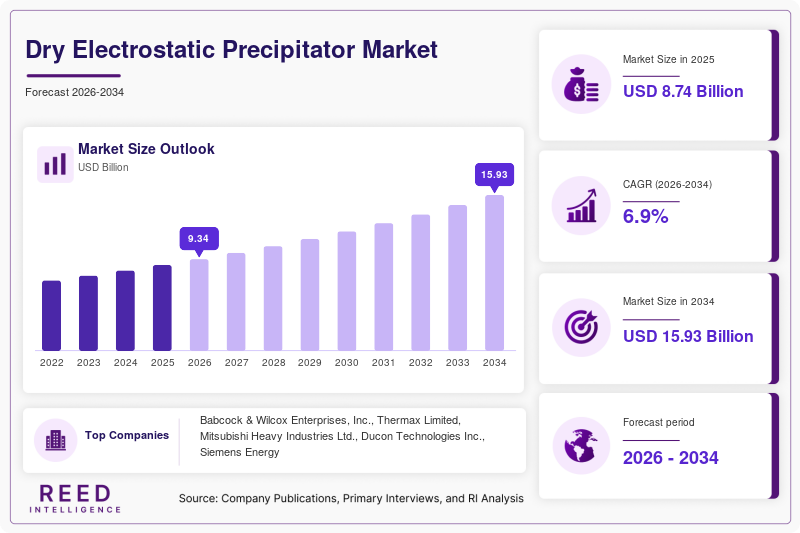
The global Dry Electrostatic Precipitator Market size was valued at USD 8.74 billion in 2026 and is projected to reach USD 14.96 billion by 2034, expanding at a CAGR of 6.9% during the forecast period from 2026 to 2034. The market continues to gain momentum due to rising industrial emission control requirements across power generation, cement, steel, chemicals, and mining industries. Governments across developed and emerging economies are strengthening air pollution standards to reduce particulate emissions from industrial facilities, which has accelerated the installation of dry electrostatic precipitator systems in large-scale industrial plants.
Dry electrostatic precipitators are widely adopted because of their high dust collection efficiency, operational reliability, and ability to manage large gas volumes under high-temperature conditions. Industrial operators are increasingly replacing outdated particulate control systems with advanced dry electrostatic precipitators equipped with automated monitoring technologies and digital control systems. The growing emphasis on environmental sustainability and carbon reduction initiatives has also supported market expansion. Rapid industrialization in Asia Pacific and modernization of aging power infrastructure in North America and Europe continue to create long-term demand for emission control technologies.
Key Highlights
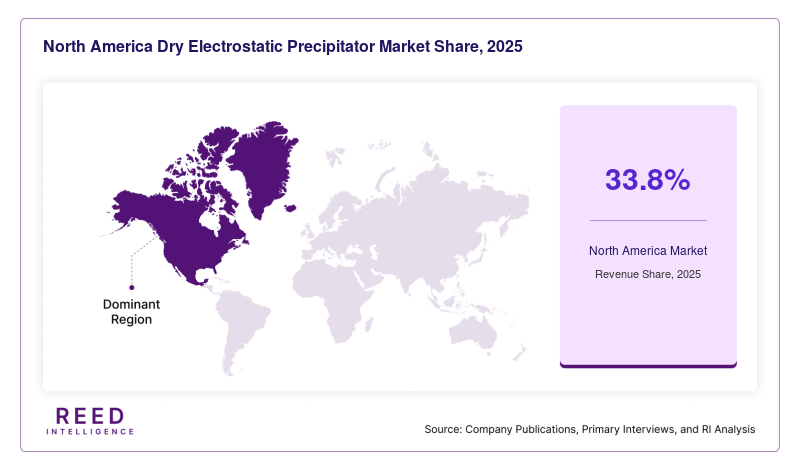
- North America dominated the market with a 33.8% share in 2025, while Asia Pacific is expected to grow at the fastest CAGR of 8.1% during 2026–2034.
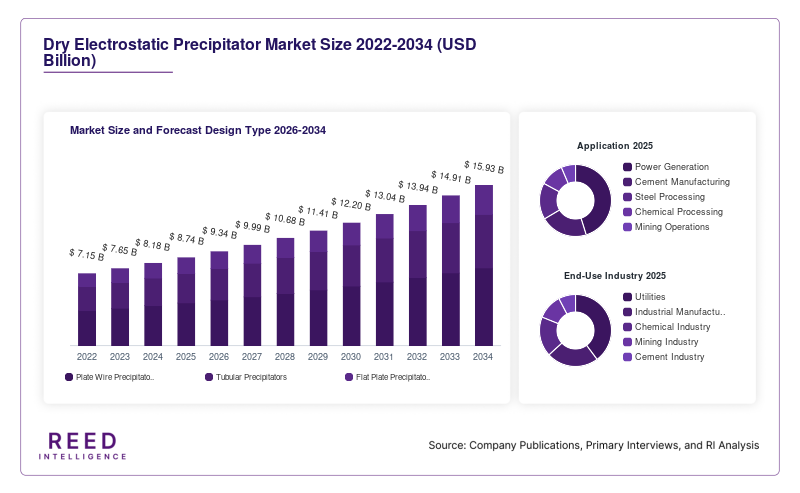
- By design type, plate wire precipitators accounted for the largest share of 44.6%, while tubular precipitators are projected to grow at a CAGR of 7.8%.
- By application, power generation led with a 39.2% share, whereas cement manufacturing is expected to expand at a CAGR of 8.4%.
- By end-use industry, utilities accounted for the largest share of 36.7%, while chemical processing is projected to grow at a CAGR of 7.9%.
- The United States remained the dominant country, with market values of USD 1.82 billion in 2024 and USD 1.95 billion in 2025.
Market Trends
Integration of Smart Monitoring and Predictive Maintenance Technologies
Industrial operators are increasingly integrating smart monitoring systems into dry electrostatic precipitators to improve efficiency and reduce unplanned maintenance costs. Modern systems are equipped with sensors, remote diagnostics, and real-time analytics platforms that continuously monitor particle collection performance, voltage stability, gas flow, and electrode conditions. These technologies help industrial facilities identify operational inefficiencies before system failures occur. The adoption of Industrial Internet of Things platforms is also enabling centralized monitoring of multiple facilities, which supports large industrial companies operating across various geographic locations.
Manufacturers are responding by offering digitalized dry electrostatic precipitator systems with cloud-based reporting capabilities and automated fault detection. This trend is particularly visible in thermal power plants and steel manufacturing facilities where continuous emission monitoring is required by environmental authorities. The shift toward predictive maintenance reduces operational interruptions and improves long-term asset utilization. Increasing demand for automation in industrial environments is expected to strengthen the adoption of digitally enabled electrostatic precipitation systems throughout the forecast period.
Expansion of Retrofitting Projects in Aging Industrial Facilities
A significant trend shaping the Dry Electrostatic Precipitator Market is the growing number of retrofitting projects in aging industrial plants. Many industrial facilities in North America and Europe operate emission control systems that were installed more than two decades ago and no longer meet current environmental standards. Companies are investing in retrofit solutions that upgrade electrode systems, power supplies, gas distribution units, and control mechanisms without replacing the entire installation. This approach helps reduce capital expenditure while improving collection efficiency and regulatory compliance.
Retrofitting activities are increasing in coal-fired power plants, cement production facilities, and metal processing industries where stricter particulate emission standards are being enforced. Governments are also introducing environmental compliance deadlines that encourage plant modernization. In addition, industrial operators prefer retrofit projects because they minimize operational disruption compared to complete equipment replacement. The availability of modular dry electrostatic precipitator components is supporting faster installation timelines and improved operational flexibility across industrial applications.
Market Drivers
Increasing Industrial Air Pollution Regulations Across Major Economies
The expansion of industrial emission control regulations remains one of the primary drivers for the Dry Electrostatic Precipitator Market. Governments worldwide are implementing stricter environmental standards to reduce airborne particulate matter generated from manufacturing and energy production activities. Industries such as power generation, cement, mining, iron and steel, and chemicals are under increasing pressure to comply with emission limits established by environmental authorities. Dry electrostatic precipitators provide high-efficiency particulate removal, making them a preferred solution for large-scale industrial applications.
Regulatory agencies in countries including the United States, China, India, Germany, and Japan are enforcing more rigorous emission monitoring requirements. Industrial facilities that fail to comply with these regulations often face operational restrictions, penalties, or mandatory technology upgrades. As a result, industrial operators are investing in advanced dry electrostatic precipitator systems capable of handling large gas volumes and maintaining consistent filtration efficiency. The growing global focus on environmental sustainability is expected to continue driving investments in industrial air pollution control technologies.
Rising Demand from Thermal Power and Cement Industries
The thermal power and cement industries continue to generate substantial demand for dry electrostatic precipitators due to high particulate emissions during production processes. Coal-based thermal power plants produce large volumes of fly ash and fine particulate matter that require effective filtration systems to meet environmental standards. Similarly, cement manufacturing processes generate dust emissions from kilns, grinding operations, and material handling activities. Dry electrostatic precipitators are widely used in these industries because of their ability to operate efficiently under high-temperature and high-volume gas conditions.
Emerging economies are witnessing rapid infrastructure development and increasing electricity demand, leading to expansion in power generation and cement production capacity. Countries across Asia Pacific, the Middle East, and Latin America are investing heavily in industrial infrastructure, which is creating long-term demand for emission control equipment. In addition, modernization projects in older power plants are supporting replacement demand for upgraded electrostatic precipitator systems with improved collection efficiency and energy performance.
Market Restraint
High Initial Installation and Maintenance Costs Limiting Adoption
The high capital investment associated with dry electrostatic precipitator installation remains a significant restraint for market growth, particularly among small and medium-sized industrial facilities. These systems require substantial infrastructure, including large collection chambers, electrical components, transformer rectifier systems, and complex gas flow management units. Installation costs increase further when facilities require customized system configurations to accommodate operational conditions or plant layouts. For industries operating with limited capital budgets, these expenses may delay investment decisions or encourage the selection of lower-cost filtration alternatives.
Maintenance costs also present operational challenges for industrial operators. Dry electrostatic precipitators require periodic inspection of electrodes, discharge wires, rappers, and dust collection hoppers to maintain optimal performance. Industries operating in corrosive or high-dust environments often experience faster component wear, which increases replacement and servicing expenses. Smaller industrial facilities in developing economies may lack technical expertise for maintaining advanced electrostatic systems, limiting adoption rates in certain regions. In some applications, fabric filters and hybrid dust collection systems are emerging as competing technologies because they offer lower installation complexity and reduced maintenance requirements for medium-scale industrial operations.
Market Opportunities
Growing Industrialization in Emerging Economies
Rapid industrialization across emerging economies presents substantial opportunities for the Dry Electrostatic Precipitator Market. Countries including India, Indonesia, Vietnam, Brazil, and Saudi Arabia are expanding industrial production capacities in sectors such as cement, chemicals, metals, and power generation. As industrial activity increases, governments are simultaneously introducing stricter air pollution standards to address environmental concerns in urban and industrial regions. This combination of industrial growth and regulatory enforcement is creating favorable conditions for emission control equipment manufacturers.
Infrastructure investments across emerging economies are also supporting the construction of new industrial plants that require advanced particulate control technologies from the initial project stage. Dry electrostatic precipitators are increasingly being integrated into newly commissioned thermal power stations, cement kilns, and steel plants to ensure regulatory compliance and operational efficiency. Global manufacturers are expanding their regional production facilities and service networks to capitalize on the growing demand for industrial air pollution control solutions in developing markets.
Development of Energy-Efficient and Compact System Designs
The development of energy-efficient and compact dry electrostatic precipitator systems is creating new growth opportunities across industrial sectors. Traditional electrostatic precipitators are often associated with large installation footprints and significant energy consumption. Manufacturers are now focusing on advanced electrode configurations, improved power supply technologies, and optimized airflow management systems that reduce operational costs while maintaining high collection efficiency.
Compact system designs are particularly attractive for medium-sized industrial facilities with limited installation space. Industries such as food processing, specialty chemicals, and waste management are increasingly adopting smaller electrostatic precipitation systems that provide flexible integration into existing production lines. In addition, energy-efficient systems help industrial operators reduce electricity consumption and achieve sustainability objectives. Technological advancements in pulse energization and automatic voltage control are further improving operational performance and supporting wider adoption across diverse industrial applications.
Segmental Analysis
By Design Type
Plate wire precipitators accounted for the largest market share of 44.6% in 2024 due to their widespread application across thermal power plants, cement facilities, and metal processing industries. These systems provide effective particulate collection efficiency while supporting large gas handling capacities under high-temperature operating conditions. Industrial operators prefer plate wire configurations because of their operational reliability, lower maintenance frequency, and ability to manage fine particulate matter. The technology is particularly effective in coal-fired power plants where fly ash removal remains a critical operational requirement. Manufacturers are also introducing advanced plate wire designs with improved discharge electrodes and optimized gas flow systems to enhance collection efficiency and reduce power consumption. Growing replacement demand from aging industrial facilities continues to strengthen the position of plate wire precipitators within the global market.
Tubular precipitators are projected to expand at the fastest CAGR of 7.8% during the forecast period due to increasing adoption in chemical processing, pharmaceutical manufacturing, and specialty industrial applications. These systems are highly suitable for handling sticky, corrosive, and fine particulate emissions that may reduce the efficiency of conventional plate wire systems. Industrial operators are increasingly investing in tubular configurations because they provide improved performance in applications involving oil mist, chemical fumes, and volatile compounds. The compact design and flexibility of tubular precipitators are also supporting their integration into medium-sized industrial facilities with limited installation space. Advancements in corrosion-resistant materials and automated cleaning systems are further improving operational performance and reducing maintenance costs for industrial users.
By Application
Power generation accounted for the largest share of 39.2% in 2024 due to the extensive deployment of dry electrostatic precipitators in coal-fired and biomass-based thermal power plants. Power generation facilities produce substantial volumes of particulate emissions during combustion processes, creating consistent demand for high-capacity filtration systems. Dry electrostatic precipitators are widely preferred in this sector because they provide reliable operation under high-temperature conditions while ensuring compliance with environmental regulations. Many power plants across North America and Europe are modernizing aging emission control infrastructure to improve collection efficiency and reduce particulate discharge levels. The integration of digital monitoring technologies and automated voltage control systems is also enhancing operational performance in power generation applications. Growing electricity demand in emerging economies continues to support the expansion of electrostatic precipitation systems in newly constructed thermal power facilities.
Cement manufacturing is anticipated to register the fastest CAGR of 8.4% during the forecast period owing to rising infrastructure development and urban construction activities worldwide. Cement production processes generate large quantities of dust emissions from kilns, grinding operations, and raw material handling systems. Dry electrostatic precipitators are increasingly used to manage these emissions and maintain compliance with environmental standards. Industrial operators are investing in advanced particulate control technologies to reduce operational emissions and improve sustainability performance. Emerging economies across Asia Pacific, the Middle East, and Latin America are expanding cement production capacities to support infrastructure development programs, which is generating additional market opportunities. Manufacturers are also developing energy-efficient electrostatic precipitator systems tailored specifically for cement industry operating environments.
By End-Use Industry
Utilities accounted for the largest market share of 36.7% in 2024 due to the extensive deployment of dry electrostatic precipitators in power generation and public utility operations. Utility companies operate large-scale combustion systems that generate high levels of particulate emissions requiring continuous filtration. Dry electrostatic precipitators are widely adopted because they provide high collection efficiency while supporting long operational lifecycles. Many utility operators are upgrading legacy systems with advanced digital controls and automated maintenance solutions to improve performance and meet evolving environmental regulations. Regulatory pressure related to particulate emissions continues to encourage investments in advanced air pollution control technologies across the utility sector. In addition, the increasing adoption of biomass and waste-to-energy power generation systems is creating further demand for reliable particulate collection equipment.
Chemical processing is expected to witness the fastest CAGR of 7.9% during the forecast period due to rising industrial output and stricter environmental regulations governing hazardous emissions. Chemical manufacturing facilities generate diverse particulate pollutants, including corrosive and fine particles that require specialized filtration technologies. Dry electrostatic precipitators are increasingly being adopted in chemical plants because of their ability to operate efficiently under complex industrial conditions. Manufacturers are developing customized systems with corrosion-resistant materials and advanced electrode technologies to address industry-specific operational challenges. Expanding investments in specialty chemicals, fertilizers, and petrochemical production across Asia Pacific and the Middle East are supporting strong market growth. Increasing emphasis on environmental sustainability and worker safety standards is also accelerating the adoption of advanced emission control systems in chemical processing industries.
Regional Analysis
North America
North America accounted for 33.8% of the global Dry Electrostatic Precipitator Market share in 2025 and is expected to expand at a CAGR of 5.9% during the forecast period. The region maintains a strong position due to strict industrial emission standards and extensive modernization activities in aging power generation facilities. Utilities and industrial manufacturers across the United States and Canada continue to invest in advanced particulate control technologies to meet environmental compliance requirements. The replacement of legacy emission systems with digitally integrated dry electrostatic precipitators is supporting regional market growth.
The United States remains the dominant country in the regional market due to large-scale investments in industrial infrastructure modernization and environmental compliance programs. Industrial sectors including power generation, cement, and steel manufacturing continue to generate strong demand for advanced emission control systems. The increasing adoption of automated monitoring technologies and predictive maintenance solutions has further strengthened the market position of dry electrostatic precipitators in the country.
Europe
Europe represented 27.1% of the global market in 2025 and is projected to register a CAGR of 5.7% from 2026 to 2034. The region benefits from stringent environmental legislation focused on reducing industrial air pollution and improving environmental sustainability. Countries across Western Europe are implementing strict particulate emission limits for manufacturing and power generation facilities, encouraging investments in advanced filtration technologies. Retrofitting activities in older industrial plants are also supporting demand for upgraded dry electrostatic precipitator systems.
Germany continues to dominate the European market due to its extensive industrial manufacturing base and emphasis on clean industrial technologies. The country’s steel, cement, and chemical industries are investing heavily in advanced emission control systems to comply with European Union environmental directives. Growing investments in industrial automation and energy-efficient manufacturing processes are also contributing to the expansion of the dry electrostatic precipitator industry across Germany.
Asia Pacific
Asia Pacific held 24.6% of the global Dry Electrostatic Precipitator Market share in 2025 and is anticipated to witness the fastest CAGR of 8.1% during the forecast period. Rapid industrialization, urbanization, and rising energy demand are major factors supporting market growth in the region. Governments across China, India, and Southeast Asia are strengthening environmental regulations to reduce industrial emissions and improve air quality. Increasing construction of thermal power plants, cement facilities, and steel manufacturing units continues to create substantial demand for emission control technologies.
China remains the leading country in the Asia Pacific market due to its large industrial production capacity and expanding environmental compliance initiatives. The government is encouraging industrial operators to adopt high-efficiency particulate removal systems as part of broader pollution reduction strategies. Continuous investments in infrastructure development and manufacturing expansion are also supporting the growing installation of dry electrostatic precipitators across multiple industrial sectors.
Middle East & Africa
The Middle East & Africa region accounted for 8.2% of the global market in 2025 and is projected to grow at a CAGR of 6.6% through 2034. Industrial diversification initiatives and expanding infrastructure development projects are contributing to market growth across the region. Countries in the Gulf Cooperation Council are investing in power generation, petrochemical production, and cement manufacturing facilities, which require efficient emission control systems. Increasing environmental awareness and adoption of industrial sustainability standards are further supporting regional demand.
Saudi Arabia represents the dominant country within the regional market due to ongoing industrial expansion and energy sector investments. The country continues to develop large-scale industrial and infrastructure projects under long-term economic diversification strategies. Growing investments in petrochemical processing and power generation facilities are increasing the need for advanced dry electrostatic precipitator installations capable of handling high-volume industrial emissions.
Latin America
Latin America captured 6.3% of the global Dry Electrostatic Precipitator Market share in 2025 and is expected to expand at a CAGR of 6.1% during the forecast period. The region is witnessing steady growth in mining, cement production, and industrial manufacturing activities, which is supporting demand for industrial emission control equipment. Governments in several Latin American countries are introducing updated environmental regulations to improve air quality and reduce industrial pollution. Investments in infrastructure modernization are also contributing to regional market expansion.
Brazil continues to dominate the Latin American market due to its extensive industrial base and large mining and cement industries. The country is experiencing increasing adoption of emission control technologies in response to environmental compliance requirements and operational efficiency goals. Industrial operators are upgrading existing filtration systems with advanced dry electrostatic precipitators to improve dust collection performance and reduce environmental impact across manufacturing facilities.
Competitive Landscape
The Dry Electrostatic Precipitator Market remains moderately consolidated, with major companies focusing on technology innovation, regional expansion, and strategic partnerships to strengthen market presence. Leading manufacturers are investing in energy-efficient systems, digital monitoring platforms, and customized emission control solutions to address changing industrial requirements. Competition is increasing as regional manufacturers expand their product portfolios and target emerging industrial markets across Asia Pacific and Latin America.
Babcock & Wilcox Enterprises remains one of the leading players in the market due to its broad industrial customer base and advanced emission control technologies. The company recently introduced upgraded dry electrostatic precipitator systems integrated with predictive maintenance software to improve operational efficiency in thermal power applications. Other prominent participants are focusing on retrofit services and modernization projects for aging industrial facilities. Companies are also expanding local manufacturing operations to reduce delivery timelines and strengthen customer support capabilities in developing economies.
Key Players
- Babcock & Wilcox Enterprises, Inc.
- Thermax Limited
- Mitsubishi Heavy Industries Ltd.
- Ducon Technologies Inc.
- Siemens Energy
- GE Vernova
- KC Cottrell Co., Ltd.
- FLSmidth & Co. A/S
- Hamon Group
- Sumitomo Heavy Industries Ltd.
- Trion IAQ
- Fujian Longking Co., Ltd.
- ANDRITZ AG
- Beltran Technologies Inc.
- GEA Group AG
Recent Developments
- Babcock & Wilcox Enterprises launched an upgraded dry electrostatic precipitator platform with integrated digital diagnostics for thermal power facilities in 2025.
- Thermax Limited expanded its industrial air pollution control manufacturing capacity in India to support rising regional demand from cement and utility sectors in 2024.
- Mitsubishi Heavy Industries introduced energy-efficient transformer rectifier systems designed to reduce operational power consumption in industrial electrostatic precipitators in 2025.
- ANDRITZ AG secured multiple retrofit contracts for emission control modernization projects across European steel manufacturing facilities in 2024.
- Fujian Longking Co., Ltd. developed compact dry electrostatic precipitator solutions targeted at medium-sized industrial plants operating in Southeast Asia in 2025.
Dry Electrostatic Precipitator Market Segments
Design Type
- Plate Wire Precipitators
- Tubular Precipitators
- Flat Plate Precipitators
Application
- Power Generation
- Cement Manufacturing
- Steel Processing
- Chemical Processing
- Mining Operations
End-Use Industry
- Utilities
- Industrial Manufacturing
- Chemical Industry
- Mining Industry
- Cement Industry
By Region
- North America
- Europe
- APAC
- Middle East and Africa
- LATAM