Dry Ice Blasting Machine Market Size, Share, Demand Report by Machine Type (Portable Dry Ice Blasting Machines), By Application (Industrial Cleaning, Precision Cleaning, Surface Preparation, Maintenance Cleaning), By End-Use Industry (Automotive, Aerospace & Defense, Food & Beverage, Manufacturing, Energy & Power), By Distribution Channel (Direct Sales, Indirect Sales) & Regional Forecasts, 2026–2034
USD 3950
Market Overview
The Dry Ice Blasting Machine Market size is projected to be valued at USD 620.4 million in 2026 and is anticipated to reach USD 1,121.8 million by 2034, registering a CAGR of 7.6% during the forecast period (2026–2034). The market growth is primarily supported by increasing demand for non-abrasive and environmentally sustainable industrial cleaning technologies across manufacturing, automotive, and energy sectors. The shift toward chemical-free cleaning processes has significantly enhanced the adoption of dry ice blasting systems globally, particularly in industries seeking reduced downtime and improved operational efficiency.
A key global factor supporting the expansion of the Dry Ice Blasting Machine Market is the rising enforcement of environmental regulations restricting the use of solvent-based cleaning agents. This regulatory pressure has encouraged industries to transition toward dry ice blasting solutions, which use recycled CO₂ pellets and produce no secondary waste, making them an efficient and eco-friendly alternative.
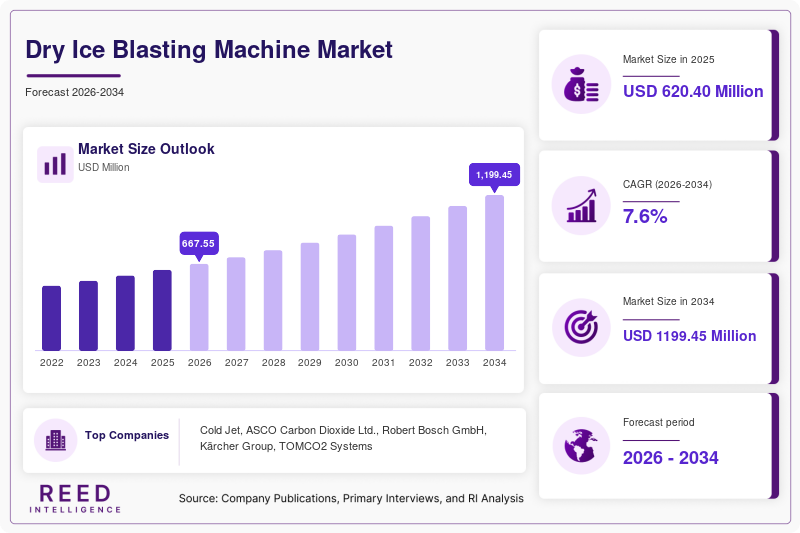
Key Highlights:
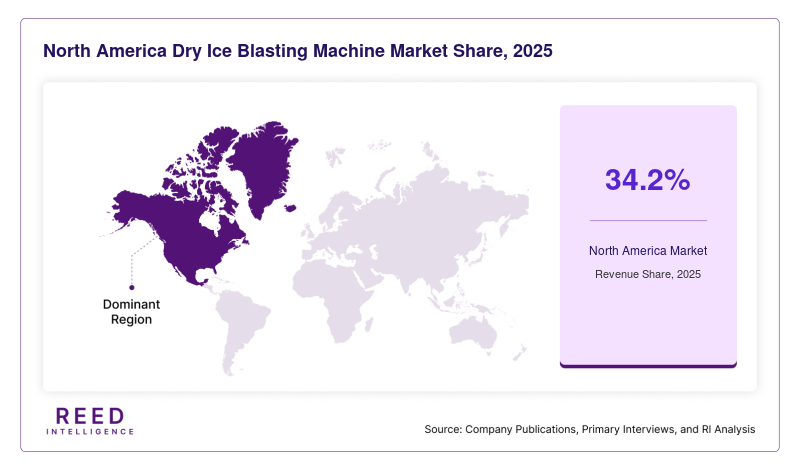
- Dominant Region Share (2025): North America accounted for approximately 34.2% of the Dry Ice Blasting Machine Market.
- Fastest-Growing Region CAGR (2026–2034): Asia Pacific is expected to expand at a CAGR of 8.4%.
- Leading Subsegment (Type): Portable dry ice blasting machines held the largest share of 58.6% in 2025.
- Fastest-Growing Subsegment (End-use): Aerospace & defense applications are projected to grow at a CAGR of 8.9%.
- Dominant Country Market Values
- United States: USD 185.3 million (2024) and USD 198.6 million (2025)
- Germany: USD 92.1 million (2024) and USD 97.8 million (2025)
The overall Dry Ice Blasting Machine Market continues to expand due to its rising adoption across precision cleaning applications and growing awareness of sustainable industrial maintenance solutions.
Market Trends
Integration of Automation and Smart Cleaning Systems
The Dry Ice Blasting Machine Market is witnessing a strong shift toward automated and semi-automated systems. Manufacturers are integrating IoT-enabled controls, pressure optimization sensors, and programmable cleaning cycles to enhance efficiency. This trend is driven by the need for precision cleaning in sensitive manufacturing environments such as electronics and aerospace, where manual intervention is limited.
Expansion in Food Processing and Pharmaceutical Cleaning Applications
Another significant trend shaping the Dry Ice Blasting Machine Market is its increasing usage in hygienic cleaning applications. The food processing and pharmaceutical industries are adopting dry ice blasting systems to comply with strict sanitation standards. The absence of water and chemicals makes these machines suitable for contamination-free cleaning processes.
Market Drivers
Rising Demand for Eco-Friendly Industrial Cleaning Solutions
One of the primary drivers of the Dry Ice Blasting Machine Market is the increasing preference for sustainable cleaning technologies. Dry ice blasting eliminates the need for water and chemical solvents, reducing hazardous waste generation. This aligns with global sustainability initiatives and encourages widespread industrial adoption.
Growing Industrial Maintenance Requirements Across Heavy Industries
The expansion of manufacturing, automotive, and energy sectors is driving demand for efficient maintenance solutions. The Dry Ice Blasting Machine Market benefits from the need to reduce equipment downtime and improve productivity through non-invasive cleaning methods that preserve machinery integrity.
Market Restraint
High Initial Investment and Equipment Costs
A key restraint impacting the Dry Ice Blasting Machine Market is the high upfront cost associated with equipment purchase and operational setup. Small and medium-sized enterprises often face financial constraints, limiting widespread adoption despite long-term cost benefits.
Market Opportunities
Expansion in Emerging Economies
Rapid industrialization in emerging economies presents a major opportunity for the Dry Ice Blasting Machine Market. Countries in Asia Pacific and Latin America are witnessing increased demand for modern cleaning technologies, driven by infrastructure development and manufacturing expansion.
Technological Advancements in Equipment Efficiency
Continuous innovation in nozzle design, pellet delivery systems, and energy-efficient compressors is creating new opportunities. These advancements are expected to enhance performance and reduce operational costs, strengthening adoption across multiple industries in the Dry Ice Blasting Machine Market.
Segmental Analysis
By Type
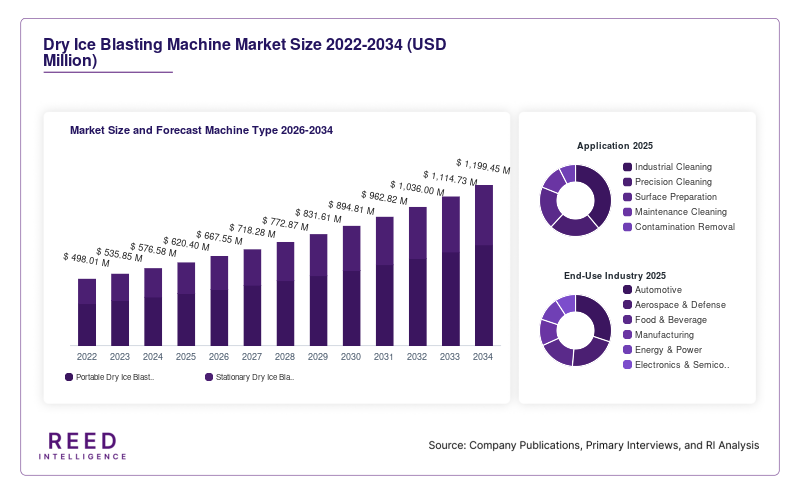
The Dry Ice Blasting Machine Market is segmented into portable and stationary systems. Portable machines dominated the segment with a 58.6% share in 2025, owing to their flexibility and ease of use in field operations. These systems are widely adopted in maintenance services and on-site industrial cleaning.
The fastest-growing subsegment is stationary systems, projected to grow at a CAGR of 7.9% (2026–2034). This growth is attributed to increasing demand for automated cleaning in manufacturing facilities where continuous and high-volume operations are required.
By End-use Industry
The market includes automotive, aerospace, food & beverage, manufacturing, energy, and others. The automotive sector held the dominant share of 29.4% in 2025 due to extensive use in engine cleaning and mold maintenance.
Aerospace & defense is the fastest-growing subsegment with a projected CAGR of 8.9% (2026–2034) in the Dry Ice Blasting Machine Market, driven by the need for precision cleaning of sensitive aircraft components without surface damage.
By Application
Industrial cleaning dominated with a 46.7% share in 2025, as dry ice blasting is widely used for removing grease, paint, and residues. The fastest-growing application is precision cleaning, expected to grow at a CAGR of 8.2%, supported by demand in electronics and medical device manufacturing.
By Distribution Channel
Direct sales accounted for 64.1% share in 2025, as manufacturers prefer direct engagement for customized equipment solutions. Indirect channels are expected to grow faster at a CAGR of 7.5%, supported by expanding distributor networks in emerging markets within the Dry Ice Blasting Machine Market.
Regional Analysis
North America
North America held approximately 34.2% share of the Dry Ice Blasting Machine Market in 2025 and is expected to grow at a CAGR of 7.1% (2026–2034). The region benefits from advanced manufacturing infrastructure and strong adoption in automotive and aerospace sectors. The United States dominates regional demand due to high industrial automation levels and strict environmental regulations promoting chemical-free cleaning technologies.
Europe
Europe accounted for around 27.8% share in 2025 and is projected to grow at a CAGR of 7.3% (2026–2034) in the Dry Ice Blasting Machine Market. Germany leads regional adoption, driven by strong automotive production and engineering industries. The region’s emphasis on sustainability and workplace safety standards further supports market penetration.
Asia Pacific
Asia Pacific captured 23.6% share in 2025 and is forecasted to grow at the fastest CAGR of 8.4% (2026–2034) in the Dry Ice Blasting Machine Market. China is the dominant country due to large-scale manufacturing expansion and increasing adoption of industrial cleaning technologies. Rising foreign investments in manufacturing infrastructure also contribute to market growth.
Middle East & Africa
The region accounted for 8.1% share in 2025 and is expected to grow at a CAGR of 6.8% (2026–2034) in the Dry Ice Blasting Machine Market. Growth is driven by oil & gas maintenance activities and increasing industrial diversification efforts, particularly in the UAE and Saudi Arabia.
Latin America
Latin America held 6.3% share in 2025 and is projected to grow at a CAGR of 6.5% (2026–2034) in the Dry Ice Blasting Machine Market. Brazil leads regional demand due to expanding automotive and food processing industries, along with gradual adoption of advanced cleaning systems.
Competitive Landscape
The Dry Ice Blasting Machine Market is moderately consolidated, with several global and regional manufacturers competing based on technology innovation, product efficiency, and after-sales services. Key players include Cold Jet, ASCO Carbon Dioxide Ltd., Karcher, Phoenix Unlimited LLC, and TOMCO2 Systems.
Cold Jet maintains a strong presence due to its advanced dry ice blasting systems and continuous product innovation in automated cleaning solutions. ASCO Carbon Dioxide Ltd. focuses on integrated CO₂ production and blasting systems, strengthening its supply chain advantage. Karcher emphasizes industrial cleaning equipment diversification, while Phoenix Unlimited LLC specializes in customized blasting solutions for aerospace and defense. TOMCO2 Systems continues to expand its footprint in industrial applications with energy-efficient designs.
Recent developments include product automation upgrades, expansion into emerging markets, and partnerships for CO₂ supply optimization, enhancing competitiveness in the Dry Ice Blasting Machine Market.
Key Players List
- Cold Jet
- ASCO Carbon Dioxide Ltd.
- Karcher
- TOMCO2 Systems
- Phoenix Unlimited LLC
- Artimpex NV
- CO2 Air Inc.
- Dry Ice Energy LLC
- Innovative Cleaning Equipment
- IceTech A/S
- SODA Blasting Systems
- Ultimate Washer
- CryoSnow GmbH
- CO2 Solutions Inc.
- Polar Systems Inc.
Recent Developments
- In 2025, several manufacturers introduced IoT-enabled dry ice blasting systems to improve process monitoring and operational efficiency in the Dry Ice Blasting Machine Market.
- Expansion of production facilities in Asia Pacific was observed to meet rising demand from manufacturing and automotive sectors.
- Strategic collaborations between equipment manufacturers and CO₂ suppliers improved supply chain efficiency and reduced operational costs.
- New portable machine models with reduced energy consumption were launched, targeting small and medium industrial users in the Dry Ice Blasting Machine Market.
- Increased investment in R&D focused on improving blasting precision and reducing compressed air consumption enhanced overall product competitiveness.
Dry Ice Blasting Machine Market Segments
Machine Type
- Portable Dry Ice Blasting Machines
- Stationary Dry Ice Blasting Machines
Application
- Industrial Cleaning
- Precision Cleaning
- Surface Preparation
- Maintenance Cleaning
- Contamination Removal
End-Use Industry
- Automotive
- Aerospace & Defense
- Food & Beverage
- Manufacturing
- Energy & Power
- Electronics & Semiconductor
Distribution Channel
- Direct Sales
- Indirect Sales
By Region
- North America
- Europe
- APAC
- Middle East and Africa
- LATAM