Dry Type Automated Solar Panel Cleaning Market Size, Share & Demand Report By Type (Robotic Cleaning Systems, AI-Enabled Autonomous Systems, Brush-Based Systems), By Operation Mode (Fully Automated, Semi-Automated), By Application (Utility-Scale Solar Farms, Commercial Installations, Residential Installations), By End-Use (Energy Sector, Industrial, Commercial), By Distribution Channel (Direct Sales, Third-Party Service Providers), By Region & Segment Forecasts, 2026–2034
USD 3950
Market Overview
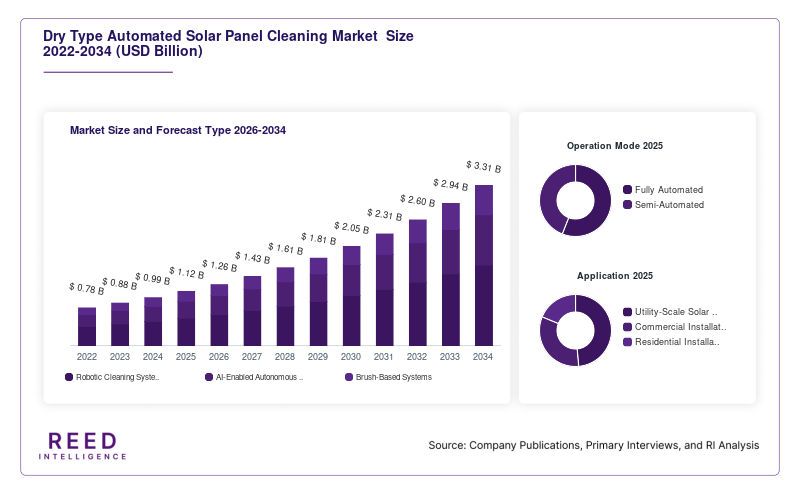
The global Dry Type Automated Solar Panel Cleaning Market size was valued at approximately USD 1.12 billion in 2026 and is projected to reach around USD 2.94 billion by 2034, expanding at a CAGR of 12.8% during the forecast period (2026–2034). The market has witnessed steady expansion due to the rising installation of solar photovoltaic (PV) systems across utility-scale, commercial, and residential applications, where efficiency optimization remains critical.
A key global factor supporting market growth is the increasing adoption of solar energy in water-scarce regions. Dry cleaning technologies, which eliminate the need for water, are gaining traction in arid and semi-arid regions where conventional wet cleaning methods are not viable. This shift aligns with sustainability goals and operational cost reduction strategies adopted by solar farm operators worldwide.
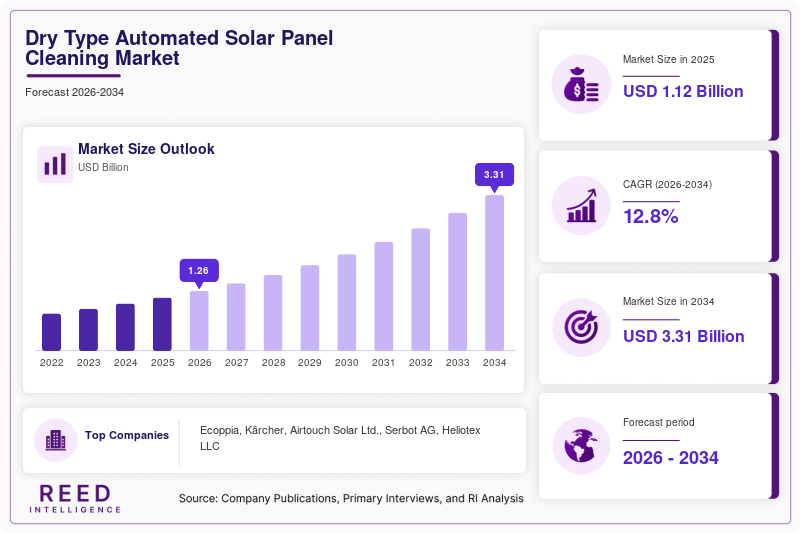
Key Highlights:
- Asia Pacific dominated the market with a share of 38.6% in 2025, while the Middle East & Africa is projected to register the fastest CAGR of 14.9% during the forecast period.
- By product type, robotic cleaning systems led with a share of 52.3% in 2025, while AI-enabled autonomous systems are expected to grow at the fastest CAGR of 15.6%.
- By application, utility-scale solar farms dominated the segment with a 61.4% share in 2025, whereas commercial installations are projected to grow at a CAGR of 13.7%.
- China, the dominant country, recorded market values of USD 215 million in 2024 and USD 242 million in 2025, driven by large-scale solar deployment.
Market Trends
Integration of AI and IoT in Cleaning Systems
The integration of artificial intelligence (AI) and Internet of Things (IoT) technologies is transforming the Dry Type Automated Solar Panel Cleaning Market. Smart systems equipped with sensors and predictive analytics can determine cleaning frequency based on dust accumulation levels, weather patterns, and panel efficiency. This reduces operational downtime and enhances energy output, making automated dry cleaning systems more appealing to solar asset owners.
Rise of Waterless Sustainability Solutions
The global shift toward water conservation is driving the adoption of dry cleaning technologies. Solar plants located in desert regions are increasingly transitioning from water-based cleaning to brush-based or electrostatic dry systems. This trend supports environmental compliance and reduces logistical challenges associated with water transportation and storage.
Market Drivers
Increasing Solar Energy Installations
The rapid expansion of solar photovoltaic installations globally is a major driver for the Dry Type Automated Solar Panel Cleaning Market. As solar capacity grows, maintaining panel efficiency becomes essential. Dust, sand, and pollutants can significantly reduce energy output, creating demand for automated cleaning solutions that operate efficiently without manual intervention.
Rising Demand for Operational Efficiency
Solar plant operators are increasingly focusing on reducing maintenance costs and improving system uptime. Automated dry cleaning systems minimize labor dependency and operational disruptions, offering consistent cleaning performance. This has led to increased adoption across utility-scale solar farms and industrial installations.
Market Restraint
High Initial Investment Costs
The high upfront cost associated with installing automated dry cleaning systems remains a key restraint. Small-scale solar operators may find it challenging to justify the investment despite long-term cost benefits, limiting market penetration in certain regions.
Market Opportunities
Expansion in Desert Solar Projects
Large-scale solar projects in desert regions present a strong growth opportunity for the Dry Type Automated Solar Panel Cleaning Market. Countries in the Middle East and North Africa are investing heavily in solar energy, where dry cleaning solutions are essential due to water scarcity and high dust levels.
Technological Advancements in Robotics
Advancements in robotics and automation are creating new opportunities for market players. Lightweight, energy-efficient robots with enhanced navigation capabilities are expected to improve adoption rates across diverse solar installations, including rooftop systems.
Segmental Analysis
By Type
Robotic cleaning systems dominated the market with a 52.3% share in 2025, as they offer efficient and automated cleaning for large-scale solar installations. These systems are widely used in utility-scale solar farms due to their reliability and ability to operate in harsh environments.
AI-enabled autonomous systems are expected to grow at the fastest CAGR of 15.6%, driven by advancements in smart technologies. These systems use real-time data analytics to optimize cleaning schedules, reducing energy losses and improving efficiency.
By Operation Mode
Fully automated systems held the largest share of 63.8% in 2025, as they require minimal human intervention and provide consistent performance.
Semi-automated systems are projected to grow at a CAGR of 11.8%, supported by their cost-effectiveness and suitability for medium-scale installations.
By Application
Utility-scale solar farms dominated with a 61.4% share in 2025, owing to the large number of panels requiring regular maintenance.
Commercial installations are expected to grow at the fastest CAGR of 13.7%, driven by increasing adoption of solar energy in commercial buildings and industrial facilities.
By End-Use
The energy sector accounted for the largest share of 68.5% in 2025, as solar power generation remains the primary application.
Industrial end-use is projected to grow at a CAGR of 12.9%, supported by rising adoption of captive solar power systems in manufacturing units.
By Distribution Channel
Direct sales dominated the market with a 57.2% share in 2025, as large solar project developers prefer direct procurement from manufacturers.
Third-party service providers are expected to grow at a CAGR of 13.2%, driven by the increasing outsourcing of maintenance services.
Regional Analysis
North America
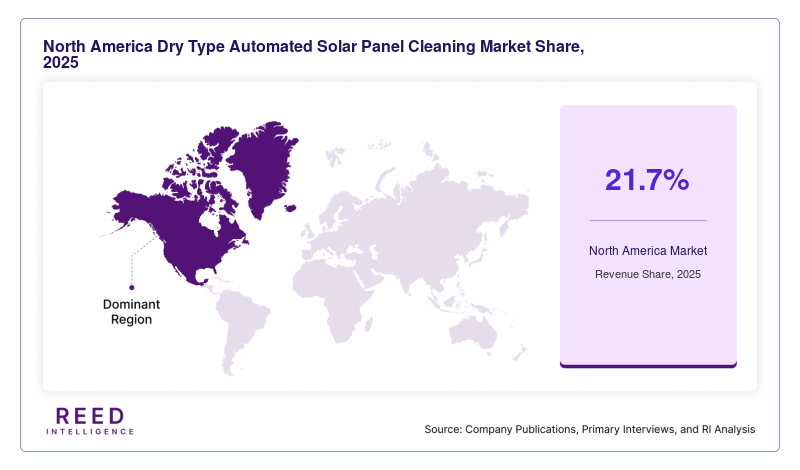
North America accounted for 21.7% of the global market share in 2025 and is expected to grow at a CAGR of 11.9% during the forecast period. The United States dominated the region due to the expansion of utility-scale solar farms and increasing adoption of automated maintenance technologies. The presence of advanced infrastructure and strong investment in renewable energy supported market growth.
Europe
Europe held a 18.4% market share in 2025 and is projected to grow at a CAGR of 11.3% through 2034. Germany emerged as the dominant country, driven by stringent environmental regulations and widespread adoption of solar energy systems. The focus on energy efficiency and sustainable maintenance practices contributed to market expansion.
Asia Pacific
Asia Pacific led the Dry Type Automated Solar Panel Cleaning Market with a 38.6% share in 2025 and is anticipated to grow at a CAGR of 13.6%. China dominated the region due to its large-scale solar installations and strong manufacturing base. Government incentives and rapid industrialization further accelerated market growth.
Middle East & Africa
The Middle East & Africa accounted for 13.2% of the market share in 2025 and is expected to grow at the fastest CAGR of 14.9%. The United Arab Emirates dominated the region, supported by extensive solar projects in desert environments. High dust accumulation and water scarcity significantly boosted the adoption of dry cleaning systems.
Latin America
Latin America captured 8.1% of the market share in 2025 and is projected to grow at a CAGR of 12.4%. Brazil led the region, driven by increasing solar installations and favorable government policies promoting renewable energy adoption.
Competitive Landscape
The Dry Type Automated Solar Panel Cleaning Market is moderately fragmented, with several global and regional players competing based on technology innovation, product efficiency, and pricing strategies. Leading companies are focusing on developing advanced robotic systems integrated with AI and IoT capabilities to enhance performance and reduce operational costs.
Ecoppia has emerged as a market leader, offering fully autonomous, water-free robotic cleaning solutions widely deployed in large-scale solar projects. The company recently introduced next-generation robots with improved energy efficiency and remote monitoring features.
Other prominent players include Kärcher, Serbot AG, Heliotex LLC, and Airtouch Solar Ltd., all of which are investing in research and development to expand their product portfolios. Strategic partnerships with solar project developers and expansion into emerging markets remain key growth strategies adopted by these companies.
Key Players List
- Ecoppia
- Kärcher
- Airtouch Solar Ltd.
- Serbot AG
- Heliotex LLC
- SolarCleano
- Nomadd Desert Solar Solutions
- SunBrush Mobil GmbH
- Robotic Solar Cleaning Ltd.
- Clean Solar Solutions Ltd.
- BladeRanger
- Sol-Bright Technology
- Greenbotics
- Indisolar Products Pvt. Ltd.
- Parish Maintenance Supply
Recent Developments
- In 2025, Ecoppia launched an advanced AI-powered robotic cleaning system designed for high-efficiency solar farms.
- Airtouch Solar Ltd. introduced a new water-free cleaning technology with improved dust removal capabilities.
- Kärcher expanded its product portfolio with automated dry cleaning solutions for commercial solar installations.
- Serbot AG entered into strategic partnerships with solar developers to deploy robotic cleaning systems in Europe.
- SolarCleano developed lightweight cleaning robots suitable for rooftop solar panels.
Dry Type Automated Solar Panel Cleaning Market Segments
Type
- Robotic Cleaning Systems
- AI-Enabled Autonomous Systems
- Brush-Based Systems
Operation Mode
- Fully Automated
- Semi-Automated
Application
- Utility-Scale Solar Farms
- Commercial Installations
- Residential Installations
End-Use
- Energy Sector
- Industrial
- Commercial
Distribution Channel
- Direct Sales
- Third-Party Service Providers
By Region
- North America
- Europe
- APAC
- Middle East and Africa
- LATAM