Dual Cure Adhesives Market Size, Share Demand Report By Resin Type (Epoxy-Based Dual Cure Adhesives, Acrylic-Based Dual Cure Adhesives, Silicone-Based Dual Cure Adhesives), By Curing Mechanism (UV + Heat Cure, UV + Moisture Cure, UV + Anaerobic Cure, UV + Chemical Reaction Cure), By Application (Electronics Assembly, Medical Device Bonding), By End-Use Industry (Automotive, Electronics & Semiconductor) By Region & Segment Forecasts, 2026–2034
USD 3950
Market Overview
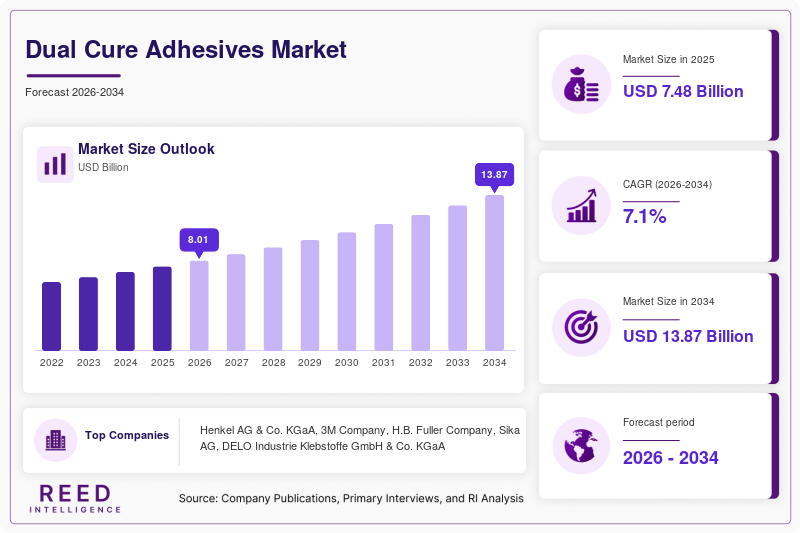
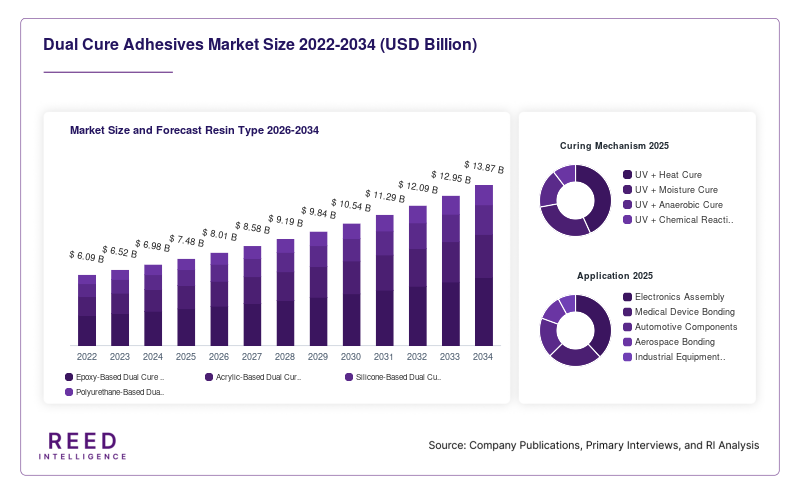
The global Dual Cure Adhesives Market size was valued at USD 7.48 billion in 2026 and is projected to reach USD 12.96 billion by 2034, expanding at a CAGR of 7.1% during the forecast period of 2026–2034. The market growth is being supported by increasing demand for high-performance bonding materials across electronics, automotive, aerospace, medical devices, and industrial manufacturing sectors. Dual cure adhesive systems combine two curing mechanisms, such as UV and moisture curing or light and thermal curing, which enhances bonding flexibility and improves curing reliability in complex applications.
The rapid shift toward lightweight materials and miniaturized electronic assemblies has increased the adoption of advanced adhesive technologies capable of delivering strong structural integrity and operational durability. Manufacturers are increasingly integrating dual cure adhesives into automated production environments to improve assembly efficiency, reduce curing time, and optimize product performance. These adhesives are widely used in applications where shadow areas or inaccessible bonding zones require secondary curing support.
Key Highlights:
- North America accounted for 36.1% of the global Dual Cure Adhesives Market share in 2025, while Asia Pacific is projected to register the fastest CAGR of 8.4% during 2026–2034.
- By resin type, epoxy-based dual cure adhesives held the leading market share of 42.7% in 2025, while silicone-based adhesives are expected to grow at a CAGR of 8.9%.
- By curing mechanism, UV and moisture cure systems accounted for 46.8% of the market share in 2025, whereas UV and thermal cure systems are projected to expand at a CAGR of 8.6%.
- By application, electronics assembly represented 38.5% of the global market share in 2025, while medical device bonding is anticipated to register a CAGR of 9.1%.
- The U.S. Dual Cure Adhesives Market was valued at USD 1.92 billion in 2024 and reached USD 2.08 billion in 2025.
Market Trends
Rising Adoption of Dual Cure Adhesives in Electronics Miniaturization
The increasing miniaturization of consumer electronics and industrial electronic systems is driving demand for advanced adhesive technologies capable of precise bonding and rapid curing. Dual cure adhesives are increasingly used in smartphones, wearable devices, semiconductors, and automotive electronics because they provide strong adhesion in confined assembly environments.
Manufacturers are developing formulations with enhanced thermal conductivity, electrical insulation, and optical clarity to support advanced electronic applications. Automated dispensing and UV-curing integration are also improving production efficiency in high-volume electronics manufacturing facilities.
Development of Sustainable and Low-VOC Adhesive Formulations
Environmental regulations and sustainability initiatives are encouraging manufacturers to introduce eco-friendly adhesive products with reduced volatile organic compound emissions. Companies are investing in bio-based raw materials and solvent-free formulations to improve environmental performance without compromising bonding strength.
This trend is expected to strengthen the adoption of dual cure adhesive technologies across industries seeking compliance with environmental and workplace safety standards.
Market Drivers
Growing Demand from Automotive Lightweighting Applications
Automotive manufacturers are increasingly adopting lightweight materials such as composites, engineered plastics, and aluminum alloys to improve fuel efficiency and electric vehicle performance. Dual cure adhesives provide reliable bonding for mixed-material assemblies while reducing the need for mechanical fasteners.
The growing production of electric vehicles and advanced driver assistance systems is further increasing demand for high-performance adhesives with vibration resistance and thermal stability.
Expansion of Industrial Automation and Smart Manufacturing
Industrial automation and precision manufacturing processes are increasing the need for adhesives that support rapid curing and consistent bonding performance. Dual cure adhesive systems improve manufacturing efficiency by enabling controlled curing through multiple mechanisms.
Industries such as aerospace, medical devices, and electronics are increasingly integrating automated adhesive dispensing systems to improve assembly precision and reduce operational downtime.
Market Restraint
Complex Processing and Higher Product Costs
The Dual Cure Adhesives Market faces limitations associated with complex formulation requirements and relatively high production costs. Advanced curing technologies and specialty raw materials increase overall product pricing, which may limit adoption among cost-sensitive small and medium-scale manufacturers.
Market Opportunities
Increasing Use in Medical Device Manufacturing
The growing production of minimally invasive medical devices and wearable healthcare equipment is creating opportunities for dual cure adhesive manufacturers. These adhesives provide strong bonding, biocompatibility, and sterilization resistance required for medical applications.
Increasing healthcare investments and rising demand for advanced diagnostic equipment are expected to support long-term segment expansion.
Growth in Renewable Energy Equipment Assembly
Renewable energy infrastructure projects are creating demand for durable bonding solutions capable of withstanding harsh environmental conditions. Dual cure adhesives are increasingly used in solar panel assembly, wind turbine components, and energy storage systems.
The expansion of clean energy investments is expected to generate new opportunities for manufacturers specializing in industrial-grade adhesive technologies.
Segmental Analysis
By Resin Type
Epoxy-Based Dual Cure Adhesives
Epoxy-based dual cure adhesives accounted for 42.7% of the market share in 2025. These adhesives gained significant adoption due to their strong mechanical strength, chemical resistance, and durability in industrial and structural applications.
Silicone-Based Dual Cure Adhesives
Silicone-based dual cure adhesives are projected to expand at a CAGR of 8.9% during the forecast period. The segment growth is being supported by increasing demand for flexible bonding solutions with superior thermal stability and moisture resistance.
By Curing Mechanism
UV and Moisture Cure Systems
UV and moisture cure systems represented 46.8% of the global market share in 2025. These systems were widely used in electronics and medical device assembly due to rapid surface curing combined with secondary curing capability in shadowed areas.
UV and Thermal Cure Systems
UV and thermal cure systems are expected to grow at a CAGR of 8.6% during 2026–2034. The segment growth is being driven by increasing adoption in automotive electronics and aerospace manufacturing applications.
By Application
Electronics Assembly
Electronics assembly dominated the market with 38.5% share in 2025. Increasing production of compact electronic devices and semiconductor systems supported strong segment demand.
Medical Device Bonding
Medical device bonding is forecast to witness a CAGR of 9.1% during the forecast period. Rising demand for advanced wearable healthcare products and diagnostic devices is expected to accelerate segment expansion.
By End-Use Industry
Automotive
The automotive segment accounted for 31.6% of the global market share in 2025. Automotive manufacturers increasingly adopted dual cure adhesives for lightweight assembly and battery component integration.
Renewable Energy
The renewable energy segment is projected to register a CAGR of 8.8% during the forecast period. Expanding solar and wind energy infrastructure projects are expected to increase demand for durable industrial bonding solutions.
By Distribution Channel
Direct Sales
Direct sales held the dominant market share of 58.9% in 2025. Large industrial manufacturers preferred direct procurement agreements to ensure technical support and customized adhesive formulations.
Online Distribution
Online distribution channels are expected to grow at a CAGR of 7.8% during 2026–2034. Increasing digital procurement adoption and expanding industrial e-commerce platforms are supporting segment growth.
Regional Analysis
North America
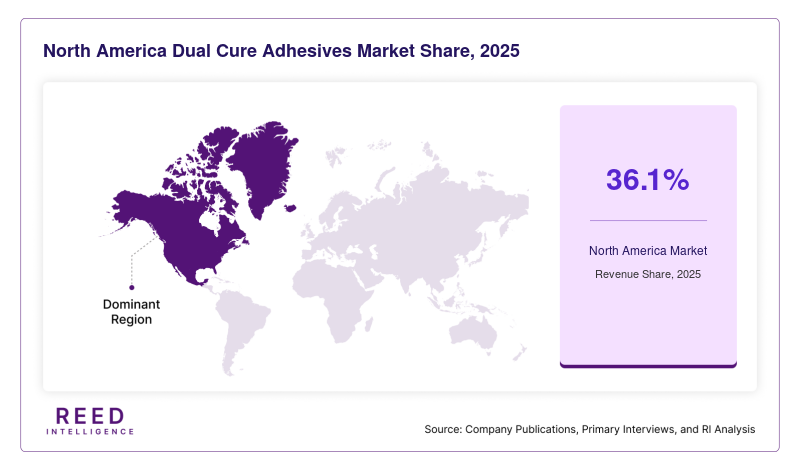
North America accounted for 36.1% of the global Dual Cure Adhesives Market share in 2025. The region benefited from strong demand across aerospace, automotive, and electronics manufacturing sectors. The United States remained the dominant market due to growing investments in electric vehicle production and advanced industrial automation systems.
Manufacturers in the region increasingly adopted high-performance adhesives for lightweight structural assembly and precision electronic applications. Research investments in advanced polymer technologies also contributed to market expansion.
North America is projected to grow at a CAGR of 6.8% during 2026–2034.
Europe
Europe held 28.4% of the global market share in 2025. Germany emerged as the dominant regional market due to its strong automotive manufacturing base and increasing adoption of industrial automation technologies.
The region witnessed growing use of dual cure adhesives in electric mobility applications and advanced electronics manufacturing. Sustainability-focused industrial policies encouraged the development of environmentally compliant adhesive formulations.
Europe is forecast to register a CAGR of 6.9% during the forecast period.
Asia Pacific
Asia Pacific represented 24.7% of the global Dual Cure Adhesives Market share in 2025 and is anticipated to expand at the fastest CAGR of 8.4% during 2026–2034. China remained the leading regional market due to rapid industrialization and large-scale electronics production.
The region experienced rising investments in semiconductor manufacturing, electric vehicles, and renewable energy infrastructure. Expanding consumer electronics demand and increasing automation adoption are expected to support continued market growth.
Middle East & Africa
Middle East & Africa accounted for 5.8% of the global market share in 2025. The United Arab Emirates remained the dominant country due to increasing industrial diversification initiatives and investments in infrastructure modernization.
Industrial manufacturers increasingly adopted advanced adhesive systems for energy equipment assembly and transportation applications. Growing construction activities also supported demand for industrial bonding solutions.
The region is expected to grow at a CAGR of 6.3% during the forecast period.
Latin America
Latin America captured 5.0% of the global market share in 2025. Brazil dominated the regional market due to increasing automotive manufacturing and expanding industrial production activities.
The adoption of dual cure adhesives increased across consumer goods, transportation, and industrial machinery sectors. Rising infrastructure modernization initiatives supported steady market expansion.
Latin America is projected to expand at a CAGR of 5.9% during 2026–2034.
Competitive Landscape
The Dual Cure Adhesives Market is moderately competitive with key companies focusing on product innovation, sustainability initiatives, and strategic expansion activities. Manufacturers are investing in advanced resin chemistry and automated curing technologies to strengthen market positioning.
Henkel AG & Co. KGaA remained a leading player due to its extensive industrial adhesive portfolio and strong global distribution network. The company recently launched advanced dual cure adhesive formulations designed for high-speed electronics assembly and automotive applications.
3M focused on developing environmentally compliant adhesive technologies for industrial and healthcare applications. DELO Industrial Adhesives expanded its UV-curable product portfolio for semiconductor and electronics manufacturing. Dymax Corporation increased investments in light-curing adhesive technologies for medical device applications. Permabond LLC introduced new structural adhesive solutions with enhanced thermal resistance and durability.
Key Players List
- Henkel AG & Co. KGaA
- 3M Company
- DELO Industrial Adhesives
- Dymax Corporation
- Permabond LLC
- Master Bond Inc.
- H.B. Fuller Company
- Sika AG
- Arkema Group
- Huntsman Corporation
- Panacol-Elosol GmbH
- LORD Corporation
- Avery Dennison Corporation
- BASF SE
Recent Developments
- Henkel AG & Co. KGaA launched advanced dual cure adhesive products for high-speed automotive electronics assembly.
- DELO Industrial Adhesives expanded its UV-curing adhesive manufacturing capacity to support semiconductor applications.
- Dymax Corporation introduced low-VOC dual cure adhesive formulations for medical device manufacturing.
- H.B. Fuller Company invested in research initiatives focused on sustainable industrial adhesive technologies.
- Sika AG developed new structural bonding solutions for renewable energy equipment applications.
Dual Cure Adhesives Market Segments
Resin Type
- Epoxy-Based Dual Cure Adhesives
- Acrylic-Based Dual Cure Adhesives
- Silicone-Based Dual Cure Adhesives
- Polyurethane-Based Dual Cure Adhesives
Curing Mechanism
- UV + Heat Cure
- UV + Moisture Cure
- UV + Anaerobic Cure
- UV + Chemical Reaction Cure
Application
- Electronics Assembly
- Medical Device Bonding
- Automotive Components
- Aerospace Bonding
- Industrial Equipment Assembly
End-Use Industry
- Automotive
- Electronics & Semiconductor
- Healthcare
- Aerospace & Defense
- Industrial Manufacturing
Distribution Channel
- Direct Sales
- Industrial Distributors
- Online Industrial Platforms
By Region
- North America
- Europe
- APAC
- Middle East and Africa
- LATAM