Dumping Hopper Market Size, Share, Demand Report By Product Type (Self-Dumping Hoppers, Forklift Hoppers, Bottom-Dump Hoppers, Specialty & Mobile Dumping Hoppers), By Capacity (Below 1,000 lbs, 1,000–5,000 lbs, Above 5,000 lbs), By Application (Construction Waste Handling, Mining Operations, Manufacturing, Agriculture, Recycling), By Region & Segment Forecasts, 2026–2034
USD 3950
Market Overview
The global Dumping Hopper Market size is valued at approximately USD 1.48 billion in 2026 and is projected to reach around USD 2.89 billion by 2034, expanding at a CAGR of 8.7% during the forecast period (2026–2034). Dumping hoppers, widely used for bulk material handling in construction, mining, agriculture, and manufacturing industries, are gaining traction due to increasing demand for efficient material transfer systems and workplace safety compliance. Rising industrial automation and mechanization across developing economies have significantly contributed to product adoption.
One key global factor supporting market growth is the rapid expansion of infrastructure development projects, particularly in emerging economies, where construction activities require efficient bulk material unloading and handling systems. The growing emphasis on reducing manual labor dependency and improving operational efficiency has further strengthened demand for advanced dumping hopper solutions. Additionally, increased mining exploration activities and port logistics modernization are creating sustained opportunities for manufacturers.
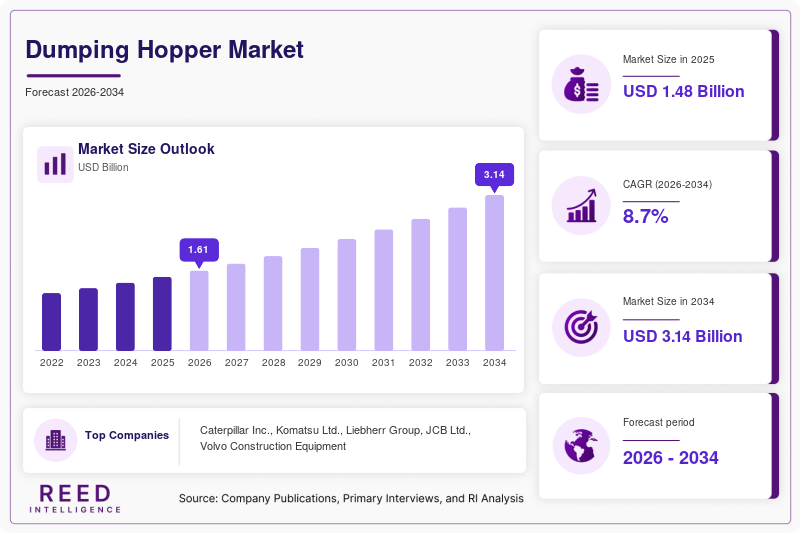
Key Highlights
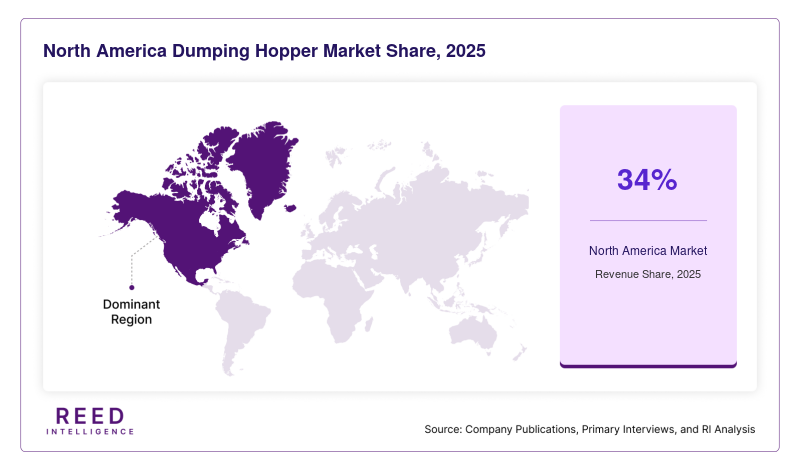
- North America dominated the market with a 34.2% share in 2025.
- Asia Pacific is expected to grow at the fastest CAGR of 11.2% during 2026–2034.
- By material type, steel dumping hoppers accounted for the largest share of 46.8%, while hydraulic dumping hoppers are projected to grow at a CAGR of 10.9%.
- By application, construction waste handling led with a 39.6% share, whereas mining operations are expected to expand at a CAGR of 11.5%.
- The United States remained the dominant country, with market values of USD 620 million in 2024 and USD 665 million in 2025.
Market Trends
Automation-Integrated Material Handling Systems
A major trend shaping the dumping hopper market is the increasing integration of automation and smart material handling systems. Industries are progressively adopting IoT-enabled dumping hoppers that allow real-time monitoring of load capacity, discharge rates, and maintenance needs. These systems improve efficiency in large-scale construction and mining operations by reducing manual intervention and operational delays. Automation integration also enhances safety by minimizing worker exposure to heavy lifting tasks. Manufacturers are focusing on designing smart hoppers compatible with automated conveyor systems and robotic loading units, which is expected to significantly enhance productivity across industrial facilities.
Shift Toward Heavy-Duty and Corrosion-Resistant Materials
Another key trend is the rising preference for heavy-duty and corrosion-resistant dumping hoppers, particularly in mining, marine, and chemical processing applications. End-users are increasingly demanding equipment that can withstand harsh operating environments and abrasive materials. As a result, manufacturers are investing in advanced alloys, reinforced steel structures, and anti-corrosion coatings. This trend is also driven by the need for longer equipment lifespan and reduced maintenance costs. Additionally, environmentally sustainable coating materials are gaining attention as industries aim to comply with stricter environmental regulations while maintaining operational durability.
Market Drivers
Expansion of Construction and Infrastructure Development
The rapid expansion of global construction and infrastructure development projects is a key driver of the dumping hopper market. Governments across developing regions are heavily investing in transportation networks, smart cities, and industrial zones, all of which require efficient bulk material handling solutions. Dumping hoppers play a critical role in handling construction debris, aggregates, and raw materials efficiently at job sites. Increasing urbanization and population growth are further fueling demand for residential and commercial construction, thereby boosting equipment utilization across the sector.
Growth in Mining and Bulk Material Handling Industries
The mining industry’s expansion is another significant driver supporting market growth. Rising demand for minerals, metals, and raw resources has led to increased mining activities globally, especially in Asia Pacific and Latin America. Dumping hoppers are essential in handling extracted ores, waste rock, and bulk materials efficiently. The need to improve operational efficiency and reduce transportation bottlenecks in mining operations is pushing companies to adopt high-capacity dumping systems. Additionally, advancements in mining automation are further accelerating equipment deployment across large-scale extraction sites.
Market Restraint
High Initial Investment and Maintenance Costs
A major restraint affecting the dumping hopper market is the high initial investment cost associated with advanced and automated systems. Heavy-duty dumping hoppers, especially those integrated with hydraulic or IoT-enabled systems, require significant capital expenditure. Small and medium-sized enterprises often face financial limitations in adopting such equipment. Additionally, maintenance costs, including periodic inspections, part replacements, and corrosion treatment, add to operational expenses. In cost-sensitive markets, this becomes a barrier to widespread adoption, particularly in developing regions where manual material handling is still prevalent. The lack of skilled operators for advanced systems further adds to operational challenges.
Market Opportunities
Adoption in Waste Management and Recycling Applications
The growing emphasis on sustainable waste management and recycling presents a significant opportunity for the dumping hopper market. Municipalities and industrial facilities are increasingly adopting mechanized systems for handling construction and demolition waste. Dumping hoppers play a crucial role in segregating and transferring recyclable materials efficiently. The expansion of circular economy initiatives is encouraging industries to invest in automated waste handling systems. This trend is particularly strong in urban regions where waste generation is high, creating long-term demand for durable and efficient dumping hopper solutions.
Technological Advancements in Hydraulic and Smart Systems
Technological innovation in hydraulic mechanisms and smart monitoring systems offers another major opportunity. Manufacturers are developing advanced dumping hoppers equipped with sensors, automated tilt functions, and predictive maintenance capabilities. These innovations improve operational efficiency and reduce downtime in industrial operations. The integration of AI-based monitoring systems allows real-time performance optimization and reduces equipment failure risks. As industries continue to adopt Industry 4.0 practices, demand for technologically advanced dumping hoppers is expected to increase significantly across manufacturing and logistics sectors.
Segmental Analysis
By Product Type
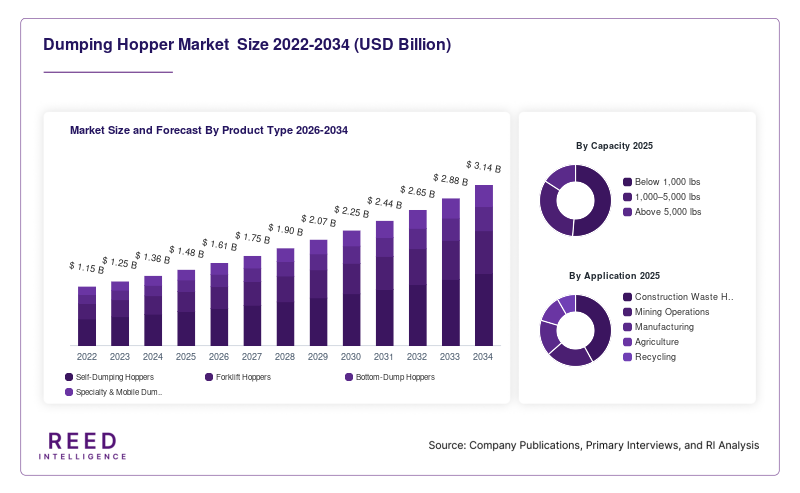
The dumping hopper market is segmented into self-dumping hoppers, forklift hoppers, bottom-dump hoppers, and specialty hoppers. Among these, self-dumping hoppers held the largest share of approximately 46.3% in 2025, driven by their automatic discharge mechanism, ease of operation, and high efficiency in handling bulk materials. These hoppers are widely used across construction sites, manufacturing facilities, warehouses, and recycling plants where frequent material unloading is required. Their durability and low operational complexity make them a preferred choice for industrial users seeking productivity improvements.
The fastest-growing segment is specialty and mobile dumping hoppers, expected to expand at a CAGR of around 9.8% from 2026 to 2034. Growth is supported by increasing demand for flexible and transportable material handling solutions across dynamic industrial environments. Mobile hoppers are gaining traction in logistics hubs, construction projects, and temporary industrial setups due to their ability to improve operational flexibility. Integration with forklifts and automated handling systems is further accelerating adoption across global markets.
By Capacity
The market is segmented into below 1,000 lbs, 1,000–5,000 lbs, and above 5,000 lbs capacity hoppers. The 1,000–5,000 lbs segment dominated the market with approximately 52.1% share in 2025, as it provides an optimal balance between load capacity, maneuverability, and cost efficiency. This capacity range is widely adopted across construction, manufacturing, and waste management industries where medium-scale material handling is required. Its versatility and operational efficiency make it the most widely used segment globally.
The fastest-growing segment is above 5,000 lbs capacity hoppers, projected to grow at a CAGR of nearly 10.5% during the forecast period. Growth is driven by increasing large-scale infrastructure development, mining expansion, and heavy industrial applications requiring high-volume material transfer. These high-capacity systems reduce cycle times and improve productivity in bulk handling operations. Continuous improvements in structural design and hydraulic systems are enhancing load-bearing capacity and operational safety.
By Application
The application segment includes construction waste handling, mining operations, manufacturing, agriculture, and recycling. Construction waste handling dominated the market with approximately 39.6% share in 2025, supported by rapid urbanization and rising infrastructure development activities worldwide. Dumping hoppers are extensively used for handling construction debris, aggregates, and raw materials efficiently at job sites. Increasing adoption of mechanized waste management systems is further strengthening this segment’s dominance.
The fastest-growing application segment is mining operations, expected to expand at a CAGR of around 11.5% from 2026 to 2034. Growth is driven by increasing global demand for minerals, metals, and energy resources. Mining companies are increasingly adopting advanced material handling systems to improve operational efficiency and reduce downtime. Dumping hoppers play a critical role in transporting extracted ores and waste materials, supporting large-scale mining productivity improvements.
Regional Analysis
North America
North America accounted for approximately 34%–35% of the global market share in 2025, with a projected CAGR of 8.1% through 2034. The region benefits from strong industrial infrastructure, advanced construction technologies, and high adoption of automated material handling systems. Demand is particularly strong across construction, manufacturing, and mining industries, where efficiency and safety are key priorities.
The United States dominates the regional market due to large-scale infrastructure modernization, industrial automation, and mining operations. A key growth factor is the increasing integration of smart material handling systems that enhance productivity and reduce manual labor dependency across industrial applications.
Europe
Europe held around 25%–27% market share in 2025, with a projected CAGR of 7.5%–8.0% during the forecast period. The region is characterized by strict workplace safety regulations, high automation adoption, and strong manufacturing capabilities. Countries such as Germany, the United Kingdom, and France contribute significantly to regional demand.
Germany leads the European market due to its advanced engineering sector and strong industrial base. A key growth factor is the rising demand for energy-efficient and environmentally compliant material handling equipment, encouraging the adoption of advanced dumping hopper systems in industrial and construction applications.
Asia Pacific
Asia Pacific is the fastest-growing region, accounting for approximately 28%–43% market share in 2025, with a strong CAGR of 10%–11.5% during 2026–2034. Rapid urbanization, infrastructure expansion, and industrialization across China, India, Japan, and Southeast Asia are driving strong demand for dumping hoppers.
China dominates the regional market due to massive construction activities and mining operations. A key growth factor is government-led infrastructure development programs, including smart cities and transportation networks, which are significantly increasing demand for efficient material handling equipment.
Middle East & Africa
The Middle East & Africa region accounted for approximately 7%–8% share in 2025, with a projected CAGR of 9%–9.5% during the forecast period. Growth is supported by increasing construction activities, mining projects, and large-scale infrastructure development initiatives across GCC countries and South Africa.
Saudi Arabia leads the regional market due to ongoing mega infrastructure projects and economic diversification programs. A key growth factor is the increasing investment in smart city development and industrial expansion projects, driving demand for advanced material handling systems.
Latin America
Latin America held around 4%–5% market share in 2025, with a projected CAGR of 8%–9% during the forecast period. Growth is driven by mining activities, infrastructure development, and increasing industrial automation adoption, particularly in Brazil and Argentina.
Brazil dominates the regional market due to its strong mining industry and ongoing infrastructure expansion. A key growth factor is rising investment in industrial modernization and export-oriented mining operations, which require efficient and durable bulk material handling systems.
Competitive Landscape
The dumping hopper market is moderately fragmented with the presence of global and regional manufacturers focusing on product innovation and durability enhancement. Key players include Caterpillar Inc., Komatsu Ltd., Liebherr Group, JCB Ltd., and Volvo Construction Equipment. These companies are investing in automation integration and material innovation to strengthen market presence. Caterpillar Inc. remains a leading player due to its strong product portfolio and global distribution network. A recent development includes the launch of advanced hydraulic dumping systems designed for heavy-duty industrial applications.
Key Players
- Caterpillar Inc.
- Komatsu Ltd.
- Liebherr Group
- JCB Ltd.
- Volvo Construction Equipment
- Hitachi Construction Machinery
- Terex Corporation
- SANY Group
- Doosan Infracore
- Hyundai Construction Equipment
- XCMG Group
- CNH Industrial
- Kubota Corporation
- Manitou Group
- Wacker Neuson SE
Recent Developments
- In 2025, several manufacturers introduced IoT-enabled dumping hopper systems integrated with predictive maintenance features to enhance operational efficiency. These systems are designed to reduce downtime and improve equipment lifespan in heavy-duty applications.
- Another development includes the expansion of production facilities by leading companies in Asia Pacific to meet rising regional demand. This expansion aims to strengthen supply chain efficiency and reduce delivery timelines for industrial customers.
- Additionally, new partnerships between equipment manufacturers and construction firms have been established to develop customized dumping solutions tailored for large-scale infrastructure projects.
Dumping Hopper Market Segments
By Product Type
- Self-Dumping Hoppers
- Forklift Hoppers
- Bottom-Dump Hoppers
- Specialty & Mobile Dumping Hoppers
By Capacity
- Below 1,000 lbs
- 1,000–5,000 lbs
- Above 5,000 lbs
By Application
- Construction Waste Handling
- Mining Operations
- Manufacturing
- Agriculture
- Recycling
By Region
- North America
- Europe
- APAC
- Middle East and Africa
- LATAM