Durable Medical Equipment (DME) Market Size, Share & Trends Analysis Report By Product Type, By Distribution Channel, By End User and By Region, Forecasts 2026–2034
USD 3950
Durable Medical Equipment (DME) Market Size
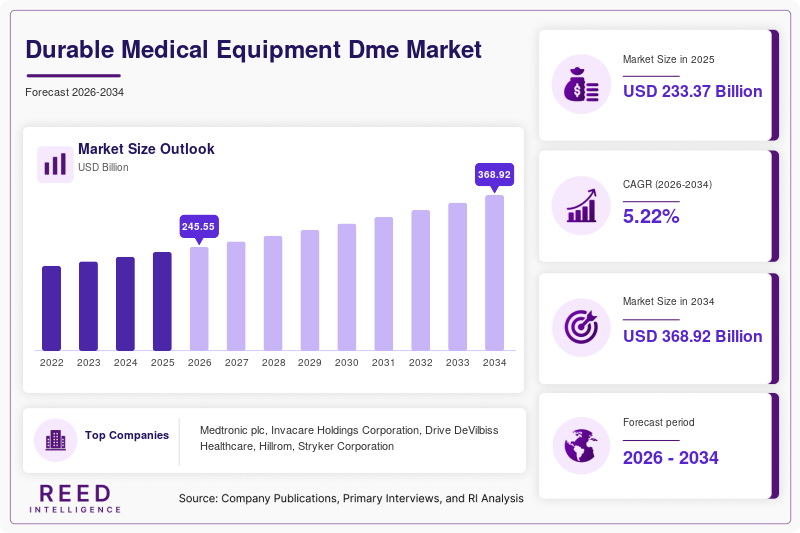
The global durable medical equipment (DME) market was valued at USD 233.37 billion in 2025 and is projected to grow from USD 245.54 billion in 2026 to USD 368.82 billion by 2034, registering a CAGR of 5.22% during the forecast period from 2026 to 2034.
Durable medical equipment refers to reusable medical devices designed for long-term use in healthcare, rehabilitation, monitoring, treatment and home-care settings. Products include mobility equipment, monitoring devices, therapeutic equipment, hospital beds, oxygen equipment, wheelchairs and other medically necessary devices.
The market is benefiting from population aging, increasing prevalence of chronic diseases, greater utilization of home healthcare and rehabilitation services, and the expansion of healthcare infrastructure. The shift toward decentralized care is particularly important because patients are increasingly receiving treatment and monitoring outside traditional hospital environments.
Durable Medical Equipment (DME) Market Drivers
Aging Global Population
The increasing number of older adults is generating demand for mobility, respiratory, monitoring and home-care equipment.
Older populations have greater requirements for assistive devices, rehabilitation equipment and long-term disease management, supporting sustained DME consumption.
Rising Prevalence of Chronic Diseases
Chronic conditions such as cardiovascular diseases, diabetes, respiratory disorders and neurological conditions often require long-term monitoring or therapeutic equipment.
The growing burden of chronic disease therefore creates recurring demand for durable medical equipment across hospitals, clinics and home-care settings.
Expansion of Home Healthcare
Healthcare systems are increasingly shifting selected services from hospitals to patients' homes.
Home oxygen equipment, hospital beds, mobility aids, patient-monitoring systems and other DME products enable patients to receive treatment and assistance outside traditional healthcare facilities.
Growth in Rehabilitation Services
Increasing demand for physical rehabilitation and recovery services is supporting the use of mobility aids, therapeutic equipment and assistive devices.
The expansion of rehabilitation infrastructure across developed and emerging economies provides additional opportunities for DME manufacturers.
Technological Advancements
Manufacturers are incorporating sensors, connectivity, automation and remote-monitoring functionality into medical equipment.
Smart DME can enable healthcare professionals and caregivers to monitor patients remotely and identify changes in health status more efficiently.
Durable Medical Equipment (DME) Market Restraints
High Equipment Costs
Advanced durable medical equipment can involve significant acquisition and maintenance costs.
High prices can limit adoption among patients and healthcare providers, particularly in developing healthcare systems with constrained budgets.
Reimbursement Challenges
Reimbursement policies have a significant impact on DME adoption.
Changes in reimbursement rates, eligibility criteria, coverage requirements and procurement policies can influence purchasing decisions and manufacturer revenues.
Regulatory Requirements
Medical equipment manufacturers must comply with extensive requirements concerning safety, performance, quality management and market authorization.
Compliance can increase product-development costs and lengthen commercialization timelines.
Maintenance and Servicing Requirements
DME often requires installation, maintenance, calibration and periodic servicing.
The need for technical support can increase the total cost of ownership and create logistical challenges, particularly in remote areas.
Durable Medical Equipment (DME) Market Opportunities
Increasing Demand for Home-Based Medical Equipment
The expansion of home healthcare creates significant opportunities for portable and user-friendly DME.
Products designed for home use can help patients manage chronic conditions while reducing reliance on hospital-based care.
Connected and Remote-Monitoring Equipment
Connected DME can transmit patient information to healthcare professionals and caregivers.
Integration with telehealth platforms and electronic health records creates opportunities for manufacturers to develop equipment that supports continuous patient monitoring.
Emerging-Market Healthcare Infrastructure
Healthcare infrastructure investments in Asia-Pacific, Latin America, the Middle East and Africa are expanding access to medical equipment.
Increasing hospital capacity, improving insurance coverage and rising healthcare expenditure can support DME adoption.
Portable Medical Devices
Demand for lightweight and portable equipment is increasing as healthcare becomes more decentralized.
Portable oxygen concentrators, compact monitoring systems and mobility equipment can provide greater convenience for patients and caregivers.
Smart Mobility Equipment
Advanced wheelchairs, powered mobility systems and intelligent assistive devices provide opportunities for manufacturers to combine DME with sensors, connectivity and automation.
Product Type Segment Analysis
Mobility Equipment Holds the Largest Share
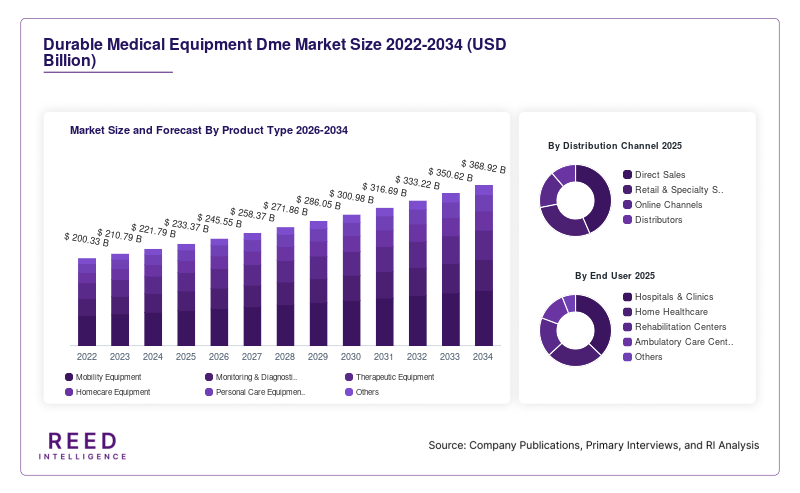
Mobility equipment accounted for approximately 29% of the DME Market in 2025, making it the largest product segment. Wheelchairs, walkers, mobility scooters and related equipment are widely used by older adults and patients requiring rehabilitation or long-term mobility assistance.
Monitoring & diagnostic equipment accounted for approximately 23% and is projected to grow at approximately 6.4% CAGR, making it the fastest-growing major product segment. Increasing home-based monitoring and connected healthcare are supporting demand.
Therapeutic equipment represented approximately 21%, homecare equipment 17%, and personal care and other equipment approximately 10%.
Distribution Channel Segment Analysis
Direct Sales Hold the Largest Share
Direct sales accounted for approximately 44% of the market in 2025, supported by institutional procurement and relationships between manufacturers, hospitals and healthcare organizations.
Online channels accounted for approximately 14% and are projected to grow at approximately 8.1% CAGR, making them the fastest-growing major distribution channel. Greater consumer familiarity with online healthcare purchasing and home-care equipment is supporting digital sales.
Retail and specialty stores represented approximately 26%, while distributors accounted for approximately 16%.
End-User Segment Analysis
Hospitals & Clinics Hold the Largest Share
Hospitals & clinics accounted for approximately 39% of the market in 2025, making them the largest end-user segment. Hospitals require DME for patient treatment, monitoring, rehabilitation and post-acute care.
Home healthcare accounted for approximately 28% and is projected to grow at approximately 7.0% CAGR, making it the fastest-growing major end-user segment. The shift toward home-based treatment and chronic disease management is supporting adoption.
Rehabilitation centers represented approximately 18%, ambulatory care centers approximately 9%, and other end users approximately 6%.
Durable Medical Equipment (DME) Market Regional Analysis
North America Holds the Largest Share
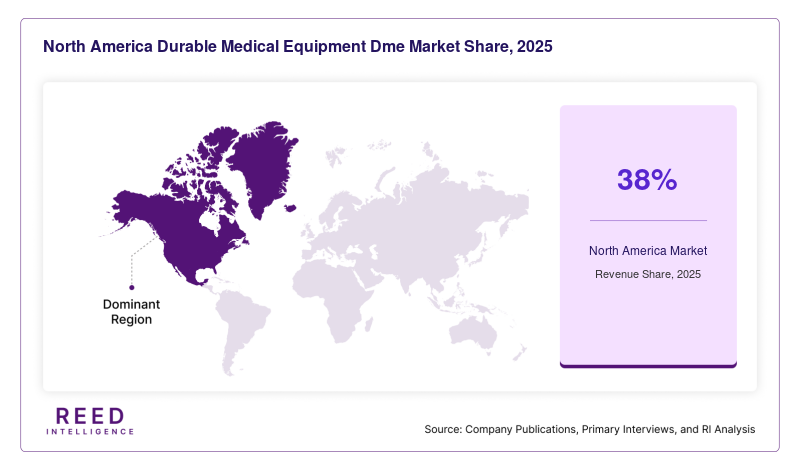
North America accounted for approximately 38% of the global DME Market in 2025, making it the dominant regional market. The region benefits from developed healthcare infrastructure, high healthcare expenditure, established reimbursement systems and significant adoption of home healthcare.
The United States represents the largest national market in the region, supported by substantial demand for mobility, respiratory, monitoring and therapeutic equipment.
Asia-Pacific accounted for approximately 24% and is projected to grow at approximately 7.0% CAGR, making it the fastest-growing major region. Population aging, increasing healthcare expenditure, expanding hospital infrastructure and greater adoption of home healthcare are supporting regional growth.
Europe Maintains Strong Demand
Europe accounted for approximately 29% of the market in 2025 and is projected to grow at approximately 4.8% CAGR.
An aging population, established healthcare systems and increasing demand for rehabilitation and home-care services are supporting DME consumption.
Latin America Shows Expanding Adoption
Latin America accounted for approximately 5% of the market in 2025 and is projected to grow at approximately 5.7% CAGR.
Healthcare infrastructure improvements and increasing access to medical services are supporting demand for durable equipment.
Middle East & Africa Represents an Emerging Market
Middle East & Africa accounted for approximately 4% of the market in 2025 and is projected to grow at approximately 6.1% CAGR.
Healthcare infrastructure investment, hospital expansion and growing demand for specialized medical equipment are supporting regional development.
Durable Medical Equipment (DME) Market Competitive Landscape
Competition in the Durable Medical Equipment Market is based on product quality, clinical performance, regulatory compliance, technology, pricing, distribution reach, reimbursement coverage, after-sales service and product reliability.
Manufacturers are increasingly investing in connected equipment, portable products and solutions designed for home healthcare.
Key Market Players
- Medtronic plc
- Invacare Holdings Corporation
- Drive DeVilbiss Healthcare
- Hillrom
- Stryker Corporation
- ResMed
- Getinge AB
- Arjo AB
- Sunrise Medical
- Fisher & Paykel Healthcare
Durable Medical Equipment (DME) Market Recent Developments
- ResMed continues to expand connected medical-device and digital-health capabilities across sleep and respiratory care. Connected devices allow clinicians and providers to access patient data remotely and support more continuous care management.
- Philips continues developing connected monitoring and home healthcare technologies designed to support care outside conventional hospital settings.
Durable Medical Equipment Dme Market Segments
By Product Type
- Mobility Equipment
- Monitoring & Diagnostic Equipment
- Therapeutic Equipment
- Homecare Equipment
- Personal Care Equipment
- Others
By Distribution Channel
- Direct Sales
- Retail & Specialty Stores
- Online Channels
- Distributors
By End User
- Hospitals & Clinics
- Home Healthcare
- Rehabilitation Centers
- Ambulatory Care Centers
- Others
By Region
- North America
- Europe
- APAC
- Middle East and Africa
- LATAM