Dynamic Digital Radiography Market Size, Share Demand Report By Technology (Flat-Panel Detector Systems, Image Intensifier Systems, AI-Integrated Imaging Systems), By Application (Orthopedic Motion Analysis, Pulmonary Function Imaging, Cardiovascular Motion Imaging, Swallowing and Gastrointestinal Studies), By End-User (Hospitals, Diagnostic Imaging Centers, Specialty Clinics), By Region & Segment Forecasts, 2025–2034
USD 3950
Market Overview
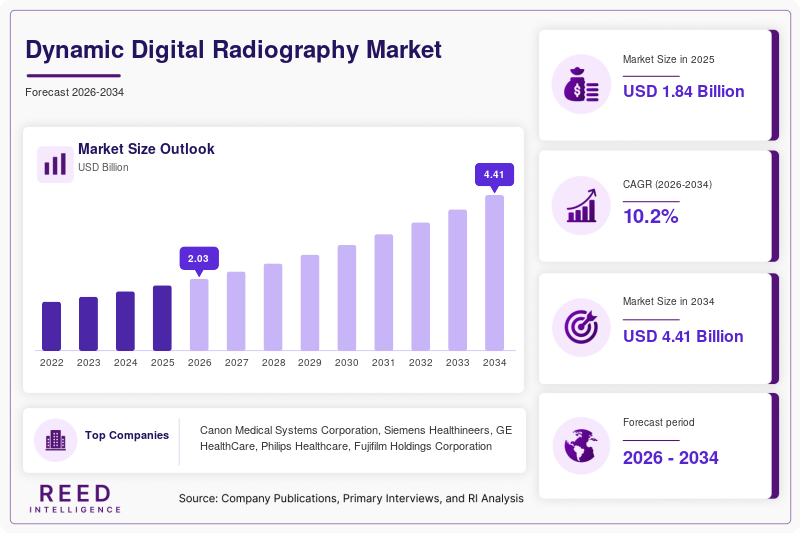
The Dynamic Digital Radiography Market size was valued at USD 1.84 billion in 2025 and is projected to reach USD 4.12 billion by 2033, expanding at a CAGR of 10.2% during 2025–2034. Dynamic digital radiography (DDR) is an advanced imaging technology that captures sequential X-ray images in real time, enabling physicians to observe physiological movement such as lung ventilation, joint motion, and cardiac function. Unlike conventional static radiography, DDR allows continuous imaging with low radiation exposure while delivering detailed motion analysis.
A key global factor supporting the growth of the Dynamic Digital Radiography Market is the increasing adoption of advanced diagnostic imaging technologies in modern healthcare systems. Hospitals and diagnostic centers are investing in digital radiography solutions that improve diagnostic accuracy, accelerate clinical workflows, and reduce radiation exposure. The shift toward digital healthcare infrastructure, along with the expansion of imaging-based disease diagnosis, has strengthened demand for DDR systems across developed and emerging healthcare markets.
Key Highlights
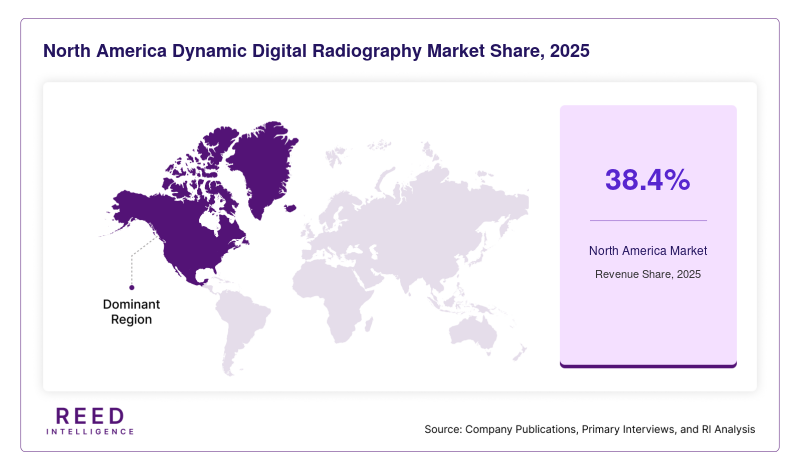
- North America held the dominant market share of 38.4% in 2025, while Asia Pacific is expected to grow at the fastest CAGR of 11.8%.
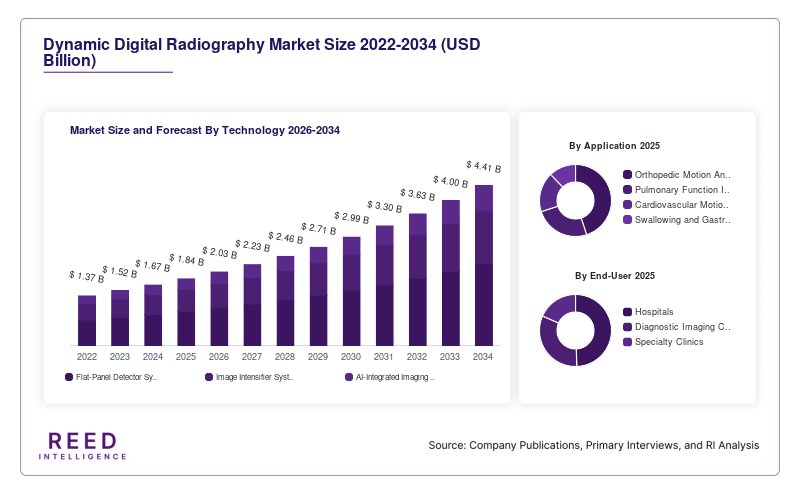
- Flat-panel detector systems led the technology segment with 46.7% share, while AI-integrated imaging systems are projected to grow at a 12.3% CAGR.
- Orthopedic motion analysis dominated the application segment with 34.5% share, while pulmonary function imaging will grow at a 12.1% CAGR.
- The United States remained the leading country with a market value of USD 612.5 million in 2025, projected to reach USD 664.3 million in 2026.
Market Trends
Integration of Artificial Intelligence in Dynamic Imaging
The Dynamic Digital Radiography Market is witnessing increasing integration of artificial intelligence in diagnostic imaging systems. AI-powered software is being incorporated into DDR platforms to enhance image reconstruction, motion tracking, and automated diagnostic analysis. These tools assist radiologists in detecting abnormalities such as joint instability or lung ventilation disorders more efficiently. AI algorithms also support real-time interpretation of sequential radiographic images, improving workflow efficiency in busy clinical environments. Healthcare providers are gradually adopting these technologies as they help reduce interpretation time and improve diagnostic confidence.
Expansion of Functional Imaging Applications
Another notable trend in the Dynamic Digital Radiography Market is the expansion of functional imaging capabilities. Traditional radiography systems capture static anatomical images, whereas DDR technology provides visualization of physiological movement. This capability is increasingly used in pulmonary imaging, orthopedic motion assessment, and swallowing studies. Hospitals are integrating DDR systems into imaging departments to improve diagnostic evaluation of dynamic body functions. Continuous advancements in detector sensitivity and image processing algorithms are further expanding the clinical utility of functional imaging technologies.
Market Drivers
Rising Demand for Advanced Diagnostic Imaging Technologies
The growing demand for advanced diagnostic imaging technologies is a major driver for the Dynamic Digital Radiography Market. Healthcare providers are increasingly focusing on improving diagnostic accuracy and patient care outcomes. Dynamic imaging allows clinicians to observe real-time physiological movement, enabling more precise identification of abnormalities in organs, joints, and respiratory systems. The ability to capture dynamic information helps physicians make more informed treatment decisions, which encourages adoption of DDR systems across hospitals and diagnostic centers.
Increasing Prevalence of Musculoskeletal and Respiratory Disorders
The rising prevalence of musculoskeletal injuries and respiratory diseases is also supporting the growth of the Dynamic Digital Radiography Market. Orthopedic disorders, sports injuries, and pulmonary conditions often require imaging methods capable of evaluating functional movement. Dynamic digital radiography systems provide detailed visualization of joint motion, lung ventilation patterns, and diaphragm movement. This diagnostic capability enables healthcare providers to evaluate disease progression and treatment effectiveness, increasing the use of DDR systems in clinical practice.
Market Restraint
High Capital Investment for Advanced Imaging Systems
A major restraint affecting the Dynamic Digital Radiography Market is the high capital cost associated with advanced imaging systems and supporting infrastructure. Dynamic digital radiography equipment includes high-performance detectors, imaging software, and integrated data processing systems, which significantly increases system costs compared with conventional radiography equipment. Healthcare facilities must also invest in installation, system integration, and staff training.
Smaller hospitals and diagnostic centers in emerging markets may face financial challenges when adopting DDR technology. In addition, maintenance costs and software upgrades add to operational expenses. Budget limitations can delay purchasing decisions, particularly in regions where healthcare infrastructure development is still evolving.
Market Opportunities
Expansion of Digital Healthcare Infrastructure
An emerging opportunity in the Dynamic Digital Radiography Market is the expansion of digital healthcare infrastructure across developing economies. Governments and healthcare organizations are investing in hospital modernization and digital diagnostic capabilities. As healthcare systems transition from analog to digital imaging technologies, demand for advanced radiography solutions is expected to increase. Dynamic digital radiography systems provide efficient imaging capabilities that align with modern digital healthcare environments.
Growing Use in Sports Medicine and Rehabilitation
Another promising opportunity lies in the growing use of DDR technology in sports medicine and rehabilitation diagnostics. Athletes and physically active individuals frequently require imaging methods that can evaluate joint movement and functional biomechanics. Dynamic radiography allows clinicians to analyze movement patterns and identify joint instability or injury-related abnormalities. Sports medicine clinics and rehabilitation centers are increasingly adopting DDR systems to support accurate diagnosis and recovery monitoring.
Segmental Analysis
By Technology
Flat-panel detector systems represented the dominant subsegment with 46.7% share in 2025. These detectors have been widely used in dynamic radiography systems due to their high image resolution, fast capture speed, and improved sensitivity. Healthcare facilities adopted flat-panel detectors because they provide high-quality imaging while maintaining relatively low radiation exposure.
AI-integrated imaging systems will be the fastest-growing subsegment with a CAGR of 12.3%. These systems will enable automated motion analysis and improved diagnostic support through advanced image processing algorithms. AI-driven solutions will help radiologists interpret dynamic imaging data more efficiently and enhance diagnostic accuracy.
By Application
Orthopedic motion analysis held the largest share of 34.5% in 2025. Dynamic digital radiography systems have been widely used for evaluating joint motion, detecting ligament instability, and assessing musculoskeletal conditions. Orthopedic specialists rely on motion imaging to better understand functional abnormalities during patient movement.
Pulmonary function imaging will be the fastest-growing application with a CAGR of 12.1%. DDR systems will increasingly be used to analyze lung ventilation patterns and diaphragm movement. This capability will support improved diagnosis of respiratory disorders and evaluation of treatment outcomes.
By End-User
Hospitals accounted for the largest share of 58.2% in 2025. Large hospitals frequently operate advanced imaging departments equipped with various radiology systems. Integration of dynamic digital radiography solutions supports faster diagnosis and improved clinical workflows in these settings.
Diagnostic imaging centers will be the fastest-growing end-user segment with a CAGR of 11.5%. These centers are expanding imaging services to meet increasing demand for specialized diagnostic tests. Adoption of advanced radiography systems will enable imaging centers to provide more comprehensive diagnostic capabilities.
Regional Analysis
North America
North America accounted for 38.4% of the Dynamic Digital Radiography Market in 2025and is projected to grow at a CAGR of 9.6% through 2034. The region maintained strong demand due to the presence of advanced healthcare infrastructure and high adoption of medical imaging technologies. Hospitals and diagnostic centers widely utilized digital radiography systems to improve clinical diagnostics and patient care. Additionally, continuous investment in imaging technologies supported the integration of advanced radiographic systems into healthcare facilities.
The United Statesdominated the regional market due to its extensive network of hospitals, diagnostic laboratories, and imaging centers. Healthcare providers in the country have steadily integrated advanced imaging solutions into routine diagnostics. The presence of major medical imaging equipment manufacturers and a strong regulatory framework supporting medical technology innovation further contributed to market expansion.
Europe
Europe represented 27.2% of the Dynamic Digital Radiography Market in 2025and will expand at a CAGR of 9.1% during the forecast period. The region maintained a well-established medical imaging infrastructure supported by public healthcare systems and advanced hospital networks. European healthcare institutions increasingly adopted digital radiography solutions to improve imaging efficiency and diagnostic accuracy.
Germanyremained the leading country in the regional market due to its strong medical technology sector and advanced hospital infrastructure. The country hosts several medical imaging research institutions and technology manufacturers that contribute to innovation in radiography systems. Hospitals in Germany have steadily implemented digital imaging technologies to support modern diagnostic workflows.
Asia Pacific
Asia Pacific held 23.6% share of the Dynamic Digital Radiography Market in 2025and is expected to grow at the fastest CAGR of 11.8% through 2034. The region experienced growing demand due to expanding healthcare infrastructure and increasing healthcare investments. Rapid urbanization and rising awareness of diagnostic healthcare services also supported adoption of advanced imaging systems.
Chinaemerged as the dominant country in the regional market. The country has been investing heavily in healthcare modernization and hospital infrastructure development. Increasing patient volumes and expansion of diagnostic imaging services have encouraged hospitals to adopt advanced radiography technologies to improve clinical efficiency.
Middle East & Africa
The Middle East & Africaaccounted for 6.3% of the Dynamic Digital Radiography Market in 2025and is projected to grow at a CAGR of 10.5% during the forecast period. Healthcare infrastructure development and government initiatives to expand diagnostic healthcare services have supported market growth in the region.
Saudi Arabiaremained the dominant country due to increasing investments in hospital infrastructure and medical technology adoption. Government healthcare modernization programs have encouraged hospitals to integrate advanced diagnostic equipment to improve healthcare services and patient care quality.
Latin America
Latin America captured 4.5% of the Dynamic Digital Radiography Market in 2025and will grow at a CAGR of 8.7% through 2034. The region has been gradually improving its healthcare infrastructure and diagnostic imaging capabilities. Hospitals and diagnostic laboratories are expanding their medical imaging services to meet growing patient demand.
Brazilled the regional market due to its relatively large healthcare system and expanding diagnostic imaging facilities. The country’s hospitals are gradually adopting digital radiography systems as part of healthcare modernization efforts.
Competitive Landscape
The Dynamic Digital Radiography Market includes a combination of established medical imaging companies and emerging technology developers. Market participants focus on improving detector technology, software integration, and imaging performance to enhance diagnostic capabilities.
Canon Medical Systems Corporationis recognized as a major market participant due to its development of advanced dynamic radiography systems designed for functional imaging applications. The company recently introduced enhanced DDR technology with improved motion analysis capabilities and advanced image processing features.
Other companies are also investing in research and development to improve detector performance and integrate AI-based analysis tools into imaging platforms. Strategic collaborations between imaging technology providers and healthcare institutions are supporting the development of new diagnostic solutions and expanding the application of dynamic digital radiography systems.
Key Players
- Canon Medical Systems Corporation
- Siemens Healthineers
- GE HealthCare
- Philips Healthcare
- Fujifilm Holdings Corporation
- Shimadzu Corporation
- Carestream Health
- Konica Minolta Inc.
- Hitachi Medical Systems
- Samsung Medison
- Agfa-Gevaert Group
- Hologic Inc.
- Varian Medical Systems
- Mindray Medical International
- United Imaging Healthcare
Recent Developments
- Medical imaging companies introduced AI-enhanced dynamic radiography platforms to support automated motion analysis.
- Several hospitals expanded radiology departments with advanced dynamic imaging systems for respiratory and orthopedic diagnostics.
- Detector technology improvements enabled higher frame-rate imaging with reduced radiation exposure.
- Healthcare providers adopted integrated digital imaging platforms that combine radiography with cloud-based data management systems.
Dynamic Digital Radiography Market Segments
By Technology
- Flat-Panel Detector Systems
- Image Intensifier Systems
- AI-Integrated Imaging Systems
By Application
- Orthopedic Motion Analysis
- Pulmonary Function Imaging
- Cardiovascular Motion Imaging
- Swallowing and Gastrointestinal Studies
By End-User
- Hospitals
- Diagnostic Imaging Centers
- Specialty Clinics
By Region
- North America
- Europe
- APAC
- Middle East and Africa
- LATAM