E-Beam Controller Market Size, Share & Demand Report By Type (Analog Controllers, Digital Controllers, AI-Integrated Controllers), By Application (Semiconductor Manufacturing, Medical Sterilization, Materials Processing, Research & Development), By End-Use Industry (Electronics, Healthcare, Industrial Manufacturing, Research Institutions), By Component (Hardware, Software), By Region & Segment Forecasts, 2025–2034
USD 3950
Market Overview
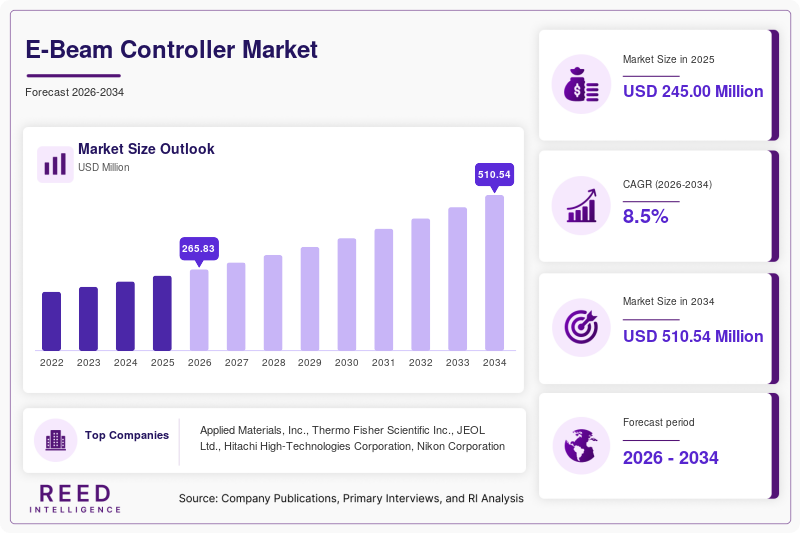
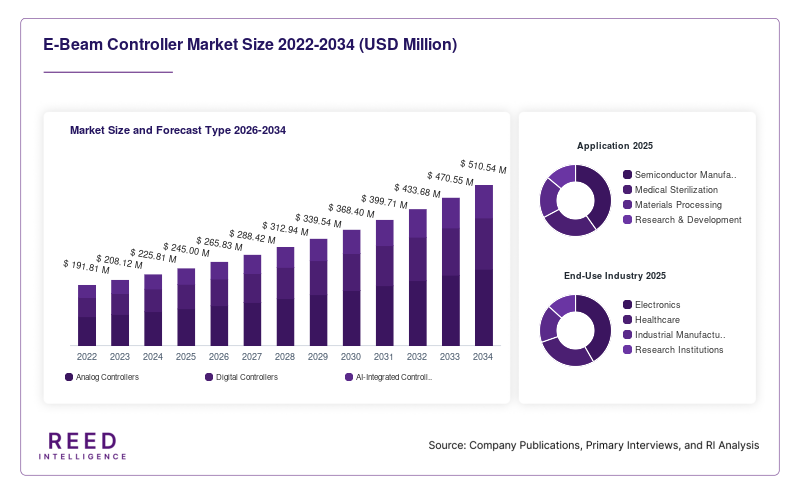
The E-Beam Controller Market was valued at approximately USD 245 million in 2025 and is projected to reach USD 512 million by 2034, expanding at a CAGR of 8.5% during the forecast period (2025–2034). The market is witnessing steady expansion due to increasing adoption of electron beam (e-beam) technologies in semiconductor manufacturing, medical device sterilization, and advanced materials processing. E-beam controllers play a critical role in ensuring precision, stability, and efficiency in electron beam systems, making them essential components in high-tech industrial applications.
A key global factor supporting market growth is the rising demand for high-precision fabrication in semiconductor and microelectronics industries. As chip architectures become increasingly complex, manufacturers require advanced control systems capable of delivering consistent beam alignment and energy output. This has accelerated investments in automation and digital control systems, boosting the demand for sophisticated e-beam controllers.
Key Highlights:
- North America dominated the market with a 34% share in 2025, while Asia Pacific is expected to register the fastest CAGR of 9.6% during the forecast period.
- The digital controller segment led the market in 2024 with a 61% share, while AI-integrated controllers are projected to grow at the fastest CAGR of 10.8%.
- The semiconductor application segment held the largest share at 42% in 2024, whereas medical sterilization is anticipated to expand at a CAGR of 9.9%.
- The U.S. remained the dominant country, with market values of USD 78 million in 2024 and USD 83 million in 2025.
Market Trends
Integration of AI and Machine Learning in Beam Control Systems
The E-Beam Controller Market is witnessing a transition toward intelligent control systems powered by artificial intelligence and machine learning. These technologies enable real-time optimization of beam parameters, reducing errors and improving throughput. AI-based controllers can adapt to variations in materials and environmental conditions, which enhances process reliability. This trend is particularly evident in semiconductor fabrication and advanced research applications, where precision is critical.
Growing Adoption of Compact and Modular Controller Designs
Manufacturers are increasingly focusing on compact and modular e-beam controller systems to meet the evolving needs of industrial users. Modular designs allow easier integration with existing systems and reduce maintenance complexity. These systems are also more energy-efficient and scalable, making them suitable for both small-scale laboratories and large industrial setups. The shift toward miniaturization and flexibility is expected to significantly influence product development strategies in the coming years.
Market Drivers
Rising Demand for Semiconductor Manufacturing Equipment
The increasing complexity of semiconductor devices has driven the need for advanced fabrication technologies, including electron beam lithography and inspection systems. E-beam controllers are essential for maintaining beam accuracy and consistency, which directly impacts production yield. As global demand for semiconductors continues to rise across industries such as consumer electronics, automotive, and telecommunications, the demand for high-performance e-beam controllers is also growing.
Expansion of Medical Sterilization Applications
E-beam technology is gaining traction in medical sterilization due to its ability to provide rapid and chemical-free sterilization. E-beam controllers ensure precise dose control, which is critical for maintaining product safety and compliance with regulatory standards. The increasing production of medical devices and pharmaceuticals has accelerated the adoption of e-beam sterilization systems, thereby boosting the market for controllers.
Market Restraint
High Initial Investment and System Complexity
One of the major challenges in the E-Beam Controller Market is the high cost associated with system installation and integration. Advanced e-beam controllers require sophisticated hardware and software components, which can significantly increase capital expenditure for end users. Additionally, the complexity of these systems necessitates skilled personnel for operation and maintenance, further adding to operational costs.
Small and medium-sized enterprises often face difficulties in adopting such technologies due to budget constraints. Moreover, integration with existing industrial systems can be challenging, particularly in legacy manufacturing setups. These factors may limit the widespread adoption of e-beam controllers, especially in developing regions where cost sensitivity remains high.
Market Opportunities
Emerging Applications in Advanced Materials Processing
The use of electron beam technology in advanced materials processing, including additive manufacturing and surface modification, presents significant growth opportunities. E-beam controllers enable precise control over beam intensity and focus, which is essential for achieving desired material properties. As industries increasingly adopt advanced materials for high-performance applications, the demand for specialized e-beam controllers is expected to rise.
Growth in Research and Development Activities
Increasing investments in research and development across academic institutions and industrial laboratories are creating new opportunities for the E-Beam Controller Market. Researchers rely on e-beam systems for applications such as microscopy, nanofabrication, and particle physics experiments. The need for highly customizable and precise control systems is driving innovation in controller technologies, opening new avenues for market expansion.
Segmental Analysis
By Type
Digital controllers dominated the E-Beam Controller Market in 2024, accounting for approximately 61% of the total share. Their ability to provide precise control and integration with automated systems made them widely preferred across industries.
AI-integrated controllers are expected to witness the fastest growth, with a projected CAGR of 10.8%. Their capability to optimize beam performance in real time and reduce operational errors will drive adoption in high-precision applications.
By Application
The semiconductor segment held the largest share of 42% in 2024, driven by the increasing demand for advanced chip manufacturing technologies. E-beam controllers are essential for ensuring accuracy in lithography and inspection processes.
The medical sterilization segment is expected to grow at the fastest CAGR of 9.9%, supported by the increasing use of e-beam technology for safe and efficient sterilization of medical equipment.
By End-Use Industry
The electronics industry dominated the market in 2024, with a share of 38%, due to widespread use of e-beam systems in device fabrication and testing.
The healthcare industry is anticipated to grow at the fastest CAGR of 9.4%, driven by rising demand for sterilization and advanced medical research applications.
By Component
Hardware components accounted for the largest share of 54% in 2024, as they form the core of e-beam control systems.
Software components are projected to grow at the fastest CAGR of 10.2%, owing to increasing demand for advanced analytics and automation capabilities.
Regional Analysis
North America
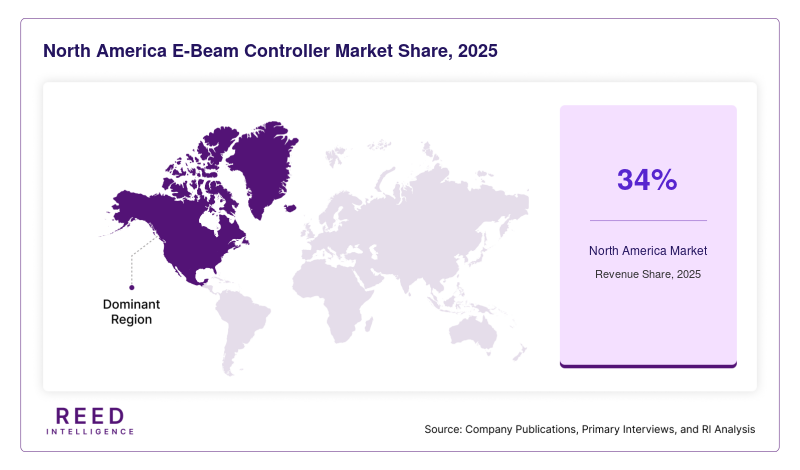
North America accounted for 34% of the E-Beam Controller Market share in 2025 and is expected to grow at a CAGR of 7.8% during the forecast period. The region benefited from strong investments in semiconductor manufacturing and advanced research facilities.
The United States dominated the regional market due to its well-established semiconductor industry and significant funding for technological innovation. The presence of leading research institutions and high adoption of automation technologies contributed to sustained demand for advanced e-beam controllers.
Europe
Europe held a 26% market share in 2025 and will grow at a CAGR of 7.5% through 2034. The region experienced steady growth due to increasing adoption of e-beam technology in industrial and medical applications.
Germany emerged as the dominant country, driven by its strong manufacturing base and focus on precision engineering. The country’s emphasis on advanced industrial processes supported the adoption of high-performance e-beam controllers.
Asia Pacific
Asia Pacific captured 28% of the market share in 2025 and is projected to grow at the fastest CAGR of 9.6% during the forecast period. The region experienced rapid industrialization and expansion of electronics manufacturing.
China led the regional market due to its large-scale semiconductor production and government initiatives supporting technological advancement. Increasing investments in electronics and healthcare sectors contributed to strong market growth.
Middle East & Africa
The Middle East & Africa accounted for 6% of the market share in 2025 and is expected to grow at a CAGR of 6.9%. The region showed gradual adoption of advanced technologies in industrial applications.
The United Arab Emirates dominated the market, supported by investments in healthcare infrastructure and industrial diversification. The growing focus on modernization contributed to increased adoption of e-beam technologies.
Latin America
Latin America held a 6% market share in 2025 and is projected to grow at a CAGR of 7.1% during the forecast period. The region experienced moderate growth driven by expanding industrial activities.
Brazil emerged as the leading country due to its growing manufacturing sector and increasing adoption of advanced technologies. Government initiatives supporting industrial development further boosted market demand.
Competitive Landscape
The E-Beam Controller Market is moderately competitive, with key players focusing on technological innovation and strategic partnerships. Companies are investing in advanced control systems to enhance performance and reliability.
The market leader, Applied Materials, Inc., has maintained its position through continuous innovation and expansion of its product portfolio. The company recently introduced a new generation of AI-enabled e-beam controllers designed to improve precision and efficiency in semiconductor manufacturing.
Other prominent players are emphasizing research and development to strengthen their market presence and address evolving customer requirements. Strategic collaborations and product launches remain key strategies for growth in this market.
Key Players
- Applied Materials, Inc.
- Thermo Fisher Scientific Inc.
- JEOL Ltd.
- Hitachi High-Technologies Corporation
- Nikon Corporation
- Carl Zeiss AG
- KLA Corporation
- Advantest Corporation
- ASML Holding N.V.
- Canon Inc.
- Veeco Instruments Inc.
- Oxford Instruments plc
- Raith GmbH
- Elionix Inc.
- Danaher Corporation
Recent Developments
- In 2025, Applied Materials launched an advanced AI-based e-beam controller to enhance semiconductor fabrication precision.
- In 2024, JEOL Ltd. expanded its product portfolio with compact modular controllers for research applications.
- In 2025, Hitachi High-Technologies introduced upgraded control systems with improved energy efficiency.
- In 2024, KLA Corporation partnered with semiconductor firms to develop next-generation inspection technologies.
- In 2025, Thermo Fisher Scientific enhanced its e-beam solutions for advanced material analysis.
E-Beam Controller Market Segments
Type
- Analog Controllers
- Digital Controllers
- AI-Integrated Controllers
Application
- Semiconductor Manufacturing
- Medical Sterilization
- Materials Processing
- Research & Development
End-Use Industry
- Electronics
- Healthcare
- Industrial Manufacturing
- Research Institutions
Component
- Hardware
- Software
By Region
- North America
- Europe
- APAC
- Middle East and Africa
- LATAM