E-Reader Market Size, Share & Trends Analysis Report By Screen Type (E Ink Black & White, E Ink Color), By Device Type (Basic E-Readers, Premium E-Readers, E-Note & Writing Devices), By Screen Size (Below 6 Inches, 6–8 Inches, Above 8 Inches), By Application (Consumer Reading, Education & Academic, Professional & Business, Comics & Illustrated Content), By Distribution Channel (Online, Offline) and By Region (North America, Europe, APAC, Middle East and Africa, LATAM) Forecasts, 2026–2034
USD 3950
E-Reader Market Size
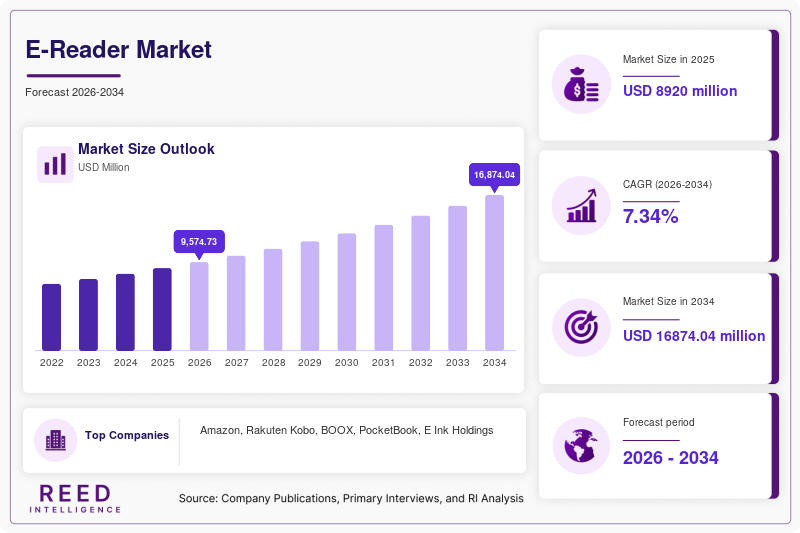
The global E-Reader Market size was valued at USD 8,920 million in 2025 and is projected to grow from USD 9,570 million in 2026 to USD 16,874.04 million by 2034, registering a CAGR of 7.34% during the forecast period from 2026 to 2034.
The market is being reshaped by the combination of expanding digital reading, color E Ink displays, larger note-taking devices, longer battery life, waterproof designs, and integration with digital bookstores and library platforms. Amazon reported that Kindle global sales reached a decade high in 2023, with most purchases coming from first-time Kindle owners, while its newer devices increasingly combine reading with writing and AI-assisted note management.
E-readers occupy a distinct position between printed books and general-purpose smartphones or tablets. Their main commercial advantage is a reading-focused experience based on low-glare displays, long battery life, lightweight hardware, distraction-free software and direct access to digital libraries. Current devices are expanding that proposition into color reading, handwriting, annotation, document review and AI-assisted productivity.
The technology transition is particularly visible in color E Ink. Amazon introduced its first color Kindle in 2024 and subsequently expanded Colorsoft into additional markets, while Kobo introduced the Libra Colour and Clara Colour using E Ink Kaleido 3 displays. Amazon's 2026 Scribe Colorsoft adds color writing and productivity capabilities, extending e-readers into the digital-notebook category.
E-Reader Market Drivers
Color E Ink is expanding the addressable use case
The introduction of color E Ink is one of the most important hardware changes in the e-reader category. Traditional monochrome E Ink has been highly effective for novels and text-heavy books, but color adds value for comics, graphic novels, children's books, cookbooks, travel guides, textbooks, charts and highlighted study material.
Amazon's Kindle Colorsoft introduced color reading and multicolor highlighting, while Kobo's Libra Colour and Clara Colour use Kaleido 3 technology and retain the glare-free characteristics and low-power profile associated with E Ink. Kobo specifically positions its color models around color covers, illustrations, highlighting and note-taking rather than simply reproducing conventional tablet functionality.
The commercial mechanism is product upgrading. Existing monochrome e-reader owners gain a reason to replace older devices, while consumers who previously preferred tablets for illustrated content can consider dedicated e-readers.
Color displays also allow manufacturers to create premium price tiers. The counterbalance is that color E Ink remains less vivid and less versatile than conventional LCD or OLED displays, limiting its suitability for video-heavy applications.
Digital reading continues to create a large content base
E-reader demand ultimately depends on available digital content. The U.S. publishing market generated approximately USD 2.2 billion in trade eBook revenue in 2025, up 3.0% from the prior year, while digital formats accounted for 21.5% of U.S. trade publishing revenue.
China provides a larger-scale digital-reading signal. The country's digital-reading user base reached 689 million in 2025, up 2.95% year over year, while the number of digital-reading works reached more than 70.5 million. The 2025 Chinese adult-reading survey also found that average annual e-book reading increased to 3.58 books from 3.52 in 2024.
This content expansion supports device utilization because users can build large digital libraries without carrying physical books. The counterbalance is that much of digital reading takes place on smartphones and tablets, meaning content growth does not automatically translate into equivalent hardware demand.
E-readers are expanding into note-taking and productivity
Premium e-readers are increasingly being positioned as digital paper rather than simply electronic books. Amazon's Kindle Scribe combines reading with handwriting, document annotation and notebook functions, and its newer generation is 40% faster for writing and page turns. AI-powered features can summarize and refine handwritten notes.
Amazon's 2026 Scribe Colorsoft adds the first color display to the Scribe line and combines color writing with cloud integration and productivity features. BOOX similarly introduced the Go 6 Gen II in June 2026 with stylus support and an ePaper reading format aimed at portability.
This expands the customer base from recreational readers toward students, researchers, professionals, writers and business users. Larger displays also create higher-value device categories. The limitation is that note-taking e-readers compete directly with tablets and digital-paper devices, which can offer faster processors, richer applications and more flexible operating systems.
E-Reader Market Restraints
Smartphones and tablets remain the default digital-reading devices
E-readers compete against devices that consumers already own. Smartphones offer immediate access to books, news, web content, social platforms and audio, while tablets provide larger color screens and broader application support.
China's 2025 reading survey illustrates this competitive pressure. Smartphone reading reached 79.0% among adults, compared with 21.3% for dedicated e-readers. This difference shows that digital-reading growth can occur without proportional growth in dedicated hardware.
E-readers retain advantages in glare reduction, battery life and distraction-free reading, but users who prioritize multimedia, color performance, productivity applications or price may select multifunctional devices instead.
E-book growth is uneven across markets
Digital reading does not automatically mean accelerating e-book purchases. U.S. trade eBook revenue increased in 2025, but monthly 2026 data have shown periods of decline. For example, AAP reported that U.S. trade eBook revenue was down 3.1% year to date through July 2026, while digital audio revenue increased 12.6%.
This creates a mixed content environment for e-reader manufacturers. Audiobooks, smartphones and subscription platforms can capture consumer spending that might otherwise support e-books.
The market therefore depends on the ability of hardware companies to create differentiated use cases rather than relying solely on overall growth in digital publishing.
E-Reader Market Opportunities
Color reading, comics and illustrated content
Color E Ink provides an opportunity to move e-readers beyond conventional novels. Amazon's Colorsoft supports color images, illustrated books, comics and multicolor highlighting, while Kobo's color devices target books with illustrations and color covers.
This creates a broader product proposition for publishers and device manufacturers. Comics, graphic novels, cookbooks, travel content, children's books and educational materials can benefit from color without requiring users to switch to a conventional LCD tablet.
The commercial opportunity also extends to accessories and premium models, because color devices can support larger storage, stylus input, waterproofing and wireless charging. The challenge is ensuring that color quality and refresh performance are sufficiently strong to justify a premium over monochrome E Ink.
Education, professional reading and digital paper
The expansion of e-note devices creates another growth path. Students and professionals can use large-format e-paper for textbooks, academic papers, PDFs, handwritten notes and document review. Amazon's Scribe integrates reading, writing, notebook organization and cloud connectivity, while BOOX continues developing compact ePaper devices with stylus support.
China's digital-reading ecosystem also shows growing professional and educational digital content. Its 2025 digital-reading report said professional-reading revenue rose strongly, supported by digital textbooks, professional databases and technology-enabled reading services.
This creates opportunities for larger displays, stylus-enabled devices, enterprise document workflows, institutional procurement and education-focused products.
Segmental Analysis
By Screen Type
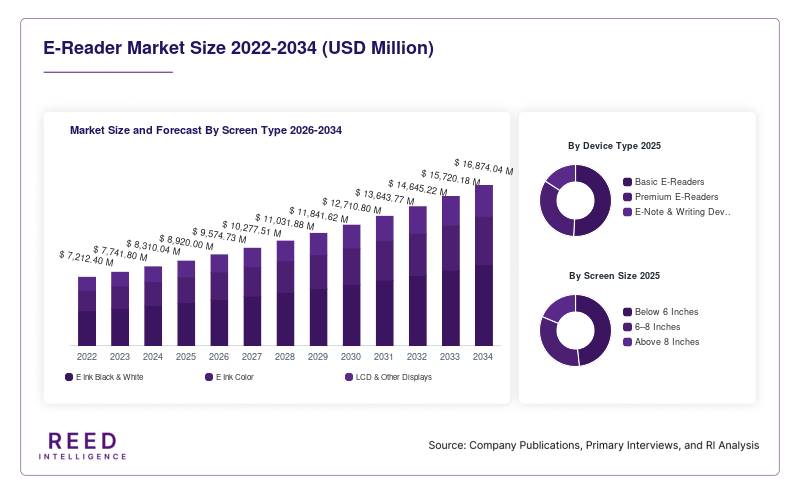
E Ink Black & White represents approximately 72% of the global market in 2025, supported by its strong suitability for novels, textbooks and text-heavy documents. Low glare, low power consumption and long battery life remain major reasons consumers select dedicated e-readers over conventional screens.
E Ink Color accounts for approximately 21% and is the fastest-growing screen category at about 12.8% CAGR. Amazon and Kobo have both commercialized color E Ink devices, expanding applications to comics, illustrated books, color covers and multicolor annotation.
LCD & Other Displays account for approximately 7%, serving selected low-cost and specialized reading products. This segment faces direct competition from tablets and smartphones.
By Device Type
Basic E-Readers account for approximately 48% of the global market in 2025, supported by consumers who primarily want distraction-free access to digital books.
Premium E-Readers represent approximately 32% and benefit from waterproofing, improved lighting, larger storage, faster processors and color screens.
E-Note & Writing Devices account for approximately 20% and are the fastest-growing device category at about 11.6% CAGR. Kindle Scribe, Kobo's stylus-compatible Libra Colour and BOOX's stylus-enabled products demonstrate how the category is expanding from reading toward handwriting and document workflows.
By Screen Size
6–8 Inches represents approximately 63% of the global market in 2025, making it the dominant size range. This format balances portability with sufficient screen area for conventional books.
Above 8 Inches accounts for approximately 24% and is the fastest-growing screen-size segment at about 10.8% CAGR. Larger screens are particularly relevant to PDFs, textbooks, academic documents, comics and handwriting.
Below 6 Inches represents approximately 13%, primarily serving consumers who prioritize compact size and portability.
By Application
Consumer Reading represents approximately 67% of the global market in 2025, supported by novels, non-fiction, genre fiction and general digital books.
Education & Academic accounts for approximately 15% and is the fastest-growing application at about 11.2% CAGR. Large-format e-note devices can accommodate textbooks, academic papers, annotations and study notes, while digital content libraries continue to expand. China's 2025 reading data show increasing digital content and professional-reading activity.
Professional & Business represents approximately 11%, including reports, contracts, technical documents and business reading.
Comics & Illustrated Content accounts for approximately 7%, with color E Ink creating additional demand potential.
By Distribution Channel
Online represents approximately 71% of the global market in 2025 and is the fastest-growing distribution channel at about 8.5% CAGR. E-readers are highly suited to online sales because device specifications can be compared easily and customers can purchase hardware directly alongside digital books and subscriptions.
Offline accounts for approximately 29%, including electronics stores, bookstores, specialty retailers and department stores. Physical retail remains important for premium devices because consumers may want to compare screen quality, weight and handwriting performance before purchasing.
Regional Analysis
North America E-Reader Market
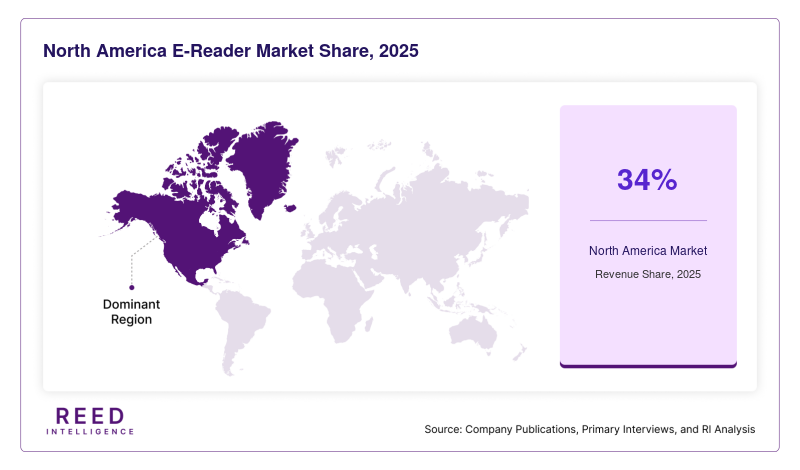
North America represents approximately 34% of the global market in 2025 and is growing at about 6.6% CAGR. The region has a mature e-book ecosystem, strong Kindle adoption, established online retail infrastructure and a large installed base of digital-reading users.
Amazon remains a major hardware and content ecosystem player. The company reported that Kindle sales reached their highest level in a decade in 2023, with most purchases coming from first-time Kindle owners. Amazon subsequently expanded the lineup with Colorsoft and redesigned Scribe devices, increasing the range from basic reading to color and writing applications.
U.S. publishing data provide a mixed but established digital-content base. Trade eBook revenue reached approximately USD 2.2 billion in 2025, up 3.0%, although print continued to account for the majority of trade revenue.
The regional growth mechanism is therefore device replacement, premiumization, color displays and e-note applications rather than a complete shift from print to digital. Education, professional reading and comics provide additional opportunities.
The main constraint is competition from smartphones and tablets, particularly among consumers who do not require long battery life or a distraction-free reading environment.
Europe E-Reader Market
Europe accounts for approximately 26% of the global market in 2025 and is growing at about 6.3% CAGR. The region has a strong reading culture, established e-book distribution and a diverse ecosystem of digital-reading platforms.
Kobo has expanded its European presence through color and waterproof e-readers, while Amazon continues to sell Kindle products throughout major European markets. Kobo's current lineup includes color, waterproof, stylus-compatible and larger-format devices.
The region is also relevant to digital libraries. Kobo's devices integrate OverDrive for borrowing library books, connecting dedicated hardware with institutional digital content.
Premiumization is an important growth mechanism because European consumers have access to specialized readers designed around comfort, portability, sustainability and library integration. Color E Ink and digital notebooks can create new upgrade cycles.
The constraint is competition from smartphones, tablets and traditional books, combined with differences in publishing markets, languages and e-book pricing across European countries.
APAC E-Reader Market
APAC represents approximately 28% of the global market in 2025 and is the fastest-growing region at about 9.2% CAGR. China, Japan, South Korea, India and Southeast Asia provide large digital-reading populations, expanding e-commerce infrastructure, and increasing access to digital content.
China is particularly important. The 2025 national reading survey reported that 21.3% of adults used dedicated e-readers for reading, while 80.8% had contact with some form of digital reading. The country's digital-reading market generated RMB 78.937 billion in revenue in 2025, up 19.35%, and the digital-reading user base reached 689 million.
These figures indicate that APAC has a large digital-content ecosystem, although smartphones remain the dominant reading device. The hardware opportunity therefore centers on readers who value eye comfort, longer reading sessions, distraction-free use and specialized note-taking.
Amazon's 2026 launch of Kindle Scribe Colorsoft in Japan demonstrates continued premiumization in the region. BOOX also launched the Go 6 Gen II in June 2026, showing continued product development from Asian ePaper-device manufacturers.
The principal constraint is price sensitivity and strong smartphone competition.
Middle East and Africa E-Reader Market
Middle East and Africa represent approximately 5% of the global market in 2025 and are growing at about 8.0% CAGR. Digital reading adoption is increasing alongside smartphone penetration, online retail and broader digital-content distribution.
The region provides opportunities for lightweight devices with long battery life because dedicated e-readers can operate for weeks between charges and provide a reading experience without the distraction of social-media applications.
Amazon's global Kindle ecosystem and Kobo's international availability provide consumers with access to large digital bookstores, while online distribution reduces the need for extensive physical retail networks. Kobo's current devices emphasize weeks of battery life, broad e-book-format support and access to digital libraries.
The growth mechanism is therefore primarily digital-content access and online device distribution. Education and professional reading can provide additional demand as digital materials become more widely available.
The key constraint is affordability. Smartphones often provide a lower incremental cost because consumers already own them, limiting dedicated e-reader penetration.
LATAM E-Reader Market
LATAM represents approximately 7% of the global market in 2025 and is growing at about 7.5% CAGR. Growth is supported by expanding online retail, digital publishing and the increasing availability of e-books across Spanish- and Portuguese-language markets.
The region has a natural opportunity for cloud-connected reading because consumers can access digital bookstores without relying on large local physical inventories. Dedicated e-readers can also provide access to large international catalogs while reducing the physical weight associated with books.
Color and note-taking devices provide additional opportunities as e-readers move beyond novels into comics, educational materials and professional documents. Amazon's Colorsoft and Scribe product families demonstrate this broader hardware positioning.
The principal constraint is price sensitivity and the availability of low-cost smartphones and tablets. Currency volatility and import costs can also affect premium-device pricing.
Competitive Landscape
The E-Reader Market is concentrated around vertically integrated ecosystems that combine hardware, digital bookstores, content subscriptions and cloud services. Amazon, Rakuten Kobo and a group of specialist ePaper manufacturers compete through screen technology, battery life, software, content access and increasingly through writing capabilities.
Amazon has expanded Kindle from conventional monochrome reading into color and digital-paper applications. The 2024 Kindle refresh introduced Colorsoft and a redesigned Scribe, while the 2026 Scribe lineup added a color writing model and AI-powered notebook features.
Rakuten Kobo competes through e-book-store integration, library borrowing, color E Ink, waterproofing, stylus compatibility and broad format support. Its Libra Colour and Clara Colour were among its first color E Ink products, and its current lineup includes both color and monochrome readers.
BOOX focuses on flexible ePaper devices and Android-based functionality, with the Go 6 Gen II adding stylus support in 2026.
Key Market Players
- Amazon
- Rakuten Kobo
- BOOX
- PocketBook
- E Ink Holdings
- Hanvon
- Tolino
- Bigme
- reMarkable
- Onyx International
- Meebook
- Barnes & Noble
Recent Market Developments
- July 2026 – Amazon promoted the new Kindle Scribe Colorsoft in Japan. The campaign followed the June 2026 shipment of the new Scribe generation, highlighting color writing, thinner hardware, faster performance, cloud integration, and AI-enabled productivity.
- June 2026 – BOOX launched Go 6 Gen II. The new 6-inch ePaper reader added stylus support and a redesigned portable form factor, demonstrating continued product development around compact digital-paper devices.
E-Reader Market Segments
By Screen Type
- E Ink Black & White
- E Ink Color
- LCD & Other Displays
By Device Type
- Basic E-Readers
- Premium E-Readers
- E-Note & Writing Devices
By Screen Size
- Below 6 Inches
- 6–8 Inches
- Above 8 Inches
By Application
- Consumer Reading
- Education & Academic
- Professional & Business
- Comics & Illustrated Content
By Distribution Channel
- Online
- Offline
By Region
- North America
- Europe
- APAC
- Middle East and Africa
- LATAM