E-Sports Betting Market Size, Share & Trends Analysis Report By Betting Type (Pre-Match Betting, Live/In-Play Betting, Proposition Betting), By Game Type (Counter-Strike, League of Legends, Dota 2, Valorant, Other Games), By Platform (Desktop, Mobile), By Distribution Channel (Online Betting Operators, Esports-Specific Platforms, Other Channels) and By Region (North America, Europe, APAC, Middle East and Africa, LATAM) Forecasts, 2026–2034
USD 3950
E-Sports Betting Market Size
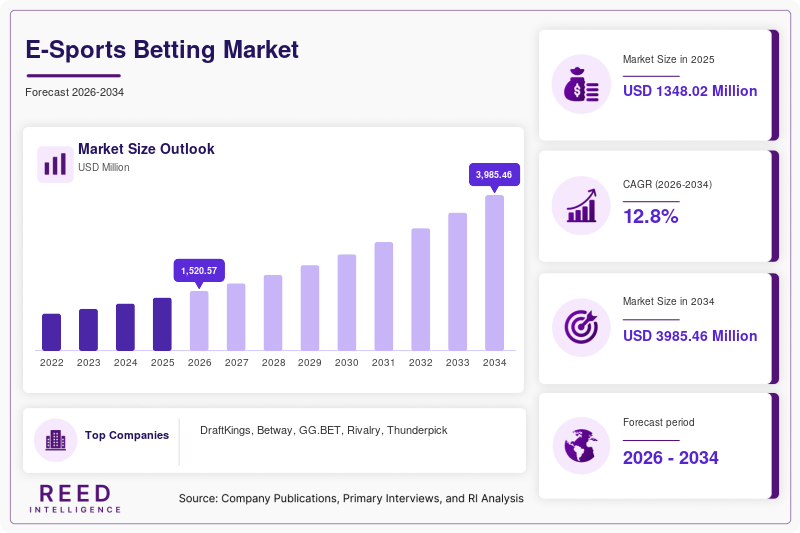
The global E-Sports Betting Market size was valued at USD 1,348.02 million in 2025 and is projected to grow from USD 1,520.57 million in 2026 to USD 3,985.46 million by 2034, registering a CAGR of 12.8% during the forecast period from 2026 to 2034.
The market is moving from a niche wagering category toward a broader digital betting segment built around competitive gaming, real-time data, live streaming, and mobile engagement. The commercial opportunity is increasingly linked to the ability of operators to offer reliable odds, fast in-play markets, multiple game titles, and betting products that match the way esports audiences consume events.
The e-sports betting market is being shaped by three connected developments: a wider supply of professional esports events, greater availability of real-time game data, and the expansion of digital betting platforms. Operators now offer markets across major titles such as Counter-Strike 2, League of Legends, Dota 2, and Valorant, including match winners, map outcomes, totals, player propositions, and live markets. Betway, for example, currently offers pre-match and live markets across major esports competitions, while DraftKings provides esports markets including Counter-Strike, League of Legends, and Valorant in eligible jurisdictions.
Live betting is particularly important because esports produces continuous game-state information. Betting operators can update odds as matches develop, although regulators identify integrity, information timing, and technological advantages as specific considerations for in-play betting.
Drivers
Expansion of Live and In-Play Betting
Live betting is becoming a major commercial feature because esports matches generate a continuous flow of information that can be translated into changing betting markets. Operators can update prices according to maps, rounds, kills, objectives, player performance, and match momentum. Betway currently provides live in-play markets across esports, while GG.BET offers live markets and real-time match information across multiple disciplines.
The commercial mechanism is straightforward: more live events and more available markets create additional betting occasions within a single match. In-play betting also increases the value of real-time data infrastructure because operators need fast information to price markets, suspend markets, and settle bets accurately. The UK Gambling Commission notes that real-time information is important for operators and customers in in-play betting.
Wider Coverage of Esports Titles
The expansion of betting coverage beyond one or two established games is increasing the addressable market. GG.BET lists more than 30 esports disciplines, while its current esports offering includes CS2, Dota 2, League of Legends, Valorant, Mobile Legends, StarCraft II, Halo, Rocket League, and other titles.
This broadens the commercial opportunity for operators because different games attract different audiences and regional preferences. Counter-Strike and League of Legends remain important sources of betting activity, while Valorant and mobile-oriented titles create additional inventory. More tournaments also allow operators to maintain betting activity across different time zones rather than depending on a small number of major events.
Digital and Mobile Distribution
The shift toward online betting supports the expansion of esports wagering because esports itself is consumed through digital platforms. Mobile applications allow customers to move between live streams, game information, odds, and betting markets without switching to traditional retail channels.
DraftKings currently makes esports betting available in selected U.S. states and Canadian provinces, illustrating how market access is closely linked to jurisdiction-level regulation. Meanwhile, operators such as GG.BET provide mobile-oriented access to esports markets and live betting.
Restraints
Betting Integrity and Match-Manipulation Risk
Integrity remains one of the most important constraints because esports betting can create incentives to manipulate individual matches or specific in-game events. ESIC's Gold Standard was created specifically for betting-related esports products and includes controls covering physical security, surveillance, communication restrictions, game settings, referee training, player contracts, data integrity, and suspicious betting alerts.
Recent enforcement demonstrates the commercial importance of this issue. In 2025, ESIC investigated alleged match-fixing involving ATOX after unusual betting patterns were identified, while a separate StarCraft II investigation resulted in sanctions involving manipulated results and betting activity. In April 2026, ESIC also sanctioned Counter-Strike 2 player Dmytro “nifee” Tediashvili following an investigation into match manipulation and betting-related corruption involving a proposition market.
Fragmented Regulation and Market Access
Esports betting does not operate under one global regulatory framework. Licensing requirements, permitted betting products, responsible-gambling rules, age requirements, advertising restrictions, and market availability vary by jurisdiction. In Great Britain, esports betting requires the relevant betting licence, while DraftKings restricts esports availability to specific U.S. and Canadian jurisdictions.
This fragmentation increases compliance costs and limits the ability of operators to deploy identical products globally. It also affects marketing, payment methods, customer acquisition, and the types of betting markets that can be offered.
Opportunities
Growth of Proposition Betting
Proposition betting provides operators with additional ways to monetize individual in-game events rather than only match winners. Markets can include kills, rounds, map outcomes, first events, player performance, or other defined match occurrences. GG.BET currently offers proposition-style markets involving player statistics and specific in-game events.
The opportunity comes with a corresponding integrity requirement. The 2026 ESIC sanction involving a CS2 proposition market demonstrates why operators and tournament organizers need stronger monitoring when betting is tied to isolated in-game events. Better surveillance, automated anomaly detection, and verified data feeds can therefore support proposition-market expansion while reducing operational risk.
Expansion Across APAC and Latin America
APAC and Latin America offer opportunities because esports consumption, digital payments, mobile gaming, and local competitive gaming ecosystems create conditions for wider online betting adoption. Localized products, regional payment methods, language support, and coverage of games popular in individual markets can help operators move beyond a standardized global product.
The opportunity is not simply geographic expansion. Operators need to match game coverage and betting formats with local audience behavior while complying with each country's gambling framework.
Segmental Analysis
By Betting Type
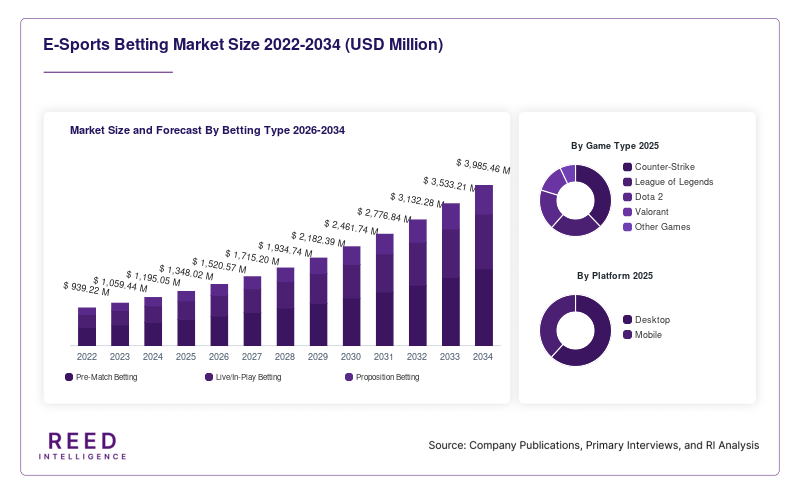
Pre-match betting accounted for approximately 45% of the global e-sports betting market in 2025, equivalent to USD 606.61 Million. This segment remains important because it is available before the match begins and gives operators sufficient time to build odds around team form, player availability, historical performance, map selection, tournament position, and other pre-event information.
Pre-match betting also benefits from the established structure of major esports tournaments. Operators can publish markets several days or weeks before high-profile events, creating longer customer engagement periods. Major titles such as CS2, League of Legends, Dota 2, and Valorant provide a steady supply of tournament and match inventory. Betway currently offers tournament winner, map-by-map, and other pre-match markets across major esports competitions.
Live/in-play betting represented approximately 35% of the market in 2025, equivalent to USD 471.81 Million, and is the fastest-growing betting type, with a CAGR of approximately 13.9% during 2026–2034. Its growth is linked to the digital nature of esports, where customers can follow matches through live streams while betting markets change during play.
Operators can create markets around maps, rounds, kills, objectives, and match outcomes. The UK Gambling Commission recognizes live betting as a mainly online activity and notes the importance of real-time information for updating prices and settling bets.
Proposition betting accounted for approximately 20% of the global market in 2025, equivalent to USD 269.60 Million, with a CAGR of approximately 13.0% through 2034. This category allows operators to move beyond match-level outcomes and create markets around individual players or specific game events.
Its commercial potential is high because one match can generate multiple proposition markets. However, the segment requires stronger integrity controls because isolated game events can be targeted for manipulation. ESIC's 2026 CS2 case specifically highlighted risks associated with proposition markets.
By Game Type
Counter-Strike represents approximately 30% of the global market in 2025, equivalent to USD 404.41 Million. Its position is supported by an established professional tournament structure, frequent matches, strong international participation, and broad availability of betting markets. Operators such as DraftKings and Betway currently offer Counter-Strike-related betting products.
League of Legends represents approximately 25% of the market, equivalent to USD 337.01 Million in 2025. Its structured leagues and international competitions provide operators with predictable event calendars and recurring betting inventory. Betway currently lists major League of Legends leagues including LEC, LPL, LCK, and LCS.
Dota 2 represents approximately 18% of the market, equivalent to USD 242.64 Million in 2025. Its international tournaments and established betting ecosystem support continued operator coverage. GG.BET and Betway both maintain Dota 2 betting markets.
Valorant represents approximately 17% of the market, equivalent to USD 229.16 Million in 2025, and is one of the fastest-expanding game categories. Its professional tournament structure and availability of pre-match, live, and player-related markets are increasing its importance to betting operators. DraftKings currently includes Valorant among its esports offerings.
By Platform
Mobile represents approximately 62% of the global e-sports betting market in 2025, equivalent to USD 835.77 Million. Mobile betting benefits from the close relationship between esports consumption and smartphones, allowing customers to access odds, match information, live markets, and account functions while watching tournaments.
Desktop represents approximately 38% of the market, equivalent to USD 512.25 Million in 2025. Desktop remains relevant for customers who prefer larger interfaces for comparing multiple markets, viewing detailed statistics, monitoring live matches, and managing complex betting selections.
By Distribution Channel
Online betting operators represent approximately 65% of the global market in 2025, equivalent to USD 876.21 Million. These platforms benefit from established customer accounts, payment infrastructure, regulatory systems, and broad sports-betting portfolios that can be extended to esports.
Esports-specific platforms account for approximately 25% of the market, equivalent to USD 337.01 Million. Their competitive advantage comes from specialist game coverage, esports-focused interfaces, tournament content, statistics, and communities built around specific games.
GG.BET, for example, positions itself around esports and offers markets across more than 30 disciplines.
Regional Analysis
North America
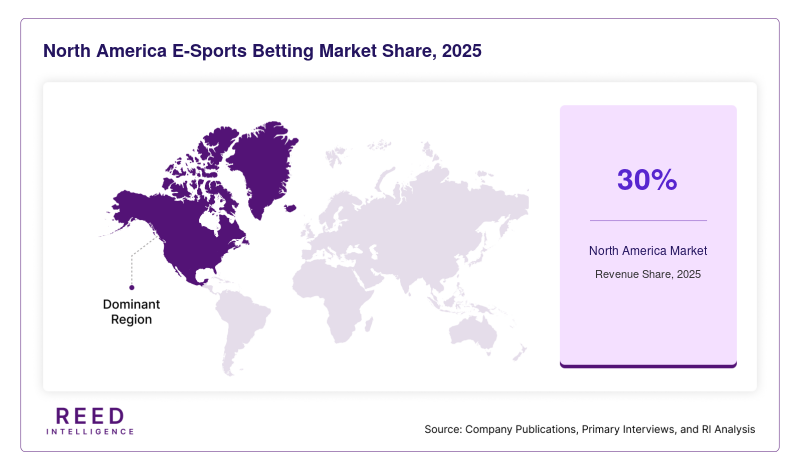
North America accounted for approximately 30% of the global e-sports betting market in 2025, equivalent to USD 404.41 Million, making it one of the largest regional markets. The region benefits from established sportsbook infrastructure, large digital entertainment markets, professional esports events, and expanding legal sports-betting frameworks.
Market access remains jurisdiction-specific. DraftKings currently lists selected U.S. states and Ontario and Alberta in Canada for esports betting availability, showing how regulatory approval directly determines addressable demand.
The region is also important because major operators can integrate esports with wider sportsbook ecosystems. DraftKings offers Counter-Strike, League of Legends, and Valorant through its Pick6 product.
North American demand is therefore closely linked to licensing expansion, mobile sportsbook adoption, esports event visibility, and the ability of operators to convert existing sportsbook customers into esports bettors. The principal constraint is regulatory fragmentation between states and provinces, which requires operators to manage different product and compliance requirements.
Europe
Europe represented approximately 24% of the global market in 2025, equivalent to USD 323.52 Million. The region has an established esports ecosystem, strong online betting infrastructure, major tournament activity, and a mature regulatory environment.
The UK provides a clear regulatory example. The UK Gambling Commission requires operators offering esports betting to British consumers to hold an appropriate betting licence. The Commission also maintains specific betting-integrity requirements and expects operators to manage risks associated with suspicious activity and misuse of inside information.
European operators also have access to established game titles and recurring tournament calendars. Betway currently offers markets across CS2, League of Legends, Valorant, Dota 2, and other esports.
The market's future development will depend on regulatory consistency, responsible-gambling requirements, integrity systems, and the ability of operators to create localized products across different European jurisdictions.
Asia-Pacific
Asia-Pacific accounted for approximately 31% of the global market in 2025, equivalent to USD 417.89 Million, making it the largest regional market. The region has a large competitive-gaming audience, strong esports participation, established tournament ecosystems, and significant mobile gaming activity.
The region also provides a broad supply of betting inventory across games such as Dota 2, League of Legends, Counter-Strike, Valorant, and mobile esports. GG.BET's current tournament listings demonstrate the wide range of Asian and international esports competitions available to betting platforms.
Market development differs considerably between individual countries because gambling laws, payment infrastructure, consumer protection rules, and enforcement vary. This makes localization important. Operators need regional payment options, language support, relevant game coverage, and compliance systems adapted to each market.
Asia-Pacific is projected to reach approximately USD 1,517.21 Million by 2034, supported by digital betting adoption, mobile access, expanding esports competitions, and broader availability of betting markets.
Middle East and Africa
The Middle East and Africa represented approximately 7% of the global market in 2025, equivalent to USD 94.36 Million. The region remains smaller than North America, Europe, and APAC, but digital platforms provide opportunities for market expansion where regulation permits betting activity.
Growth is connected to improved internet access, smartphone usage, digital entertainment, esports events, and increasing availability of international tournament content. Operators with multilingual platforms and flexible digital payment systems can address different consumer groups across the region.
Regulatory diversity remains the central market constraint. Gambling legislation varies substantially between countries, and in some markets commercial betting is prohibited or heavily restricted. Consequently, market expansion depends more on regulatory conditions and licensed market access than simply on esports audience size.
The regional market is projected to reach approximately USD 261.67 Million by 2034, supported by digital distribution and greater esports participation in markets where regulated betting is permitted.
Latin America
Latin America accounted for approximately 8% of the global e-sports betting market in 2025, equivalent to USD 107.84 Million. Brazil, Mexico, Argentina, Colombia, Chile, and other markets contribute to the region's esports and online betting ecosystem.
Brazil is particularly relevant to esports betting because of its large gaming audience and established esports organizations. International operators have also built partnerships and commercial relationships around Latin American esports. Betway, for example, has maintained esports partnerships in Brazil and other Latin American markets.
Mobile distribution is important because it reduces dependence on physical betting infrastructure and allows customers to access markets directly through smartphones. Local payment methods and localized content can further improve adoption.
Latin America is projected to reach approximately USD 311.29 Million by 2034, supported by digital betting adoption, esports engagement, and continued development of regulated online betting markets.
Competitive Landscape
The e-sports betting market has a mix of large multi-sport sportsbook operators and specialist esports platforms. Large operators benefit from established customer databases, payment infrastructure, regulatory capabilities, and cross-selling between traditional sports and esports. Specialist platforms compete through deeper game coverage, esports-specific content, live markets, tournament information, and community engagement.
Product breadth is an important competitive factor. DraftKings currently covers Counter-Strike, League of Legends, and Valorant, while Betway provides markets across major games and live events. GG.BET differentiates through broad esports coverage, reporting more than 30 disciplines and a combination of pre-match and live markets.
Integrity infrastructure is becoming another competitive factor. ESIC's Gold Standard evaluates betting-related esports operations across security, data integrity, player welfare, monitoring, training, and reporting. BETER received the Gold Standard accreditation in June 2025 following an operational audit, while Drafted.gg received the accreditation earlier in 2025.
Key Market Players
Recent Market Developments
July 2026 – ESIC partnered with Runestone as an Official Data Partner: Runestone began providing data and integrity-monitoring support to ESIC to identify suspicious activity and support investigations across esports competitions.
July 2026 – Esports World Cup updated its Global Rulebook on team roster integrity. The update introduced an exception for roster changes caused by circumstances outside a participant's control, including documented visa and border-entry issues.
E-Sports Betting Market Segments
By Betting Type
- Pre-Match Betting
- Live/In-Play Betting
- Proposition Betting
By Game Type
- Counter-Strike
- League of Legends
- Dota 2
- Valorant
- Other Games
By Platform
- Desktop
- Mobile
By Distribution Channel
- Online Betting Operators
- Esports-Specific Platforms
- Other Channels
By Region
- North America
- Europe
- APAC
- Middle East and Africa
- LATAM