Earth Space Mining Sensor Market Size, Share Demand Report By Type (Spectroscopy Sensors, Imaging Sensors, Thermal Sensors, AI-Integrated Sensors), By Application (Space Exploration, Asteroid Mining, Terrestrial Mining Support), By End-Use (Government & Space Agencies, Commercial Space Companies, Research Institutions) By Region & Segment Forecasts, 2026–2034
USD 3950
Market Overview
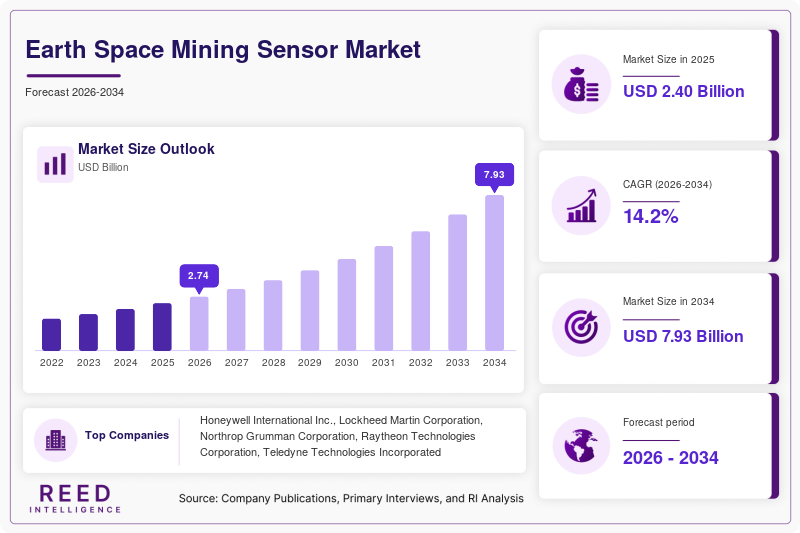
The Earth Space Mining Sensor Market size was valued at approximately USD 2.4 billion in 2026 and is projected to reach USD 6.9 billion by 2034, expanding at a CAGR of 14.2% during the forecast period (2026–2034). The market reflects increasing investments in extraterrestrial resource exploration and the integration of advanced sensing technologies for both Earth-based and space mining applications. Sensors play a critical role in enabling real-time data acquisition, environmental monitoring, and operational precision in harsh and remote environments.
A key global factor supporting market growth is the rising demand for rare earth elements and critical minerals required for renewable energy systems, electronics, and aerospace applications. Governments and private organizations are increasingly exploring space mining as a long-term solution to resource scarcity. This shift has accelerated the development of advanced sensor systems capable of functioning in extreme conditions, including vacuum, radiation, and temperature fluctuations.
Key Highlights
- North America dominated the market with a 38% share.
- Asia Pacific is the fastest-growing region with a CAGR of 16.5%.
- Spectroscopic sensors led the type segment with a 34% share, while hyperspectral imaging sensors are the fastest-growing at a CAGR of 17.8%.
- Exploration applications accounted for the largest share at 41%, while autonomous mining applications are growing fastest at 18.2% CAGR.
- The United States recorded market values of USD 0.82 billion in 2024 and USD 0.95 billion in 2025.
Market Trends
Integration of AI-Driven Sensor Analytics
The integration of artificial intelligence into Earth space mining sensors is transforming how data is collected, processed, and utilized. AI-enabled sensors can analyze geological patterns, detect anomalies, and predict mineral deposits with improved accuracy. This trend is particularly relevant for space mining missions where real-time human intervention is limited. The ability to process large volumes of data onboard spacecraft reduces dependency on ground stations and improves operational efficiency. Furthermore, AI-driven analytics are enabling predictive maintenance of mining equipment, reducing downtime and operational risks. This trend is expected to gain traction as companies aim to optimize exploration costs and improve decision-making capabilities.
Development of Radiation-Resistant Sensor Technologies
The growing interest in space mining has led to the development of sensors capable of operating in extreme radiation environments. Traditional sensors often fail under high radiation exposure, making it essential to design specialized systems for extraterrestrial applications. Manufacturers are investing in radiation-hardened materials and advanced shielding technologies to enhance sensor durability. These innovations are not only benefiting space mining but also improving sensor performance in deep-earth mining operations. The increasing collaboration between aerospace and mining industries is further accelerating advancements in this area, contributing to the overall growth of the market.
Market Drivers
Increasing Demand for Critical Minerals
The rising global demand for critical minerals such as lithium, cobalt, and rare earth elements is a significant driver of the Earth Space Mining Sensor Market. These materials are essential for manufacturing batteries, electronics, and renewable energy systems. As terrestrial reserves become limited or difficult to access, mining companies are exploring new frontiers, including deep-sea and space mining. Sensors are crucial for identifying and extracting these resources efficiently. Advanced sensing technologies enable precise mapping of mineral deposits, reducing exploration risks and costs. This growing demand is encouraging investments in sensor innovation and deployment.
Expansion of Space Exploration Programs
The expansion of space exploration initiatives by governments and private companies is another key driver. Agencies and commercial players are increasingly focusing on asteroid mining and lunar resource extraction. These activities require highly sophisticated sensor systems to operate in challenging environments. Sensors are used for navigation, resource detection, and environmental monitoring. The increasing number of space missions and the commercialization of space activities are creating significant opportunities for sensor manufacturers. This trend is expected to drive market growth over the forecast period.
Market Restraint
High Development and Deployment Costs
One of the primary restraints in the Earth Space Mining Sensor Market is the high cost associated with the development and deployment of advanced sensor systems. Designing sensors that can operate in extreme environments, such as outer space or deep underground, requires specialized materials, rigorous testing, and compliance with stringent standards. These factors significantly increase production costs, making it challenging for small and medium-sized enterprises to enter the market.
In addition, the cost of launching and maintaining sensor-equipped systems in space is substantial. Space missions involve complex logistics, including payload integration, launch services, and mission control operations. These expenses limit the number of organizations capable of investing in space mining projects. For example, the deployment of a sensor network on an asteroid mining mission requires not only advanced technology but also significant financial resources for transportation and operation. This restraint may slow down market adoption, particularly in emerging economies where budget constraints are more pronounced.
Market Opportunities
Growth in Autonomous Mining Technologies
The increasing adoption of autonomous mining systems presents a significant opportunity for the Earth Space Mining Sensor Market. Autonomous systems rely heavily on sensors for navigation, obstacle detection, and real-time decision-making. The integration of advanced sensors into these systems enhances their efficiency and safety. In space mining, autonomous operations are essential due to the lack of human presence. This creates a strong demand for reliable and high-performance sensor technologies. Companies investing in autonomous mining solutions are likely to drive innovation in sensor design and functionality, creating new growth avenues for the market.
Advancements in Miniaturized Sensor Technologies
The development of miniaturized sensors is another promising opportunity. Compact and lightweight sensors are easier to deploy in space missions and remote mining locations. These sensors consume less power and can be integrated into various उपकरण systems without significantly increasing payload weight. Miniaturization also enables the creation of dense sensor networks, improving data accuracy and coverage. As technology continues to evolve, the cost of producing miniaturized sensors is expected to decrease, making them more accessible to a wider range of users. This trend is likely to accelerate market growth in the coming years.
Segmental Analysis
By Type
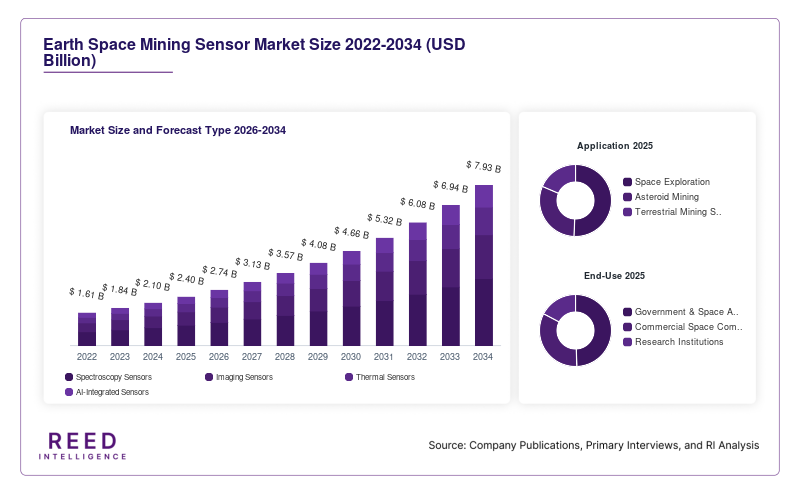
The spectroscopic sensors segment dominated the Earth Space Mining Sensor Market in 2024, accounting for approximately 34% of the total market share. These sensors are widely used for mineral identification and chemical composition analysis. Their ability to provide accurate and real-time data makes them essential for both terrestrial and space mining operations. Spectroscopic sensors are particularly effective in detecting rare earth elements, which are critical for various industrial applications. The growing demand for precise mineral analysis is driving the adoption of these sensors across the mining industry.
The hyperspectral imaging sensors segment is the fastest-growing, with a projected CAGR of 17.8% during the forecast period. These sensors offer advanced imaging capabilities, enabling detailed analysis of geological formations. The growth of this segment is driven by increasing demand for high-resolution data and improved exploration efficiency. Hyperspectral sensors can capture a wide range of wavelengths, providing comprehensive information about mineral composition. This capability is particularly valuable in space mining, where accurate data is crucial for decision-making.
By Application
The exploration segment held the largest share of the market in 2024, accounting for approximately 41%. Sensors play a critical role in exploration activities by providing data on geological formations and mineral deposits. Advanced sensing technologies enable efficient mapping and analysis, reducing exploration risks and costs. The increasing demand for new mineral sources is driving the growth of this segment. Companies are investing in advanced sensors to improve exploration accuracy and efficiency.
The autonomous mining segment is the fastest-growing, with a CAGR of 18.2%. This growth is driven by the increasing adoption of automation in mining operations. Autonomous systems rely on sensors for navigation, obstacle detection, and real-time decision-making. In space mining, autonomous operations are essential due to the lack of human presence. The integration of advanced sensors into autonomous systems enhances their efficiency and safety, driving the growth of this segment.
By End-Use
The mining companies segment dominated the market in 2024, accounting for approximately 46% of the total share. These companies are the primary users of sensor technologies, utilizing them for exploration, extraction, and monitoring activities. The increasing complexity of mining operations and the need for efficiency are driving the adoption of advanced sensors. Mining companies are investing in sensor technologies to improve productivity and reduce operational risks.
The space agencies and private space firms segment is the fastest-growing, with a CAGR of 19.1%. This growth is driven by increasing investments in space exploration and mining initiatives. Space agencies and private companies are developing advanced sensor systems for extraterrestrial applications. These sensors are used for resource detection, navigation, and environmental monitoring. The growing interest in space mining is expected to drive the demand for advanced sensor technologies in this segment.
Regional Analysis
North America
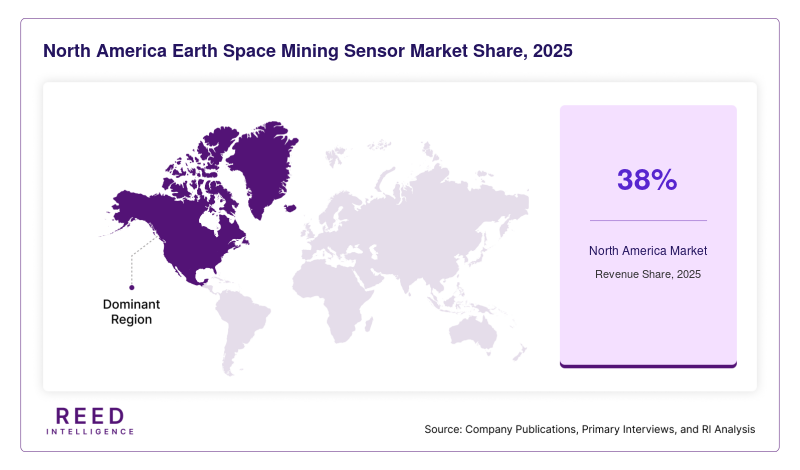
North America held the largest share of the Earth Space Mining Sensor Market in 2025, accounting for approximately 38% of the global market. The region is expected to maintain its dominance during the forecast period, with a projected CAGR of 13.8%. The strong presence of advanced aerospace infrastructure and established mining companies contributes to this leadership. Significant investments in research and development, along with government support for space exploration, further drive market growth in this region.
The United States is the dominant country in North America, supported by its robust space exploration programs and technological advancements. A unique growth factor is the increasing collaboration between private space companies and government agencies, which accelerates innovation in sensor technologies. These partnerships enable the development of advanced systems tailored for space mining applications, strengthening the region’s market position.
Europe
Europe accounted for around 24% of the market share in 2025 and is expected to grow at a CAGR of 12.9% during the forecast period. The region’s growth is driven by strong regulatory frameworks and increasing investments in sustainable mining practices. European countries are focusing on reducing environmental impact, which encourages the adoption of advanced sensor technologies for efficient resource extraction.
Germany leads the European market, supported by its strong industrial base and focus on technological innovation. A unique growth factor is the emphasis on environmental monitoring in mining operations. Sensors are increasingly used to track emissions, water quality, and land impact, aligning with the region’s sustainability goals. This focus is expected to drive further adoption of advanced sensor systems.
Asia Pacific
Asia Pacific is the fastest-growing region in the Earth Space Mining Sensor Market, with a CAGR of 16.5% during the forecast period. The region held a market share of approximately 21% in 2025. Rapid industrialization, increasing demand for minerals, and growing investments in space programs are key factors driving growth. Countries in this region are actively exploring new mining technologies to meet rising resource demands.
China is the dominant country in Asia Pacific, driven by its extensive mining activities and ambitious space exploration initiatives. A unique growth factor is the government’s strong support for technological development, including funding for sensor innovation. This support enables the rapid adoption of advanced systems in both terrestrial and space mining applications.
Middle East & Africa
The Middle East & Africa region accounted for about 9% of the market share in 2025 and is projected to grow at a CAGR of 11.7%. The region’s growth is supported by increasing investments in mining infrastructure and the exploration of untapped mineral resources. Governments are focusing on diversifying their economies, which includes developing the mining sector.
South Africa is the leading country in this region, known for its rich mineral resources. A unique growth factor is the increasing adoption of digital mining technologies to improve operational efficiency. Sensors are being used to monitor equipment performance and environmental conditions, enhancing productivity and safety in mining operations.
Latin America
Latin America held approximately 8% of the market share in 2025 and is expected to grow at a CAGR of 12.2%. The region’s growth is driven by abundant mineral resources and increasing foreign investments in the mining sector. Countries in this region are adopting advanced technologies to improve extraction efficiency and reduce environmental impact.
Brazil is the dominant country in Latin America, supported by its large mining industry. A unique growth factor is the increasing focus on exploration activities in remote areas. Sensors play a crucial role in these operations by providing accurate data and improving decision-making processes. This trend is expected to drive market growth in the region.
Competitive Landscape
The Earth Space Mining Sensor Market is characterized by the presence of several established players and emerging companies focusing on innovation and technological advancements. The competitive landscape is moderately fragmented, with companies investing in research and development to enhance their product offerings. Strategic collaborations, mergers, and acquisitions are common as companies aim to expand their market presence.
Honeywell International Inc. is considered a leading player in the market due to its extensive portfolio of advanced sensor technologies and strong presence in both aerospace and industrial sectors. The company has recently focused on developing radiation-resistant sensors for space applications, strengthening its position in the market. Other key players are also investing in AI-enabled sensor systems and miniaturization technologies to gain a competitive edge.
Key Players
- Honeywell International Inc.
- Siemens AG
- TE Connectivity Ltd.
- Lockheed Martin Corporation
- Northrop Grumman Corporation
- Thales Group
- Bosch Sensortec GmbH
- Raytheon Technologies Corporation
- ABB Ltd.
- Analog Devices Inc.
- Kongsberg Gruppen
- Trimble Inc.
- Hexagon AB
- FLIR Systems Inc.
- Rockwell Automation Inc.
Recent Developments
- In 2025, a leading aerospace company introduced a new generation of radiation-resistant sensors designed for asteroid mining missions.
- In 2024, a major sensor manufacturer partnered with a space agency to develop AI-enabled sensor systems for lunar exploration.
- In 2025, a global mining technology firm launched a miniaturized sensor platform for autonomous mining تجهیزات, enhancing operational efficiency.
Earth Space Mining Sensor Market Segments
Type
- Spectroscopy Sensors
- Imaging Sensors
- Thermal Sensors
- AI-Integrated Sensors
Application
- Space Exploration
- Asteroid Mining
- Terrestrial Mining Support
End-Use
- Government & Space Agencies
- Commercial Space Companies
- Research Institutions
By Region
- North America
- Europe
- APAC
- Middle East and Africa
- LATAM