Eisenmenger Complex Management Market Size, Share & Demand Report By Treatment Type (Drug Therapy, Oxygen Therapy, Surgical Management, Combination Therapy), By Drug Class (Endothelin Receptor Antagonists, Phosphodiesterase-5 Inhibitors, Prostacyclin Analogs, Soluble Guanylate Cyclase Stimulators), By Diagnosis Method (Echocardiography, Cardiac MRI, CT Scan, Cardiac Catheterization), By End-Use (Hospitals, Specialty Clinics, Ambulatory Surgical Centers), By Region & Segment Forecasts, 2025–2034
USD 3950
Market Overview
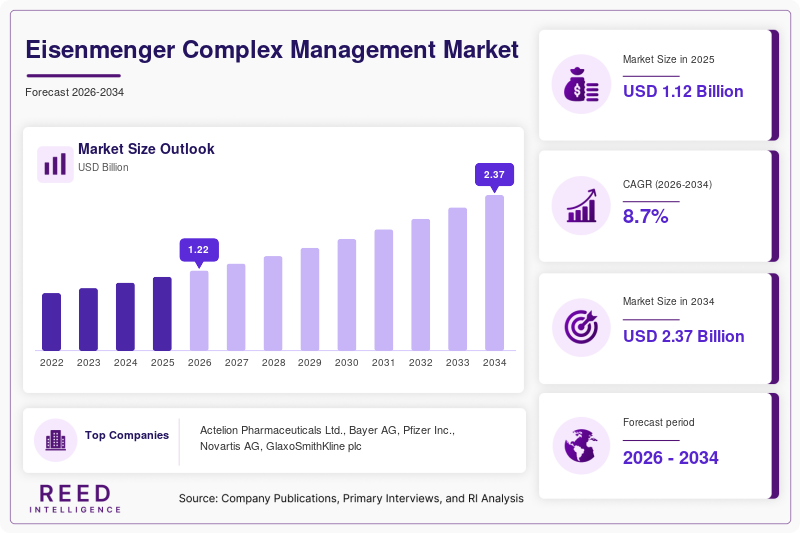
The Eisenmenger Complex Management Market size was valued at approximately USD 1.12 billion in 2025 and is projected to reach USD 2.38 billion by 2034, expanding at a compound annual growth rate (CAGR) of 8.7% during 2025–2034. The market reflects steady growth driven by the rising prevalence of congenital heart defects progressing to Eisenmenger physiology, alongside improvements in diagnostic precision and long-term patient management strategies.
A major global factor supporting the growth of the Eisenmenger Complex Management Market is the increasing adoption of targeted pulmonary arterial hypertension (PAH) therapies, which significantly enhance survival rates and quality of life. These therapies, combined with multidisciplinary care models involving cardiology, pulmonology, and hematology, are reshaping treatment paradigms globally.
Key Highlights:
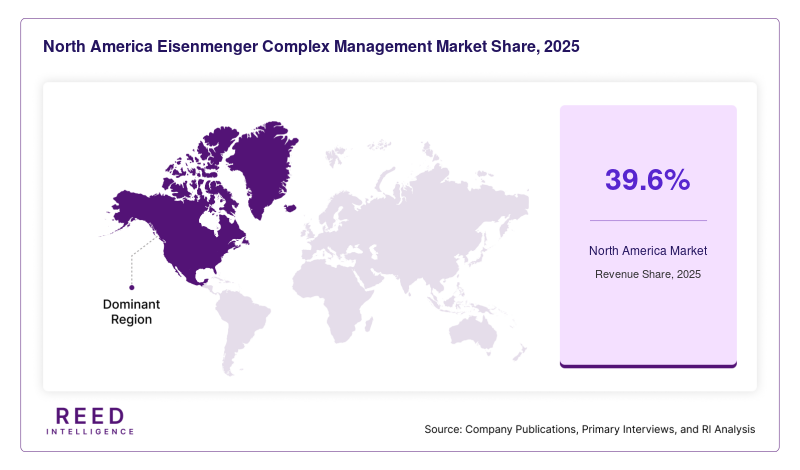
- North America dominated the market with a 39.6% share in 2025, while Asia Pacific is expected to register the fastest growth at a CAGR of 10.4%.
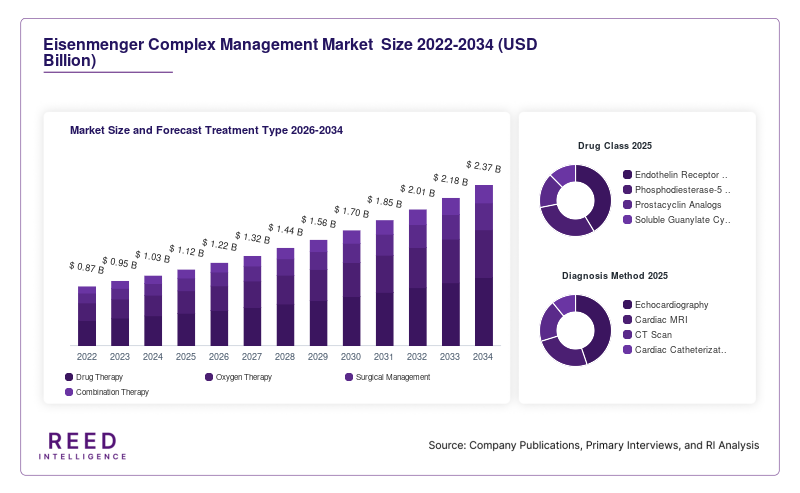
- Drug therapy emerged as the leading segment with a 54.2% share in 2024, while combination therapy is projected to grow fastest at a CAGR of 9.6%.
- Hospitals represented the dominant end-use segment with 61.8% share in 2024, while specialty clinics are anticipated to expand rapidly at a CAGR of 9.1%.
- The United States remained the dominant country, with market values of USD 410 million in 2024 and USD 438 million in 2025.
Market Trends
Expansion of Targeted PAH Therapies
The Eisenmenger Complex Management Market is witnessing increased utilization of targeted therapies such as endothelin receptor antagonists, phosphodiesterase-5 inhibitors, and prostacyclin analogs. These treatments address pulmonary hypertension, a critical complication in Eisenmenger syndrome. Pharmaceutical companies are investing in next-generation molecules with improved efficacy and reduced side effects, thereby enhancing patient adherence and long-term outcomes.
Integration of Digital Health and Remote Monitoring
Digital health technologies are transforming patient management across the Eisenmenger Complex Management Market. Wearable devices, telehealth platforms, and remote monitoring systems enable continuous tracking of oxygen saturation, heart rate, and exercise tolerance. This trend supports proactive disease management and reduces hospital admissions. Additionally, artificial intelligence-based predictive analytics is gaining traction in identifying early signs of disease progression, further strengthening clinical outcomes.
Market Drivers
Rising Prevalence of Congenital Heart Diseases
The increasing incidence of congenital heart defects globally is a major driver for the Eisenmenger Complex Management Market. A significant proportion of untreated or late-diagnosed congenital defects progress to Eisenmenger syndrome, creating sustained demand for specialized management solutions. Improved survival rates among pediatric patients with congenital conditions are also contributing to a growing adult patient pool requiring long-term care.
Advancements in Pharmacological Therapies
Continuous innovation in pharmacological treatments is accelerating market growth. The introduction of combination therapy regimens and personalized treatment approaches has significantly improved patient prognosis. Regulatory approvals of new drug classes and expanded indications for existing therapies are enhancing treatment accessibility. These advancements are encouraging healthcare providers to adopt advanced management protocols, thereby driving the overall market.
Market Restraint
High Cost of Long-Term Treatment
One of the primary challenges in the Eisenmenger Complex Management Market is the high cost associated with lifelong treatment. Management often involves a combination of expensive medications, regular monitoring, and occasional hospitalizations. In low- and middle-income regions, limited reimbursement frameworks and out-of-pocket expenditure restrict access to optimal care. Additionally, the need for specialized healthcare infrastructure and trained professionals further adds to the overall cost burden. This financial barrier limits market penetration, particularly in emerging economies, thereby restraining growth potential.
Market Opportunities
Emerging Markets with Untapped Patient Pools
Developing regions present significant growth opportunities for the Eisenmenger Complex Management Market. Increasing healthcare investments, expanding insurance coverage, and improving awareness are enabling better diagnosis and treatment access. Governments and private organizations are focusing on strengthening cardiac care infrastructure, creating a favorable environment for market expansion.
Development of Novel Therapeutic Approaches
The pipeline for innovative therapies, including gene-based treatments and advanced biologics, offers promising opportunities. Research initiatives focusing on reversing pulmonary vascular remodeling and improving oxygenation efficiency are gaining momentum. These advancements could potentially transform the treatment landscape, providing long-term benefits and opening new revenue streams for market participants.
Segmental Analysis
By Treatment Type
Drug therapy dominated the Eisenmenger Complex Management Market with a 54.2% share in 2024. This segment benefited from the widespread use of targeted PAH medications, which form the cornerstone of disease management. These therapies are widely prescribed due to their ability to improve hemodynamics and delay disease progression.
Combination therapy is anticipated to grow at the fastest rate, with a projected CAGR of 9.6%. This growth will be driven by its enhanced clinical effectiveness compared to monotherapy. Combining multiple drug classes allows for a comprehensive approach to managing pulmonary hypertension, leading to improved patient outcomes.
By Drug Class
Endothelin receptor antagonists held the largest share of the Eisenmenger Complex Management Market in 2024. Their effectiveness in reducing pulmonary vascular resistance and improving exercise capacity contributed to their dominance.
Prostacyclin analogs are expected to witness the fastest growth, with a CAGR of 9.3%. These drugs will gain traction due to their potent vasodilatory effects and increasing adoption in advanced disease stages.
By End-Use
Hospitals accounted for the largest share, contributing 61.8% in 2024. Their dominance was attributed to the availability of specialized care units and advanced diagnostic facilities required for managing complex cases.
Specialty clinics are projected to grow at the fastest pace, with a CAGR of 9.1%. These facilities will expand due to their focus on personalized care and outpatient management, offering convenience and cost efficiency for patients.
By Diagnosis Method
Echocardiography dominated the market in 2024 due to its widespread use as a primary diagnostic tool. Its non-invasive nature and ability to provide detailed cardiac imaging made it essential in disease evaluation.
Cardiac MRI is expected to grow rapidly, with a CAGR of 9.0%, driven by its superior imaging capabilities and increasing adoption in advanced diagnostic settings.
Regional Analysis
North America
North America accounted for 39.6% of the Eisenmenger Complex Management Market share in 2025 and is expected to grow at a CAGR of 7.9% through 2034. The region benefited from well-established healthcare systems, widespread adoption of advanced therapies, and strong reimbursement structures. High awareness levels among healthcare providers and patients supported early diagnosis and effective disease management.
The United States dominated the regional market due to its advanced clinical research ecosystem and availability of specialized cardiac centers. The presence of multidisciplinary care teams and ongoing clinical trials contributed to improved treatment outcomes. Additionally, strong investment in rare disease management programs further strengthened the country’s market position.
Europe
Europe held a significant share of the Eisenmenger Complex Management Market in 2025 and is projected to grow at a CAGR of 8.2%. The region’s growth was supported by government-backed healthcare systems and increasing adoption of guideline-based treatment protocols. Countries across Western Europe demonstrated high levels of diagnostic accuracy and patient management efficiency.
Germany emerged as the dominant country in the region, driven by its robust healthcare infrastructure and focus on cardiovascular research. The country’s emphasis on early screening programs and integration of specialized cardiac centers enhanced patient outcomes and contributed to market growth.
Asia Pacific
Asia Pacific represented a growing segment of the Eisenmenger Complex Management Market, with a forecast CAGR of 10.4%, the highest globally. The region experienced increasing demand due to a large patient population and improving healthcare access. Rising awareness of congenital heart diseases and government initiatives aimed at strengthening cardiac care infrastructure played a key role.
China led the regional market, supported by rapid healthcare expansion and increasing investments in advanced treatment facilities. The country’s focus on improving rural healthcare access and early diagnosis contributed to a growing patient base seeking specialized management.
Middle East & Africa
The Middle East & Africa region accounted for a smaller share of the Eisenmenger Complex Management Market in 2025 but is expected to grow at a CAGR of 8.8%. Growth in the region was driven by increasing healthcare investments and gradual improvement in diagnostic capabilities.
Saudi Arabia emerged as a leading country due to its focus on developing specialized healthcare facilities and increasing awareness of rare cardiovascular conditions. Government initiatives aimed at modernizing healthcare infrastructure supported market expansion.
Latin America
Latin America showed moderate growth in the Eisenmenger Complex Management Market, with a projected CAGR of 8.5%. The region’s growth was supported by improving healthcare systems and increasing focus on chronic disease management.
Brazil dominated the regional market due to its expanding healthcare infrastructure and growing adoption of advanced treatment options. Efforts to enhance public healthcare services and increase access to specialized care contributed to the country’s leading position.
Competitive Landscape
The Eisenmenger Complex Management Market is characterized by the presence of several established pharmaceutical and healthcare companies focusing on rare cardiovascular conditions. Market participants are actively investing in research and development to introduce advanced therapies and expand their product portfolios.
A leading player in the market has strengthened its position through the development of next-generation PAH therapies and strategic collaborations with research institutions. Recent advancements include the introduction of improved combination therapies aimed at enhancing patient outcomes.
Companies are also focusing on geographic expansion and partnerships with healthcare providers to improve treatment accessibility. The competitive environment remains moderately consolidated, with key players emphasizing innovation and patient-centric approaches.
Key Players List
- Actelion Pharmaceuticals Ltd.
- Bayer AG
- Pfizer Inc.
- Novartis AG
- GlaxoSmithKline plc
- United Therapeutics Corporation
- Gilead Sciences, Inc.
- Merck & Co., Inc.
- Johnson & Johnson
- Teva Pharmaceutical Industries Ltd.
- Sun Pharmaceutical Industries Ltd.
- Cipla Limited
- Lupin Limited
- AstraZeneca plc
- Boehringer Ingelheim GmbH
Recent Developments
- Introduction of advanced combination drug therapies improving patient survival rates.
- Expansion of clinical trials focusing on novel PAH treatment pathways.
- Increasing adoption of digital monitoring tools in chronic disease management.
- Strategic collaborations between pharmaceutical companies and research institutes.
- Regulatory approvals for expanded indications of existing therapies.
Eisenmenger Complex Management Market Segments
Treatment Type
- Drug Therapy
- Oxygen Therapy
- Surgical Management
- Combination Therapy
Drug Class
- Endothelin Receptor Antagonists
- Phosphodiesterase-5 Inhibitors
- Prostacyclin Analogs
- Soluble Guanylate Cyclase Stimulators
Diagnosis Method
- Echocardiography
- Cardiac MRI
- CT Scan
- Cardiac Catheterization
End-Use
- Hospitals
- Specialty Clinics
- Ambulatory Surgical Centers
By Region
- North America
- Europe
- APAC
- Middle East and Africa
- LATAM