Elastic Battery Binder Market Size, Share & Demand Report By Type (Polymer-Based Elastic Binders, Water-Based Elastic Binders, Solvent-Based Elastic Binders), By Application (Lithium-Ion Batteries, Solid-State Batteries, Nickel-Metal Hydride Batteries), By End-Use (Automotive, Consumer Electronics, Energy Storage Systems, Industrial Applications) By Region & Segment Forecasts, 2025–2034
USD 3950
Market Overview
The Elastic Battery Binder Market size was valued at approximately USD 1.18 billion in 2025 and is estimated to reach USD 1.32 billion in 2026. Over the forecast period, the market is projected to grow to USD 3.08 billion by 2034, registering a compound annual growth rate (CAGR) of 9.8% from 2025 to 2034.
Elastic battery binders are critical components in lithium-ion and next-generation batteries, ensuring mechanical integrity, flexibility, and long-term electrochemical performance. These binders help maintain electrode cohesion during repeated charge-discharge cycles, especially in high-capacity batteries where volume expansion is significant. The increasing shift toward silicon-based anodes and solid-state battery chemistries has intensified the demand for high-performance elastic binders.
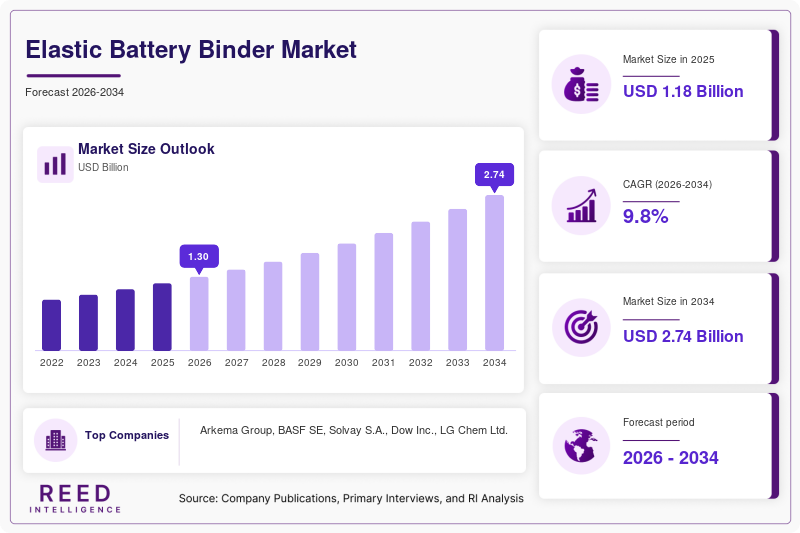
Key Highlights
- Asia Pacific dominated the market with a share of approximately 41% in 2025, driven by strong EV production and battery manufacturing capacity in China, Japan, and South Korea.
- North America is expected to be the fastest-growing region, registering a CAGR of around 11.2% from 2025 to 2034 due to rising investments in EV infrastructure and energy storage systems.
- By material type, polymer-based binders accounted for nearly 49% of the market share in 2025 owing to their flexibility and strong adhesion properties.
- By battery type, lithium-ion batteries held the largest share of about 67% in 2025 driven by widespread use in EVs and portable electronics.
- By application, electric vehicles dominated with a share of around 55% in 2025 due to accelerating global EV adoption.
- By end-use, automotive sector is projected to grow at the fastest CAGR of approximately 10.5% through 2034 supported by increasing electrification of transportation.
Market Trends
Growing Adoption of Silicon-Based Anodes
The transition from graphite to silicon-based anodes is significantly influencing the Elastic Battery Binder Market. Silicon offers a much higher energy density compared to traditional materials, but it also undergoes substantial volume expansion during charge cycles. This expansion creates mechanical stress within the battery, leading to degradation if not properly managed. Elastic binders are becoming essential to accommodate these volume changes and maintain electrode integrity. Manufacturers are developing advanced polymer-based binders with enhanced elasticity and adhesion properties to support silicon anodes. This trend is expected to reshape material requirements in battery manufacturing, driving continuous innovation in binder technologies.
Increasing Focus on Water-Based and Sustainable Binders
Environmental sustainability is emerging as a key trend in the battery materials industry. Traditional solvent-based binders pose environmental and safety concerns due to the use of toxic chemicals. As a result, there is a growing shift toward water-based elastic binders that offer similar or improved performance while reducing environmental impact. Regulatory pressures and corporate sustainability goals are accelerating this transition. Companies are investing in eco-friendly formulations that minimize emissions and energy consumption during production. This trend is also aligned with the broader push for green manufacturing practices in the battery value chain, making sustainable binders a critical area of development.
Market Drivers
Expansion of Electric Vehicle Production
The rapid growth of electric vehicle production is a major driver for the Elastic Battery Binder Market. Automotive manufacturers are increasing their EV portfolios to meet regulatory requirements and consumer demand for sustainable mobility. Batteries used in EVs must deliver high energy density, long cycle life, and reliability under varying conditions. Elastic binders play a vital role in ensuring these performance characteristics by maintaining electrode stability. As EV production scales up globally, the demand for advanced binder materials is expected to rise significantly. This driver is further supported by government incentives and investments in EV infrastructure.
Rising Demand for Energy Storage Systems
The increasing deployment of renewable energy sources such as solar and wind is driving the need for efficient energy storage systems. These systems rely on advanced batteries to store and distribute energy effectively. Elastic binders are essential for enhancing the durability and performance of these batteries, particularly in large-scale applications. The growing focus on grid stability and energy security is encouraging investments in storage technologies. As a result, the demand for high-performance battery components, including elastic binders, is expanding. This driver is expected to sustain long-term market growth.
Market Restraint
High Cost and Complexity of Advanced Binder Materials
One of the key restraints in the Elastic Battery Binder Market is the high cost associated with advanced binder materials. Developing binders with superior elasticity, thermal stability, and chemical resistance requires significant research and development investment. These costs are often passed on to battery manufacturers, impacting overall production expenses. Additionally, integrating new binder formulations into existing manufacturing processes can be complex and time-consuming. This challenge is particularly evident in large-scale battery production, where consistency and efficiency are critical.
For example, transitioning from conventional binders to advanced elastic variants may require modifications in electrode fabrication processes. This can lead to increased operational costs and potential delays in production. Small and medium-sized manufacturers may find it difficult to adopt these technologies due to financial constraints. As a result, the high cost and complexity of advanced binders may limit their widespread adoption, especially in price-sensitive markets.
Market Opportunities
Development of Solid-State Batteries
The emergence of solid-state battery technology presents a significant opportunity for the Elastic Battery Binder Market. Solid-state batteries offer improved safety, higher energy density, and longer lifespan compared to traditional lithium-ion batteries. However, they require specialized materials to maintain structural integrity and performance. Elastic binders can play a crucial role in addressing these requirements by providing flexibility and adhesion in solid-state systems. As research and commercialization efforts for solid-state batteries accelerate, the demand for innovative binder solutions is expected to grow. This opportunity is likely to drive new product development and partnerships within the industry.
Expansion in Emerging Markets
Emerging markets are becoming important growth areas for the Elastic Battery Binder Market. Countries in Asia, Latin America, and Africa are experiencing rapid industrialization and urbanization, leading to increased demand for energy storage and consumer electronics. Governments in these regions are also investing in renewable energy projects and electric mobility initiatives. This creates a favorable environment for the adoption of advanced battery technologies. Manufacturers can capitalize on this opportunity by expanding their presence in these markets and offering cost-effective binder solutions. The growing demand in emerging economies is expected to contribute significantly to overall market growth.
Segmental Analysis
By Type
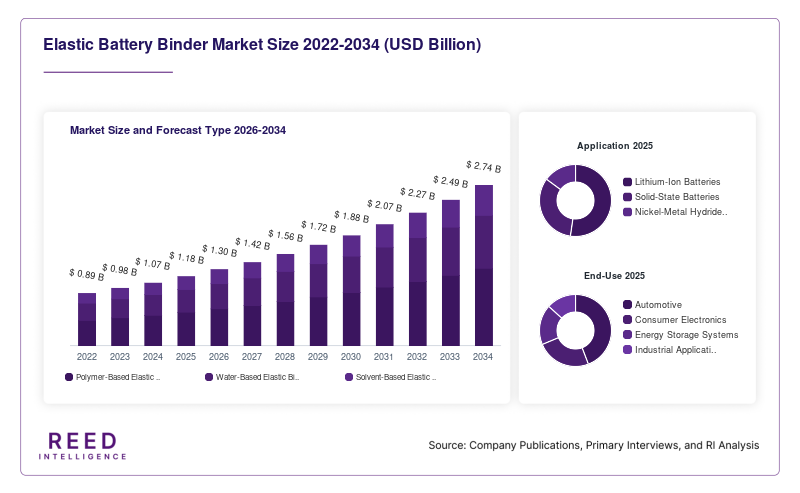
The polymer-based elastic binder segment dominated the market in 2024, accounting for approximately 54.2% of the total share. These binders are widely used due to their excellent flexibility, adhesion properties, and compatibility with various battery chemistries. Polymer-based binders help maintain electrode integrity during repeated charge cycles, making them suitable for high-performance applications. Their ability to accommodate volume changes in advanced battery materials further enhances their demand. Manufacturers are focusing on developing improved polymer formulations to meet evolving performance requirements.
The water-based elastic binder segment is expected to register the fastest CAGR of 10.6% during the forecast period. This growth is driven by increasing environmental concerns and regulatory pressures to reduce the use of toxic solvents. Water-based binders offer a more sustainable alternative while maintaining performance standards. Their adoption is particularly strong in regions with strict environmental regulations. Continuous innovation in formulation technologies is expected to further enhance their performance and expand their application scope.
By Application
The lithium-ion battery segment held the largest share in 2024, accounting for around 61.5% of the market. These batteries are widely used in electric vehicles, consumer electronics, and energy storage systems. Elastic binders play a critical role in maintaining the structural integrity of lithium-ion batteries, especially under high-stress conditions. The increasing demand for high-energy-density batteries is further driving the adoption of advanced binder materials.
The solid-state battery segment is projected to grow at the fastest CAGR of 11.3% during the forecast period. This growth is driven by the increasing focus on next-generation battery technologies that offer improved safety and performance. Elastic binders are essential for addressing the unique material requirements of solid-state batteries. Ongoing research and development efforts are expected to accelerate the commercialization of these technologies, thereby boosting demand for specialized binders.
By End-Use
The automotive segment dominated the market in 2024 with a share of approximately 48.7%. The rapid growth of electric vehicle production is a key factor driving this segment. Elastic binders are essential for ensuring the durability and performance of EV batteries. Automotive manufacturers are increasingly focusing on advanced battery technologies to improve vehicle range and efficiency, which in turn is boosting demand for high-performance binders.
The energy storage segment is expected to grow at the fastest CAGR of 10.9% during the forecast period. The increasing deployment of renewable energy systems is driving demand for efficient storage solutions. Elastic binders play a crucial role in enhancing the performance and lifespan of these systems. The growing focus on grid stability and energy security is further supporting the expansion of this segment.
Regional Analysis
North America
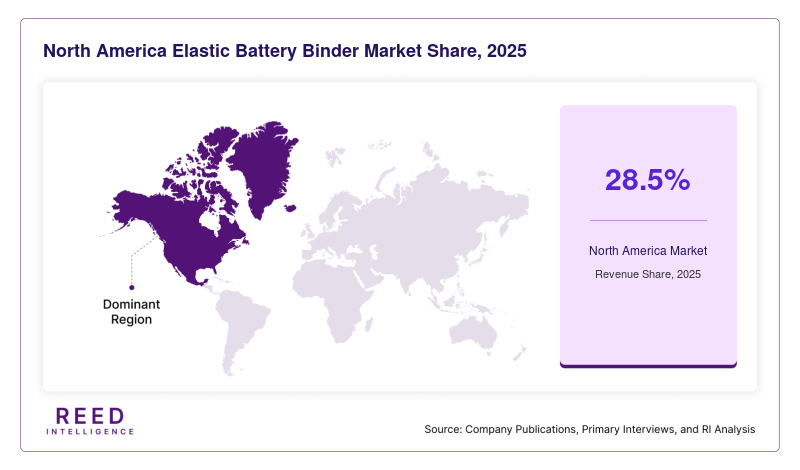
North America accounted for a significant share of the Elastic Battery Binder Market in 2025, holding approximately 28.5% of the global market. The region is expected to register a CAGR of 8.9% during the forecast period. Strong investments in electric vehicles and renewable energy infrastructure are driving market growth. The presence of established battery manufacturers and research institutions further supports innovation in binder technologies.
The United States dominates the regional market due to its advanced automotive and energy sectors. A key growth factor is the increasing adoption of grid-scale energy storage systems to support renewable energy integration. Government policies promoting clean energy and EV adoption are also contributing to market expansion. These factors are expected to sustain demand for elastic battery binders in the region.
Europe
Europe held a market share of approximately 24.3% in 2025 and is projected to grow at a CAGR of 9.2% through 2034. The region’s focus on sustainability and stringent environmental regulations are driving the adoption of advanced battery materials. The expansion of EV manufacturing and battery gigafactories is further supporting market growth.
Germany leads the European market due to its strong automotive industry and technological capabilities. A unique growth factor is the region’s emphasis on circular economy practices, including battery recycling and reuse. This approach is encouraging the development of sustainable binder materials, creating new opportunities for market players.
Asia Pacific
Asia Pacific dominated the Elastic Battery Binder Market in 2025 with a share of 32.7% and is expected to register the fastest CAGR of 11.1% during the forecast period. The region’s large-scale battery manufacturing capacity and growing demand for consumer electronics are key growth drivers. Countries such as China, Japan, and South Korea are leading in battery innovation.
China is the dominant country in the region, driven by its extensive EV production and battery manufacturing ecosystem. A unique growth factor is the government’s strong support for domestic battery supply chains, including raw materials and components. This support is fostering rapid development and adoption of advanced binder technologies.
Middle East & Africa
The Middle East & Africa region accounted for a smaller share of around 7.8% in 2025 but is expected to grow at a CAGR of 8.5% through 2034. Increasing investments in renewable energy projects are driving demand for energy storage solutions. The region is gradually adopting advanced battery technologies to support energy diversification.
The United Arab Emirates is a key market within the region. A unique growth factor is the development of large-scale solar energy projects that require efficient storage systems. These projects are creating demand for high-performance battery components, including elastic binders, thereby supporting market growth.
Latin America
Latin America held a market share of approximately 6.7% in 2025 and is projected to grow at a CAGR of 8.7% during the forecast period. The region is witnessing increased adoption of renewable energy and electric mobility solutions. Governments are implementing policies to promote sustainable energy and reduce carbon emissions.
Brazil dominates the regional market due to its expanding renewable energy sector. A unique growth factor is the growing use of distributed energy storage systems in rural and remote areas. This trend is driving demand for reliable battery technologies, thereby supporting the adoption of elastic binders.
Competitive Landscape
The Elastic Battery Binder Market is moderately competitive, with several global and regional players focusing on innovation and strategic collaborations. The market is characterized by continuous research and development activities aimed at improving binder performance and sustainability. Companies are investing in advanced materials and technologies to gain a competitive edge.
One of the leading players in the market is Arkema Group, known for its strong portfolio of specialty materials. The company has been actively developing advanced binder solutions for high-performance batteries. A recent development includes the introduction of a new range of water-based binders designed for next-generation battery applications.
Other key players are also focusing on expanding their production capacities and forming partnerships with battery manufacturers. These strategies are aimed at strengthening market presence and meeting the growing demand for elastic battery binders.
Key Players List
- Arkema Group
- BASF SE
- Solvay S.A.
- Dow Inc.
- LG Chem Ltd.
- Kureha Corporation
- ZEON Corporation
- JSR Corporation
- Ashland Global Holdings Inc.
- Mitsubishi Chemical Group
- Daikin Industries Ltd.
- Nippon Shokubai Co., Ltd.
- Wacker Chemie AG
- DIC Corporation
- Kuraray Co., Ltd.
Recent Developments
- In 2024, Arkema Group launched a new series of eco-friendly elastic binders designed for high-capacity lithium-ion batteries.
- In 2023, BASF SE expanded its production facility to increase output of advanced battery materials, including elastic binders.
- In 2024, LG Chem Ltd. announced a partnership with a leading EV manufacturer to develop next-generation binder technologies for improved battery performance.
Elastic Battery Binder Market Segments
Type
- Polymer-Based Elastic Binders
- Water-Based Elastic Binders
- Solvent-Based Elastic Binders
Application
- Lithium-Ion Batteries
- Solid-State Batteries
- Nickel-Metal Hydride Batteries
End-Use
- Automotive
- Consumer Electronics
- Energy Storage Systems
- Industrial Applications
By Region
- North America
- Europe
- APAC
- Middle East and Africa
- LATAM