Elastomeric Membrane Market Size, Share, Growth Demand Report By Type (Sheet-Based Elastomeric Membranes), By Material (EPDM, TPO, PVC, Silicone, Polyurethane), By Application (Roofing, Walls, Underground Construction, Bridges), By End Use Industry (Residential Construction, Commercial Construction, Industrial Infrastructure), By Region & Segment Forecasts, 2026–2034
USD 3950
Market Overview
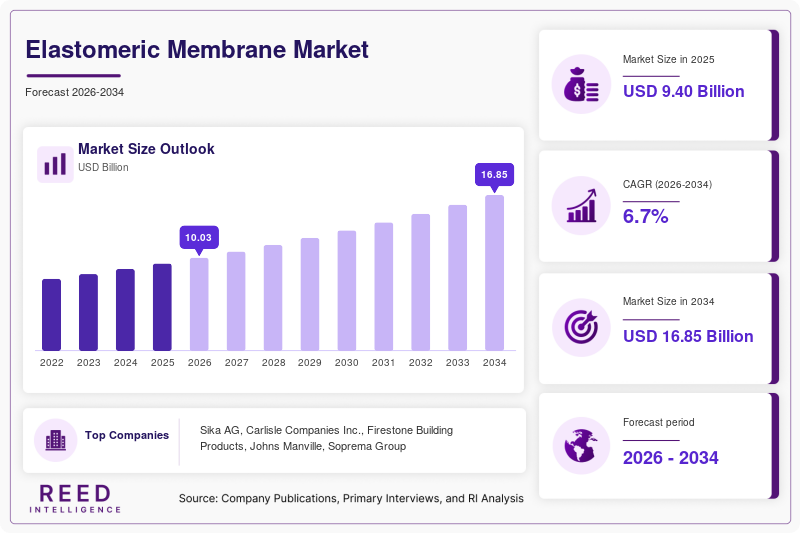
The Elastomeric Membrane Market Size was valued at approximately USD 9.4 billion in 2026 and is projected to reach USD 15.8 billion by 2034, expanding at a CAGR of 6.7% during the forecast period (2026–2034). The market is witnessing substantial growth due to rising infrastructure modernization, increasing demand for waterproofing systems, and growing adoption of durable roofing and insulation materials across commercial and industrial sectors. Elastomeric membranes are widely utilized in roofing, wall protection, underground waterproofing, and bridge construction because of their flexibility, weather resistance, and long operational lifespan. Their ability to withstand thermal expansion, moisture penetration, and harsh environmental conditions has positioned them as a preferred solution in modern construction and industrial protection systems.
A major global factor supporting the expansion of the Elastomeric Membrane Market size is the rapid growth of urban infrastructure projects combined with rising investments in sustainable construction materials. Governments and private developers are increasingly focusing on long-lasting and energy-efficient building solutions to reduce maintenance costs and improve structural durability. As climate variability and environmental exposure continue to impact construction quality worldwide, elastomeric membrane systems are gaining importance for waterproofing and surface protection applications across residential, commercial, and industrial infrastructure.
Key Highlights
- Dominant Region (2025): Asia Pacific held 39% share, driven by infrastructure development and urban construction activities
- Fastest-Growing Region: Middle East & Africa is projected to grow at 7.4% CAGR (2026–2034)
- Leading Subsegment (Type): Sheet-based elastomeric membranes accounted for 47% share in 2025
- Fastest-Growing Subsegment (Application): Roofing applications are expected to grow at 7.8% CAGR
- Dominant Country (2024): China accounted for approximately USD 1.92 billion
- Dominant Country (2025): China increased to USD 2.08 billion, supported by commercial infrastructure expansion and industrial construction projects
Market Trends
Increasing Adoption of Energy-Efficient Roofing Systems
The Elastomeric Membrane Market is witnessing strong demand for energy-efficient roofing solutions that improve thermal insulation and reduce building energy consumption. Elastomeric membranes are increasingly being integrated into cool roofing systems because of their reflective properties and weather resistance capabilities. Commercial infrastructure developers are adopting advanced roofing membranes to improve indoor energy efficiency and comply with evolving environmental building standards. This trend is becoming particularly important in regions with high temperature exposure and growing focus on sustainable urban construction.
Shift Toward Liquid-Applied Waterproofing Technologies
Another notable trend shaping the Elastomeric Membrane Market is the growing adoption of liquid-applied membrane systems for complex structural surfaces and renovation projects. These membranes provide seamless waterproofing performance and are easier to apply in irregular construction areas where sheet membranes may be difficult to install. Manufacturers are increasingly introducing low-VOC and fast-curing formulations to support rapid infrastructure development and reduce environmental impact during construction operations.
Market Drivers
Rising Global Construction and Infrastructure Development
Rapid urbanization and increasing investment in commercial, industrial, and residential infrastructure projects are major growth drivers for the Elastomeric Membrane Market. Governments across developing economies are investing heavily in transportation networks, smart cities, industrial parks, and public infrastructure, which is significantly increasing demand for waterproofing and protective membrane systems. Elastomeric membranes provide structural durability, moisture protection, and long-term weather resistance, making them essential materials in modern construction projects.
Growing Demand for Waterproofing and Structural Protection
The increasing need for advanced waterproofing systems across underground structures, bridges, tunnels, and industrial facilities is driving adoption of elastomeric membrane solutions globally. Water leakage and moisture penetration remain critical concerns in construction and industrial environments, encouraging builders and engineers to adopt high-performance membrane technologies that improve operational life and reduce maintenance costs over extended periods.
Market Restraint
Fluctuation in Petrochemical Raw Material Prices
The Elastomeric Membrane Market faces challenges associated with fluctuating prices of petrochemical-derived raw materials such as synthetic rubber and polymer compounds. Variability in crude oil prices affects manufacturing costs and creates pricing pressure for producers operating in competitive construction material markets. Additionally, transportation and logistics cost increases can further impact profit margins and supply chain stability across global regions.
Market Opportunities
Expansion of Green Building Projects
The increasing adoption of green building standards and environmentally sustainable construction practices is creating strong growth opportunities for the Elastomeric Membrane Market. Developers are increasingly using advanced waterproofing and insulation systems that improve building performance, reduce energy consumption, and support long-term sustainability goals. Demand for recyclable and low-emission membrane products is expected to increase significantly during the forecast period.
Rising Demand in Industrial and Transportation Infrastructure
Industrial facilities, transportation hubs, airports, and railway infrastructure projects are generating new opportunities for membrane manufacturers. Elastomeric membrane systems are increasingly used in bridges, parking structures, tunnels, and logistics centers due to their durability and resistance to environmental degradation. Rising investment in transportation modernization projects is expected to create sustained demand for advanced waterproofing technologies.
Segmental Analysis
By Type
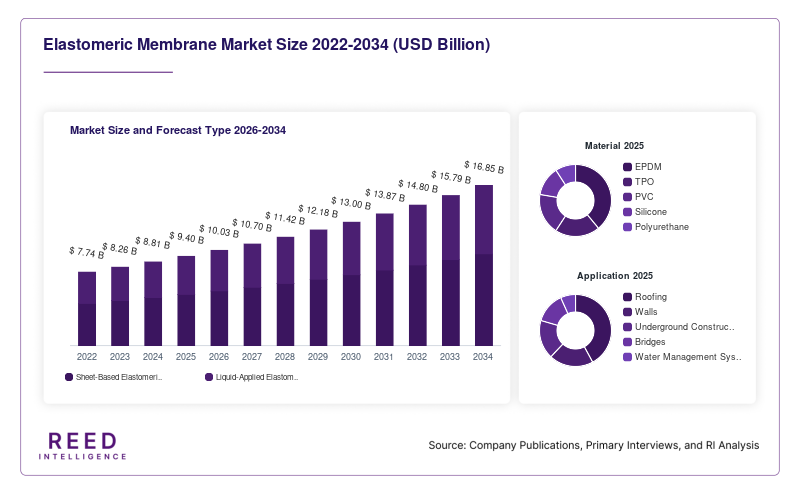
The Elastomeric Membrane Market is segmented into sheet-based membranes and liquid-applied membranes. Sheet-based elastomeric membranes dominated with 47% share in 2025 because of their durability, consistent thickness, and high-performance waterproofing capabilities in commercial and industrial construction projects. Liquid-applied membranes are expected to grow at a 7.5% CAGR, driven by increasing demand for seamless waterproofing systems in renovation and irregular surface applications where installation flexibility is critical.
By Material
Based on material, the market includes EPDM, TPO, PVC, silicone, and polyurethane membranes. EPDM membranes accounted for 41% share in 2025 due to their superior weather resistance, flexibility, and long operational lifespan in roofing and waterproofing systems. Silicone-based membranes are projected to grow at a 7.3% CAGR, supported by rising demand for UV-resistant and temperature-stable coating systems in industrial and commercial environments.
By Application
Applications include roofing, walls, underground construction, bridges, and water management systems. Roofing applications dominated with 38% share in 2025 due to rising commercial building construction and increasing replacement of aging roofing systems. Underground waterproofing applications are projected to grow at a 7.2% CAGR, driven by rising tunnel, metro rail, and basement construction projects globally.
By End Use Industry
The market is segmented into residential construction, commercial construction, industrial infrastructure, and transportation infrastructure. Commercial construction accounted for 36% share in 2025, supported by increasing office, retail, and hospitality infrastructure development. Transportation infrastructure is expected to grow at a 7.4% CAGR, driven by expanding bridge, airport, and railway modernization projects.
Regional Analysis
North America
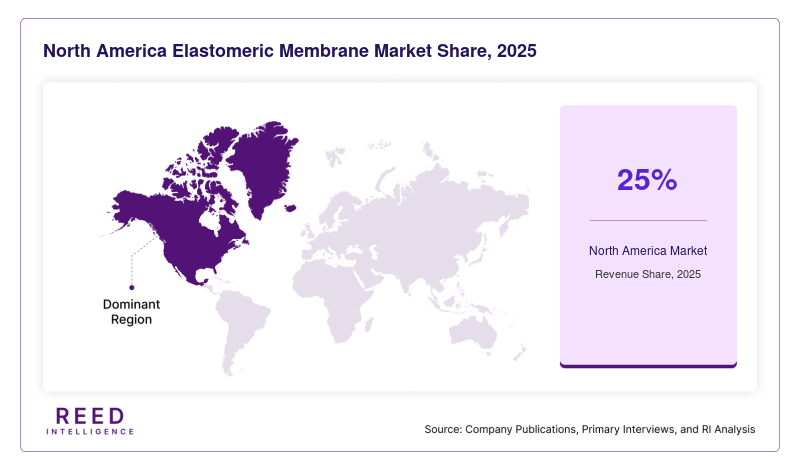
North America accounted for 25% share of the Elastomeric Membrane Market in 2025 and is projected to grow at a 6.4% CAGR (2026–2034). The region benefits from strong renovation activities, increasing adoption of energy-efficient roofing systems, and rising commercial construction investments. The United States dominates the regional market due to large-scale infrastructure rehabilitation projects and growing adoption of sustainable construction materials across commercial real estate developments.
Europe
Europe held 23% share in 2025 and is expected to grow at a 6.1% CAGR (2026–2034). Market growth is supported by stringent environmental regulations and increasing demand for advanced insulation and waterproofing systems. Germany remains the dominant contributor due to strong industrial construction activity and rising implementation of energy-efficient building standards across residential and commercial sectors.
Asia Pacific
Asia Pacific dominated with 39% share in 2025 and is projected to grow at a 7.0% CAGR (2026–2034). The region is experiencing rapid urbanization, increasing infrastructure investment, and large-scale commercial construction development. China leads the market due to massive industrial infrastructure expansion, growing smart city initiatives, and rising adoption of waterproofing technologies in transportation and residential construction projects.
Middle East & Africa
Middle East & Africa accounted for 8% share in 2025 and is expected to grow at a 7.4% CAGR (2026–2034). Increasing investment in commercial real estate, tourism infrastructure, and industrial diversification projects is supporting regional market expansion. Saudi Arabia dominates due to large-scale urban development programs and rising demand for weather-resistant construction materials in extreme climatic conditions.
Latin America
Latin America held 5% share in 2025 and is projected to grow at a 6.2% CAGR (2026–2034). Brazil remains the leading regional market due to increasing infrastructure modernization projects and growing industrial construction activity. Rising investment in public transportation and logistics infrastructure is further supporting membrane system adoption across the region.
Competitive Landscape
The Elastomeric Membrane Market is moderately competitive, with key companies focusing on product innovation, sustainable membrane technologies, and geographic expansion strategies. Manufacturers are increasingly investing in advanced polymer formulations and environmentally compliant waterproofing systems to strengthen their market presence and address evolving construction requirements.
Sika AG leads the market with a strong portfolio of roofing and waterproofing membrane systems used across commercial and industrial infrastructure projects. The company recently expanded its elastomeric membrane production capacity to support growing demand from infrastructure modernization programs.
Carlisle Companies Inc. and Firestone Building Products continue to strengthen their positions through advanced roofing technologies and global distribution expansion. Johns Manville focuses on energy-efficient waterproofing systems, while Soprema Group is expanding its sustainable membrane solutions portfolio for green construction projects.
Key Players List
- Sika AG
- Carlisle Companies Inc.
- Firestone Building Products
- Johns Manville
- Soprema Group
- GAF Materials Corporation
- BASF SE
- Dow Inc.
- Saint-Gobain
- Fosroc International
- Kemper System America Inc.
- Renolit SE
- RPM International Inc.
- Polyglass USA Inc.
- Oriental Yuhong Waterproof Technology Co. Ltd.
Recent Developments
Elastomeric Membrane Market Segments
Type
- Sheet-Based Elastomeric Membranes
- Liquid-Applied Elastomeric Membranes
Material
- EPDM
- TPO
- PVC
- Silicone
- Polyurethane
Application
- Roofing
- Walls
- Underground Construction
- Bridges
- Water Management Systems
End Use Industry
- Residential Construction
- Commercial Construction
- Industrial Infrastructure
- Transportation Infrastructure
By Region
- North America
- Europe
- APAC
- Middle East and Africa
- LATAM