Elastomers for Valve Soft Seat Market Size, Share & Demand Report By Material Type (EPDM Elastomers, Nitrile Elastomers, Fluorocarbon Elastomers, Silicone Elastomers, Neoprene Elastomers, Others), By Valve Type (Ball Valves, Butterfly Valves, Gate Valves, Globe Valves, Plug Valves, Others), By End-Use Industry (Oil and Gas, Water and Wastewater Treatment, Chemical Processing, Food and Beverage, Pharmaceuticals, Power Generation, Others) By Region & Segment Forecasts, 2026–2034
USD 3950
Market Overview
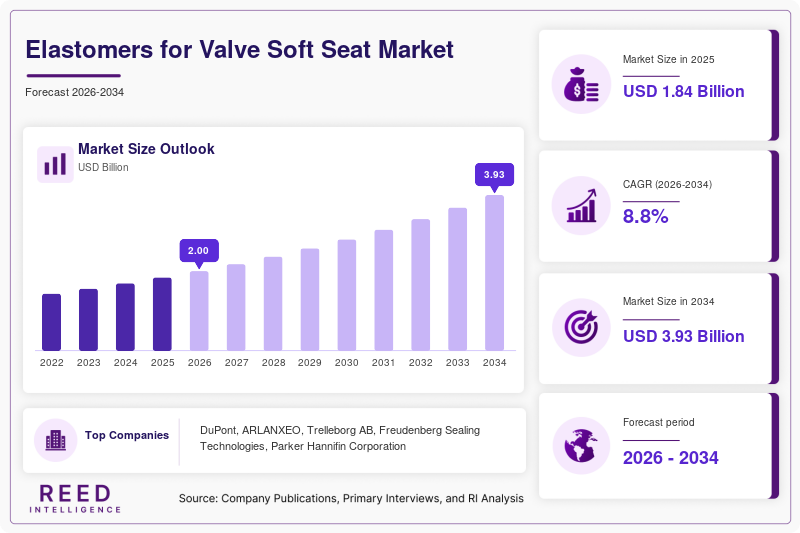
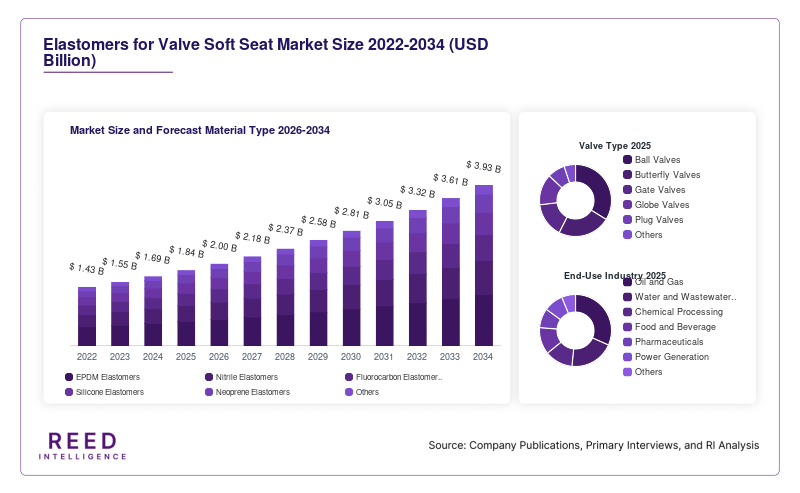
The global Elastomers for Valve Soft Seat Market size was valued at USD 1.84 billion in 2026 and is projected to reach USD 3.62 billion by 2034, expanding at a CAGR of 8.8% during the forecast period from 2026 to 2034. The market is gaining steady momentum due to increasing demand for industrial valves across oil and gas, chemical processing, water treatment, pharmaceuticals, and food manufacturing sectors. Valve soft seats made from elastomer materials provide enhanced sealing performance, lower leakage rates, chemical resistance, and durability in demanding operating environments. Growing investments in industrial automation and process optimization are also supporting demand for advanced sealing solutions in control valves and shut-off valves.
One of the major global factors supporting market growth is the rising focus on infrastructure modernization and energy efficiency. Governments and private manufacturers are investing in pipeline networks, wastewater treatment systems, and industrial fluid management facilities that require high-performance valve systems. Elastomer-based valve soft seats are increasingly preferred because they reduce maintenance requirements and improve operational reliability. Manufacturers are also developing specialty elastomers with improved thermal resistance, abrasion resistance, and compatibility with aggressive chemicals. The increasing use of automation in industrial plants is further accelerating adoption, as automated valve systems require dependable sealing materials that can withstand repeated operation cycles.
Key Highlights
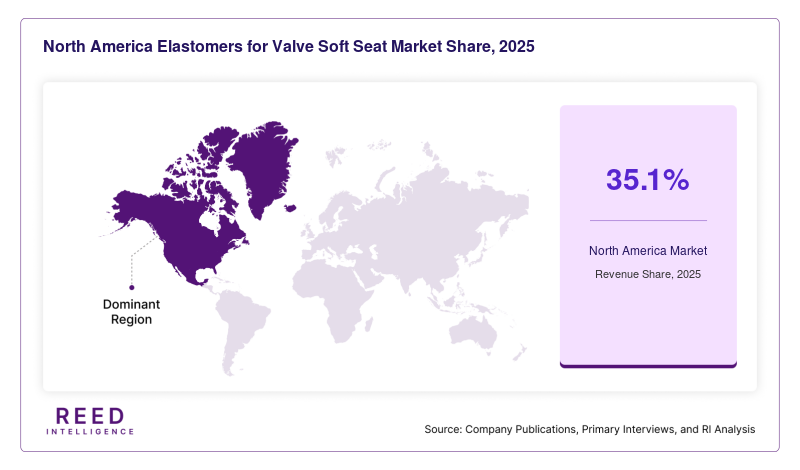
- North America dominated the market with a 35.1% share in 2025.
- Asia Pacific is expected to grow at the fastest CAGR of 10.9% during 2026–2034.
- By material type, EPDM elastomers accounted for the largest share of 39.4%, while fluorocarbon elastomers are projected to grow at a CAGR of 11.6%. By valve type, ball valves led with a 42.7% share, whereas butterfly valves are expected to expand at a CAGR of 10.8%.
- By end-use industry, oil and gas held the dominant share of 33.8%, while water and wastewater treatment is projected to grow at a CAGR of 11.2%. The United States remained the dominant country, with market values of USD 465 million in 2024 and USD 512 million in 2025.
Market Trends
Growing Adoption of High-Performance Fluoroelastomers in Industrial Valve Systems
Manufacturers across the industrial valve ecosystem are increasingly adopting high-performance fluoroelastomers to improve sealing efficiency in demanding environments. These materials provide superior resistance to aggressive chemicals, elevated temperatures, and pressure fluctuations compared to conventional rubber compounds. Industries such as petrochemicals, offshore drilling, pharmaceutical processing, and power generation are integrating advanced elastomer soft seats to improve equipment life and reduce downtime. The trend is particularly visible in automated valve systems where operational reliability directly impacts production efficiency. In addition, industrial operators are focusing on lifecycle cost reduction, leading to increased preference for durable elastomer solutions that require fewer replacements and maintenance interventions. This transition toward specialty elastomer materials is expected to support long-term market expansion.
Expansion of Sustainable Water Infrastructure and Wastewater Projects
The increasing number of water infrastructure modernization projects is creating strong demand for elastomers used in valve soft seats. Municipal authorities and industrial facilities are upgrading water treatment and wastewater systems to comply with stricter environmental regulations and water reuse targets. Elastomer soft seats play an important role in controlling leakage and ensuring reliable flow management in filtration, pumping, and distribution systems. The growing adoption of desalination facilities in water-stressed regions is also contributing to demand for corrosion-resistant sealing materials. Furthermore, the development of bio-based and recyclable elastomer formulations is emerging as a significant trend among manufacturers seeking sustainable production methods. Companies are investing in environmentally compliant materials to align with evolving procurement standards in public infrastructure projects.
Market Drivers
Rising Investments in Oil and Gas Pipeline Infrastructure
The expansion of oil and gas transportation infrastructure continues to drive demand for elastomers used in valve soft seat applications. Pipeline operators require high-quality valve sealing materials capable of handling fluctuating temperatures, corrosive fluids, and high-pressure conditions. Elastomer soft seats are widely used in ball valves, gate valves, and butterfly valves because they help prevent leakage and improve operational safety. Increasing energy demand in developing economies is encouraging governments and private companies to invest in new pipelines, storage facilities, and refining operations. In addition, aging pipeline networks in developed regions are undergoing replacement and modernization projects, which further supports the need for advanced sealing materials. The growing use of automated control valves in energy facilities is also contributing to increased consumption of durable elastomer compounds.
Increasing Industrial Automation Across Process Industries
Industrial automation is becoming a major growth driver for the Elastomers for Valve Soft Seat Market as manufacturers prioritize efficiency, precision, and process safety. Automated valves require reliable sealing systems that can withstand frequent opening and closing cycles without degradation. Elastomer soft seats provide flexibility, resilience, and chemical compatibility, making them suitable for automated fluid handling systems in industries such as food processing, pharmaceuticals, chemicals, and power generation. Smart manufacturing initiatives are encouraging facilities to upgrade legacy equipment with digitally controlled valves that require advanced elastomer materials for dependable performance. Additionally, predictive maintenance technologies are increasing awareness regarding the benefits of high-quality sealing components, encouraging end users to adopt premium elastomer solutions that extend equipment lifespan and minimize unplanned shutdowns.
Market Restraint
Volatility in Raw Material Prices and Supply Chain Disruptions
Fluctuations in the prices of raw materials used in elastomer manufacturing represent a key challenge for market participants. Synthetic rubber compounds, fluoropolymers, and specialty additives are closely linked to crude oil prices and global petrochemical supply chains. Sudden increases in feedstock costs can reduce profit margins for manufacturers and create pricing pressure across the supply chain. In addition, disruptions in global transportation networks and geopolitical tensions have affected the availability of industrial raw materials, leading to delays in production schedules and procurement activities. Small and medium-sized manufacturers are particularly vulnerable because they often operate with limited supplier networks and lower purchasing power. The restraint is also impacting long-term contracts within industries such as oil and gas and chemicals, where buyers seek stable pricing structures. As a result, companies are focusing on regional sourcing strategies, inventory optimization, and material innovation to reduce dependence on volatile supply chains.
Market Opportunities
Increasing Demand for Valve Systems in Hydrogen and Renewable Energy Projects
The growing development of hydrogen infrastructure and renewable energy facilities is creating new opportunities for elastomer manufacturers. Hydrogen transportation and storage systems require highly reliable valve sealing materials that can tolerate pressure variation and prevent leakage. Advanced elastomers with improved resistance to permeation and thermal stress are gaining attention in hydrogen fueling stations, electrolyzer systems, and renewable energy processing facilities. Governments in Europe, Asia Pacific, and North America are allocating significant investments toward clean energy infrastructure, which is expected to support long-term demand for industrial valve components. In addition, renewable natural gas facilities and carbon capture projects are integrating specialized valves that rely on durable elastomer soft seats for safe operation.
Growth of Smart Water Management and Urban Infrastructure Projects
Urbanization and rising pressure on water resources are generating opportunities for elastomer-based valve soft seat solutions in smart water management systems. Municipal authorities are investing in intelligent water distribution networks that use automated valves and monitoring systems to reduce leakage and improve efficiency. Elastomer soft seats are important components in these systems because they ensure consistent sealing performance under varying pressure conditions. Emerging economies are also expanding urban infrastructure projects that include sewage treatment plants, industrial water recycling facilities, and desalination systems. Manufacturers are responding by developing elastomer compounds with enhanced resistance to chlorine, ozone, and abrasive particles. The combination of digital water infrastructure and sustainability-focused investment is expected to create a favorable environment for market growth over the coming decade.
Segmental Analysis
By Material Type
EPDM elastomers represented the dominant subsegment in 2024, accounting for 39.4% of the global Elastomers for Valve Soft Seat Market. EPDM materials are widely used because they provide excellent resistance to water, steam, ozone, and weather-related degradation. These properties make them highly suitable for industrial valve systems used in water treatment, food processing, and HVAC applications. Manufacturers prefer EPDM-based valve soft seats due to their cost efficiency, flexibility, and long operational lifespan. The increasing focus on leak prevention and maintenance reduction is further supporting the adoption of EPDM compounds across industrial facilities. In addition, the material offers compatibility with a wide range of fluids and moderate operating temperatures, making it suitable for multiple end-use environments. Growing investments in municipal infrastructure and industrial water systems continue to strengthen demand for EPDM-based sealing solutions.
Fluorocarbon elastomers are expected to emerge as the fastest-growing subsegment, registering a CAGR of 11.6% during the forecast period. These advanced materials are gaining popularity because they can withstand aggressive chemicals, high temperatures, and harsh industrial operating conditions. Industries such as petrochemicals, pharmaceuticals, aerospace, and energy production are increasingly using fluorocarbon elastomer soft seats to improve valve reliability and reduce maintenance frequency. The material’s superior resistance to fuel, solvents, and corrosive fluids makes it suitable for critical process applications. In addition, growing investments in hydrogen infrastructure and renewable energy facilities are creating demand for specialty elastomers capable of maintaining performance under extreme pressure variations. Manufacturers are also introducing improved fluorocarbon formulations with enhanced flexibility and sealing capabilities, further supporting growth across advanced industrial applications.
By Valve Type
Ball valves held the largest share of the Elastomers for Valve Soft Seat Market in 2024, contributing 42.7% of total revenue. Ball valves are widely used across oil and gas, chemical processing, water treatment, and food manufacturing industries because they provide effective shut-off performance and reliable flow control. Elastomer soft seats used in ball valves help improve sealing efficiency, reduce leakage, and support long-term operational stability. Industrial facilities prefer ball valves because they require relatively low maintenance and can operate efficiently in automated systems. The increasing use of process automation in industrial operations is further driving demand for high-performance elastomer materials in ball valve assemblies. In addition, infrastructure modernization projects involving fluid handling and pipeline transportation systems are increasing installations of ball valves equipped with durable sealing components.
Butterfly valves are projected to record the fastest CAGR of 10.8% during the forecast period due to their lightweight structure, cost efficiency, and suitability for large-scale fluid control systems. These valves are increasingly used in water distribution networks, wastewater treatment plants, and industrial processing facilities where compact design and operational efficiency are important. Elastomer soft seats in butterfly valves improve sealing performance and support reliable operation under varying pressure conditions. The growing focus on smart water management systems is contributing significantly to segment growth, as automated butterfly valves are commonly integrated into digital infrastructure networks. In addition, industries are seeking energy-efficient valve solutions that reduce operational costs and support environmental compliance objectives. Manufacturers are therefore developing advanced elastomer compounds that enhance wear resistance and extend valve service life.
By End-Use Industry
The oil and gas industry accounted for the largest share of the Elastomers for Valve Soft Seat Market in 2024, representing 33.8% of total demand. Industrial valves are critical components in upstream, midstream, and downstream operations where reliable sealing performance is essential for operational safety and process efficiency. Elastomer soft seats are extensively used in pipeline systems, refinery operations, LNG facilities, and offshore drilling equipment because they help prevent fluid leakage and maintain pressure integrity. Increasing investments in natural gas transportation infrastructure and refinery modernization are supporting steady demand for advanced sealing materials. Furthermore, energy companies are upgrading aging equipment to comply with stricter environmental and safety regulations, encouraging the adoption of high-performance elastomer valve components capable of operating in corrosive and high-pressure environments.
Water and wastewater treatment is expected to register the fastest CAGR of 11.2% during the forecast period due to rising investments in sustainable water infrastructure and urban utility modernization. Municipal authorities and industrial facilities are increasingly adopting automated valve systems to improve water management efficiency and reduce distribution losses. Elastomer soft seats are essential in these systems because they provide dependable sealing under continuous operating conditions and exposure to chemicals such as chlorine and disinfectants. Rapid urbanization in emerging economies is accelerating the construction of wastewater treatment plants, desalination facilities, and industrial recycling systems. In addition, environmental regulations promoting water conservation and pollution control are encouraging utilities to invest in advanced valve technologies that require durable and chemically resistant elastomer materials.
Regional Analysis
North America
North America accounted for 35.1% of the global Elastomers for Valve Soft Seat Market in 2025 and is expected to maintain a stable growth trajectory with a CAGR of 7.9% during the forecast period. The region benefits from strong industrial infrastructure, widespread automation adoption, and continuous investment in energy transportation systems. Demand for high-performance elastomer materials is increasing across oil and gas pipelines, chemical processing facilities, and water treatment plants. The presence of major valve manufacturers and advanced material suppliers is further supporting market expansion. In addition, strict industrial safety regulations are encouraging the use of reliable sealing materials that reduce leakage risks and improve equipment efficiency.
The United States remains the dominant country in the regional market due to its extensive oil and gas operations and modernization of industrial infrastructure. The country continues to invest in pipeline replacement projects, LNG export terminals, and advanced manufacturing facilities that require durable valve systems. Another important growth factor is the increasing deployment of smart water infrastructure projects across municipal utilities. Water conservation initiatives and regulatory compliance requirements are encouraging utilities to adopt advanced valve technologies equipped with elastomer soft seats that offer long operational life and minimal maintenance requirements.
Europe
Europe held a significant share of the Elastomers for Valve Soft Seat Market in 2025 and is projected to grow at a CAGR of 8.1% through 2034. The regional market is supported by strong demand from chemical manufacturing, pharmaceuticals, food processing, and renewable energy sectors. European industries are placing greater emphasis on energy-efficient process systems and low-emission industrial operations, which is increasing the use of advanced valve technologies. The region is also witnessing rising demand for specialty elastomers that comply with environmental and safety standards. Manufacturers are focusing on sustainable material innovation and recyclable elastomer compounds to align with regulatory requirements.
Germany continues to dominate the European market due to its strong industrial base and leadership in engineering and automation technologies. The country’s chemical and industrial manufacturing sectors require reliable valve systems for complex production environments. One unique growth factor is the rapid expansion of hydrogen energy projects and green industrial initiatives. Hydrogen transport and storage infrastructure requires high-quality sealing systems capable of operating under demanding pressure and temperature conditions, which is creating additional demand for advanced elastomer valve soft seats across the country.
Asia Pacific
Asia Pacific is expected to record the fastest CAGR of 10.9% during the forecast period, supported by rapid industrialization and infrastructure development. The region is witnessing increasing investments in manufacturing plants, petrochemical facilities, water treatment projects, and energy infrastructure. Countries across Asia Pacific are expanding urban utilities and industrial processing capacity, leading to greater consumption of industrial valves and sealing materials. Local manufacturers are also increasing production of cost-effective elastomer compounds to meet rising domestic demand. In addition, foreign investments in industrial automation are strengthening adoption of technologically advanced valve systems across emerging economies.
China remains the leading country in the Asia Pacific market because of its large-scale industrial production and extensive infrastructure development activities. The country continues to expand chemical processing, power generation, and water treatment facilities that require reliable valve sealing components. A unique growth factor is the rapid growth of electronics and semiconductor manufacturing, where precision fluid handling systems rely on advanced elastomer soft seats for contamination control and operational consistency. The increasing focus on domestic manufacturing capabilities is also encouraging regional suppliers to invest in advanced elastomer technologies.
Middle East & Africa
The Middle East & Africa market is experiencing consistent growth due to increasing investments in oil production, water infrastructure, and industrial development projects. The region accounted for a moderate share of the global market in 2025 and is expected to expand at a CAGR of 8.4% through 2034. Oil-exporting countries are upgrading refinery facilities and pipeline systems to improve operational efficiency and safety standards. Demand for elastomer soft seats is increasing because industrial operators require sealing materials that can tolerate corrosive environments and high temperatures. Water desalination projects are also contributing to market growth across the region.
Saudi Arabia remains the dominant country within the regional market because of its extensive energy sector and ongoing industrial diversification initiatives. The country is investing in petrochemical facilities, industrial cities, and large-scale water desalination infrastructure. One important growth factor is the expansion of smart industrial projects linked to economic diversification strategies. These projects are increasing demand for automated valve systems equipped with durable elastomer components that can deliver reliable performance in harsh environmental conditions and continuous industrial operations.
Latin America
Latin America is projected to witness stable growth in the Elastomers for Valve Soft Seat Market during the forecast period, supported by infrastructure upgrades and industrial recovery trends. The region accounted for a developing share of global revenue in 2025 and is expected to expand at a CAGR of 7.6% through 2034. Demand is increasing across mining, oil refining, food processing, and municipal water management sectors. Governments and private companies are investing in pipeline modernization and industrial process optimization, which is supporting the installation of advanced valve systems. The growing emphasis on reducing industrial leakage and maintenance costs is further encouraging the adoption of high-quality elastomer sealing materials.
Brazil dominates the Latin American market due to its large industrial sector and significant investments in energy and mining activities. The country continues to expand offshore oil production and water treatment infrastructure, creating demand for corrosion-resistant valve soft seat materials. A unique growth factor is the increasing modernization of mining operations, where heavy-duty valve systems are used in slurry handling and mineral processing applications. These demanding environments require elastomer compounds capable of resisting abrasion, chemicals, and high-pressure operating conditions.
Competitive Landscape
The Elastomers for Valve Soft Seat Market is characterized by the presence of global material manufacturers, industrial sealing specialists, and regional valve component suppliers competing on product quality, material innovation, and long-term durability. Companies are focusing on developing elastomer compounds with enhanced resistance to chemicals, abrasion, and extreme temperatures to meet evolving industrial requirements. Strategic collaborations between valve manufacturers and elastomer producers are becoming more common as end users demand customized sealing solutions for specialized applications.
DuPont remains one of the leading companies in the market due to its extensive portfolio of high-performance elastomer materials and strong presence across industrial sectors. The company continues to invest in advanced fluoroelastomer technologies for energy, chemical, and industrial processing applications. Other major players are also strengthening their market positions through acquisitions, regional expansion strategies, and increased investment in research and development activities.
Key Players
- DuPont
- ARLANXEO
- Trelleborg AB
- Freudenberg Sealing Technologies
- Parker Hannifin Corporation
- Greene Tweed
- Precision Polymer Engineering
- Saint-Gobain Performance Plastics
- Solvay
- NOK Corporation
- Daikin Industries Ltd.
- James Walker Group
- Eagle Elastomer Inc.
- Flowserve Corporation
- Emerson Electric Co.
Recent Developments
- In February 2026, Trelleborg AB introduced an advanced fluorocarbon elastomer sealing solution for industrial valves used in hydrogen transportation infrastructure.
- In August 2025, Parker Hannifin Corporation expanded its sealing materials manufacturing capacity in Asia Pacific to support increasing demand from industrial automation and water treatment sectors.
- In November 2025, Freudenberg Sealing Technologies launched a new EPDM-based valve soft seat compound with improved chemical resistance for wastewater treatment applications.
- In March 2026, DuPont announced collaborative research initiatives with industrial valve manufacturers to develop next-generation elastomer materials for high-temperature processing systems.
Elastomers for Valve Soft Seat Market Segments
Material Type
- EPDM Elastomers
- Nitrile Elastomers
- Fluorocarbon Elastomers
- Silicone Elastomers
- Neoprene Elastomers
- Others
Valve Type
- Ball Valves
- Butterfly Valves
- Gate Valves
- Globe Valves
- Plug Valves
- Others
End-Use Industry
- Oil and Gas
- Water and Wastewater Treatment
- Chemical Processing
- Food and Beverage
- Pharmaceuticals
- Power Generation
- Others
By Region
- North America
- Europe
- APAC
- Middle East and Africa
- LATAM