Elbow Fixators Market Size, Share & Demand Report By Product Type (Internal Elbow Fixators, External Elbow Fixators), By Material (Titanium-Based Fixators, Stainless Steel Fixators, Carbon Fiber Fixators), By Application (Trauma Fracture Management, Sports Injury Reconstruction), By End-Use (Hospitals, Ambulatory Surgical Centers, Orthopedic Specialty Clinics) By Region & Segment Forecasts, 2026–2034
USD 3950
Market Overview
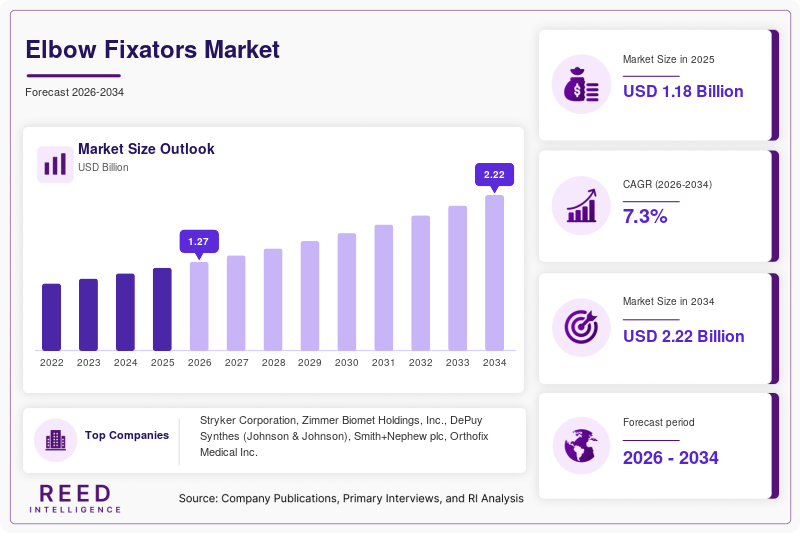
The Elbow Fixators Market size was valued at USD 1.18 billion in 2026 and is projected to reach USD 2.07 billion by 2034, expanding at a CAGR of 7.3% during the forecast period (2026–2034). The global Elbow Fixators Market growth has been supported by the increasing prevalence of orthopedic trauma injuries and the growing adoption of minimally invasive fixation procedures across hospitals and ambulatory surgical centers. Rising healthcare investments in trauma management infrastructure and the growing aging population prone to musculoskeletal disorders have also strengthened the demand outlook for elbow fixation systems globally.
The Elbow Fixators Market has experienced stable expansion due to technological advancements in orthopedic implants and the increasing availability of anatomically designed external and internal fixation devices. Medical device manufacturers are focusing on lightweight materials, modular fixation systems, and improved biocompatibility to enhance surgical outcomes and reduce patient recovery time. Additionally, increasing sports injuries and road traffic accidents have contributed to higher procedural volumes worldwide.
Key Highlights
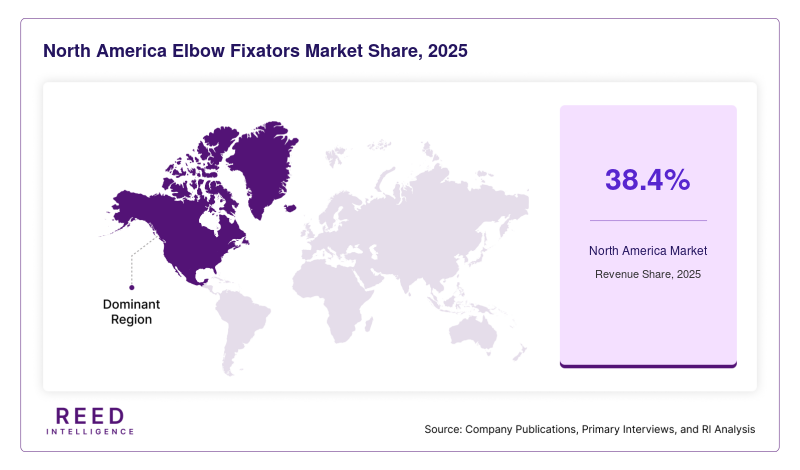
- North America accounted for 38.4% of the global Elbow Fixators Market share in 2025, while Asia Pacific is projected to register the fastest CAGR of 8.6% during 2026–2034.
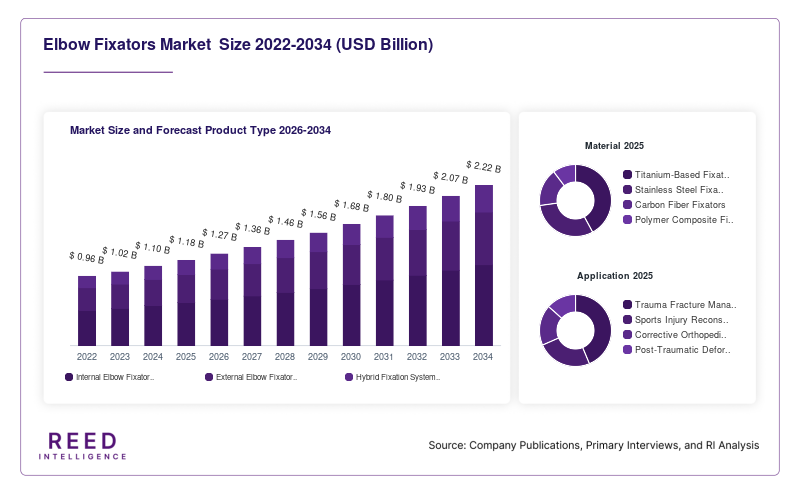
- By product type, internal elbow fixators dominated the market with a 61.2% share in 2025, while external elbow fixators are anticipated to grow at a CAGR of 8.1%.
- By material, titanium-based fixators held the leading share of 47.8% in 2025, whereas carbon fiber fixators are expected to expand at a CAGR of 8.4%.
- By application, trauma fracture management accounted for 54.6% of the market share in 2025, while sports injury reconstruction is forecast to witness a CAGR of 8.7%.
- By end-use, hospitals represented 58.9% of the global market share in 2025, while ambulatory surgical centers are projected to grow at a CAGR of 8.3%.
- The United States dominated the regional market with values of USD 312 million in 2024 and USD 334 million in 2025.
Market Trends
Rising Adoption of Patient-Specific Orthopedic Fixation Systems
The growing demand for customized orthopedic devices has become a significant trend in the Elbow Fixators Market. Manufacturers are increasingly developing patient-specific fixation systems using 3D imaging and digital surgical planning technologies. These customized systems improve alignment accuracy, reduce surgery duration, and enhance post-operative mobility. Hospitals and orthopedic surgeons are adopting tailored elbow fixation solutions to improve clinical outcomes for complex fractures and revision surgeries.
Increasing Integration of Biocompatible Lightweight Materials
The use of lightweight and corrosion-resistant materials such as titanium alloys and carbon fiber composites is transforming the Elbow Fixators Market. These materials improve patient comfort and reduce implant-related complications. Advanced material engineering has enabled manufacturers to design durable yet lightweight fixation systems suitable for long-term orthopedic stabilization. The trend is particularly visible in premium healthcare facilities and sports medicine applications.
Market Drivers
Growing Incidence of Orthopedic Trauma Cases
The increasing number of orthopedic trauma injuries globally has emerged as a primary growth driver for the Elbow Fixators Market. Road accidents, workplace injuries, and sports-related fractures continue to rise across urban populations. Trauma centers are expanding surgical capacities to manage increasing patient admissions requiring elbow stabilization procedures. This trend has directly increased the demand for both external and internal elbow fixator systems.
Expanding Geriatric Population and Bone Degeneration Disorders
The growing elderly population susceptible to osteoporosis and degenerative bone conditions has accelerated the demand for elbow fixation devices. Older adults are more prone to fractures due to reduced bone density and fall-related injuries. Healthcare providers are increasingly utilizing advanced elbow fixators to improve bone healing and mobility restoration in geriatric patients. This demographic trend continues to support long-term market expansion.
Market Restraint
High Cost Associated with Advanced Orthopedic Fixation Procedures
The high procedural and device costs associated with advanced elbow fixation surgeries remain a notable restraint in the Elbow Fixators Market. Premium titanium-based and customized fixation systems can significantly increase treatment expenses for patients and healthcare providers. Limited reimbursement availability in developing healthcare systems also restricts the widespread adoption of advanced orthopedic fixation technologies.
Market Opportunities
Expansion of Outpatient Orthopedic Surgery Centers
The rapid development of ambulatory surgical centers presents a major opportunity for the Elbow Fixators Market. Outpatient orthopedic facilities are increasingly performing minimally invasive fracture fixation procedures due to lower operational costs and shorter patient recovery periods. Manufacturers are introducing compact and procedure-efficient elbow fixator systems specifically designed for outpatient surgical environments.
Growth in Sports Medicine and Rehabilitation Applications
The increasing participation in professional and recreational sports has created substantial growth opportunities for elbow fixation products. Sports medicine centers are adopting advanced fixation systems for ligament reconstruction and fracture stabilization procedures. Growing investments in athlete rehabilitation programs and orthopedic recovery technologies are expected to accelerate demand for specialized elbow fixators.
Segmental Analysis
By Product Type
Internal Elbow Fixators
Internal elbow fixators dominated the Elbow Fixators Market with a 61.2% share in 2025. Their dominance was supported by higher procedural adoption in complex fracture stabilization and reconstructive orthopedic surgeries. Internal systems offered improved anatomical alignment and reduced external infection risks, making them preferred in advanced healthcare settings.
External Elbow Fixators
External elbow fixators are expected to register the fastest CAGR of 8.1% during the forecast period. Their growth will be supported by increasing use in emergency trauma care and temporary stabilization procedures. External systems provide rapid application benefits and flexibility for severe soft tissue injury management.
By Material
Titanium-Based Fixators
Titanium-based fixators accounted for 47.8% of the market share in 2025. Their dominance resulted from superior biocompatibility, corrosion resistance, and structural strength. Titanium materials also supported improved patient recovery and reduced implant rejection rates.
Carbon Fiber Fixators
Carbon fiber fixators are projected to grow at a CAGR of 8.4% through 2034. Their growth will be driven by increasing preference for lightweight orthopedic implants and enhanced imaging compatibility during post-operative monitoring. Carbon fiber systems also reduce patient discomfort during rehabilitation.
By Application
Trauma Fracture Management
Trauma fracture management held the largest share of 54.6% in 2025 due to rising global orthopedic trauma admissions. Hospitals increasingly adopted advanced fixation systems for elbow fractures resulting from traffic accidents and workplace injuries.
Sports Injury Reconstruction
Sports injury reconstruction is anticipated to witness the fastest CAGR of 8.7% during the forecast period. Growing athletic participation and increasing sports-related ligament injuries will accelerate demand for specialized elbow stabilization systems in rehabilitation centers.
By End-Use
Hospitals
Hospitals dominated the Elbow Fixators Market with a 58.9% share in 2025. Large patient volumes, access to advanced orthopedic surgeons, and integrated trauma management infrastructure contributed to segment growth.
Ambulatory Surgical Centers
Ambulatory surgical centers are expected to grow at a CAGR of 8.3% during 2026–2034. Rising demand for same-day orthopedic procedures and lower treatment costs will strengthen segment expansion globally.
Regional Analysis
North America
North America held 38.4% of the global Elbow Fixators Market share in 2025 and is expected to grow at a CAGR of 6.9% during the forecast period. The region benefited from advanced trauma care infrastructure, high orthopedic surgical volumes, and favorable reimbursement systems. The United States remained the dominant country due to increasing demand for minimally invasive orthopedic fixation procedures and strong adoption of technologically advanced implants.
Europe
Europe accounted for 27.1% of the global Elbow Fixators Market share in 2025 and is projected to expand at a CAGR of 6.8% through 2034. The regional market growth has been influenced by rising orthopedic procedure rates and strong healthcare expenditure. Germany emerged as the leading country due to its extensive orthopedic device manufacturing ecosystem and increasing adoption of modular fixation systems in trauma centers.
Asia Pacific
Asia Pacific represented 22.8% of the global Elbow Fixators Market share in 2025 and is anticipated to register the fastest CAGR of 8.6% during 2026–2034. The region has experienced rising orthopedic trauma cases alongside expanding healthcare accessibility. China dominated the regional market due to rapid hospital infrastructure expansion and growing investments in orthopedic surgical technologies.
Middle East & Africa
Middle East & Africa captured 6.2% of the global Elbow Fixators Market share in 2025 and is forecast to grow at a CAGR of 7.1% during the assessment period. Increasing healthcare modernization projects and improving trauma care facilities have supported market growth. Saudi Arabia led the regional market due to rising investments in advanced surgical equipment and increasing healthcare digitization initiatives.
Latin America
Latin America accounted for 5.5% of the global Elbow Fixators Market share in 2025 and is projected to expand at a CAGR of 6.7% over the forecast period. The region witnessed increasing orthopedic treatment demand due to rising urban accident rates and expanding healthcare access. Brazil remained the dominant country owing to growing orthopedic surgery volumes and increasing public-private healthcare collaborations.
Competitive Landscape
The Elbow Fixators Market remains moderately consolidated with several global and regional orthopedic device manufacturers competing through innovation, strategic partnerships, and product portfolio expansion. Companies are investing in lightweight fixation technologies, modular orthopedic systems, and customized surgical solutions to strengthen their market presence.
Stryker Corporation remained one of the leading companies in the market due to its broad orthopedic trauma portfolio and global distribution network. The company recently introduced an upgraded elbow fixation platform designed to improve surgical precision and reduce procedure time.
Zimmer Biomet continued expanding its trauma fixation product range through advanced implant designs and surgeon training programs. DePuy Synthes focused on modular fixation technologies and enhanced biocompatible materials. Smith+Nephew emphasized sports medicine integration and minimally invasive orthopedic solutions. Orthofix Medical Inc. expanded its external fixation product portfolio targeting trauma care facilities and outpatient orthopedic centers.
Key Players List
- Stryker Corporation
- Zimmer Biomet Holdings, Inc.
- DePuy Synthes (Johnson & Johnson)
- Smith+Nephew plc
- Orthofix Medical Inc.
- B. Braun SE
- Acumed LLC
- Integra LifeSciences Holdings Corporation
- Wright Medical Group N.V.
- Medtronic plc
- CONMED Corporation
- Arthrex, Inc.
- Bioimpianti S.r.l.
- Skeletal Dynamics LLC
- Advanced Orthopaedic Solutions
Recent Developments
- In 2024, Stryker Corporation launched an advanced elbow fixation platform with improved modular stabilization features for orthopedic trauma procedures.
- In 2024, Zimmer Biomet expanded its orthopedic trauma manufacturing facility to increase production capacity for fixation devices.
- In 2025, Orthofix Medical Inc. introduced a lightweight carbon fiber elbow fixation system targeting outpatient surgical applications.
- In 2025, Smith+Nephew announced a strategic collaboration with rehabilitation centers to enhance post-operative orthopedic recovery solutions.
- In 2025, DePuy Synthes upgraded its titanium elbow fixation product line with enhanced imaging compatibility and surgical flexibility.
Elbow Fixators Market Segments
Product Type
- Internal Elbow Fixators
- External Elbow Fixators
- Hybrid Fixation Systems
Material
- Titanium-Based Fixators
- Stainless Steel Fixators
- Carbon Fiber Fixators
- Polymer Composite Fixators
Application
- Trauma Fracture Management
- Sports Injury Reconstruction
- Corrective Orthopedic Surgery
- Post-Traumatic Deformity Treatment
End-Use
- Hospitals
- Ambulatory Surgical Centers
- Orthopedic Specialty Clinics
- Trauma Care Centers
By Region
- North America
- Europe
- APAC
- Middle East and Africa
- LATAM