Elderberry Extract Market Size, Share & Demand Report By Type (Conventional, Organic), By Form (Liquid, Powder, Capsules/Tablets), By Application (Dietary Supplements, Functional Beverages, Pharmaceuticals, Food & Bakery), By Distribution Channel (Online Retail, Offline Retail) & Segment Forecasts, 2025–2034
USD 3950
Market Overview
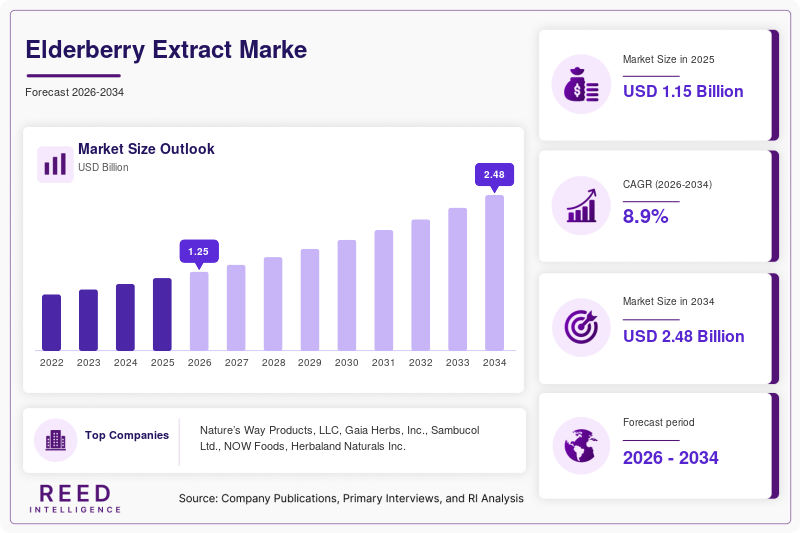
The global Elderberry Extract Market size was valued at approximately USD 1.15 billion in 2025 and is projected to reach USD 2.48 billion by 2034, expanding at a CAGR of 8.9% during the forecast period (2025–2034). The market has experienced steady expansion due to increasing consumer inclination toward plant-based nutraceuticals and functional ingredients. Elderberry extract, derived from Sambucus nigra, has gained widespread recognition for its antioxidant and immune-supporting properties, making it a preferred ingredient across dietary supplements, food & beverages, and pharmaceutical applications.
A major global factor supporting the growth of the Elderberry Extract Market is the rising awareness of preventive healthcare. Consumers are increasingly shifting toward natural remedies to strengthen immunity and reduce dependency on synthetic drugs. This transition has led manufacturers to incorporate elderberry extract into a wide range of products, including syrups, capsules, gummies, and fortified beverages.
Key Highlights
- North America dominated the market with a 38.6% share in 2025, while Asia Pacific is expected to register the fastest CAGR of 10.7% during the forecast period
- Dietary supplements emerged as the leading application segment with a 44.2% share, while functional beverages are projected to grow fastest at a CAGR of 11.3%
- Conventional elderberry extract accounted for the dominant type segment, whereas organic extracts are expected to expand at a CAGR of 10.9%
- The U.S. market was valued at USD 410 million in 2025 and is expected to reach USD 445 million in 2026
Market Trends
Expansion of Functional Food and Beverage Applications
The Elderberry Extract Market is witnessing increased incorporation of elderberry in functional foods and beverages. Manufacturers are developing immunity-boosting drinks, herbal teas, and fortified snacks infused with elderberry extract. This trend is driven by consumer demand for convenient health solutions that combine nutrition with functionality. As a result, food and beverage companies are investing in product innovation and formulation improvements to enhance taste and stability.
Rising Demand for Organic and Clean-Label Products
Another notable trend shaping the Elderberry Extract Market is the growing preference for organic and clean-label ingredients. Consumers are actively seeking products free from artificial additives, preservatives, and genetically modified components. Organic elderberry extracts are gaining traction as they align with sustainability and transparency expectations. This trend is encouraging suppliers to adopt eco-friendly farming practices and obtain certifications, thereby strengthening their market positioning.
Market Drivers
Increasing Consumer Focus on Immune Health
The growing emphasis on immune health has been a primary driver for the Elderberry Extract Market. Elderberry is widely recognized for its high content of flavonoids and vitamins that support immune function. This has led to increased adoption across nutraceutical products, especially during seasonal health concerns and changing lifestyles.
Growth of Nutraceutical and Herbal Supplement Industry
The rapid expansion of the global nutraceutical sector has significantly contributed to market growth. Elderberry extract is extensively used in capsules, syrups, and gummies due to its natural origin and perceived health benefits. The shift toward preventive healthcare and self-medication has further accelerated demand, prompting manufacturers to expand production capacities and diversify product offerings.
Market Restraint
Limited Raw Material Availability and Price Volatility
One of the key challenges in the Elderberry Extract Market is the limited availability of high-quality elderberries and fluctuations in raw material prices. Elderberries are primarily cultivated in specific climatic conditions, making supply susceptible to environmental changes such as adverse weather and crop diseases. This dependency on seasonal harvests can create supply-demand imbalances.
Additionally, the growing demand for elderberry extract has intensified pressure on cultivation and sourcing, leading to increased costs for manufacturers. Small-scale farmers often face challenges in meeting quality standards and certification requirements, further constraining supply. These factors collectively impact pricing stability and profit margins, posing a restraint to market expansion.
Market Opportunities
Expansion into Emerging Markets
Emerging economies present significant growth opportunities for the Elderberry Extract Market. Increasing disposable income, urbanization, and awareness of natural health products are driving demand in regions such as Asia Pacific and Latin America. Market players can capitalize on these trends by establishing distribution networks and launching region-specific products.
Innovation in Delivery Formats
The development of innovative delivery formats such as gummies, effervescent tablets, and ready-to-drink formulations offers new growth avenues. These formats enhance consumer convenience and appeal, particularly among younger demographics. Companies investing in product diversification and flavor enhancement are likely to gain a competitive advantage in the evolving market landscape.
Segmental Analysis
By Type
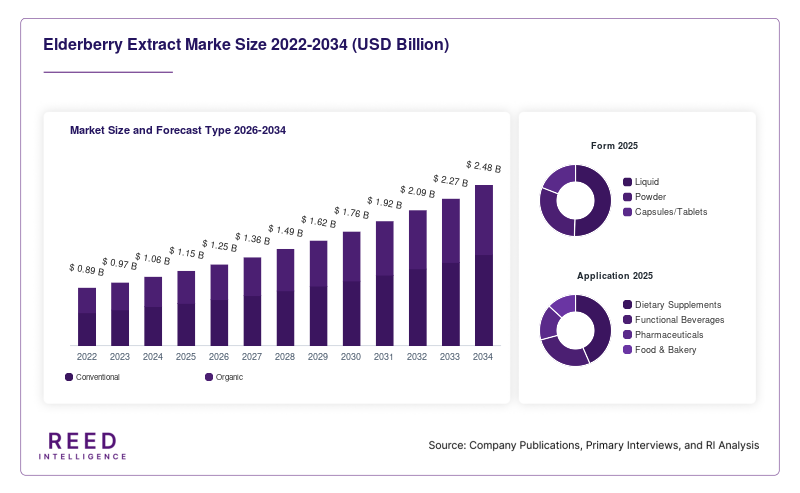
Conventional elderberry extract dominated the Elderberry Extract Market in 2025, accounting for 68.5% of the total share. This dominance was attributed to its widespread availability and lower production costs compared to organic variants. Manufacturers have traditionally relied on conventional farming practices to meet the growing demand for elderberry-based products.
Organic elderberry extract will grow at a CAGR of 10.9% during the forecast period. The increasing consumer preference for clean-label and sustainably sourced ingredients will drive demand for organic extracts. Certification standards and environmentally friendly cultivation practices will further enhance the appeal of this segment.
By Form
Liquid elderberry extract held the largest share of 46.7% in 2025. Its ease of incorporation into syrups, beverages, and tinctures made it a preferred choice among manufacturers and consumers. Liquid formulations offer faster absorption and versatility across applications.
Powdered elderberry extract is expected to grow at a CAGR of 10.5% over the forecast period. The rising demand for convenient and shelf-stable products will drive this segment. Powdered extracts are widely used in capsules, tablets, and functional foods, providing flexibility in product formulation.
By Application
Dietary supplements dominated the Elderberry Extract Market with a 44.2% share in 2025. The increasing use of elderberry extract in capsules, gummies, and syrups contributed to this dominance. Consumers’ focus on immunity and preventive health has driven demand in this segment.
Functional beverages will expand at a CAGR of 11.3% during the forecast period. The growing popularity of ready-to-drink health beverages and fortified drinks will support segment growth. Innovations in flavor and packaging will further enhance consumer adoption.
By Distribution Channel
Offline retail accounted for 61.4% of the market share in 2025. Supermarkets, pharmacies, and specialty stores have played a crucial role in product accessibility and consumer trust. In-store promotions and product visibility have supported sales growth.
Online retail is projected to grow at a CAGR of 12.1% during the forecast period. The increasing penetration of e-commerce platforms and digital marketing strategies will drive this segment. Consumers are increasingly opting for online purchases due to convenience and wider product availability.
Regional Analysis
North America
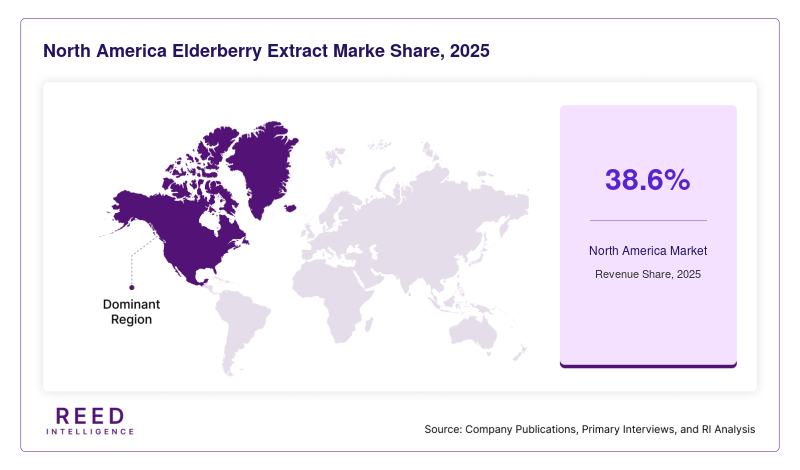
North America accounted for a 38.6% share of the Elderberry Extract Market in 2025 and will grow at a CAGR of 8.4% during the forecast period. The region has demonstrated strong adoption of herbal supplements and functional foods, supported by established distribution channels and consumer awareness.
The United States dominated the regional market due to its advanced nutraceutical industry and high consumer spending on health products. The presence of key manufacturers and continuous product innovation has further strengthened market growth. Increasing demand for plant-based immunity solutions has driven the integration of elderberry extract into mainstream dietary supplements.
Europe
Europe held a 27.3% share of the Elderberry Extract Market in 2025 and will expand at a CAGR of 8.1% through 2034. The region has a long-standing tradition of herbal medicine, which supports the adoption of elderberry-based products.
Germany emerged as the leading country due to its strong pharmaceutical and herbal product industry. The country’s focus on natural remedies and stringent quality standards has encouraged manufacturers to develop high-quality elderberry extracts. Growing consumer awareness regarding preventive healthcare has further contributed to market expansion.
Asia Pacific
Asia Pacific captured 19.8% of the Elderberry Extract Market in 2025 and will register the fastest CAGR of 10.7% during the forecast period. Rapid urbanization and rising health consciousness are key factors influencing market growth in the region.
China led the regional market due to its expanding nutraceutical and functional food sectors. The increasing popularity of traditional medicine combined with modern health products has created opportunities for elderberry extract adoption. Growing middle-class populations and evolving dietary preferences are expected to support future demand.
Middle East & Africa
The Middle East & Africa accounted for 7.1% of the Elderberry Extract Market in 2025 and will grow at a CAGR of 7.5% over the forecast period. The region is gradually adopting herbal and natural health products.
The United Arab Emirates dominated the regional market due to its well-developed retail infrastructure and increasing demand for premium health supplements. Rising awareness about immunity and wellness has encouraged consumers to explore plant-based products, including elderberry extract.
Latin America
Latin America held a 7.2% share of the Elderberry Extract Market in 2025 and will expand at a CAGR of 7.9% during the forecast period. The region is witnessing steady growth due to increasing health awareness and demand for natural products.
Brazil led the regional market owing to its growing nutraceutical industry and expanding retail sector. The rising popularity of herbal supplements and functional beverages has supported the adoption of elderberry extract across various applications.
Competitive Landscape
The Elderberry Extract Market is moderately fragmented, with several regional and global players competing based on product quality, innovation, and distribution networks. Companies are focusing on expanding their product portfolios and strengthening supply chains to maintain competitive positioning.
A leading player in the market is Nature’s Way Products, LLC, which has established a strong presence through its diverse range of elderberry-based supplements. The company recently introduced new gummy formulations targeting younger consumers, enhancing its market reach.
Other key players are investing in organic certifications, sustainable sourcing, and research and development to differentiate their offerings. Strategic partnerships and product launches remain key approaches for gaining market share.
Key Players
- Nature’s Way Products, LLC
- Gaia Herbs, Inc.
- Sambucol Ltd.
- NOW Foods
- Herbaland Naturals Inc.
- Solgar Inc.
- Blackmores Limited
- Bio-Botanica Inc.
- Nutra Green Biotechnology Co., Ltd.
- Pharmavite LLC
- Swanson Health Products
- Terranova Synergistic Nutrition
- Martin Bauer Group
- Indigo Herbs Ltd.
- Euromed S.A.
Recent Developments
- In 2025, Nature’s Way launched an expanded range of elderberry gummies with enhanced vitamin formulations
- Gaia Herbs introduced organic-certified elderberry syrup products to meet clean-label demand
- Herbaland Naturals expanded its production capacity for plant-based gummies
- Euromed S.A. invested in advanced extraction technologies to improve product quality
- NOW Foods strengthened its online distribution network to increase global reach
Elderberry Extract Marke Segments
Type
- Conventional
- Organic
Form
- Liquid
- Powder
- Capsules/Tablets
Application
- Dietary Supplements
- Functional Beverages
- Pharmaceuticals
- Food & Bakery
Distribution Channel
- Online Retail
- Offline Retail
By Region
- North America
- Europe
- APAC
- Middle East and Africa
- LATAM