Global Electric Control Panel Market Size, Share & Trends Analysis Report By Type (Power Control PanelsLow Voltage PanelsMedium Voltage PanelsHigh Voltage Panels, Motor Control Panels (MCPs)Direct-On-Line (DOL) StartersSoft StartersVariable Frequency Drives (VFDs), Automation Control PanelsPLC PanelsSCADA PanelsHMI Panels, Lighting Control PanelsTimer-Based PanelsSmart Lighting PanelsRemote-Control Panels), By Component (Circuit Breakers, Contactors and Relays, Terminal Blocks, PLC and HMIs), By
USD 3950
Electric Control Panel Market Size
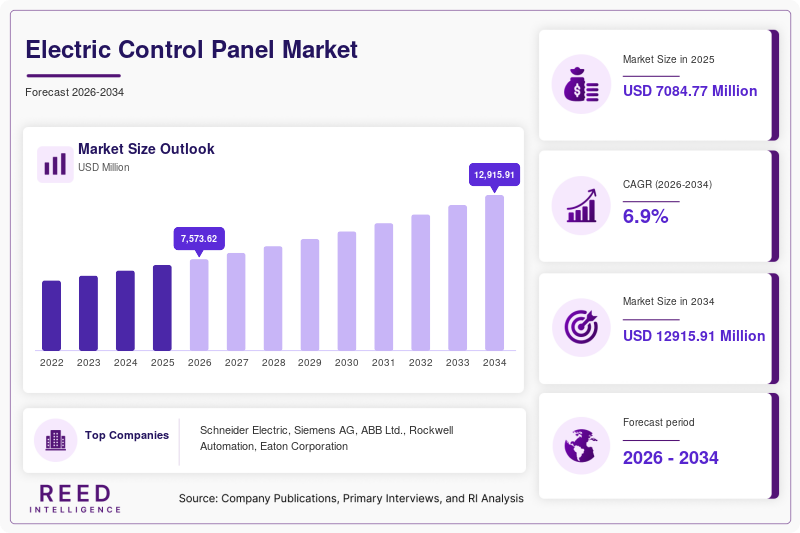
Global Electric Control Panel Market size is projected at USD 7,573.01 million in 2026 and is expected to hit USD 12,906.71 million by 2034 with a CAGR of 6.9%. The industry was valued at USD 7,084.77 million in 2025, indicating an absolute forecast-period addition of USD 5,333.70 million. The assessment covers type-level demand, component and application structures, regional performance, technology deployment, and the competitive landscape required for strategic market evaluation.
Key Takeaways
- Europe dominates regional revenue with 39.4% of the 2026 total and USD 2,981.02 million, while North America records the fastest supplied regional CAGR at 6.99%.
- Power Control Panels dominate type revenue with approximately 40.8% in 2026, equivalent to USD 3,091.38 million.
- Motor Control Panels (MCPs) are the fastest-growing supplied type, expanding at 7.11% CAGR to USD 2,784.35 million by 2034.
- Automation Control Panels represent approximately 21.8% of type revenue in 2026 and advance at 7.08% CAGR.
- Asia Pacific reaches USD 2,078.09 million by 2034 at a 6.87% CAGR, supported by major industrializing economies including China and India.
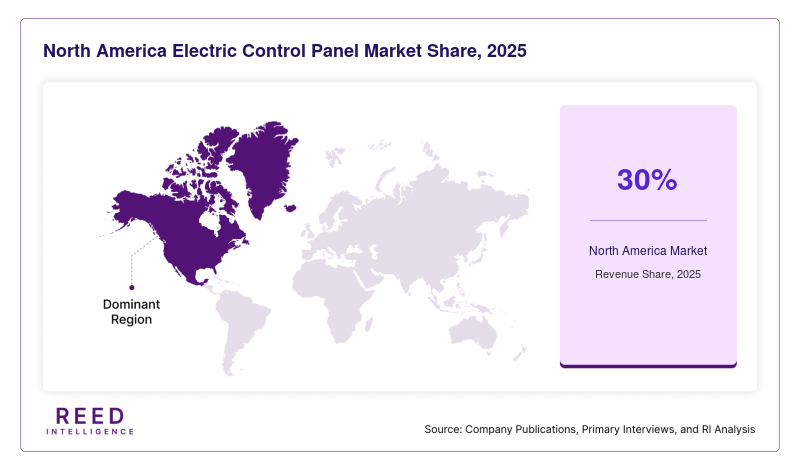
The electric control panel industry comprises engineered assemblies integrating switching, protection, motor-control, automation, monitoring, and operator-interface equipment for electrical and industrial systems. Based on the supplied regional dataset, Europe contributes 39.4% of 2026 revenue, North America 30.0%, Asia Pacific 16.1%, Middle East and Africa 8.0%, and LATAM 6.5%. By type, Power Control Panels contribute approximately 40.8%, Automation Control Panels 21.8%, Motor Control Panels 21.2%, Lighting Control Panels 10.5%, and Instrument Control Panels 5.7% of the supplied 2026 type total.
Electric Control Panel Market Trends
Digital, Connected and Modular Panel Architectures
Industrial control architectures are shifting from conventional relay-dominant assemblies toward PLCs, HMIs, variable-frequency drives, Ethernet-connected controllers, remote diagnostics, and modular enclosures. Modern installations can operate continuously on 24/7 production cycles while monitoring hundreds or thousands of digital and analog I/O points. Three-phase motor systems, intelligent protection devices, and digitally configured drives are increasingly combined within unified panels, reducing separate field equipment and supporting predictive maintenance.
Panel engineering is also moving toward compact wiring, push-in terminals, smart motor management, and standardized modular layouts. Schneider Electric highlights panel-building technologies including HMIs, Modicon PLCs, Altivar drives, TeSys motor-management equipment and compact push-in technology, while stating that smarter machine approaches can cut build time by 66% and costs by almost 30%.
Electric Control Panel Market Drivers
Industrial Automation and Electrification Accelerate Panel Deployment
Expansion of automated manufacturing, renewable-power integration, water infrastructure, HVAC controls and data-center electrical systems is increasing the number of controlled electrical loads per facility. Production environments increasingly require 24-hour, 7-day monitoring, multi-motor control, PLC-based sequencing and protection across low- and medium-voltage networks. Siemens' SIPANEL platform, for example, combines protection, automation and control functions and is produced in ISO 9001 and UL 508A certified facilities, illustrating the industry's movement toward standardized, scalable engineered-panel production.
Electric Control Panel Market Restraints
Engineering Complexity and Retrofit Costs Limit Rapid Replacement
Control-panel modernization can require replacement of PLCs, HMIs, breakers, drives, contactors, field wiring and communications simultaneously. A facility containing dozens of motors and hundreds of I/O points may therefore face substantially greater engineering complexity than a simple component replacement. Compliance requirements such as UL 508A and ISO 9001 practices add documentation, testing and quality-control stages. Legacy modernization also requires maintaining production availability approaching 24/7, making shutdown windows and compatibility constraints important barriers.
Electric Control Panel Market Opportunities
Smart Infrastructure and Legacy Modernization Create New Revenue Pools
Utilities, microgrids, smart buildings and industrial operators provide substantial opportunities for retrofit-oriented panel builders. Digitally connected designs can combine 2-way machine communication, multiple PLC/HMI interfaces and continuous 24/7 condition monitoring. Siemens specifically positions customizable SIPANEL configurations for utilities, industrial operators, microgrids and smart infrastructure and supports retrofit applications intended to modernize legacy systems with limited disruption. Schneider Electric similarly integrates PLCs, HMIs, variable-speed drives, soft starters and protection relays into its panel ecosystem.
Challenges in Global Electric Control Panel Market
Cybersecurity, Interoperability and Skilled Engineering Remain Critical
The transition from isolated electrical cabinets to connected PLC, SCADA and HMI architectures introduces interoperability and cybersecurity requirements alongside traditional electrical safety. A single installation can combine 3-phase power, multiple communication protocols, hundreds of I/O channels and 24/7 remote access requirements. Engineering teams must consequently coordinate electrical protection, software configuration, network architecture, thermal management and lifecycle support while meeting standards such as UL 508A and IEC 61439-2, increasing design and commissioning complexity.
Electric Control Panel Market Segmentation
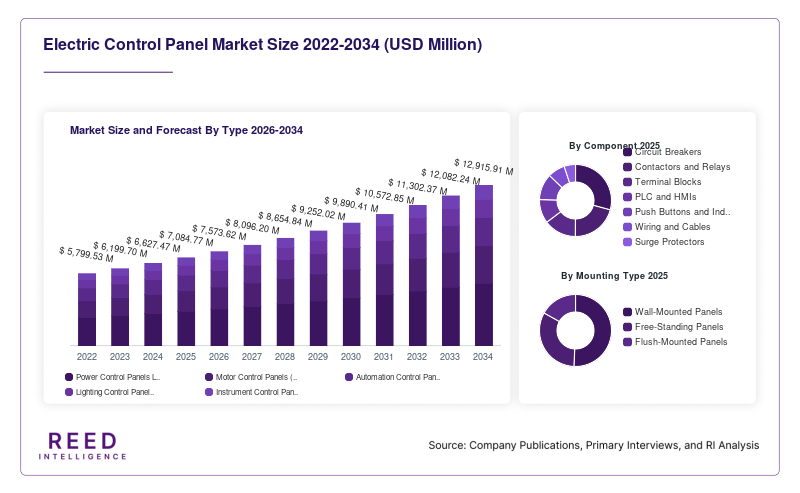
The supplied type segmentation totals USD 7,577.64 million in 2026. Power Control Panels lead with approximately 40.8%, followed by Automation Control Panels at 21.8%, Motor Control Panels at 21.2%, Lighting Control Panels at 10.5%, and Instrument Control Panels at 5.7%.
By Type
Power Control Panels, comprising low-, medium- and high-voltage panels, are the largest category at USD 3,091.38 million in 2026 and USD 5,279.88 million by 2034, advancing at 6.92% CAGR. Their leadership reflects broad power-distribution requirements across factories, utilities and infrastructure.
Motor Control Panels, including DOL starters, soft starters and VFD configurations, record the fastest supplied type CAGR of 7.11%, rising from USD 1,607.25 million in 2026 to USD 2,784.35 million by 2034. Automation Control Panels reach USD 2,858.63 million at 7.08% CAGR, while Lighting and Instrument Control Panels advance at 6.64% and 6.76%, respectively.
By Component
Component segmentation includes circuit breakers, contactors and relays, terminal blocks, PLCs and HMIs, push buttons and indicators, wiring and cables, and surge protectors. Power switching and protection hardware remains fundamental to panel construction, while PLC/HMI integration gains importance as industrial assets become digitally controlled.
Component selection increasingly depends on voltage class, switching cycles, fault protection, communications and enclosure requirements. PLC/HMI and intelligent relay architectures are positioned for stronger adoption than conventional electromechanical-only configurations as facilities increase automated I/O, remote diagnostics and variable-speed motor control.
By Mounting Type
Wall-mounted, free-standing and flush-mounted configurations address different space, power-density and accessibility requirements. Wall-mounted systems typically serve compact machine and building-control installations, whereas free-standing panels support higher component counts and industrial distribution applications.
Demand is shifting toward configurations capable of accommodating additional PLCs, drives, communication modules and thermal-management equipment without extensive redesign. Modular free-standing systems consequently offer advantages where expansion capacity and multi-circuit integration are priorities.
By Form Factor
Open panels, enclosed panels and custom modular panels form the principal form-factor categories. Enclosed designs support protection against environmental exposure and accidental contact, while open designs remain applicable within protected electrical rooms and machinery.
Custom modular panels are positioned for faster expansion as end users seek scalable configurations combining multiple control functions. Modular layouts can reduce redesign requirements when adding VFDs, PLC I/O, relays or network equipment.
By Application
Applications span industrial automation, power distribution, HVAC, water and wastewater management, oil and gas, and infrastructure and buildings. Industrial automation incorporates assembly lines, packaging, robotics and material handling, while power-distribution systems cover substations, generators and renewable integration.
Automation-intensive applications are expected to record stronger adoption as PLC, SCADA, HMI and VFD functionality expands. Water systems increasingly employ pump control and SCADA monitoring, while buildings integrate HVAC, lighting, elevators and security systems into centralized electrical-control architectures.
By End-User
Manufacturing and process industries, commercial buildings, utilities, oil and gas companies, municipal infrastructure, and data centers represent major customer groups. Manufacturing requires coordinated motor, process and machine control, while utilities emphasize protection and distribution reliability.
Data centers and digitally managed commercial facilities represent increasingly sophisticated applications because uninterrupted power, HVAC operation and backup-system coordination require continuous monitoring. Municipal water infrastructure similarly depends on distributed pump and treatment-control systems.
Electric Control Panel Market Regional Outlook
North America
North America accounts for approximately 30.0% of the supplied 2026 regional total, increasing from USD 2,274.00 million in 2026 to USD 3,904.23 million in 2034 at 6.99% CAGR. The United States is the principal industrial contributor, supported by manufacturing automation, utilities, data centers and infrastructure modernization. Siemens expanded U.S. SIPANEL assembly in North Carolina in 2025 for protection, automation and control applications.
Europe
Europe is the largest region, contributing approximately 39.4% in 2026. Revenue rises from USD 2,981.02 million to USD 5,053.41 million by 2034 at 6.82% CAGR. Germany, France, Italy and the United Kingdom represent important automation and electrical-equipment centers, with manufacturing, building automation, renewable integration and utility modernization supporting demand.
APAC
Asia Pacific represents approximately 16.1% of the 2026 regional total and advances from USD 1,221.29 million to USD 2,078.09 million by 2034 at 6.87% CAGR. China, India, Japan and South Korea underpin regional deployment through manufacturing, infrastructure, data centers, water systems and industrial automation.
Middle East and Africa
Middle East and Africa contributes approximately 8.0% in 2026, increasing from USD 605.66 million to USD 1,029.80 million by 2034 at 6.86% CAGR. Gulf economies support deployment through oil and gas, utilities, water treatment, buildings and infrastructure, while African demand is concentrated around electrification and municipal systems.
LATAM
LATAM represents approximately 6.5% of 2026 revenue and reaches USD 841.18 million by 2034 from USD 491.04 million, registering 6.96% CAGR. Brazil and Mexico are central contributors, supported by manufacturing, utilities, commercial infrastructure, mining and process-industry automation.
Top players in Global Electric Control Panel Market
- Schneider Electric
- Siemens AG
- ABB Ltd.
- Rockwell Automation
- Eaton Corporation
- Mitsubishi Electric Corporation
- Honeywell International Inc.
- Emerson Electric Co.
- General Electric
- Fuji Electric Co., Ltd.
- Rittal GmbH & Co. KG
- WEG S.A.
- Larsen & Toubro
- Omron Corporation
- Phoenix Contact
Top Two Companies
-
Schneider Electric: Schneider Electric maintains a broad control-panel ecosystem spanning circuit protection, contactors, relays, push buttons, HMIs, PLC/PAC controllers, variable-speed drives and soft starters. Its 2025 Automation and Control Essentials portfolio incorporates Modicon PLCs, Altivar drives, TeSys motor management and Harmony operator devices. Schneider reports panel-building approaches capable of cutting build time by 66% and costs by almost 30% in relevant smart-machine implementations. A defensible company-level percentage of global industry revenue is not disclosed in the supplied dataset; therefore, no unsupported percentage is assigned.
-
Siemens AG: Siemens competes through industrial automation, electrification, motor-control and engineered-panel capabilities. Its SIPANEL offering supports protection, automation, power distribution, microgrids and smart infrastructure, with configurable retrofit capabilities for legacy installations. In 2025, Siemens expanded SIPANEL production in Wendell, North Carolina, using ISO 9001 and UL 508A certified manufacturing infrastructure. A verified company-specific percentage of worldwide panel revenue is unavailable in the mandatory input data and public source reviewed, so an unsupported percentage is not stated.
Recent Developments in Global Electric Control Panel Market
- 2026: Siemens' worldwide Industry Mall catalog listed its control-panel solutions in its February 2026 product catalog, maintaining integrated HMI and machine-control offerings.
- 2025: Siemens expanded its SIPANEL protection, automation and control-panel offering in the United States, with engineering and assembly located in Wendell, North Carolina.
- 2025: Schneider Electric issued its Automation and Control Essentials Catalog 2025, covering HMIs, PLCs, drives, motor management, safety modules and enclosure technologies.
- 2025: Schneider Electric's panel-builder portfolio emphasized smart-panel integration across variable-speed drives, soft starters, PLC/PAC controllers, HMIs and protection relays, alongside reported build-time reductions of 66% in highlighted implementations.
- 2025: Siemens positioned SIPANEL for custom retrofit projects, utilities, microgrids, industrial operators and smart-infrastructure applications, combining engineering, assembly, testing and commissioning support within its certified U.S. facility.
Electric Control Panel Market Segments
By Type
-
Power Control Panels
- Low Voltage Panels
- Medium Voltage Panels
- High Voltage Panels
-
Motor Control Panels (MCPs)
- Direct-On-Line (DOL) Starters
- Soft Starters
- Variable Frequency Drives (VFDs)
-
Automation Control Panels
- PLC Panels
- SCADA Panels
- HMI Panels
-
Lighting Control Panels
- Timer-Based Panels
- Smart Lighting Panels
- Remote-Control Panels
-
Instrument Control Panels
- Pressure/Temperature Controllers
- Flow Monitoring Panels
- Sensor Interface Panels
By Component
- Circuit Breakers
- Contactors and Relays
- Terminal Blocks
- PLC and HMIs
- Push Buttons and Indicators
- Wiring and Cables
- Surge Protectors
By Mounting Type
- Wall-Mounted Panels
- Free-Standing Panels
- Flush-Mounted Panels
By Form Factor
- Open Panels
- Enclosed Panels
- Custom Modular Panels
By Application
-
Industrial Automation
- Assembly Lines
- Packaging Systems
- Robotics and Material Handling
-
Power Distribution
- Grid Substations
- Backup Generators
- Renewable Integration
-
HVAC Systems
- Building Climate Control
- Smart Thermostats
- Chiller Plant Control
-
Water and Wastewater Management
- Pump Control
- SCADA Systems
- Water Treatment Monitoring
-
Oil and Gas
- Drilling Rig Panels
- Explosion-Proof Panels
- Pipeline Monitoring
-
Infrastructure and Buildings
- Building Automation Systems (BAS)
- Lighting Control
- Elevator and Security System Panels
By End-User
- Manufacturing and Process Industries
- Commercial Buildings
- Utilities and Power Generation
- Oil and Gas Companies
- Municipal Infrastructure (Water, Waste)
- Data Centers and IT Parks
By Region
- North America
- Europe
- APAC
- Middle East and Africa
- LATAM