Electric Scooter Lift Carrier Market Size, Share & Demand Report By Product Type (Platform Lift Carriers, Internal Hoist Lift Systems, Hitch-Mounted Carriers, Hybrid Lift Carriers), By Vehicle Compatibility (SUVs and Crossovers, Vans, Sedans, Compact Vehicles), By End Use (Individual Consumers, Healthcare Transportation Providers, Rehabilitation Centers, Assisted Living Facilities), By Region & Segment Forecasts, 2026–2034
USD 3950
Market Overview
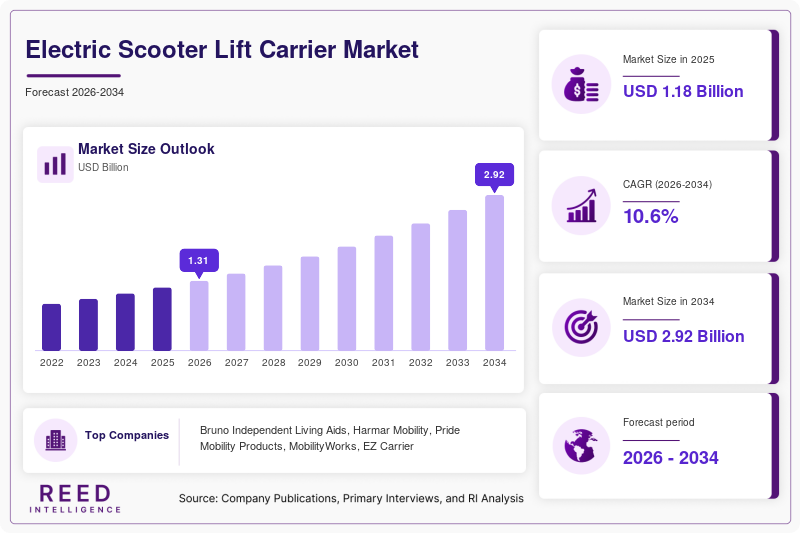
The global Electric Scooter Lift Carrier Market size was valued at approximately USD 1.18 billion in 2026 and is projected to reach nearly USD 2.64 billion by 2034, expanding at a CAGR of 10.6% during the forecast period from 2026 to 2034. The market is gaining momentum as mobility assistance products become increasingly integrated into personal transportation systems across developed and emerging economies. Electric scooter lift carriers are vehicle-mounted systems designed to transport mobility scooters and power wheelchairs safely, improving accessibility for elderly individuals and people with physical disabilities. Rising aging populations, increasing healthcare awareness, and growing adoption of mobility devices continue to support long-term market expansion.
One major global factor contributing to market growth is the rapid increase in elderly demographics and mobility-impaired populations worldwide. Governments and healthcare organizations are encouraging independent mobility solutions, leading to stronger demand for electric scooters and compatible transportation accessories. Consumers are also prioritizing convenience and vehicle compatibility, resulting in higher adoption of automatic and lightweight lift carriers. Technological improvements in hydraulic lifting systems, corrosion-resistant materials, foldable structures, and remote-control operations are further strengthening industry demand. In addition, SUV and crossover vehicle ownership has increased substantially, creating a favorable environment for hitch-mounted and platform-based lift carriers.
Key Highlights
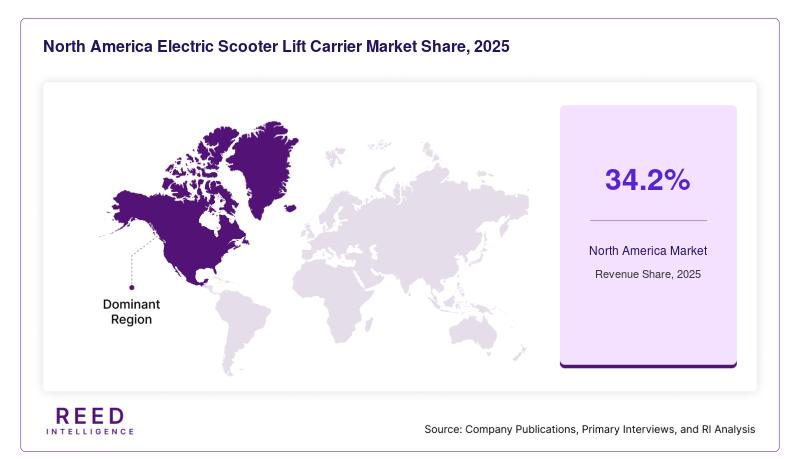
- North America dominated the market with a 34.2% share in 2025.
- Asia Pacific is expected to grow at the fastest CAGR of 11.8% during 2026–2034.
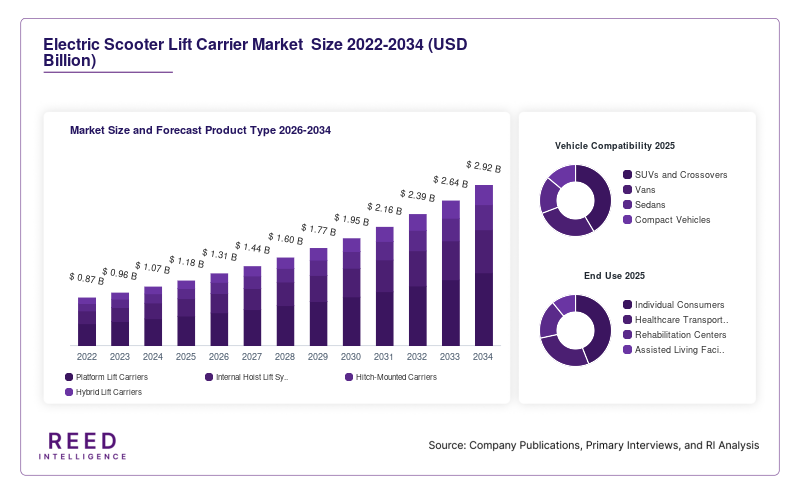
- By product type, platform lift carriers accounted for the largest share of 42.7%.
- while internal hoist lift systems are projected to grow at a CAGR of 12.1%.
- By vehicle compatibility, SUVs and crossover vehicles led with a 39.4% share.
- whereas compact vehicle-compatible carriers are expected to expand at a CAGR of 11.6%.
- By end use, individual consumers held a 48.3% share, while healthcare transportation providers are anticipated to grow at a CAGR of 12.4%.
- The United States remained the dominant country, with market values of USD 368 million in 2024 and USD 401 million in 2025.
Market Trends
Smart and Automated Lift Systems Increasing Product Adoption
The Electric Scooter Lift Carrier Market is witnessing a growing preference for smart and automated lifting solutions that reduce manual handling and improve safety. Manufacturers are integrating remote-control operation, automatic folding systems, anti-sway locking technology, and wireless monitoring functions into modern lift carriers. These innovations are improving convenience for elderly users and caregivers who require easy-to-operate mobility transportation equipment. Consumers increasingly prefer lightweight aluminum-based lift systems with enhanced durability and lower maintenance requirements. Vehicle owners are also seeking compact systems that can be installed without extensive vehicle modification, especially for SUVs and crossover vehicles.
Digital integration is becoming a noticeable trend across premium lift carrier products. Some manufacturers are introducing battery monitoring systems and smartphone-enabled operational controls to enhance usability. The growing acceptance of connected mobility equipment among aging consumers is supporting higher adoption rates in developed economies. Additionally, smart lifting systems help reduce loading injuries and operational errors, which is encouraging rehabilitation centers and healthcare transportation providers to upgrade traditional carrier systems. These technology-focused developments are expected to reshape product competition during the forecast period.
Expansion of Lightweight and Compact Carrier Designs
Manufacturers in the Electric Scooter Lift Carrier Market are increasingly focusing on lightweight and compact product development to address changing vehicle preferences and urban transportation trends. Consumers now favor smaller vehicles with improved fuel efficiency, creating demand for portable and foldable lift carriers that occupy less storage space. Aluminum and composite materials are replacing conventional steel structures in many newly launched products because they offer improved corrosion resistance and easier installation. Compact designs are also gaining popularity among users who frequently travel and require flexible mobility transportation systems.
The market is additionally benefiting from the growing popularity of modular carrier systems that can support multiple scooter sizes and wheelchair configurations. This flexibility helps consumers avoid frequent equipment replacement when mobility requirements change. Manufacturers are also designing aerodynamic carrier systems that minimize vehicle drag and improve driving stability. In urban regions where parking and storage limitations are common, compact lift carriers are becoming an attractive solution for individual users and assisted living service providers. The trend toward user-friendly and space-efficient designs is expected to remain a significant growth contributor over the next decade.
Market Drivers
Rising Elderly Population Supporting Mobility Equipment Demand
The increasing global elderly population remains one of the primary growth drivers for the Electric Scooter Lift Carrier Market. Aging individuals often experience reduced mobility and require transportation assistance for daily activities, medical visits, and social engagement. Electric mobility scooters have become widely adopted among elderly users because they support independent movement and reduce physical strain. As scooter ownership rises, demand for reliable transportation carriers is expanding simultaneously. Governments in several countries are investing in healthcare accessibility initiatives, indirectly supporting adoption of mobility assistance equipment and related transportation systems.
Families and caregivers are also seeking safer and more efficient methods for transporting mobility scooters during travel. Electric scooter lift carriers reduce manual lifting requirements, minimizing injury risks for caregivers and improving overall convenience. Increased awareness regarding independent living solutions for elderly populations is further accelerating product adoption. Developed economies with rapidly aging populations, including the United States, Germany, Japan, and Canada, are generating consistent market demand. In emerging economies, improving healthcare infrastructure and rising disposable income are gradually supporting greater adoption of mobility transportation products.
Growth in Accessible Transportation and Healthcare Services
Expanding healthcare transportation services and accessible mobility infrastructure are contributing significantly to Electric Scooter Lift Carrier Market growth. Rehabilitation centers, nursing facilities, and patient transportation companies are increasingly using mobility scooters and powered wheelchairs for patient movement and daily operations. Efficient transportation systems are necessary to support these mobility devices across medical facilities and public environments. Electric scooter lift carriers provide a safer and faster loading process, helping healthcare organizations improve operational efficiency and patient comfort.
Public awareness regarding disability inclusion and accessible travel is also influencing consumer purchasing behavior. Travel companies, assisted living communities, and medical transport providers are investing in accessible transportation fleets equipped with lift carrier systems. Automotive manufacturers are additionally collaborating with mobility equipment suppliers to improve compatibility between lift systems and modern vehicles. Insurance reimbursement programs and healthcare subsidies in several countries are helping consumers purchase advanced mobility equipment more affordably. These combined factors are strengthening long-term industry growth and encouraging innovation across vehicle-mounted accessibility solutions.
Market Restraint
High Installation and Equipment Costs Limiting Mass Adoption
High product and installation costs remain a significant restraint affecting the Electric Scooter Lift Carrier Market, particularly in price-sensitive economies. Advanced lift carrier systems equipped with hydraulic automation, electronic controls, and heavy-duty platforms often require substantial upfront investment. In addition to product pricing, consumers frequently incur additional expenses related to professional installation, vehicle modifications, wiring systems, and maintenance services. These cumulative costs can discourage middle-income consumers from adopting advanced lift carrier technologies despite growing mobility needs.
The challenge is more evident in developing regions where healthcare reimbursement systems and mobility assistance subsidies remain limited. Consumers may prefer manual ramps or lower-cost transportation alternatives instead of automated carrier systems. Smaller healthcare transportation providers also face budget limitations that restrict fleet upgrades and large-scale equipment adoption. Furthermore, certain compact vehicles lack compatibility with heavy-duty lift carriers, requiring consumers to purchase larger vehicles or customized mounting systems. This creates additional financial pressure and slows product penetration in urban markets. Although manufacturers are introducing lightweight and affordable solutions, pricing sensitivity continues to affect broader industry expansion and competitive positioning across emerging markets.
Market Opportunities
Expansion of E-Commerce and Direct-to-Consumer Distribution
The rapid growth of e-commerce platforms and direct-to-consumer sales channels presents a strong opportunity for the Electric Scooter Lift Carrier Market. Consumers increasingly research and purchase mobility assistance products online because digital platforms provide detailed product comparisons, installation videos, and customer reviews. Manufacturers are leveraging online retail channels to reach wider customer bases while reducing dependency on traditional dealership networks. This distribution transformation is particularly beneficial for small and medium-sized manufacturers seeking international market exposure.
Online sales channels also allow companies to offer customized product bundles, financing options, and remote technical support services. Consumers in rural and underserved regions can now access specialized mobility transportation equipment more easily than before. Additionally, digital marketing campaigns targeting elderly users and caregivers are improving product awareness globally. Subscription-based maintenance packages and online installation consultation services are becoming more common, helping manufacturers strengthen customer relationships. As digital healthcare purchasing behavior continues to increase, e-commerce expansion is expected to generate substantial long-term growth opportunities for industry participants.
Emerging Demand from Urban Mobility and Travel Applications
Urban mobility trends and accessible travel demand are creating new growth opportunities within the Electric Scooter Lift Carrier Market. Increasing participation of elderly and mobility-impaired individuals in tourism, outdoor recreation, and community activities is encouraging demand for portable transportation systems. Consumers are seeking flexible lift carriers that support long-distance travel while maintaining ease of vehicle access. Recreational vehicle owners, tourism companies, and accessible transportation providers are investing in mobility-friendly infrastructure and transportation accessories.
Urbanization is also driving the need for compact carrier systems compatible with smaller parking spaces and city vehicles. Manufacturers are developing foldable and detachable lift carriers that can operate efficiently in congested urban environments. Shared mobility service providers and accessible ride-sharing operators are beginning to integrate mobility scooter transportation solutions into vehicle fleets. These developments create opportunities for manufacturers to diversify product offerings and expand into commercial mobility services. Increasing public investments in inclusive transportation infrastructure are likely to further accelerate demand for adaptable and travel-oriented lift carrier systems over the forecast period.
Segmental Analysis
By Product Type
Platform lift carriers held the dominant share of the Electric Scooter Lift Carrier Market in 2024, accounting for approximately 42.7% of total revenue. These systems are widely preferred because they provide stable scooter transportation, higher weight capacity, and compatibility with multiple mobility device sizes. Platform lift carriers are commonly used with SUVs, vans, and crossover vehicles, making them suitable for both personal and commercial applications. Consumers favor these systems because they offer easier loading and unloading operations compared to traditional ramp-based alternatives. Commercial healthcare transportation providers also prefer platform carriers due to their operational reliability and reduced manual handling requirements.
Internal hoist lift systems are projected to register the fastest CAGR of 12.1% during the forecast period. These systems are gaining popularity because they protect mobility scooters from external weather exposure and improve vehicle security. Consumers increasingly prefer internal hoist systems for premium vehicles and long-distance travel applications where equipment safety is important. Technological advancements in compact hydraulic mechanisms and lightweight lifting components are improving installation flexibility. Growing demand for aesthetically integrated vehicle solutions is also supporting adoption. Manufacturers are introducing automated folding and remote-control hoist systems that simplify scooter transportation while maximizing interior vehicle storage efficiency.
By Vehicle Compatibility
SUVs and crossover vehicles represented the leading subsegment within the Electric Scooter Lift Carrier Market in 2024, capturing nearly 39.4% of overall revenue. These vehicle categories provide greater towing capacity, higher ground clearance, and improved mounting flexibility for lift carrier systems. Consumers increasingly prefer SUVs because they accommodate heavier mobility scooters and allow easier installation of platform-based transportation systems. Rising global SUV sales are directly supporting demand for hitch-mounted lift carriers across North America, Europe, and Asia Pacific. Healthcare transportation providers also favor SUVs due to their passenger comfort and adaptable cargo configurations.
Compact vehicle-compatible lift carriers are expected to witness the fastest CAGR of 11.6% over the forecast period. Urbanization and increasing fuel efficiency concerns are encouraging consumers to purchase smaller vehicles, creating demand for lightweight carrier systems designed specifically for compact automotive platforms. Manufacturers are responding by developing foldable and modular carrier solutions with reduced structural weight and improved space utilization. Compact lift carriers are becoming increasingly attractive in densely populated cities where parking limitations and narrow road infrastructure create transportation challenges. Technological advancements in aluminum-based carrier systems are further improving compatibility with smaller passenger vehicles.
By End Use
Individual consumers accounted for the largest share of the Electric Scooter Lift Carrier Market in 2024, representing approximately 48.3% of global demand. Rising ownership of mobility scooters among elderly users and physically disabled individuals continues to drive segment growth. Consumers increasingly seek transportation systems that improve travel flexibility and reduce dependence on caregivers. Vehicle-mounted lift carriers provide greater independence for users attending medical appointments, recreational activities, and social engagements. The segment is also benefiting from increased awareness regarding aging-in-place solutions and independent living support technologies across developed economies.
Healthcare transportation providers are anticipated to expand at the fastest CAGR of 12.4% during the forecast period. Rehabilitation centers, assisted living communities, patient transport operators, and non-emergency medical transportation services are increasingly investing in advanced mobility transportation equipment. Lift carrier systems help these organizations improve operational efficiency by reducing loading times and minimizing physical strain on healthcare staff. The growing need for accessible transportation infrastructure is encouraging commercial fleet operators to adopt automated lifting technologies. Rising healthcare investments and increasing demand for specialized patient transportation services are expected to sustain strong growth within this end-use segment.
Regional Analysis
North America
North America accounted for the largest share of the Electric Scooter Lift Carrier Market in 2025, representing approximately 34.2% of global revenue. The region is expected to maintain stable growth at a CAGR of 9.8% through 2034 due to rising demand for mobility assistance products and accessible transportation systems. Strong healthcare infrastructure, higher consumer purchasing power, and widespread adoption of electric mobility scooters continue to support regional expansion. The increasing popularity of SUVs and recreational vehicles also creates favorable conditions for vehicle-mounted lift carrier systems across the United States and Canada.
The United States remains the dominant contributor within North America due to its large elderly population and advanced accessibility regulations. Consumers in the country increasingly prioritize independent mobility solutions, especially among aging veterans and rehabilitation patients. One unique growth factor supporting the U.S. market is the strong presence of mobility equipment rental and travel assistance services. These businesses frequently invest in advanced lift carriers to improve transportation accessibility for tourists and patients, creating consistent commercial demand for premium automated lifting systems.
Europe
Europe represented a substantial portion of the Electric Scooter Lift Carrier Market in 2025 and is projected to expand at a CAGR of 9.6% during the forecast period. Rising awareness regarding disability accessibility and aging population management is encouraging wider adoption of mobility transportation equipment throughout the region. Government-backed healthcare programs and mobility assistance subsidies are improving consumer access to advanced scooter transportation solutions. The market is additionally benefiting from growing demand for lightweight and energy-efficient vehicle accessories that align with regional sustainability goals.
Germany remains the leading country in the European market due to its advanced healthcare infrastructure and strong automotive manufacturing sector. Consumers in Germany increasingly prefer technologically advanced mobility support products with enhanced safety features and compact designs. One unique growth factor driving the German market is the integration of accessible transportation standards into urban mobility planning. Public and private transportation providers are expanding accessibility initiatives, increasing demand for vehicle-compatible mobility transportation systems across healthcare and assisted living sectors.
Asia Pacific
Asia Pacific is anticipated to register the fastest CAGR of 11.8% between 2026 and 2034 in the Electric Scooter Lift Carrier Market. Rapid urbanization, improving healthcare awareness, and expanding elderly populations are supporting strong regional growth. Countries across the region are witnessing rising adoption of mobility scooters among aging citizens and physically disabled individuals. Growing disposable income and improving healthcare accessibility are encouraging consumers to invest in advanced transportation assistance equipment. The increasing availability of affordable lift carriers from regional manufacturers is also strengthening market penetration.
Japan remains the dominant country in the Asia Pacific market because of its rapidly aging demographic structure and strong demand for elderly care technologies. The country has a high concentration of mobility scooter users who require reliable transportation solutions for urban and suburban travel. One unique growth factor supporting the Japanese market is the widespread adoption of compact mobility technologies designed for dense urban environments. Manufacturers are developing highly space-efficient lift carriers tailored for smaller vehicles and limited parking spaces, improving product suitability for urban consumers.
Middle East & Africa
The Middle East & Africa region is gradually emerging within the Electric Scooter Lift Carrier Market and is forecast to grow at a CAGR of 8.7% during the assessment period. Improving healthcare infrastructure and rising investments in disability support services are creating favorable market conditions. Wealthier Gulf countries are increasingly adopting advanced mobility assistance equipment as part of broader healthcare modernization programs. Growing awareness regarding independent mobility for elderly individuals and patients recovering from injuries is also contributing to rising product demand across urban healthcare facilities.
Saudi Arabia represents the leading market within the region due to its ongoing healthcare transformation initiatives and infrastructure development programs. Hospitals, rehabilitation centers, and mobility equipment suppliers are investing in advanced transportation support systems to improve patient accessibility. One unique growth factor driving regional expansion is the increasing development of accessible tourism infrastructure. Hotels, airports, and transportation providers are adopting mobility-friendly services, creating demand for electric scooter transportation solutions and compatible vehicle-mounted lift carrier systems.
Latin America
Latin America is experiencing moderate but steady growth in the Electric Scooter Lift Carrier Market and is expected to expand at a CAGR of 8.9% through 2034. Increasing urban healthcare investments and improving mobility assistance awareness are supporting market development across several countries. Rising middle-class income levels are enabling more consumers to purchase mobility scooters and related transportation accessories. Demand for lightweight and cost-effective carrier systems is particularly strong in urban centers where vehicle ownership and healthcare accessibility continue to improve gradually.
Brazil remains the dominant country in the Latin American market due to its large population and expanding healthcare support programs. Mobility assistance adoption is increasing among elderly consumers and rehabilitation patients seeking independent transportation solutions. One unique growth factor supporting the Brazilian market is the expansion of private healthcare transportation services. These providers are investing in accessible vehicle fleets equipped with scooter lift carriers to improve patient transport efficiency and accommodate growing healthcare service demand in metropolitan areas.
Competitive Landscape
The Electric Scooter Lift Carrier Market is moderately fragmented, with several regional and international manufacturers competing through product innovation, distribution expansion, and vehicle compatibility improvements. Companies are focusing on lightweight materials, automated lifting technologies, and compact product designs to strengthen competitive positioning. Strategic partnerships with automotive dealers, healthcare providers, and mobility equipment distributors are becoming increasingly common across the industry.
Bruno Independent Living Aids remains one of the leading market participants due to its extensive portfolio of vehicle lift systems and strong distribution network across North America. The company recently introduced upgraded scooter lift systems with enhanced remote-control functionality and improved weather-resistant components. Harmar Mobility, Pride Mobility Products, EZ Carrier, and MobilityWorks also maintain strong market presence through diversified accessibility product offerings and ongoing product development initiatives.
Manufacturers are increasingly investing in smart technology integration, including wireless controls and automated safety locking systems. Several companies are additionally expanding e-commerce operations to improve direct consumer engagement and after-sales support. Competitive intensity is expected to increase further as regional manufacturers introduce lower-cost alternatives targeting emerging economies and urban mobility applications.
Key Players
- Bruno Independent Living Aids
- Harmar Mobility
- Pride Mobility Products
- MobilityWorks
- EZ Carrier
- Silver Star Mobility
- Challenger Mobility
- ScootaTrailer
- Drive Medical
- Golden Technologies
- Pride Jazzy
- Adaptive Switch Laboratories
- Freedom Mobility Systems
- Liftavator
- Mobility Innovations
Recent Developments
- Harmar Mobility introduced a next-generation lightweight aluminum scooter lift carrier with improved corrosion resistance and remote-control operation capabilities in 2025.
- Bruno Independent Living Aids expanded its dealer network across Asia Pacific in 2024 to strengthen market penetration in emerging elderly care markets.
- MobilityWorks partnered with rehabilitation service providers in North America during 2025 to supply customized accessible transportation vehicles equipped with advanced scooter lift systems.
- EZ Carrier launched compact foldable lift carriers designed specifically for urban crossover vehicles and small SUVs in 2024.
- Pride Mobility Products enhanced its automated locking technology for vehicle-mounted scooter transportation systems to improve user safety and loading stability in 2025.
Electric Scooter Lift Carrier Market Segments
Product Type
- Platform Lift Carriers
- Internal Hoist Lift Systems
- Hitch-Mounted Carriers
- Hybrid Lift Carriers
Vehicle Compatibility
- SUVs and Crossovers
- Vans
- Sedans
- Compact Vehicles
End Use
- Individual Consumers
- Healthcare Transportation Providers
- Rehabilitation Centers
- Assisted Living Facilities
By Region
- North America
- Europe
- APAC
- Middle East and Africa
- LATAM