Electric Toothbrush Market Size, Share & Trends Analysis Report By Technology, End Use, Distribution Channel and By Region (North America, Europe, APAC, Middle East and Africa, LATAM) Forecasts, 2026-2034
USD 3950
Electric Toothbrush Market Size
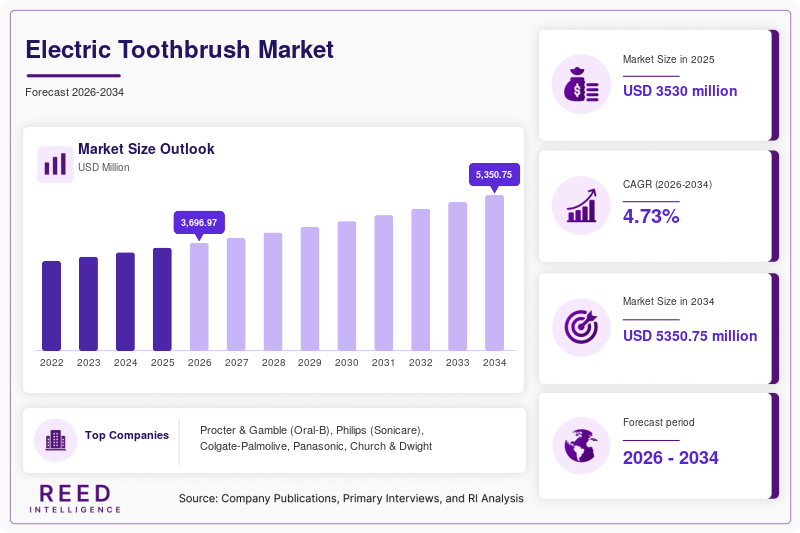
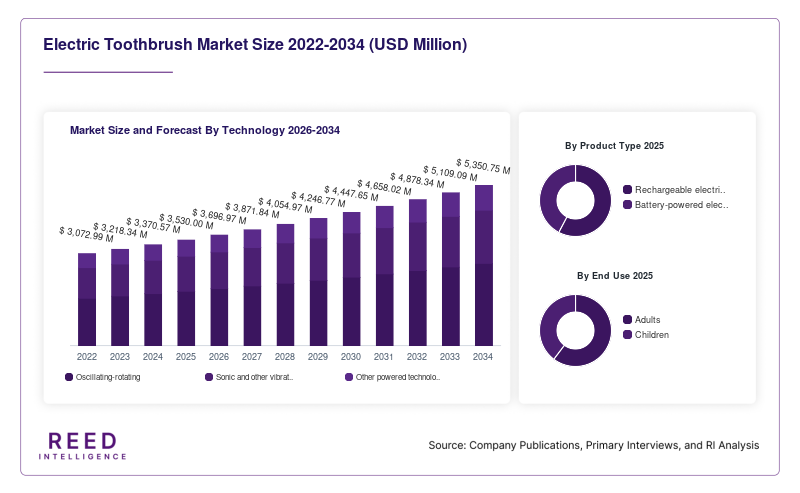
The global electric toothbrush market was valued at USD 3,530 million in 2025 and is estimated to reach USD 3,670 million in 2026. Based on the supplied forecast, the market is projected to reach USD 5,350.75 million by 2034, at a stated CAGR of 4.73%.
These global figures are supplied market assumptions and are retained as provided. Regional values presented later in this report are internal analytical allocations of these totals; they are not independently reported regional market estimates. No additional segment-level market values, segment shares, or segment CAGRs have been introduced.
Electric toothbrushes compete on cleaning performance, ease of use, brushing feedback, comfort, battery life, replacement-head availability, and total ownership cost. The category includes rechargeable and battery-powered products, from basic powered brushes to premium devices with pressure sensors, timers, connected applications, and personalized brushing guidance.
The market's commercial structure extends beyond the initial handle purchase. Replacement brush heads create repeat-purchase revenue, while proprietary head compatibility can encourage customers to remain within a brand's product ecosystem. This creates an important trade-off: a device may be affordable at the point of purchase but more expensive over its useful life if replacement heads are costly or difficult to obtain.
Product differentiation is also moving beyond motor performance. Manufacturers are incorporating pressure monitoring, brushing-mode selection, app-based coaching, and other guidance features. These additions can support premium positioning, but their commercial value depends on whether users find the features useful enough to sustain daily use and justify the higher price.
Electric Toothbrush Market Drivers
Greater emphasis on preventive oral care supports interest in powered brushing. Electric toothbrushes offer features such as built-in timers, pressure alerts, and guided brushing modes that can help users follow a more consistent routine. The commercial opportunity is strongest when these features solve a recognizable consumer problem rather than simply adding technical complexity.
Product upgrades create opportunities to trade consumers up to premium devices. Manufacturers can differentiate rechargeable models through pressure sensing, multiple modes, improved motor systems, and connected guidance. Philips' recent Sonicare launches illustrate how established brands are using technology and product design to distinguish their offerings. The limitation is affordability: consumers who see little incremental benefit may remain with manual brushes or lower-priced powered alternatives.
Replacement-head purchases strengthen recurring revenue. Handles establish the installed base, while replacement heads generate repeat sales. This structure can improve customer lifetime value for manufacturers and retailers. However, repeat revenue depends on continued usage, replacement frequency, retail availability, and consumer acceptance of the cost of compatible heads.
Retail and e-commerce broaden product discovery. Online channels allow consumers to compare product features, read reviews, purchase replacement heads, and access a wider range of brands. This can help specialist and challenger brands reach customers outside traditional retail networks. At the same time, price transparency intensifies competition and makes it harder for brands to maintain a premium solely through advertising.
Electric Toothbrush Market Restraints
Higher upfront prices limit adoption among price-sensitive buyers. Rechargeable devices with advanced features typically require a larger initial outlay than manual toothbrushes and basic battery-powered products. Replacement-head costs add to the long-term expense. This can slow adoption where consumers prioritize purchase price over additional features.
Consumers may not use advanced functions consistently. Connected applications and personalized feedback can improve the user experience for some customers, but downloading an app or purchasing a feature-rich brush does not guarantee sustained engagement. If consumers stop using the features, the practical distinction between premium and basic products may narrow.
Replacement-head compatibility can constrain choice. Proprietary formats can support repeat sales but may frustrate consumers who want lower-cost alternatives or convenient access to replacements. Poor availability can also weaken brand loyalty when a consumer cannot readily find a compatible head.
Performance claims require credible substantiation. Companies must ensure that claims about plaque removal, gum care, or other health-related benefits are supported appropriately and presented in accordance with applicable requirements. Unsupported or unclear claims can undermine trust and expose brands to regulatory or reputational risks.
Electric Toothbrush Market Opportunities
More accessible rechargeable products can widen the addressable customer base. A lower entry price can help consumers transition from manual or basic powered brushes to rechargeable models. Philips' Sonicare 5000 Series launch in 2026 included a product positioned at a more accessible price point, illustrating the industry's effort to broaden access to branded powered-brushing technology.
Simpler guidance features can differentiate products without requiring a fully connected experience. Timers, pressure alerts, and clear brushing feedback can address practical user needs while avoiding the complexity and cost of a feature-heavy app ecosystem. Brands that prioritize usability may appeal to consumers who want assistance without extensive setup.
Regional distribution and replacement-head access can improve customer retention. Wider availability through pharmacies, supermarkets, specialist retailers, dental channels, and e-commerce can reduce friction after the initial purchase. For brands entering new markets, establishing reliable replacement-head supply may be as important as expanding the range of handles.
Sustainability and repairability may become useful product differentiators. Packaging reduction, durable handles, responsible materials, and transparent end-of-life guidance can help brands respond to consumer and retailer expectations. These initiatives must be balanced against hygiene requirements, product durability, and the practical constraints of electronic components and batteries.
Segmental Analysis
Rechargeable Electric Toothbrushes
Rechargeable models compete through stronger feature sets, charging convenience, multiple brushing modes, and compatibility with a continuing range of replacement heads. Their higher initial price can be offset by consumers who value performance, comfort, or guided brushing. The principal commercial challenge is demonstrating that the extra functionality delivers benefits consumers notice and continue to use.
Battery-Powered Electric Toothbrushes
Battery-powered products can offer a lower-cost entry point and simpler operation. They may suit consumers who prefer a basic powered-brushing experience without a charging base or connected features. Their competitive position depends on balancing affordability, battery life, brush-head availability, and perceived cleaning performance.
Oscillating-Rotating Technology
Oscillating-rotating products benefit from established brand recognition and a familiar product proposition. Competition in this category often focuses on brush-head design, pressure feedback, cleaning modes, and the wider product ecosystem. Manufacturers need to communicate differences clearly because consumers may struggle to compare technical specifications across brands.
Sonic and Other Vibrational Technologies
Sonic products compete through motor performance, brushing sensation, design, and the perceived quality of the cleaning experience. Product improvements can support premium positioning, but the commercial case depends on consumer confidence, credible performance communication, and price relative to alternatives.
Adult and Children's Products
Adult products can serve a broad range of needs, from straightforward powered brushing to premium devices with guided feedback. Children's models emphasize manageable brush-head sizes, simple controls, appealing designs, and features that encourage regular brushing. Parents' willingness to pay for additional features depends on whether they perceive a practical benefit and whether the product is easy for children to use.
Distribution Channels
Online retail supports detailed product comparisons, direct-to-consumer sales, and convenient replenishment of replacement heads. Physical retailers allow shoppers to assess product size, packaging, and price in person and may make entry-level devices easier to discover. Pharmacies and dental channels can provide an additional point of trust, especially when product recommendations are linked to oral-health needs.
Regional Analysis
North America Electric Toothbrush Market
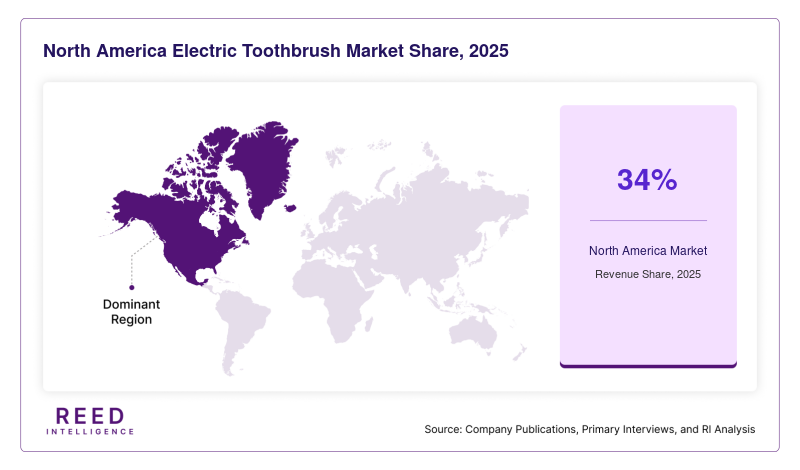
North America is estimated to account for approximately 34.0% of the global electric toothbrush market in 2025, representing around USD 1,200 million. Its modeled share is approximately 34.0% in 2026, equivalent to USD 1,248 million. By 2034, the regional market is projected to reach approximately USD 1,702 million, with an illustrative 2025–2034 CAGR of 3.96%.
The region benefits from established oral-care brands, broad retail availability, and consumer familiarity with rechargeable toothbrushes. Premium devices compete through pressure sensors, multiple brushing modes, connected guidance, and replacement-head convenience. However, competition from lower-priced alternatives and the ongoing cost of replacement heads can influence purchasing decisions. Brands that combine product differentiation with accessible pricing and reliable replenishment may be better positioned to maintain customer loyalty.
Europe Electric Toothbrush Market
Europe is estimated to represent approximately 26.0% of the global electric toothbrush market in 2025, with a modeled value of USD 918 million. Its share remains approximately 26.0% in 2026, corresponding to USD 954 million. The regional market is projected to reach around USD 1,277 million by 2034, implying an illustrative 2025–2034 CAGR of 3.74%.
Established oral-care retail channels and strong brand competition support the market. Manufacturers must balance product innovation with affordability, quality, and compliance with applicable consumer-product requirements. E-commerce expands product choice and facilitates replacement-head purchases, while household budget pressures can encourage consumers to choose less expensive devices. Clear product differentiation and consistent availability of compatible brush heads remain important to repeat purchasing.
Asia-Pacific Electric Toothbrush Market
Asia-Pacific is estimated to account for approximately 29.0% of the global electric toothbrush market in 2025, equivalent to USD 1,023 million. The modeled share is approximately 29.0% in 2026, representing USD 1,064 million. By 2034, the regional market is projected to reach approximately USD 1,702 million. This corresponds to an illustrative 2025–2034 CAGR of 5.82%.
The region includes mature consumer markets as well as countries where electric toothbrush adoption and distribution remain uneven. A wider range of price points, expanding e-commerce access, and local product development may support market expansion. Global brands compete with regional manufacturers on price, design, and features. Long-term performance will depend on affordability, consumer awareness, retail coverage, and convenient access to replacement heads. Because purchasing power and shopping behavior vary considerably across countries, regional opportunities should be assessed at the individual-market level.
Middle East and Africa Electric Toothbrush Market
The Middle East and Africa region is estimated to account for approximately 5.0% of the global electric toothbrush market in 2025, with a modeled value of USD 177 million. Its share remains approximately 5.0% in 2026, equivalent to USD 184 million. The regional market is projected to reach approximately USD 266 million by 2034, implying an illustrative 2025–2034 CAGR of 4.63%.
Market conditions vary across the region. Premium products may find opportunities in higher-income markets, while affordability and distribution coverage are more important in price-sensitive areas. A tiered portfolio can help companies address different purchasing needs. Reliable availability of compatible replacement heads is also important because consumers may be reluctant to purchase devices that are difficult or expensive to maintain.
Latin America Electric Toothbrush Market
Latin America is estimated to represent approximately 6.0% of the global electric toothbrush market in 2025, equivalent to USD 212 million. Its modeled share is approximately 6.0% in 2026, representing USD 220 million. By 2034, the regional market is projected to reach around USD 373 million, corresponding to an illustrative 2025–2034 CAGR of 6.49%.
Market development depends on product affordability, retail reach, and consumers' willingness to pay for powered-brushing features. Currency fluctuations, import costs, and household purchasing power can affect retail prices and premium-product availability. Online retail can improve access to product ranges and replacement heads, although delivery coverage and costs vary by country. Offering accessible entry-level products alongside premium models may help brands reach more consumers and encourage repeat purchases.
Competitive Landscape
Competition in the electric toothbrush market is shaped by brand reputation, product performance, pricing, technological differentiation, and access to replacement brush heads. Established companies such as Procter & Gamble's Oral-B and Philips Sonicare compete across multiple price tiers, while other manufacturers target consumers through design, affordability, digital retail, and specialized product features.
Product innovation is an important competitive lever. Manufacturers are introducing features such as pressure sensors, brushing timers, multiple cleaning modes, and app-based or on-device brushing guidance to differentiate premium models. However, the commercial value of these features depends on whether consumers find them useful in everyday brushing and consider the additional cost worthwhile.
Pricing strategy also influences competition. Entry-level powered toothbrushes can attract price-sensitive consumers, while premium rechargeable models target buyers seeking more advanced functionality and a differentiated user experience. Brands must balance the cost of product innovation against consumers' willingness to pay, particularly where lower-priced alternatives offer a simpler but acceptable brushing experience.
Key Market Players
Recent Market Developments
- July 2026, Philips announced the Next-Generation DiamondClean Prestige toothbrush with on-device AI, real-time brushing guidance, a visual mouth map, pressure sensing, and personalized settings. The company positioned the product around making brushing coverage more visible to users. Premium differentiation is moving toward real-time feedback and personalized guidance, although adoption will depend on whether consumers find these functions useful enough to justify the product’s cost.
- March 2026, Philips announced new electric-toothbrush ranges, updated Sonicare technology, and changes to branding, packaging, and product positioning. The launch covered both accessible products and more feature-rich models. Manufacturers are attempting to broaden the appeal of powered brushing while maintaining differentiation in the premium segment. The commercial challenge is to communicate meaningful benefits across products with overlapping feature claims.
Electric Toothbrush Market Segments
By Technology
- Oscillating-rotating
- Sonic and other vibrational technologies
- Other powered technologies, where applicable
By Product Type
- Rechargeable electric toothbrushes
- Battery-powered electric toothbrushes
By End Use
- Adults
- Children
By Distribution Channel
- Supermarkets and hypermarkets
- Pharmacies and drugstores
- Specialty stores
- Online retail
- Dental and other channels
By Region
- North America
- Europe
- APAC
- Middle East and Africa
- LATAM