Electric Vehicle Battery Current Sensor Market Size, Share, Demand Report By Sensor Type (Hall-Effect Current Sensors,Shunt-Based Current Sensors, Magnetoresistive Current Sensors), By Application (Battery Management Systems, Fast-Charging Systems,Energy Recovery Systems), By Vehicle Type (Commercial Electric Vehicles, Hybrid Electric Vehicles), By Region & Segment Forecasts, 2026–2034
USD 3950
Market Overview
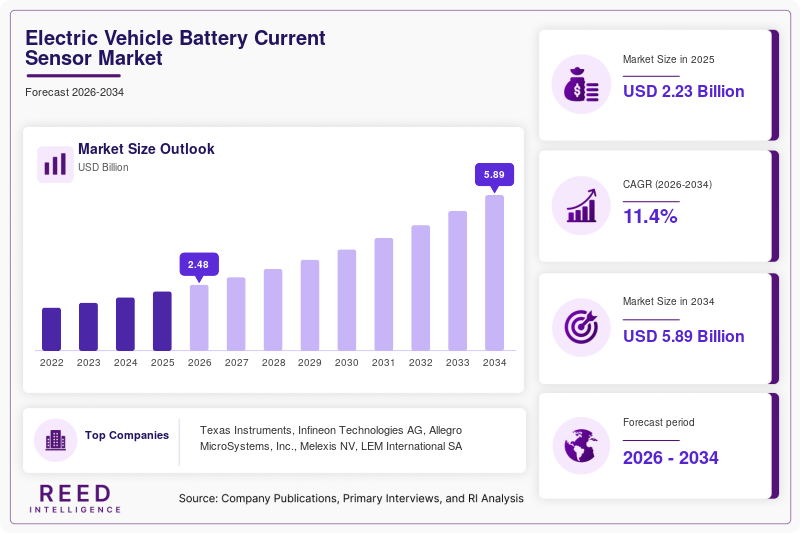
The Electric Vehicle Battery Current Sensor Market size is projected to reach a value of USD 2.48 billion in 2026 and is expected to expand to USD 5.92 billion by 2034, registering a compound annual growth rate (CAGR) of 11.4% during 2026–2034. The market is primarily driven by the rapid electrification of automotive fleets, where precise current monitoring is essential for battery management systems (BMS), energy efficiency optimization, and thermal safety control.
One of the major global factors supporting market growth is the accelerating shift toward electric mobility supported by stringent emission regulations and government incentives for EV adoption. As EV battery packs become more advanced, demand for high-precision current sensors capable of delivering real-time data for state-of-charge (SOC) and state-of-health (SOH) estimation has increased significantly across OEMs and Tier-1 suppliers.
Key Highlights
- North America dominated the market with a 34.2% share in 2025.
- Asia Pacific is expected to grow at the fastest CAGR of 11.2% during 2026–2034.
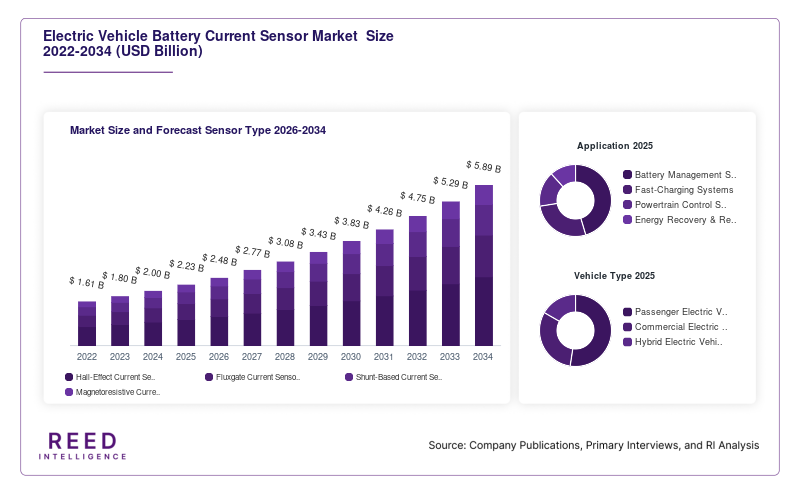
- By sensor type, Hall-effect current sensors accounted for the largest share of 38.5%, while fluxgate-based sensors are projected to grow at a CAGR of 12.4%.
- By application, battery management systems led with a 41.7% share, whereas fast-charging systems are expected to expand at a CAGR of 11.8%.
- The United States remained the dominant country, with market values of USD 610 million in 2024 and USD 680 million in 2025.
Market Trends
Integration of High-Precision Digital Sensing Architectures
The Electric Vehicle Battery Current Sensor Market is witnessing a strong shift toward digital and high-resolution sensing architectures. Manufacturers are increasingly integrating microcontroller-based current sensors capable of real-time signal conditioning, diagnostics, and fault detection. These advanced sensors enable improved accuracy in measuring bidirectional current flow in EV battery packs, which is critical for optimizing regenerative braking and energy recovery systems. Additionally, digital sensors reduce calibration errors and support predictive maintenance capabilities, making them suitable for next-generation EV platforms. Automakers are also adopting software-defined sensing modules that can be updated remotely, improving long-term adaptability in evolving EV architectures.
Rising Adoption of Non-Invasive Hall-Effect and Magnetoresistive Sensors
A major trend shaping the Electric Vehicle Battery Current Sensor Market is the growing preference for non-invasive sensing technologies such as Hall-effect and magnetoresistive sensors. These sensors eliminate the need for direct electrical contact, reducing power losses and improving safety in high-voltage EV systems. Their compact design and high reliability make them suitable for integration into space-constrained battery packs. Additionally, magnetoresistive sensors are gaining traction due to their higher sensitivity at low current ranges, which is essential for accurate battery diagnostics in small electric vehicles and hybrid platforms. This trend is further supported by advancements in miniaturization and cost reduction of semiconductor-based sensing components.
Market Drivers
Expansion of Electric Vehicle Production and Battery Complexity
The rapid expansion of electric vehicle production is one of the strongest drivers of the Electric Vehicle Battery Current Sensor Market. As EV manufacturers scale production, battery systems are becoming more complex with higher energy densities and multi-module configurations. This complexity requires precise current monitoring to ensure optimal performance, thermal stability, and safety compliance. Battery current sensors play a critical role in enabling accurate state-of-charge estimation and preventing overcharging or deep discharging scenarios. The growing adoption of long-range EVs with larger battery packs further increases sensor demand, particularly in premium and commercial vehicle segments where reliability and energy efficiency are prioritized.
Regulatory Pressure on Battery Safety and Energy Efficiency
Increasing regulatory pressure on battery safety standards and energy efficiency requirements is significantly driving the Electric Vehicle Battery Current Sensor Market. Governments across major automotive regions are enforcing strict safety protocols for EV battery systems, including real-time monitoring of electrical parameters. Current sensors are essential for detecting anomalies such as overcurrent, short circuits, and thermal runaway conditions. Additionally, energy efficiency regulations encourage automakers to optimize battery usage, where precise current sensing plays a vital role. Compliance with global safety standards such as ISO 26262 and UNECE regulations has further accelerated the integration of advanced current sensing technologies in EV platforms.
Market Restraint
High Integration Cost and Calibration Complexity
A major restraint affecting the Electric Vehicle Battery Current Sensor Market is the high cost associated with advanced sensor integration and calibration. High-precision current sensors, especially fluxgate and magnetoresistive types, require sophisticated manufacturing processes and strict quality control measures, which increase overall system cost. Additionally, calibration of sensors in EV battery systems demands specialized equipment and technical expertise to ensure measurement accuracy under varying temperature and load conditions. This becomes a challenge for cost-sensitive EV manufacturers, particularly in emerging markets where affordability remains a key purchasing factor. The complexity of integrating sensors into compact battery modules also increases design and development time, limiting rapid adoption in entry-level EV models.
Market Opportunities
Growth of Smart Battery Management Systems in Next-Gen EVs
The increasing development of smart battery management systems presents a significant opportunity for the Electric Vehicle Battery Current Sensor Market. These systems rely heavily on real-time data from current sensors to optimize charging cycles, extend battery life, and improve vehicle range prediction accuracy. As EV architectures evolve toward centralized and AI-driven control systems, demand for intelligent sensing components is expected to rise. Integration of machine learning algorithms with current sensor data enables predictive analytics for battery degradation and performance optimization. This shift toward smart energy management is expected to create strong demand for advanced sensor solutions across both OEM and aftermarket applications.
Expansion of Fast-Charging Infrastructure and V2G Systems
The global expansion of fast-charging infrastructure and vehicle-to-grid (V2G) systems offers another strong growth opportunity for the Electric Vehicle Battery Current Sensor Market. Fast-charging stations require highly accurate current monitoring to manage high-power energy transfer safely and efficiently. Similarly, V2G systems depend on bidirectional current flow control, where precise sensing is essential for grid stability and energy balancing. As governments and private players invest heavily in charging networks, demand for robust and high-speed current sensors is expected to increase. This trend is particularly strong in urban areas and commercial fleet operations where charging cycles are frequent and power loads are high.
Segmental Analysis
By Sensor Type
Hall-effect sensors accounted for approximately 38.5% share in 2024, making them the dominant subsegment due to their cost-effectiveness and reliability in high-voltage EV systems. These sensors are widely used in battery management applications across mid-range electric vehicles where accuracy and durability are essential.
Fluxgate sensors are expected to be the fastest-growing subsegment with a CAGR of 12.4%, driven by their high precision and suitability for advanced EV platforms. Increasing demand for premium electric vehicles with complex battery architectures is accelerating adoption.
By Application
Battery management systems dominated the application segment with a 42.1% share in 2024, as current sensors are critical for monitoring charge-discharge cycles and ensuring battery safety. Their integration is standard across nearly all EV platforms.
Fast-charging systems are expected to grow at a CAGR of 11.7%, supported by expansion of ultra-fast charging networks. These systems require real-time current monitoring to maintain efficiency and thermal safety.
By Vehicle Type
Passenger electric vehicles held 56.3% share in 2024, driven by mass adoption of EVs in urban mobility. Increasing consumer demand for range efficiency and safety monitoring systems supports segment dominance.
Commercial EVs are expected to grow at a CAGR of 12.1%, driven by logistics electrification and fleet modernization programs requiring robust current sensing solutions.
Regional Analysis
North America
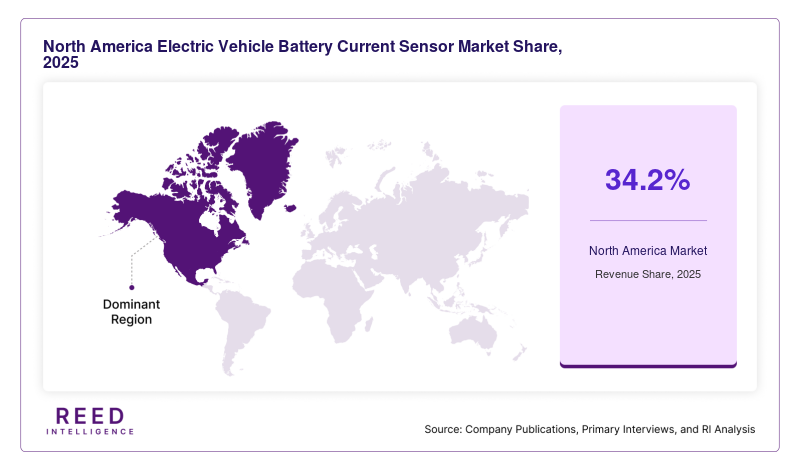
North America accounted for approximately 34.2% share in 2025, with a projected CAGR of 10.8% from 2026 to 2034. The region’s growth is driven by strong EV adoption, advanced automotive R&D capabilities, and supportive government incentives for clean mobility. Increasing deployment of high-performance EVs has strengthened demand for accurate battery current monitoring systems across passenger and commercial segments.
The United States dominates the regional market due to its strong presence of EV manufacturers and battery technology companies. A key growth factor is the expansion of domestic battery gigafactories, which is increasing demand for integrated sensing technologies in large-scale production environments.
Europe
Europe held around 28.6% market share in 2025, with a CAGR of 10.5% expected during 2026–2034. Strict emission regulations and strong EV penetration across Germany, France, and the Nordic countries are supporting market expansion. Automotive electrification programs are also encouraging adoption of advanced sensor technologies.
Germany leads the European market due to its strong automotive engineering base. A major growth factor is the increasing focus on premium electric vehicles requiring high-precision battery monitoring systems for performance optimization.
Asia Pacific
Asia Pacific captured 26.4% share in 2025 and is projected to grow at the fastest CAGR of 11.9%. Rapid EV manufacturing growth in China, Japan, and South Korea is driving regional demand. Large-scale battery production facilities further strengthen market expansion.
China dominates the region due to its extensive EV ecosystem. A key growth factor is government-backed EV subsidy programs supporting large-scale deployment of battery monitoring technologies.
Middle East & Africa
Middle East & Africa accounted for 6.1% share in 2025, with a CAGR of 9.8% expected through 2034. Increasing EV pilot projects and diversification from fossil fuels are driving adoption. Infrastructure development for electric mobility is gradually expanding across urban centers.
The United Arab Emirates leads the region due to smart city initiatives. A key growth factor is investment in sustainable transport systems integrating EV fleets and charging infrastructure.
Latin America
Latin America held 4.7% share in 2025, with a CAGR of 9.6% during 2026–2034. Brazil and Mexico are key contributors due to rising EV imports and local assembly initiatives. Government incentives are supporting gradual electrification.
Brazil dominates the region, supported by urban mobility transformation programs. A key growth factor is the expansion of public transport electrification projects.
Competitive Landscape
The Electric Vehicle Battery Current Sensor Market is moderately consolidated, with key players focusing on innovation in sensor accuracy, miniaturization, and integration with battery management systems. Leading companies include Texas Instruments, Infineon Technologies, Allegro MicroSystems, Melexis, and LEM International. Texas Instruments holds a strong position due to its advanced semiconductor-based sensing portfolio and wide automotive integration network. Recent development includes expansion of high-precision current sensing ICs designed for next-generation EV platforms, improving energy efficiency and thermal monitoring performance.
Key Players List
- Texas Instruments
- Infineon Technologies
- Allegro MicroSystems
- Melexis
- LEM International
- TDK Corporation
- Sensata Technologies
- Continental AG
- NXP Semiconductors
- Bosch Sensortec
- Honeywell International
- ON Semiconductor
- Rohm Semiconductor
- STMicroelectronics
- Analog Devices
Recent Developments
- A leading semiconductor manufacturer introduced a new high-accuracy current sensor IC optimized for 800V EV battery architectures.
- Several Tier-1 suppliers expanded production capacity for automotive-grade Hall-effect sensors to meet rising EV demand.
- A major automotive OEM announced integration of next-generation current sensing modules in its upcoming electric SUV platform to improve battery efficiency and diagnostics.
Electric Vehicle Battery Current Sensor Market Segments
Sensor Type
- Hall-Effect Current Sensors
- Fluxgate Current Sensors
- Shunt-Based Current Sensors
- Magnetoresistive Current Sensors
Application
- Battery Management Systems (BMS)
- Fast-Charging Systems
- Powertrain Control Systems
- Energy Recovery & Regenerative Braking Systems
Vehicle Type
- Passenger Electric Vehicles
- Commercial Electric Vehicles
- Hybrid Electric Vehicles
By Region
- North America
- Europe
- APAC
- Middle East and Africa
- LATAM